
EVALUATE CURRENT PRACTICES AGAINST BEST PRACTICE
ANALYSING A UNIT ACCORDING TO ORGANISATIONAL KNOWLEDGE MANAGEMENT POLICIES AND PROCEDURES
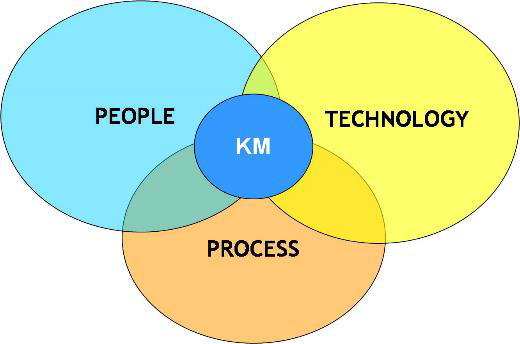
For a knowledge management solution to work, the business unit to which it belongs and the community in which it operates should own it. The power of knowledge management is in the people it serves. For that reason, ownership by the community is critical to increase participation. Knowledge management leverages a company’s intellectual assets, and greater participation within knowledge management communities enables greater exchanges of information and knowledge. This, in turn, leads to better employee performance and the desired business results.
ANALYSE THE CURRENT PRACTICES IN A UNIT
One strategy to knowledge management involves actively managing knowledge (push strategy). In such an instance, individuals strive to explicitly encode their knowledge into a shared knowledge repository, such as a database, as well as retrieving knowledge they need that other individuals have provided to the repository. This is also commonly known as the Codification approach to knowledge management.
Another strategy to knowledge management involves individuals making knowledge requests of experts associated with a particular subject on an ad hoc basis (pull strategy). In such an instance, expert individual(s) can provide their insights to the particular person or people needing this. This is also commonly known as the Personalisation approach to knowledge management.
Other knowledge management strategies53 for companies include:
Rewards (as a means of motivating for knowledge sharing)
Storytelling (as a means of transferring tacit knowledge)
Cross-project learning
After action reviews
Knowledge mapping (a map of knowledge repositories within a company accessible by all)
Communities of practice (cop)
Expert directories (to enable knowledge seeker to reach to the experts)
Best practice transfer
Competence management (systematic evaluation and planning of competences of individual organisation members)
Proximity and architecture (the physical situation of employees can be either conducive or obstructive to knowledge sharing)
Master-apprentice relationship
Collaborative technologies (groupware, etc.)
Knowledge repositories (databases, bookmarking engines, etc.)
Measuring and reporting intellectual capital (a way of making explicit knowledge for companies)
Knowledge brokers (some organisational members take on responsibility for a specific “field” and act as first reference on whom to talk about a specific subject)
Social software (social bookmarking, blogs, etc.)
Knowledge management techniques
“The greatest difficulty lies not in persuading people to accept new ideas,
but in persuading them to abandon old ones” – John Maynard Keynes.
Management techniques include methods, ways or procedures used to accomplish or achieve an end goal or objective. Knowledge management techniques are usually intended to focus on specific and essential knowledge, and using knowledge management techniques can allow for knowledge to be validated, to collate knowledge from various expert sources and to build a framework from which non-experts are better able to understand the expert’s knowledge.
There are a variety of knowledge management related techniques used to accomplish specific objectives related to knowledge creation, transfer and utilisation including for example: metaphors, storytelling, narrative, anecdotes, collaboration, after action reviews, peer assists, retrospect, knowledge cafes, positive deviance, contextual inquiry, surveys, focus groups, facilitated discussions, social network analysis, problem solving, benchmarking, group think, laddering, 20-questions, repertory grid, knowledge mapping, knowledge modelling, and knowledge communities (including communities of practice, communities of interest, communities of purpose).
Many techniques used in knowledge management have been developed or adapted to assist in eliciting knowledge from subject matter experts (SMEs). When used in this manner these are generally referred to as “knowledge acquisition” (KA) techniques. While it may seem to those new at knowledge management that there are many different types of techniques which can be selected (seemingly at random) the reality is that the selection of knowledge management techniques is often driven by and tied to a specific need to elicit a particular type of knowledge. And one viewpoint is to assume that most KA or knowledge eliciting focuses on either concept knowledge or process knowledge, each having their own range within the parameters of tacit-to-explicit knowledge. And in using techniques to elicit knowledge it is not uncommon to begin using more natural techniques and then to move toward more formal or contrived techniques.
As stated a business can use a variety of techniques to foster and promote knowledge management. The following are some of the techniques that can be applied.
After-action review:
An after-action review is a tool to evaluate and capture lessons learned. It takes the form of a quick and informal discussion at the end of a project or at a key stage within a project or activity. After-action reviews enable individuals involved to review what has happened, summarise new knowledge and decide what action should be taken next. This discussion should cover what happened and why, what went well, what needs improvement and maybe what lessons can be learned from the experience. An after-action review provides a quick way of making an informed decision about how to approach the next action.
An after-action review involves major team members and is conducted as soon as possible after the specified stage, project or event. It is structured as an informal brainstorming session to build consensus on the following questions: What was supposed to happen? What actually happened? Why were there differences? What did we learn? What are the lessons for next time? It is important to create an atmosphere of trust and openness, and to emphasise that this is a learning event, not a performance evaluation. It is also important to focus on improvement and to ensure that any mistakes made or poor practice identified can be turned into a learning opportunity. The review outcomes are normally captured during the session, on flip chart paper or electronically. This will depend on who the information is intended for and how it will be used. By recording and storing the outcomes of the interview on an intranet or website, those involved can refer back to what they have learned. The material can also be shared with those who may benefit from the acquired learning, particularly those who are working on a similar project or activity. An independent facilitator may be appointed to help draw out answers, insights and issues, and to ensure that everyone contributes. Alternatively, the interview could be facilitated by someone from the project team.
Case study
A case study is a written assessment of a project, or important part of a project. It has a clear structure that brings out key qualitative and quantitative information from the project. Case studies are often published with a broad audience in mind, so it is useful to bring the most useful and transferable information to the fore. It is vital that project and programme teams capture and record their learning and best practice so that others can learn from what they have done. The structured case study format makes information accessible to the reader. And the fact that it is written – often with a view to being published – means that case study information is usually enduring and far-reaching. Whether in print or online, case studies are one of the best ways to share learning and best practice with a large audience.
The way that a case study is written will depend on the purpose and intended audience. You have to decide what you have to share and what your audience needs to hear. You will also need to think about where the case study is going to be published, for example in print or online, internally or externally? These considerations will affect what you write and how. Many organisations will have their own guidance on what a case study should look like and what headings it should include. Most are between 800 and 1,500 words and will identify a problem or situation, explain what was done to address the problem or situation, and finally highlight the results. An example template is:
Summary
Key learning up front
Background to the problem
Key issues/problems in detail
What was done – in chronological order
Key outcomes and impact
Material resources required
Human resources required
Barriers and how were they overcome
How would you do it better?
Key contact for further information.
Most organisations will also have their own style guide. This will contain useful information on how to write a case study: that is the language, tone and style to use.
Communities of practice (CoP):
A CoP is a network of individuals with common problems or interests who get together to explore ways of working, identify common solutions and share good practice and ideas. CoP resources are related to a specific area of knowledge. Informal communities exist in some form in every organisation. The challenge is to support them so they can create and share organisational knowledge. Communities of practice are organic and self-organising, and should ideally emerge naturally. They usually evolve from the recognition of a specific need or problem. A CoP provides an environment (virtual and/ or face-to-face) that connects people and encourages the development and sharing of new ideas and strategies. This environment supports faster problem solving, cuts down on duplication of effort, and provides potentially unlimited access to expertise. Technology now allows people to network, share and develop practice entirely online. Virtual communities overcome the challenges of geographical boundaries. They encourage the flow of knowledge and enable sustainable self-improvement.
A wide range of approaches can be used when creating and developing CoPs. Before setting up a community, there are a few main points to consider:
Scope – What do you want to achieve? Who is your audience? What are the boundaries?
Participants – Who can make a major contribution? Do they share common needs and interests?
Roles and responsibilities – Who are the experts, leaders, champions, facilitators?
Interest and involvement – How will you attract interest? How will you engage participants? How will you develop your community?
Creating and sharing knowledge – How will you interact, learn and share?
Moving forward – How will you add value? How will you evolve?
Communities can have a limited shelf-life, but this is not always a bad thing. Sometimes a natural ending is reached – for instance when a group or a practice reaches a conclusion. As long as the learning is captured and redistributed, the success of the collaboration can inform others in the future.
Gone well, not gone well (lessons learned debriefing):54
A gone well, not gone well is a quick and useful tool to get candid feedback at the end of an event or activity. It allows all participants to say which aspects of an event or activity worked and which didn’t in an open and accepting atmosphere. This tool is a useful way to close a session and provides an opportunity to discuss the event. It is especially useful in getting people to express more critical comments in a relaxed way. It helps facilitators and organisers of events to gather information that will help them do better next time. This is a facilitated session to get feedback and requires a flipchart to record the information. The flip chart is divided down the middle into two columns: ‘Gone well’ and ‘Not gone well’. The facilitator asks the group to comment on anything to do with the event that went well or not so well. This could include content, delivery style, catering, room layout, discussion topics, materials used, plus whatever people want to raise in relation to the day. All positive and negative comments are written into the respective columns on the flipchart.
Knowledge café:55
A knowledge café brings people together to have open, creative conversation on topics of mutual interest. It can be organised in a meeting or workshop format, but the emphasis should be on flowing dialogue that allows people to share ideas and learn from each other. It encourages people to explore issues that require discussion in order to build a consensus around an issue. The knowledge café brings to the surface, in an informal environment, all the understanding we have in an area.
A simple and recommended method to execute a knowledge café involves the following steps:
Preparation – Appoint a facilitator – someone who can encourage participation. Identify a question relevant to those participating. Invite interested parties. Create a comfortable environment – a ‘café’ layout, with a number of small tables, supplied with tea and coffee, is one option.
Procedure – The facilitator should introduce the knowledge café concept, any codes of conduct, and finally pose the question. Participants should arrange themselves into groups to discuss the question. Each participant in turn shares their knowledge and experience without interruption, giving everyone an opportunity to talk. Alternatively, a ‘talking-stick’ can ensure only the person holding the stick can speak, thus avoiding the discussion becoming dominated by one or a few speakers. After each participant has shared, the group continues the discussion together. The groups should eventually reconvene to exchange ideas and findings – these could be captured electronically or on paper.
After session – The real value of a knowledge café is what people take away with them in their heads, and the new connections they have made with people. If the knowledge café is to be recorded – making sure to avoid disrupting or influencing the conversation – the information may be distributed to participants after the session. Remember, a knowledge café is not a talking shop. Turn-taking is important. If everyone is encouraged to have their say, a natural and stimulating group discussion should evolve, and good ideas won’t be long coming.
Knowledge exchange:
A knowledge exchange takes place when someone is moving on from their current position. It aims to recover unique and valuable information from them before they leave. Knowledge exchanges occur between a knowledge holder and a facilitator. The knowledge holder is the person who is departing. The facilitator is typically a line manager or trusted team member – someone who is close to the leaver and can ensure the questioning is of sufficient depth and relevance. Ideally, the knowledge exchange will also involve the person replacing the knowledge holder or carrying out the tasks they leave behind. They will benefit from any useful tips and knowledge and from asking their own questions. When staff leave an organisation they take with them the vital knowledge, experience and contacts they have built during their time there. The organisation suffers if this information is not passed on before they leave. Estimates suggest it takes at least six months before a new recruit contributes effectively to the organisation. Including checks of handover notes through the appraisal process protects organisational memory. If a council adopted this approach, time and money saved per year would equate to between 10 and 100 posts. Many organisations will already have some informal process in place to capture the knowledge of leavers. However, the best efficiency gains come from a formalised, structured knowledge exchange process.
The following steps could be followed to execute a knowledge exchange process.
Two days prior to the knowledge exchange, the knowledge holder receives a copy of the questions that will be asked during the knowledge exchange.
The facilitator follows these questions as a guideline, but they are best used as a means to focus on the four key areas of work: general information, key operational information, people and people skills and lessons learned and ‘pattern recognition’.
Relationship mapping provides an overview of the relationships the knowledge holder has with key contacts in the organisation.
The facilitator must then decide the best way to package this knowledge for the organisation. This may include drawing up instructional guidelines, mapping business processes, producing a list of useful contact information and relationships and recording as audio or film some of the knowledge holder’s information.
The facilitator may then choose to upload this information onto the team intranet, or save as a standalone file for future reference.
Knowledge marketplace
A knowledge marketplace could be seen as a ‘dating service’ for knowledge56. It identifies what people know and what they need to know on a particular subject, then connects them appropriately. Knowledge marketplaces can be facilitated online, via email or face-to-face. It can be used in many situations, and is particularly useful when delegating roles and responsibilities within a new project team. Success depends on the willingness of participants to both contribute and benefit in equal measure from exchanging knowledge. It is highly dependent on the degree of trust between individuals. It can be difficult to find people with the knowledge, skills and experiences you need on a specific topic. A lot of useful, specialist knowledge remains untapped in most organisations. The knowledge marketplace provides a forum to discover this knowledge and make it available to anyone who needs it.
Within the participating team or group, each person should take the following steps:
Identify your knowledge requirements – these could be areas where you feel there are gaps in your knowledge
Identify your knowledge offers – these would be areas where you have knowledge and experience to share with others
Collect some basic information to start the ‘connection and collection process’, for example: name, job title, organisation, email address, topic
This information can be recorded in a form, an Excel spreadsheet, by email, or on a flip chart during the session. This information is then used to connect people to people and the sharing process can begin. The sharing process could simply involve having a conversation. Or it could be exchanging business cards with people in who have knowledge or experience of benefit to you. Alternatively, the sharing could happen after the event has been recorded electronically and all the relationships mapped out and made available online.
Peer assist
People can use a peer assist to gather knowledge and insight from other teams before embarking on a project or activity. It partners those seeking assistance– ‘receivers’ – with a peer or group of peers who have expertise in a desired area. A peer assist can last from an hour to a full day depending on the size of the project. Talking to experienced peers about the best way to approach new projects saves time and money and avoids repetition of mistakes. It also creates strong links across teams and relationships between people.
A simple method that works well involves of the following steps:
Appoint a facilitator – Appoint someone from outside the team who will ensure the participants achieve their outcomes.
Select the participants – Choose participants who have diverse knowledge, skills, and experience. There is no hard and fast rule about minimum or maximum numbers, but the right participants are particularly important.
Share information – This is done by dividing the meeting time into four parts:
Present the feedback and agree actions – The peers present their feedback to the receivers’ analysis and answer any further questions
Rapid evidence review
A rapid evidence review (RER) is a way of reviewing research and evidence on a particular issue. It looks at what has been done in a particular area and records the main outcomes. Evidence reviews can be run in several ways. Some are more exhaustive in their execution and ambitious in their scope. A fully developed review will scan available literature as comprehensively as possible, using electronic databases and comprehensive sourcing. The RER provides a quicker but still useful way of gathering and consolidating knowledge. It’s a useful building block from which to start work on a new project. It should not be considered a definitive review, but rather the most suitable given the time and resources available. Any new piece of work is likely to draw on what has already been done by others in the sector. An RER ensures that you take account of this work before starting a project. This avoids duplication of effort and gives you a firm foundation on which to build.
RERs can be run in a variety of ways. Because of the volume of published material, a review will normally source and scan selected research.
A model that could be used is by getting knowledge about emerging effective practices from consultants working in groups. It can be run as follows:
Gather the group of people you are hoping to get information from. Ask them to write on paper any ideas and examples of work that relate to the issue you are researching.
Stick these examples on the wall around the room and arrange them into themes
Group people according to the theme that contains their ideas or example of work
Run breakout groups by theme. Use group discussions to test the effectiveness of the practice. A facilitator should be present to record the discussion. As each person in the group discusses their work, the facilitator ensures that supporting evidence is recorded.
Clarify purpose – The receivers present the background and objectives of the project or task they are about to begin. They should also say what they hope to achieve in the peer assist.
Encourage the peers to ask questions and give feedback – The peers discuss the receiver’s situation and share ideas and experiences. The receivers should simply listen.
Analyse what’s been heard – This part is for the receivers to analyse and reflect on what they have learned and to examine options. The peers should take a back seat.
Produce a report or document that summarises the discussion and outcomes. These findings should be published on the intranet, internet or as a paper publication, for anyone to use in future projects.
Retrospective review
A retrospective review is an in-depth discussion that happens after the completion of a project, event or activity. It is structured to help the people involved reflect on the project in detail. Retrospective reviews ensure that you to retain learning from what has happened, understand why it happened and it looks at what went well, what needs improvement and what lessons should inform future work. Every major project should conclude with a retrospective review. This is the main way of ensuring that lessons learned are recorded in an objective way. It also ensures that the information can be made available to others.
A retrospective review can be run in various formats, including a workshop or meeting. A simple method that works well involves the following steps:
Preparation for a retrospective review – Appoint a facilitator, someone who can help create an open environment and encourage discussion. Invite all members of the team to participate. Collate and distribute documents relating to the project being discussed.
During a retrospective review – Identify and review project objectives and deliverables. Identify and review the project plan and planned process. Discuss how success and lessons learned can be applied in the future. Discuss what could have gone better and how. Relay short summaries of main learning points to clarify understandings.
Post-retrospective review – Record findings in an appropriate format and circulate to all participants. Publish or store the main learning points and recommendations for future use. This can include online case studies (Knowledge website), printed publications or reports. Formally close the retrospective review.
Throughout the retrospective review process, invite comments and feedback. This will help you learn as much as possible before the team disbands. To inform future work, ensure that everything has been properly documented and stored or published before formally closing a project.
The above knowledge management techniques are ways and means that an enterprise can apply to manage the knowledge in its environment.
COMPARE THE KNOWLEDGE MANAGEMENT PRACTICES TO THOSE OF OTHER UNITS
Knowledge management has a variety of activities which could be depicted in the following diagram:
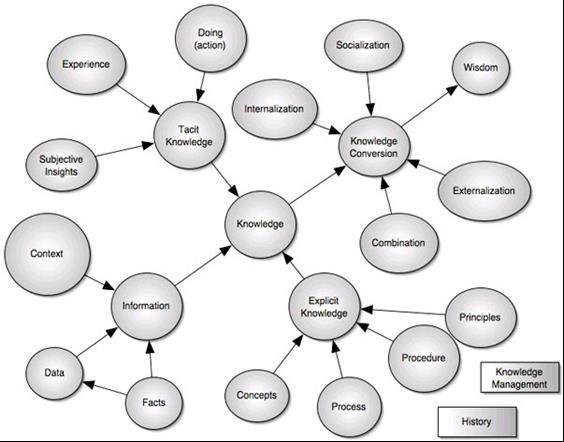
A survey amongst companies practising knowledge management revealed that the top four knowledge management activities are the capture of lessons learnt (17%), capture of best practices (17%), implementation and use of a document/content management systems (15%) and the implementation and use of an enterprise portal system (14%). Other activities could be:
Implement taxonomy (classification system)
Capture customer knowledge
Document business processes
Build content repositories for business domains
Conduct knowledge audit
Knowledge management applications rest on four important knowledge management pillars or activities. These pillars are the leadership/management, the organisation, technology and learning culture of an organisation.
Leadership/management – This deals with the environmental, strategic, and enterprise-level decision-making processes involving the values, objectives, knowledge requirements, knowledge sources, prioritisation, and resource allocation of the organisation’s knowledge assets. It stresses the need for integrative management principles and techniques, primarily based on systems thinking and approaches.
Organisation – It deals with the operational aspects of knowledge assets, including, functions, processes, formal and informal organisational structures, control measures and metrics, process improvement, and business process reengineering. Underlying this pillar are system engineering principles and techniques to ensure a flow down, tracking, and optimum utilisation of all the organisation’s knowledge assets.
Learning culture – Deals with organisational behavioural aspects and social engineering. This learning pillar focuses on the principles and practices to ensure that individuals collaborate and share knowledge to the maximum. Emphasis is given to identifying and applying the attributes necessary for a “learning organisation.” Organisational culture is one of the most important attributes in knowledge management – some authors estimate that 80% of the success of knowledge management rests on the pillar of culture.
Technology – Technology deals with the various information technologies peculiar to supporting and/or enabling knowledge management strategies and operations. One taxonomy used relates to technologies that support the collaboration and codification knowledge management strategies and functions.
Knowledge management applied in the public sector
A case study in a public sector domain (South Africa), revealed the following pertaining knowledge management:
Some of the reasons why knowledge management was needed in this public sector were:
To achieve service delivery
Achieving collaboration and common language and orientation
Dealing with service delivery challenges such as by looking for solutions to the challenges and improving accordingly
Make new partnerships and create new connections across department
Avoiding repetition or re-inventing the wheel
Strengthening relationships between spheres of government for effective service delivery
Using e-learning to build capacity and competence
To enhance knowledge sharing relating to customer needs and partner needs
For culturally relevant changes
For maximising the potential of the individuals and the organisation.
The idea of using a charter can be used as an important tool to ensure commitment from key role players towards a set of important values and principles. It is important that knowledge management role-players be active in knowledge management aspects such as:
Knowledge generation (sources)
Knowledge accounting (people, systems and processes)
Knowledge application (using the knowledge to deliver services/products)
Knowledge sharing (tools of sharing)
Knowledge drivers/champions (who is involved; leading institutions)
The department under discussion discussed, adapted and adopted a knowledge management vision stating:
Vision: To position the South African public sector in all its spheres to be a leader in the creation, management, presentation, exchanges and use of knowledge.
Principles: Our people, their knowledge and their collective wisdom are essential resources that support the services we provide Knowledge, experience, and learning are assets to be shared internally and externally in all our relationships Active engagement, dialogue with citizens (and communities), partners and stakeholders are key to ensuring our policies, programs and services respond to the needs of the public. Our work environment is one that attracts, nurtures and retains people, foster teamwork and exemplify a culture where knowledge is valued, supported and rewarded. (This makes us an employer of choice)
It was concluded that the benefits from knowledge management are:
Reduced duplication
Reduced time spent on searching and retrieving information
Reducing the costs of mistakes
Improving evidence-based decision-making
Improve transparency
Discourage the SILO mentality in the public service
Excite public servants
Some further aspects related to the knowledge management process were:
Costs of initiating knowledge management – Especially in investing in personnel, systems and processes
Tools for sharing knowledge – Tools such as internet/intranet/e-mail, communities of practice, video (story telling), sector workshops (virtual and real), documentation, post-mortems (close-out reports), database of experiences, brown-bag sessions, staff associations
Structural relationships – A clear guideline was set on the relationship between innovation, HRM and IT, and knowledge management. The consensus was that innovation is an output of knowledge management, HRM is a complementary vehicle for knowledge management and IT is a tool, an enabler of knowledge management.
Interpret the findings of the analysis
The analysing of explicit knowledge management could follow the same procedure as any other “statistical or problem solving cycle” with the addition of attending to typical knowledge management matters.
Problem solving/statistical cycle:
In our daily lives we use verified knowledge derived from data through a process of decision making. By decision making we create a cycle from the unknown to the known to use the result for a specific purpose. We can call it a project cycle, an information cycle, a knowledge cycle, a statistical cycle or a problem solving cycle, but the fundamental procedure stays the same.
THE PROBLEM SOLVING CYCLE/PROCESS
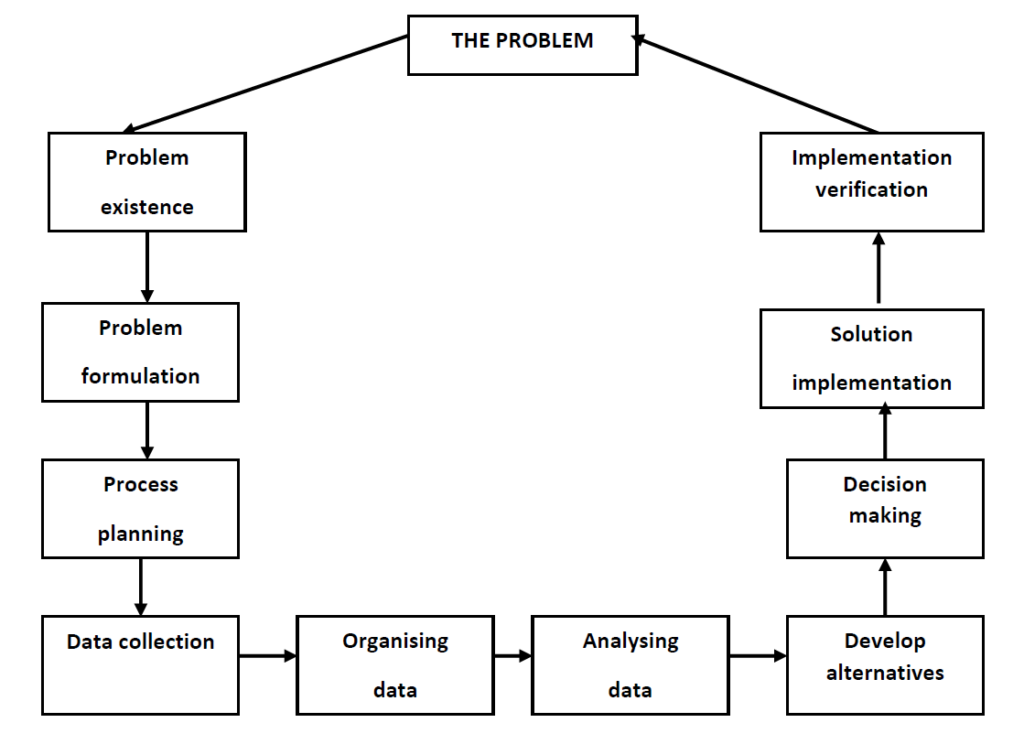
The problem solving process can also be explained by considering the following steps:
- Consider what is going on. What is the actual situation?
- What are the successes? What are the ideal situations in order to solve the problem?
- What are the questions? In other words what questions must be asked in order to develop alternatives.
- Generate answers or rather, generate alternatives.
- Forge the solutions; develop practical solutions.
- Align the resources; implement the solutions.
Additional knowledge management factors
From a measurement viewpoint, qualitative data like stories, feedback, interviews, and focus groups can answer a question that quantitative data doesn’t answer: Why? What caused us to get the numbers we got? What do they mean? In analysing the knowledge management system and in managing the knowledge, the emphasis should be on effective measurement.
In knowledge management it requires both strategic thinking and an understanding of how to develop measures. Unfortunately, a valid measurement of knowledge management isn’t easy and failing to measure could mean that in-depth information to evaluate the programs is not available. Managers don’t know if they should keep on doing what they’re doing or make adjustments. Measurement must have a purpose; measurement for its own sake is a waste of time. There are plenty of purposes for which we can produce measures that give information in context for specific reasons, such as:
The return on investment for their knowledge management projects, such as faster time to market, reduced costs, and higher customer satisfaction
Barriers to sharing knowledge
Success in gathering and using knowledge from customers
How people feel about knowledge sharing
The maturity level of their knowledge management effort
Progress in reaching their goals and achieving their strategy
The efficiency of the approaches being used
Identifying gaps in the approaches being used
An assessment of their intangible assets
The continuing health of their knowledge management system
The purpose is the starting point. It drives the rest of the measurement development. “You can only solve a problem when you can define the problem” Whether you have related or independent purposes, you need to keep them distinct and separate.
Measures that give a sense of what was accomplished in the past without a clue as to what will happen in the future are lagging indicators. Such measures do have value and can give you some of the knowledge in context you need for an actionable understanding. The danger is in relying solely upon these types of measures, no matter what your purpose in measuring is. On the other hand, they don’t tell you what to do next. Ideally, any set of measures should have a balance of both leading (future) and lagging (past) indicators. Identifying both the knowledge you need to guide your actions and also the knowledge that helps you judge your outcomes should be part of your purpose.
Measures are good, so the more measures, the better. However, measuring everything bypasses a critical benefit of a well-developed measurement system: a focus on what’s important. As you develop measures, you need to look at your options. As you work through the requirements for defining and implementing effective measures, you’ll discover that there are some things you just can’t measure effectively. Sometimes you’ll find it’s too difficult to collect data. For others, it will turn out that the measures simply replicate the results of other activities. As in any creative process-and never lose sight of the fact that developing measures is creative – you need to generate many options before you come up with something you can actually use. But you also need to practice convergent thinking, narrowing your choices of measures to a critical few. Some relevant points are:
Is it part of the strategic planning process?
Are there key measures for each part of your business strategy?
Do the measures focus on the vital few, the things that really matter for the success of your strategy?
Do they flow from the top of your organisation down to the lowest level, with modifications as needed for each level?
Are they well understood throughout your organisation?
Are the measures taken often enough to provide a consistent guide for action?
Are the results used to make decisions?
The generic process for developing measures has the following steps:
Determine your goals
Describe the audience for the measures
Define the measures
Decide what data will be collected and how it will be collected
Decide how to display the measures
Examine the team of measures
Developing measures is a reality check for your goals. For measures, you need goals that define the following:
The success must be in clear terms
Success in terms that are measurable
A measurable success that is doable
A measurable success that matters to the organisation
The level and scope of the measurement process help to define the audience for your measures. If the company is involved in a global knowledge management effort that costs a lot of money, it would be worthwhile to consider the CEO and corporate board to be a potential audience, not to mention the external stakeholders. If, on the other hand, the effort is located within a specific business unit, the corporate board may be an option but not a necessity. At the same time, the senior managers in the business unit are an important audience. Regardless of the level, some critical audiences that should be considered are:
People who approve allocation of resources, such as funding
Management at all appropriate levels, to include middle management
The users, the people who implement and use the knowledge management approach or system
Others affected by the knowledge management approach, including other employees, customers, and suppliers
The people involved in running the knowledge management effort
It is important to define the measures by giving it an “operational name” acceptable in the company. The name needs to be in simple, everyday language understandable by the audience for the measure. A good name is brief and gives a general idea of what is being measured. This operational definition is the blueprint for the rest of your work developing the measure. It gives you the specifications in enough detail to guide the work. It also tells you what is and isn’t included in the measure. An operational definition is a working definition. It gives you a description of the measure that is detailed enough for the remainder of the development process. It also sets the boundaries for what is and isn’t included in the measure.
It is also an important step for developing a good measure, one that actually measures what it is supposed to measure, not something else. This is called validity, a key concept in measurement. A valid measure is one that gives you the correct information you need for your intended actionable understanding. Validity for measures is contextual. It depends upon what question you are asking and what inference you will make from the measure. For example, if a goal defines success for a community of practice, a valid measure actually gives you the information you need to decide if the community of practice is successful. An invalid measure could lead you to assume that a community is successful when, in fact, it is not, or that a community has failed when it is, in fact, successful.
Another key concept for measurement is reliability. Reliability means consistency. The reliability of your measures will depend upon the consistency of the data collected. No matter how carefully you described the intended data and its collection, in practice, the actual data and its collection could vary widely from what you intended. For one thing, it may not be collected at the exact times you specify. While you can’t control all of the variation that will happen (variation is inevitable), you do need to take special care when instituting new measures to give detailed descriptions for the data and to use effective communications. You’ll also need to monitor how the data is collected over time. Reliability and validity are related. To be valid, a measure must be reliable. A scale that gives different results every time isn’t valid. However, a reliable measure isn’t necessarily a valid one. A measure can give you a consistent but dead-wrong result.
It is important to specify what data will be collected and how it will be collected. To determine what data will be collected and how, the following directive questions can be of use:
Who will collect it?
What data will be collected?
When it will be collected?
Where will the data be collected?
How it will be collected?
You need not only to be specific, but also be able to describe and communicate the specifications well enough so that the data collected is consistent.
The results must/should be communicated. Consider beforehand how the measures will be presented graphically, preferably on your intranet. If you’re able to present using computerised graphics, you’ll have many more options both for presenting and for dissemination, but don’t try to cram in too much information into a single display. The more things you try to present at one time, the harder it is to understand. Try to limit each graphic presentation to a key facet of the measure. Determine how often the graphic displays will be updated.
Most importantly the measurement process should take the corporate culture into account. In this regard you have to be aware that the measures could be communicated to everybody in the organisation and it will thus mean to visit the corporate norms and culture. Verify how measures are usually handled.
CONSOLIDATE THE FINDINGS AND MAKE RECOMMENDATIONS
Consolidate the findings in a report with recommendations on improvements within a unit and an entity.
Developing a knowledge management implementation plan
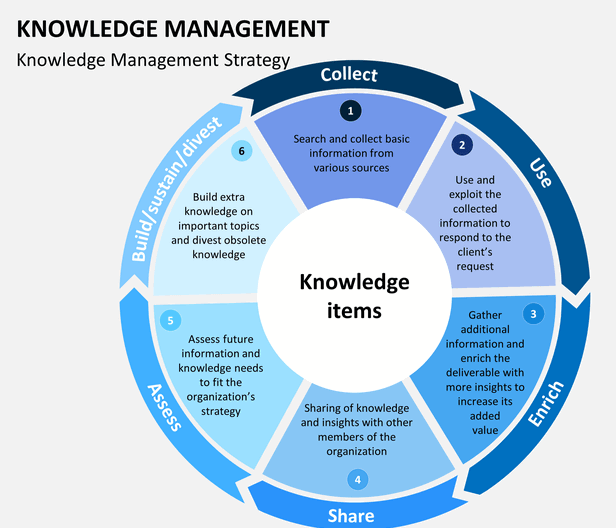
Paul Miller in his book, “Mobilising the Power of what you Know”, explains twelve practical steps to get knowledge management in “action”:
Step 1: Start with a business strategy:
The primary purpose of a company is to provide services and products that people choose to buy instead of those of the company’s competitors. Before spending time and effort changing the way you work, you must ensure you understand your business strategy to which knowledge mobilisation can contribute.
Step 2: Create a knowledge-sharing culture:
Creating a knowledge-sharing culture can take many years, but every step takes you closer. It recognised the paradox between the traditional culture of client confidentiality and its goal of encouraging its employees to share what they have learnt from cases. In actual fact, employees are not breaking client confidentiality by sharing information between colleagues. Some companies ensure that every employee is aware of everyone else’s role around them, so they can turn to the right person when seeking knowledge. This has empowered employees by allowing them to take responsibility for finding the knowledge they need in speaking to the right people. Other companies have created centralised databases for and about their employees. Allowing people to understand who the expert is on what encourages employees to turn to each other for information and knowledge.
Step 3: Get the right structure:
The structure of an organisation defines who reports to who and who works on what. Consequently, the structure will affect your knowledge mobilisation. A structure which draws different people together for projects or encourages functions to work together will naturally encourage knowledge sharing. A flatter organisational structure encourages knowledge mobilisation. If there are too many layers within an organisation, knowledge mobilisation automatically becomes more difficult. Bureaucracies are not conducive to mobilising knowledge since the culture of ‘information is power’ pervades them.
Step 4: Create a dedicated team:
Changing the culture of an organisation is a major initiative so it needs a dedicated team to push it forward. When adopting a culture of knowledge mobilisation, it is vital to enlist support to carry it through. This can either be a dedicated group of knowledge professionals or a project team consisting of employees from various functions. The team should assess what is needed and how this fit in with achieving business goals, review current channels of communication, encourage and involve people in the move towards knowledge sharing sustain, reinforce, reward and maximise knowledge sharing.
Step 5: Help people to feel secure:
Employees don’t share knowledge willingly when they fear for their jobs and employees have become wary of becoming dispensable. It is almost impossible to create an open, knowledge sharing environment when experiencing employee cutbacks. People become suspicious of each other and of management; they want to hold on to their own knowledge as a way of maintaining something unique to offer the company. Companies must be aware that employees must feel secure in their jobs in order to share their knowledge. They usually do not feel part of the organisation and they usually feel connected to their skill area and so share knowledge among other professionals with those skills, some of whom may be in the competitors’ company.
Step 6: Reward those who share knowledge:
When changing a culture, you need to create methods of reinforcing the new approach to business, and remuneration is one of the most powerful ways of doing this. knowledge management contributions should be recognised in the pay structure. If employees are being rewarded for initiating methods of mobilising knowledge, or for their contribution to a team, it will assist with creating a culture where this happens.
Step 7: Ensure commitment from the top:
A Culture change needs to be led by example. Commitment from the top is essential to a successful culture change. The role of the CEO is essential to culture changes. If the CEO changes, so does the company culture.
Step 8: Capture soft knowledge:
Connect people with people – not systems – so that the knowledge can be captured. There appears to be a correlation between how difficult knowledge is to capture and its usefulness to a company. Soft knowledge, which resides in the minds of employees, is difficult and at times impossible to access. Companies are recognising that it is vital to share ideas, creativity and opinions, as well as facts and figures, to give themselves a competitive edge.
Many companies operate systems of monitoring competitor activity. Employees are asked to contribute any information, even rumours, on their competitors through intranets and databases. Each item can be discussed or added to through a feedback system; it assesses opinion rather than hard facts. Asking employees to contribute rumours, can be an important method of keeping as up to date as possible with the market. In this way it is possible to prepare for potential competitor activity prior to its occurrence. Looking at facts along can only provide historic information. One way to capture soft knowledge is to create networks so that people can communicate with each other on more than one level.
Step 9: Handle technology with care:
Technology can enable knowledge mobilisation, but it is useless without the necessary culture – people must want to share knowledge. It is essential to invest in suitable channels of communication but, in itself, can hamper the process to achieve knowledge mobilisation. Those companies that had invested heavily in technology saw it as a useful tool. However, they were aware that it also brings its own set of problems, for example, face-to-face meetings can be replaced by electronic communication. However, the benefits of technology (when used properly) cannot be overlooked. It can create the lateral spread of information, it can make sharing knowledge feasible, both logistically and economically, and it can prevent information overload.
Step 10: Maximise employee know-how through active learning:
Investment in employee training is rising at a rapid rate. As competitive pressures increase, companies are spending more and more on training selected employees in specialist areas; this naturally creates islands of expertise. This can be minimised by ensuring that these employees can share their new-found knowledge by cascading learning through the organisation. Similarly, functions within large organisations are becoming increasingly distinct in their skills and operations. Using the intranet and similar systems enables cross-functional knowledge transfers, increasing awareness of functional roles and responsibilities as well as maintaining a relationship between departments.
Step 11: Persist and measure:
When people leave the company, they take their training and know-how with them. To minimise the impact of a departing employee, companies should capture as much as possible of that person’s knowledge before they leave. This could be done through continuous participation in knowledge mobilisation systems. An exit interview is another useful way of recording an individual’s history at a company. The interview should be carried out by an expert to ensure that the most useful information is extracted. Access to such interviews is an excellent starting point for the newcomer in understanding their role, the culture and some of the softer issues of their new position. It is essential to define success criteria and introduce instruments to measure the impact on the business before a project is implemented.
Step 12: Share with other companies and get a win-win strategy:
Be open to the idea of sharing non-sensitive information with other companies – it’s better for this process to be managed than for you to turn a blind eye to unofficial channels of information sharing. Information can be shared through trade organisations, strategic alliances or other networks. Great savings can be made by sharing knowledge and pooling resources with other companies. It is interesting to note that the results of our knowledge sharing report are being shared by all the participants; in itself, the report is a knowledge mobilisation exercise.
It is almost impossible to measure and/or analyse knowledge, especially tacit knowledge, in the context of input-system-output as used in knowledge management. The so-called analysis of knowledge is fundamentally a human interaction between humans.
DESCRIBE THE ROLE OF THE MANAGER IN IMPLEMENTING THE PLAN
Somebody has to “manage” the knowledge management process. In knowledge management research it was found that it is a pivotal issue in migrating to a knowledge strategy to create a culture to support trust and collaboration. If knowledge is to permeate in an organisation, it would be worthwhile to redefine the manner in which value is measured, change the way in which individuals approach their work, and alter corporate culture forever and look for an internal champion to lead the knowledge cause. It is debate in the knowledge management field as to what form of leader is necessary and what level of authority that leader needs to be effective. It can be argued that knowledge leadership is not new. Managing the knowledge of a process is a requirement in any enterprise, even an enterprise of only one person. However, today, knowledge is not the proprietary property of a few craftspeople or executives working within the inner sanctum of an organisation. Instead, it is a common property of virtually all workers. Add to this the transient nature of today’s workforce, the need to quickly connect and mobilise geographically disbursed teams, and the highly technical nature of modern work and you have an immense demand for greater sophistication in the way knowledge is managed.
Although there are a number of organisations with a knowledge management leader/manager in place, these are rare. Many other lesser-known titles and associated responsibilities are in use in organisations throughout the world to identify and characterise their knowledge leaders. You should consider each of these and determine the approach that is best for you and your organisation. Although no taxonomy could possibly set forth all of the titles and responsibilities included under this topic, the following are general categories that could be considered.
Knowledge engineer – The knowledge engineer is a leader typically associated with an organisation that is taking a very tactical/procedural approach to knowledge management. As the title infers, the knowledge
engineer is responsible for converting explicit knowledge to instructions, programs systems and codified applications. The knowledge engineer reduces knowledge-based work to replicable procedures by codifying them. The principle challenge of this position is performing it without outgrowing it. Effectively, the better knowledge engineers codify knowledge, the harder it is for the organisation to change when their environment demands it.
Knowledge analyst – This type of knowledge leader is a conduit to best practices. The knowledge analyst is responsible for collecting, organising and disseminating knowledge, usually on demand. Knowledge analysts provide knowledge leadership by becoming walking repositories of best practices. The liability, however, is that they can easily take all of the best practices with them if they leave. There is also a risk that these individuals become so valuable to the immediate constituency they serve that they are not able to move laterally to other parts of the organisation where their skills are equally needed.
Knowledge manager – As the title infers, the knowledge manager is an overseer. This approach to leadership works best in organisations that believe knowledge will primarily be the responsibility of multiple individuals throughout the organisation. The knowledge manager is responsible for coordinating the efforts of engineers, architects, and analysts. This position is most often required in large organisations in which the number of discrete knowledge sharing processes risk fragmentation and isolation and the knowledge manager provides the same level of coordination across these as a director of marketing may provide across a number of products. The risk in having knowledge managers is that fiefdoms may begin to form around the success of each manager’s domain.
Chief knowledge officer (CKO) – This is a very traditional, hierarchical approach to the management of knowledge. The CKO is responsible for enterprise-wide coordination of all knowledge leadership and typically reports to, or is chartered by, the CEO. Although it would go to reason that the CKO be part of IT (perhaps reporting to the CIO) this is not often the case. The CKO is not tasked with the infrastructure technology but, rather, the practice of knowledge leadership. At present the role is almost always a solo performer with little, if any, staff and no immediate line-of-business responsibility. The principle liability of putting a CKO in place is doing it too early: the CKO is powerless before a culture of knowledge sharing, incentives, and the basic precepts of knowledge leadership have been acknowledged by the enterprise, or at least a significant portion of it.
Knowledge steward – The knowledge steward is similar to a knowledge manager. The steward thrives in organisations that do not view knowledge as a corporate resource that must be managed from the top down. This role is responsible for providing minimal but ongoing support to knowledge users in the form of expertise in the tools, practices and methods of knowledge leadership. The steward is in the most precarious and most opportunistic of positions. Usually he or she is an individual who has fallen into the role of helping others to better understand and leverage the power of new technologies and practices in managing knowledge.
CoP – It is just good practice to incorporate CoPs (Codes of Good Practice) in a knowledge management structure. As previously stated, a CoP is a network of individuals with common problems or interests who get together to explore ways of working, identify common solutions and share good practice and ideas.
It is up to the organisation to decide upon the most suitable knowledge management structure in the company; obviously the knowledge management culture would dictate which structure to use.
DEVELOP AN OPERATIONAL PLAN FOR MANAGING KNOWLEDGE IN A UNIT
The operational plan includes activities, role players, timescale, measurements, costs, benefits and potential risks.
How to assess an environment and begin implementing a Knowledge Management Program:
- Develop an information/content management survey.
- Identify the gaps in current information/content management methodologies, identifying information categories, types, access locations, owners/authors, usage, effectiveness, feedback, and any existence of communities of practice.
- Build relationships by leveraging the people and the work they have been doing in trying to organise their information/content. Do not discredit people’s attempts build upon them.
- Build a comprehensive taxonomy and migration plan and begin moving current information into new taxonomy.
- Develop information/content management processes, roles and responsibilities.
- Build digital communities of practice to keep your core knowledge champions and mentors engaged.
- Set expectations/objectives for information provision and use.
- Conduct knowledge management awareness seminars addressing issues of “Knowledge is power,” “Not my job,” and “I don’t have time.”
- Develop incentive methodologies to encourage quality contribution of information/content.
- Develop constant and consistent communication methodologies to keep people excited and informed.
How to avoid pitfalls and obstacles during Knowledge Management Implementation:
Educate, communicate, educate, and communicate.
When assessing an opportunity that requires people’s time give a plan of action back designed to fix their problem and deliver on that plan by exceeding expectations. (ROT) return on time. This builds creditability and trust. People spread good news and bad news with the same enthusiasm.
Don’t become discouraged with push back. Exercise the 20 – 30 – 50 rule. 20 % of the culture will be willing to change; 30 % will resist change, and 50 % will be undecided. Focus on the 50 % undecided. Give rave recognition to the 20% that are participating and the 50 % will soon follow. After 70% of the organisation has crossed over the 30% will stand so far outside the circle they will be obligated to join or lose creditability.
How to obtain support for a Knowledge Management project at the Executive Level:
Find an opportunity to apply knowledge management principles and practices in a small pilot; show the benefit and support will soon follow. You are building a reputation; respect for your efforts will follow your ability to improve the existing environment.
Show the return on investment in quantitative or qualitative terms in areas of increased productivity, increased capacity, and time savings. (Increased innovations would be nice, too) Some companies or industries are more conducive to innovations by design (i.e. drug and food) than others, but innovation is still valid in all areas.
How to evaluate and chose the right Knowledge Management Technology:
Develop your people, process, and content components first and then select a technology to enable them.
Many vendors claim to have a knowledge management solution. You may find that no one technology or tool will work for your environment. Many tools/technology may have to be integrated into back-end architecture to meet all the requirements.
Run a side by side comparison of each tool/technology weighing the risk, benefits, pros and cons in the areas of functionality provided to meet your requirements; evaluate long-term relationship/costs with supplier. Do they insist on their knowledge engineers be used any time new functionality or changes need to be made or knowledge provided? Does it make more sense to develop a knowledge management environment of knowledge managers, engineers, practitioners, editors, etc. within your company?
Technology is changing all the time; be sure your knowledge infrastructure can adjust; plug and unplug technologies without breaking your people, process, and content components.
How to measure the result of Knowledge Management Implementation:
After determining the gaps rate the environment with levels of knowledge management maturity. Example: Level 0 (No plan to fill gap), Level 1 (Planned), Level 2 (Developed), Level 3 (Deployed), Level 4 (Performed), Level 5 (Adopted). After the program has been adopted measure the usage and effectiveness of the knowledge management processes and products being used to accelerate the pre- knowledge management environment. The success or failure of the environment will be a direct reflection of the knowledge management processes and products.
Before implementing knowledge management principles and practices into a targeted department or organisation record previous moral, productivity, and bandwidth. After implementation use story-telling for a qualitative measure of morale and look for quantitative methods to measure the delta in productivity and bandwidth or increased capacity. Time to access information before and after, time spent researching and rediscovering before accessing a knowledge base of previously discovered answers or solutions.
Replace the traditional industrial age practice of “create more quantity when asked for it, with provide more value when made aware of it”. To simply demand information contribution by metric may result in poor quality information; further resulting in the reactionary practice of cleansing.
Integrate communities of practice into your knowledge management program and measure the productivity and efficiency gains of digitally collaborating on common objectives vs. E-Mail correspondence and cost intensive physical status update and action assigning meetings.
PROMOTE THE OPERATIONAL PLAN
The promotion of the plan could include explaining the principles of knowledge management to team members, acting as a change agent for knowledge management, and creating an enabling environment for the creation, transfer and sharing of knowledge within a unit and an entity.
Every organisation has a unique environment, defined by factors such as:
Purpose and activities of the organisation
Overall strategic direction
Organisational culture
Size of the organisation
Geographic spread
Staff skills and experience
Organisational history
Available resources
Marketplace factors
For this reason, each organisation has a unique set of needs and issues to be addressed by knowledge management. It is easy to jump into ’solutions mode’, recommending approaches such as communities of practice, storytelling, content management systems, and much more.
While these approaches may have widespread success in other organisations, they will only succeed in the current environment if they meet actual staff needs.
In practice, organisations are littered with well-meaning but poorly targeted knowledge management activities. In many cases, these failed because they simply didn’t address a clear, concrete and imperative problem within the organisation. This is now recognised as one of the ‘critical success factors’ for knowledge management: identify the needs within the organisation, and then design the activities accordingly.
Emerging technologies
Executives are more mobile in the new economy and depend upon telecommunications to conduct business away from the office. Today’s executives are more challenged than previous due to the emerging mobile economy. Also, the convergences of Internet, e-business and wireless have created new opportunities for mobile economy (m-economy) companies in developing emerging management enterprise systems to meet the needs of mobile executives.
Today’s workers are more mobile, and they look towards the telecommunications and information technology industries for solutions to allow them to conduct business while on the move. However, there many front-end mobile devices (e.g., personal digital assists, cellular phones, notebooks, hybrid x-boxes) that can connect to back-office information systems (e.g. web-based database) via wireless technologies (e.g., VoIP, and broadband) and standards (e.g., Bluetooth, WAP 2.0 and IEEE 802.11). Low cost telephone service via VoIP technologies will fuel the growth of the m-commerce market. Also, new security applications (e.g., encryption) will emerge to protect the data transactions and voice communications over wireless networks.
It can be argued that the convergence of telecommunications, Internet, Web and computer-mediated networks (post 3rd wave era) created new opportunities for information management companies. Executives with frequent travel schedules are challenged to make decisions away from their home offices. It is clear that the current management support systems must evolve to meet the needs of these busy managers and executives. Also, the borderless new global (24/7) economy has forced many organisations to respond to the customers’ demands before competitors do. For example, major automakers (i.e., General Motors, Ford Motor Company, and DaimlerChrysler) are integrating emerging technologies into their business processes and manufacturing facilities to respond to customers’ demands for competitive products and faster delivery dates.
It can be argued that most organisations are implementing new e-strategies to remain competitive in the new economy. Managers are participating in new information technology projects to take advantage of Internet capabilities, for example, business-to-business (B2B), business-to-consumer (B2C), customer-to-business (C2B), and e-commerce strategies are implemented in conjunction with enhanced MSS. This approach has streamlined the management decision process thereby improving organisational effectiveness. Customers can place their orders directly with companies via e-commerce technologies and the related information is automatically processed by the MSS.
Emerging management support systems models
Key drivers (i.e., business, legislative, technological) that are forcing many organisations to evaluate their current MSS and make a decision (reengineer, replace or retire) about which information tools are best suited to compete in the new global economy will also be examined. In addition, the relationship of tenets (inputs) of the emerging management enterprise management systems and the relationship to customise emerging management support systems (outputs) will be discussed.
DESCRIBE THE IMPLEMENTATION OF THE PLAN
Knowledge is the key for decision making and strategy building. But knowing does not always translate into doing it. It is very critical for organisations to implement right and effective tools for managing organisational knowledge to build and sustain competitive advantage.
Knowledge management facilitates creation, consolidation, transformation, sharing, distribution, and application of knowledge. No two organisations can follow the same methodology to implement knowledge management. And it is not necessarily true, if an approach works for one organisation, that another organisation can use it as a cookie cutter. Knowledge is very subjective by definition and varies from one organisation to another. Even if organisations are in the same business domain, knowledge management methodology may be the same but the implementation approach may be completely different.
Knowledge starts with understanding of an organisation’s business perspective and future strategies. Organisations have not been able to implement effective knowledge management practice for the very reason that they do not understand their problems, opportunities and strategies clearly. Knowledge management starts with understanding of business processes and offerings. The organisation needs to understand what knowledge is for them and what is not. Initially while setting up a knowledge management program, technology should take a back seat. The focus should be on processes and people, and technology should be seen as an enabler. Many organisations make mistakes by implementing technology before understanding the organisational knowledge assets and processes.
For example, a software consulting organisation should know that organisational assets are project documentation and code. They need to organise and store the assets in a way that everyone in the organisation should be able to re-use them and thereby reduce the learning time. The organisation gains the competitive edge by transforming the assets into knowledge and thereby improving productivity and developing core competency. The tremendous growth and profitability of the Indian Software Industry is attributed to an effective knowledge management program.
Steps for implementing an effective knowledge management program or practice include:
Step 1: Identifying knowledge – Organisations need to identify all sources of the knowledge and information, so that it can be consolidated, stored in the centralised or distributed repositories, and shared and distributed when required.
Step 2: Organising Knowledge – Once the knowledge sources are identified, the next step is to organise and provide structure to knowledge in the organisational taxonomy. It helps in removing unnecessary and redundant information and also provides structured navigation to the information. In this step, organisations need to understand boundaries of explicit and tacit knowledge.
Step 3: Transforming Knowledge – Knowledge needs to be transformed in a way that facilitates decision making and enhances the building of new strategies. The knowledge needs to be internalised, socialised and externalised so that it is shared and applied in an efficient manner.
Step 4: Measuring knowledge benefits – No process can be improved if it is not measured for success. The key to the success of knowledge management is the ability to measure the effectiveness of the knowledge management system. The monitoring and control on processes are necessary to identify opportunities for eliminating redundancy and to allow for continuous improvement.
Remember, technology should be seen as a facilitator or enabler of a Knowledge Management program. Despite technology support, knowledge management may fail due to a lack of support from management and staff.