
Apply critical and analytical skills to analyse an issue or problem.
Implement the change
As mentioned before, in order to remain competitive, and to remain attractive as employers, organisations
need to adapt and change constantly in accordance with the changing needs of their stakeholders.
Select a model for implementing a change management process
Understanding change, therefore, and knowing how to manage it, is a crucial part of the knowledge and
skills of people managers in a successful organisation.
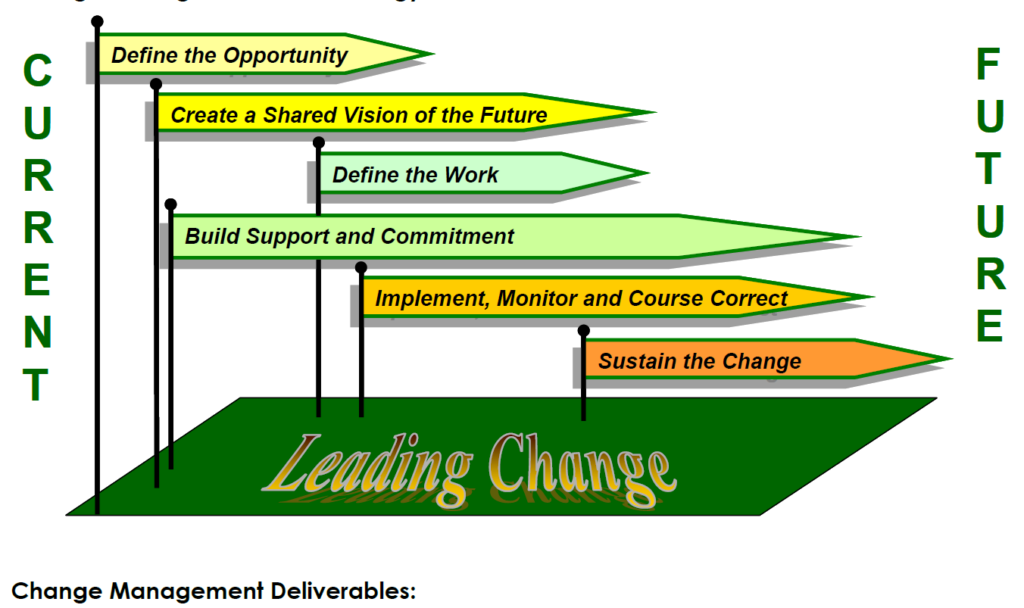
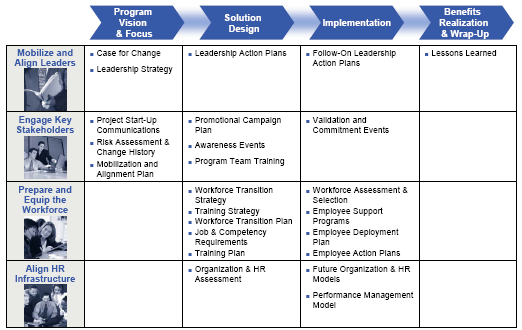
Change Management Methodology:
Describe the characteristics of change models and theories
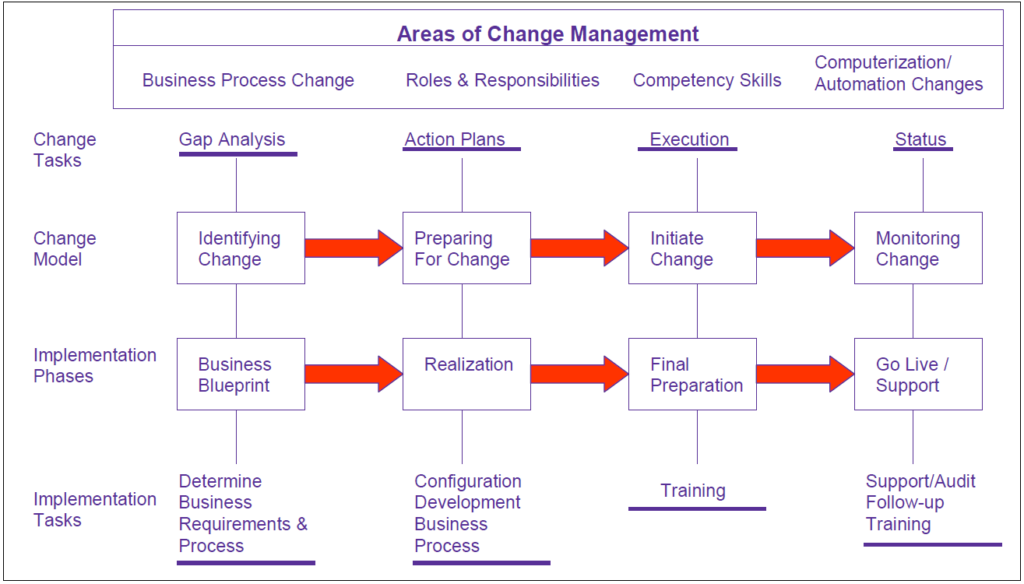
Change management models are used as a guideline to implementing the required change in the organisation. It can be illustrated as follows:
In order to implement change in an organisation, it is important and valuable to have an understanding of various theoretical change models, such as:
System’s Model for Change
Kaizen Philosophy of Continuous Incremental Improvements
Business Process Reengineering
Capability Maturity Model (CMM)
People Capability Maturity Model (CMM)
Lewin’s Change Model
Ajzen Theory of Planned Behaviour (TPB)
Malcolm Baldridge national Quality Award (MBNQA)
Burke Litwin Model of Organisational Change
Integrated Strategic Change Model
These models are discussed briefly in the following pages:
System’s model for change
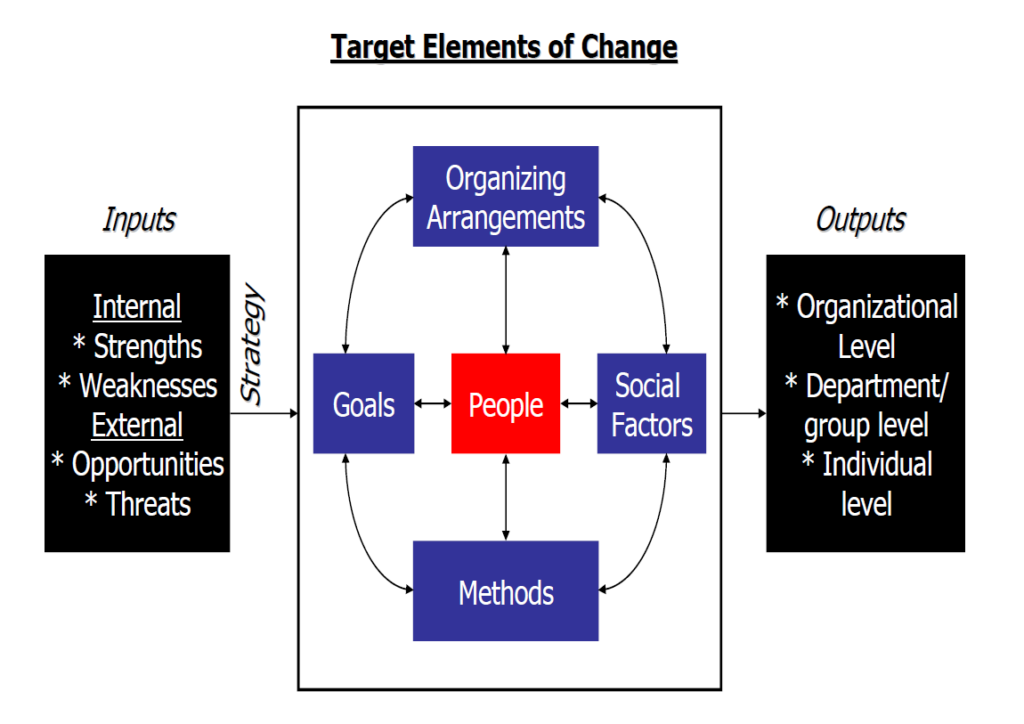
In a system there are inputs, processes and outputs. The illustration below shows the inputs (internal and external) that are then aligned to the organisation’s strategy and then processed using the various target elements of change in order to provide the outputs at various levels in the organisation.
Kaizen philosophy of continuous incremental improvements
The Kaizen method of continuous incremental improvements is an originally Japanese management concept for incremental change. Kaizen is actually a way of life philosophy, assuming that every aspect of our life deserves to be constantly improved. The Kaizen philosophy lies behind many Japanese management concepts such as Total Quality Control, Quality Control circles, small group activities, labour relations.
Japanese companies distinguish between innovation (radical) and Kaizen (continuous). Kaizen means literally: change (kai) to become good (zen).
Key elements of Kaizen are:
Quality
Effort
Involvement of all employees
Willingness to change
Communication
The foundation of the Kaizen method consists of 5 founding elements:
- Teamwork.
- Personal discipline.
- Improved morale.
- Quality circles.
- Suggestions for improvement.
Out of this foundation three key factors in Kaizen arise:
Elimination of waste and inefficiency
Standardisation
The Kaizen five-S framework for good housekeeping:
o Seiton – orderliness
o Seiso – cleanliness
o Seiketsu – standardised clean-up
o Shitsuke – discipline
Although it is difficult to give generic advice on when to apply the Kaizen philosophy, it is clear that Kaizen fits well in incremental change situations that require long-term change and in collective cultures. More individual cultures that are more focused on short-term success are often more conducive to concepts such as Business Process Reengineering (see below).
When Kaizen is compared to BPR is it clear the Kaizen philosophy is more people-oriented, more easy to implement, requires long-term discipline. BPR on the other hand is harder, technology-oriented, enables radical change but requires major change management skills.
Business process re-engineering
The business process re-engineering method (BPR) is defined by Hammer and Champy as ‘the fundamental reconsideration and radical redesign of organisational processes, in order to achieve drastic improvement of current performance in cost, service and speed’. Value creation for the customer is the leading factor for BPR and information technology often plays an important enabling role. (Davenport and Short, 1990 and Hammer and Champy, 1993)
Davenport (1992) prescribes a five-step approach to the business process re-engineering model:
- Develop the business vision and process objectives: The BPR method is driven by a business vision which implies specific business objectives such as cost reduction, time reduction, output quality improvement.
- Identify the business processes to be redesigned: most firms use the ‘High- Impact’ approach which focuses on the most important processes or those that conflict most with the business vision. Lesser number of firms use the ‘Exhaustive approach’ that attempts to identify all the processes within an organisation and then prioritise them in order of redesign urgency.
- Understand and measure the existing processes: for avoiding the repeating of old mistakes and for providing a baseline for future improvements.
- Identify IT levers: awareness of IT capabilities can and should influence BPR.
- Design and build a prototype of the new process: the actual design should not be viewed as the end of the BPR process. Rather, it should be viewed as a prototype, with successive iterations. The metaphor of prototype aligns the Business Process Reengineering approach with quick delivery of results, and the involvement and satisfaction of customers.
As a 6th step of the BPR method some mention to adapt the organisational structure and governance model towards the newly designed primary process.
Although it is difficult to give generic advice on when to use BPR, some factors that can be considered are:
Is the competition outperforming the company by factors?
Are there many conflicts in the organisation?
Is there an extremely high frequency of meetings?
Excessive use of non-structured communication? (memos, emails, etc)
Is a more continuous approach of incremental improvements not possible? (see: Kaizen)
When Kaizen is compared to the BPR method is it clear the Kaizen philosophy is more people-oriented, easier to implement, requires long-term discipline. The Business Process Reengineering approach on the other hand is harder, technology-oriented, enables radical change but requires major change management skills.
Capability maturity model (CMM)
The capability maturity model is an organisational model that describes 5 evolutionary stages (levels) in which an organisation manages its processes.
CMM describes 5 evolutionary stages in which an organisation manages its processes. The thought behind the capability maturity model, originally developed for software development, is that an organisation should be able to absorb and carry its software applications. The model also provides specific steps and activities to get from one level to the next.
The 5 stages of the Capability Maturity Model are:
- Initial (processes are ad-hoc, chaotic, or actually few processes are defined)
- Repeatable (basic processes are established and there is a level of discipline to stick to these processes)
- Defined (all processes are defined, documented, standardised and integrated into each other)
- Managed (processes are measured by collecting detailed data on the processes and their quality)
- Optimising (continuous process improvement is adopted and in place by quantitative feedback and from piloting new ideas and technologies)
The Capability Maturity Model14 is useful not only for software development, but also for describing evolutionary levels of organisations in general and in order to describe the level of Value Based Management that an organisation has realised or wants to aim for.
People capability maturity model (CMM)
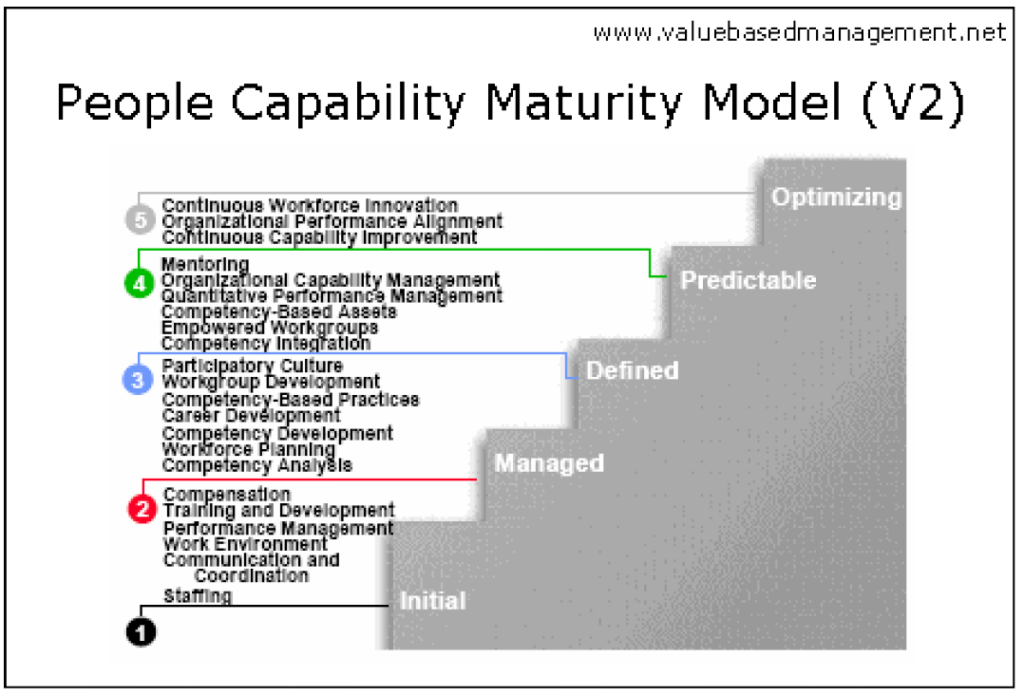
The people capability maturity model (P-CMM) framework maintained by the Carnegie Mellon SEI helps organisations in developing their workforce maturity and in addressing their critical people issues. Based on the best current practices in fields such as human resources, knowledge management, and organisational development, P-CMM guides organisations in improving their processes for managing and developing their workforces. P-CMM helps organisations characterise the maturity of their workforce practices, establish a program of continuous workforce development, set priorities for improvement actions, integrate workforce development with process improvement, and establish a culture of excellence.
P-CMM provides a roadmap for implementing workforce practices that continuously improve the capability of an organisation’s workforce. Since an organisation cannot implement all of the best workforce practices in an afternoon, P-CMM takes a staged approach. Each progressive level of the P-CMM produces a unique transformation in the organisation’s culture by equipping it with more powerful practices for attracting, developing, organising, motivating, and retaining its workforce. Thus, P-CMM establishes an integrated system of workforce practices that matures through increasing alignment with the organisation’s business objectives, performance, and changing needs.
The philosophy underlying P-CMM is based on ten principles:
- In mature organisations, workforce capability is directly related to business performance.
- Workforce capability is a competitive issue and a source of strategic advantage.
- Workforce capability must be defined in relation to the organisation’s strategic business objectives.
- Knowledge-intense work shifts the focus from job elements to workforce competencies.
- Capability can be measured and improved at multiple levels, including individuals, workgroups, workforce competencies, and the organisation.
- An organisation should invest in improving the capability of those workforce competencies that are critical to its core competency as a business.
- Operational management is responsible for the capability of the workforce.
- The improvement of workforce capability can be pursued as a process composed from proven practices and procedures.
- The organisation is responsible for providing improvement opportunities, while individuals are responsible for taking advantage of them.
- Since technologies and organisational forms evolve rapidly, organisations must continually evolve their workforce practices and develop new workforce competencies.
The P-CMM consists of five maturity levels that establish successive foundations for continuously improving individual competencies, developing effective teams, motivating improved performance, and shaping the workforce the organisation needs to accomplish its future business plans. Each maturity level is a well-defined evolutionary plateau that institutionalises new capabilities for developing the organisation’s workforce. By following the maturity framework, an organisation can avoid introducing workforce practices that its employees are unprepared to implement effectively.
The five stages of the P-CMM framework are:
P-CMM – Initial Level – Typical characteristics: Inconsistency in performing practices, Displacement of responsibility, Ritualistic practices, and Emotionally detached workforce.
P-CMM – Managed Level – Typical characteristics: Work overload, Environmental distractions, Unclear performance objectives or feedback, Lack of relevant knowledge, or skill, Poor communication, Low morale.
P-CMM – Defined Level – Although there are performing basic workforce practices, there is inconsistency in how these practices are performed across units and little synergy across the organisation. The organisation misses opportunities to standardise workforce practices because the common knowledge and skills needed for conducting its business activities have not been identified.
P-CMM – Predictable Level – The organisation manages and exploits the capability created by its framework of workforce competencies. The organisation is now able to manage its capability and performance quantitatively. The organisation is able to predict its capability for performing work because it can quantify the capability of its workforce and of the competency-based processes they use in performing their assignments.
P-CMM – Optimising Level – The entire organisation is focused on continual improvement. These improvements are made to the capability of individuals and workgroups, to the performance of competency-based processes, and to workforce practices and activities. The organisation uses the results of the quantitative management activities established at Maturity Level 4 to guide improvements at Maturity Level 5. Maturity Level 5 organisations treat change management as an ordinary business process to be performed in an
orderly way on a regular basis.
Lewin’s change model
When dealing with people and change, American social psychologist Kurt Lewin observed during the 1940s
that a successful change includes three progressive steps:
Unfreezing the present level of performance
Moving to a new level
Freezing group life at the new level
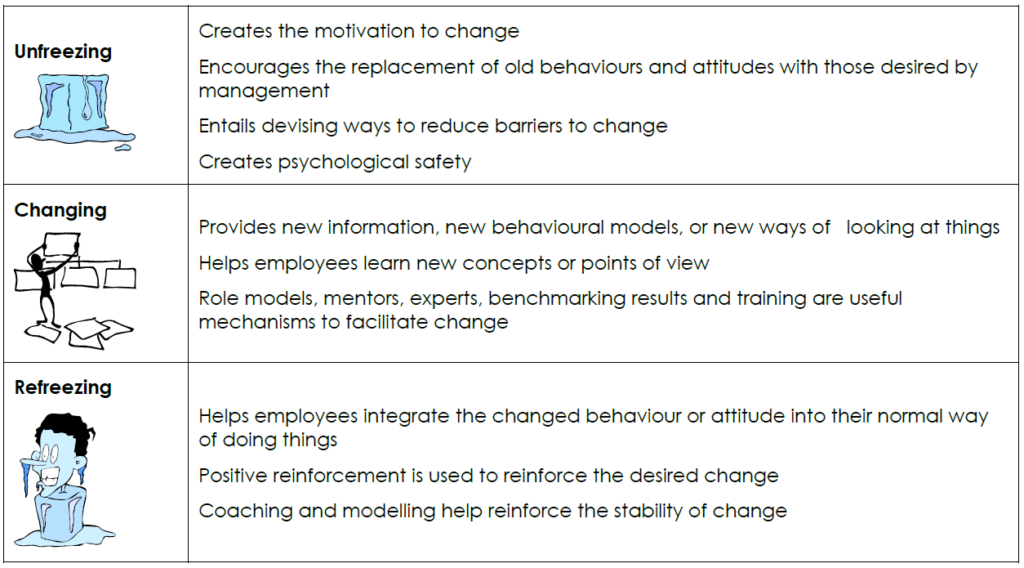
Lewin (1947) proposed his force field analysis model to explain the driving forces and restraining forces being placed on any change effort, with equilibrium, or the present state of productivity, being reached when both forces are equal. Lewin’s model points out the importance of self-assessment of both the external and internal
environments to determine the positive and negative forces and drivers for an organisation.
Ajzen theory of planned behaviour (TPB)
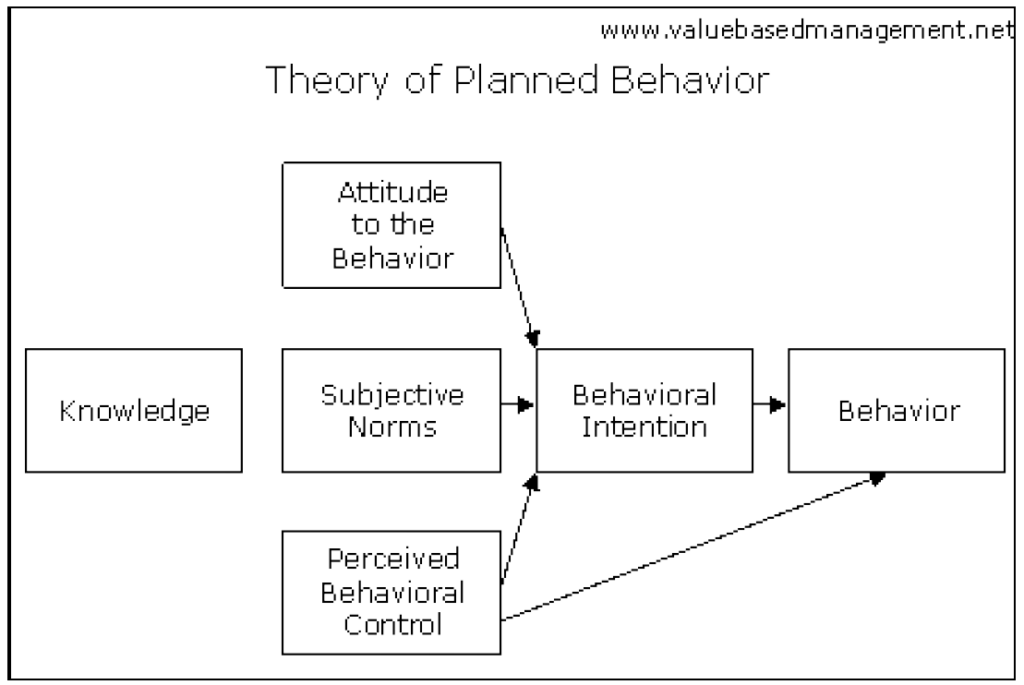
The theory of planned behaviour (TPB)15 of Icek Ajzen (1988, 1991) helps us to understand how we can change the behaviour of people. The TPB is a theory which predicts deliberate behaviour, because behaviour can be deliberative and planned.
TPB is the successor of the similar theory of reasoned action of Ajzen and Fishbein (1975, 1980). The succession was the result of the discovery that behaviour appeared not to be 100% voluntary and under control, which resulted in the addition of perceived behavioural control. With this addition the theory was called the theory of planned behaviour.
Briefly, according to TPB, human action is guided by three kinds of considerations:
Behavioural Beliefs (beliefs about the likely consequences of the behaviour)
Normative Beliefs (beliefs about the normative expectations of others)
Control Beliefs (beliefs about the presence of factors that may facilitate or impede performance of the behaviour)
Ajzen’s three considerations are crucial in circumstances / projects / programs when changing behaviour of people.
In their respective aggregates, behavioural beliefs produce a favourable or unfavourable attitude toward the behaviour, normative beliefs result in perceived social pressure or subjective norm, and control beliefs give rise to perceived behavioural control. In combination, attitude toward the behaviour, subjective norm, and perception of behavioural control lead to the formation of a behavioural intention. As a general rule, the more favourable the attitude and subjective norm and the greater the perceived control, the stronger should be the person’s intention to perform the behaviour in question.
Recently (2002) Ajzen investigated Residual Effects of Past on Later Behaviour. He came to the conclusion that this factor indeed exists but cannot be described to habituation as many people think. A review of existing evidence suggests that the residual impact of past behaviour is attenuated when measures of intention and behaviour are compatible and vanishes when intentions are strong and well formed, expectations are realistic, and specific plans for intention implementation have been developed.
A research project in the travel industry resulted in the conclusion that past travel choice contributes to the prediction of later behaviour only if circumstances remain relatively stable.
Example: The Theory of Planned Behaviour of Ajzen can help to explain why advertising campaigns merely providing information do not work. Increasing knowledge alone does not help to change behaviour very much. Campaigns that aim at attitudes, perceived norms and control in making the change or buying certain goods have better results.
Malcolm Baldridge national quality award (MBNQA)
Phillips (1983) contended that management of change should begin with questioning the company’s history of successful change and of key individuals’ awareness of the need to change. He suggested that human resources should assess the organisation’s readiness to make changes before attempting to promote organisational changes.
A popular organisational self-assessment model in the 1980’s was the Malcolm Baldridge national quality award (MBNQA) which helped organisations focus their change efforts on performance excellence. The MBNQA approach uses a questionnaire to identify an organisation’s strengths, weaknesses and opportunities. The MBNQA instrument focuses more on the strategic and organisational factors and not the whole system of an organisation which includes a deeper understanding of the organisation’s culture, climate, commitment, capabilities and the vision of its employees towards change.
Burke-Litwin model of organisational change
In contrast to the MBNQA Model noted above, the Burke-Litwin model of organisational change presented the concepts of transactional and transformational change to assess an organisation. Transactional change is where the organisation has some feature of change but the fundamental nature of the organisation remains the same. Included in transactional is organisational climate which are people’s perceptions and attitudes about the organisation. Included in transactional change are structure, management practices, and systems. Transformational change is where the organisation is fundamentally and substantially altered. Organisational culture is part of transformational change and is harder to change versus organisational climate because of its deep seated beliefs, and values. Included in transformational change are mission and strategy, leadership, and organisational culture.
The following figure presents a summary of the Burke-Litwin model.
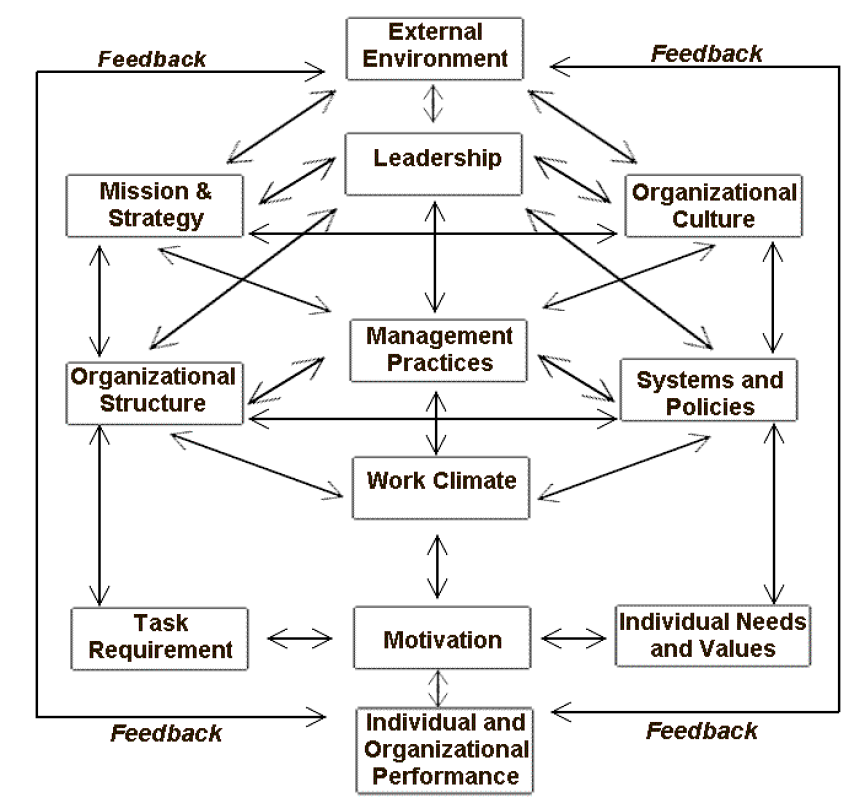
Following principles of a systems theoretic view, the Burke-Litwin model begins with environment, from which inputs are brought into the organisation, and ends with individual and organisational performance, or the outputs. In a sense, however, the model finally ends with the environment once again, as the model also includes a feedback loop linking outputs back to environment and system inputs. The factors depicted in between environment and performance are the throughput. It is here that the model offers some specificity on the mechanisms by which the organisation does its work.
The remaining throughput factors make up the transactional variables of the model. Changing transactional factors is easier than changing transformational factors, but will have less of a long-term impact on performance if transformational factors are unaffected and remain essentially unchanged.
Structure includes the formal chain of command, prescribed lines of communication, responsibilities, and decision-making relationships
Systems are the standardized behavioural systems or ways of doing things, including the policies, procedures, and practices designed to facilitate the work of the organisation’s members, such as reward systems and control processes (e.g., budgeting)
Management practices are what managers do to use resources available to them to achieve organisational goals. These are the bureaucratic manager and transactional leader behaviours that are intended to pursue current purpose and execute existing strategy.
Work unit climate is the combined sense of direction, perceived roles and responsibilities, commitment to and involvement in the organisation, and perceived equity of rewards for a group’s or organisation’s members. The climate of a work unit strongly affects intragroup and intergroup relations.
Task requirements refers to the specific requirements of a given task, the set of tasks assigned to specific roles and job positions, and the skills and abilities of the individuals who fill those positions and complete the tasks. Ideally, jobs will be appropriately matched to the talents of the individuals expected to fill them.
Individual needs and values represent the organisational factors that, at an individual level, fulfil important work-related psychosocial needs, such as a sense of autonomy and achievement, and a belief that the work – and the individual’s contribution to that work – is important and worthwhile
Motivation is defined by Burke as the “aroused” goal-directed behaviour of the organisation and its members. The enacted behavioural tendencies of the system stem directly from the energy generated by human motivation.
Integrated strategic change model
The Integrated Strategic Change Model16 points out that the major challenge management faces today is in its competitive environment- managing the external positioning of the firm is not enough; it requires executives to manage external and internal considerations simultaneously and to comprehend both the challenges in the marketplace and those within their organisations. Traditional approaches to organisational strategy were mainly externally focused and concerned with financial performance using measurements like return on investments, return on equity, debt ratio, economic value added and return on total assets.
Describe the reasons for selecting the model
Kotter published the following 8 steps to leading organisational change that could assist you in the change management process:
Step 1: Establish a sense of urgency – Unfreeze the organisation by creating a compelling reason for why change is needed
Step 2: Create the guiding coalition – Create a cross-functional, cross-level group of people with enough power to lead the change
Step 3: Develop a vision and strategy – Create a vision and strategic plan to guide the change process
Step 4: Communicate the change vision – Create an implement a communication strategy that consistently communicates the new vision and strategic plan
Step 5: Empower broad-based action – Eliminate barriers to change and use target elements of change to transform the organisation. Encourage risk taking and creative problem solving
Step 6: Generate Short-term wins – Plan for and create short-term “wins” or improvements. Recognise and reward people who contribute to the wins
Step 7: Consolidate gains and produce more change – The guiding coalition uses credibility from short-term wins to create more change. Additional people are brought into the change process as change cascades throughout the organisation. Attempts are made to reinvigorate the change process.
Step 8: Anchor new approaches in the culture – Reinforce the changes by highlighting connections between new behaviours and processes and organisational success. Develop methods to ensure leadership development and successes
Making recommendations for change
When making recommendations for change to be implemented, you need to ensure that:
Clear, goal-directed recommendations are made for consideration by senior management
All the key stakeholders are approached with the recommendations
Barriers to achieving the desired future state are identified and solutions are presented to senior management
To make effective recommendations for change, you need to follow a plan for managing change.
Setting Goals / Objectives for Change
At the heart of change management lies the change problem, that is, some future state to be realised, some current state to be left behind, and some structured, organised process for getting from the one to the other. The change problem might be large or small in scope and scale, and it might focus on individuals or groups, on one or more divisions or departments, the entire organisation, or one or on more aspects of the organisation’s environment.
At a conceptual level, the change problem is a matter of moving from one state (“old”) to another state (“new”). Moving from “old” to “new” is typically accomplished as a result of setting up and achieving three types of goals:
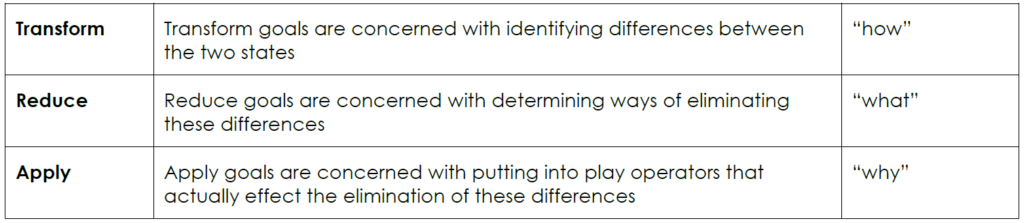
As these goal types suggest, the analysis of a change problem will at various times focus on defining the outcomes of the change effort, on identifying the changes necessary to produce these outcomes, and on finding and implementing ways and means of making the required changes. In simpler terms, the change problem can be treated as smaller problems having to do with the how, what, and why of change.
A clear sense of mission or purpose is essential for achieving a change.
Now that we know what we want to change (from Module 1), we need to set SMART goals / objectives for the “new” that we want after the change:
A mnemonic aid to write goals / objectives is SMART (Specific, Measurable, Attainable, Result-oriented, Time-limited).
Specific: – An objective must be specific with a single key result. If more than one result is to be accomplished, more than one objective should be written. Just knowing what is to be accomplished is a big step toward achieving it.
What is important to you? Once you clarify what you want to achieve, your attention will be focused on the objective that you deliberately set. You will be doing something important to you.
Measurable – An objective must be measurable. Only an objective that affects behaviour in a measurable way can be optimally effective. If possible, state the objective as a quantity. Some objectives are more difficult to measure than others are.
However, difficulty does not mean that they cannot be measured. Customer service could be measured by such indices as the number of complaints received, by the number of customers lost, and by customer interviews or responses to questionnaires. Development of subordinates could be measured by determining the number of tasks the subordinate has mastered. Cooperation with other functions could be measured by length of delay in providing requested information, or by peer ratings of degree of cooperation.
Avoid statements of objectives in generalities. Infinitives to avoid include to know, to understand, to enjoy, and to believe. Action verbs are observable and better communicate the intent of what is to be attempted. They include to write, to apply, to recite, to revise, to contrast, to install, to select, to assemble, to compare, to investigate, and to develop.
How will you know you’ve progressed?
Attainable – An objective must be attainable with the resources that are available. It must be realistic. Many objectives are realistic. Yet, the time it takes to achieve them may be unrealistic. For example, it is realistic to want to have a new customised computer system. However, it is unrealistic to want the customised computer system in one week.
What barriers stand between you and your objective? How will each barrier be overcome and within what time frame?
Result-oriented – The objective should be central to the goals of the organisation or of the change required. The successful completion of the objective should make a difference.
How will this objective help the organisation move ahead? Is the objective aligned with the mission of the organisation?
Time-limited – The objective should be traceable. Specific objectives enable time priorities to be set and time to be spent on objectives that really matter.
Are the time lines you have established realistic? Will other competing demands cause delay? Will you be able to overcome those demands to accomplish the objective you’ve set in the time frame you’ve established?
Formulate recommendations on implementing the change process
Your responsibility doesn’t end with the decision. You need to turn the decision into action. The way you communicate the decision and plan for implementation will determine your success. Many managers overlook one of the most important aspects of the decision making process: communicating the decision to everyone involved in and affected by it.
It is important to make your recommendations for change to the right people. The following guidelines could assist you:
Present your recommendations to the appropriate people – make your recommendations to senior managers or specialists in a way which helps them make a decision and in time to allow the decision to be put into effect
Amend your recommendations in the light of responses – make appropriate alterations to your recommendations on the basis of the responses you get from senior managers and specialists
The people you notify will include everyone who is responsible for implementing the decision as well as anyone who is affected by it. Your list might also include the key stakeholders: members of your unit who were not part of the decision-making group, senior management, department supervisors, external constituents and even customers if they will see a change in the way you do business with them.
Creating an action plan to implement change
Develop a detailed plan that will include:
The rationale
The aim and objectives of the change
How it will be implemented
Who will be involved and their individual roles
The resources required
The time scale
How the plan will be monitored
How you will know that the change has been successful
To create a project plan:
Identify the tasks that need to be done
Identify the time that you believe it would take to complete the tasks
Identify and assign resources to do the tasks
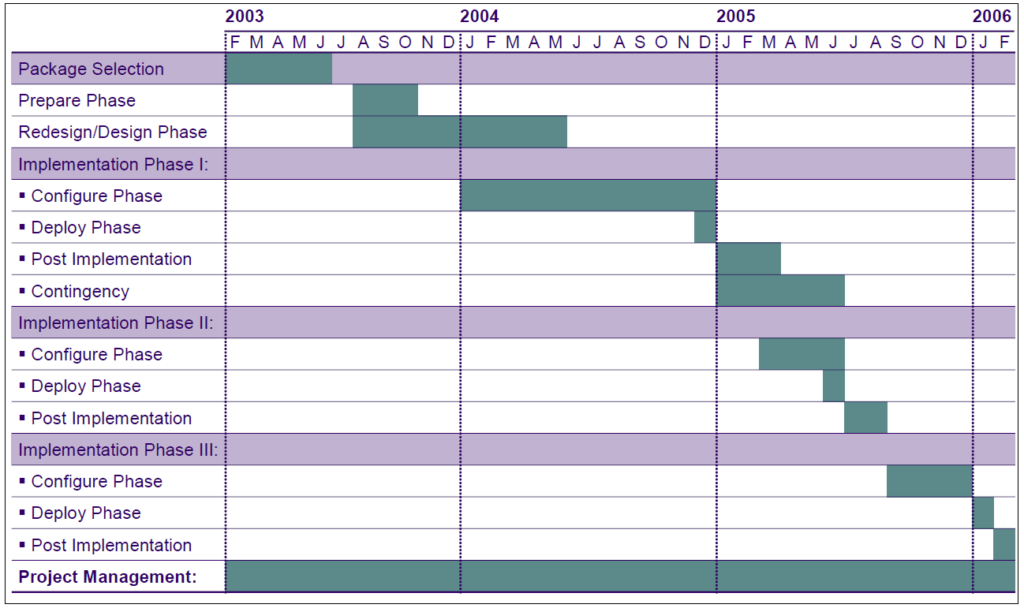
Create a project plan / schedule
An example of a Change Management Plan / schedule:
Clarifying Change Roles and Responsibilities
Encourage all the relevant people to understand and participate in the changes. Explain the changes and their effects to people and gain their support. The following guidelines could be used:
Present details of implementation plans to all concerned – make sure that you brief everyone involved, or affected by, the changes on their role in the changes and the possible impact on their area
Encourage people to seek clarification – check on their understanding of their role and encourage them to ask questions
Use resources in the most effective way – plan carefully so that you meet the new requirements as cost effectively as possible
Change tools and interventions
Change involves moving from the known (“old”) to the unknown (“new”) . Because the future is uncertain and may adversely affect people’s competencies, worth, and coping abilities, organisational employees generally do not support change, unless compelling reasons convince them to do so. Similarly, organisations tend to be heavily invested in the status quo, and they resist changing it in the face of uncertain future benefits.
Consequently, a key issue in planning for action is how to motivate commitment to change. This requires management attention to two related tasks:
Creating readiness for change
Overcoming resistance to change
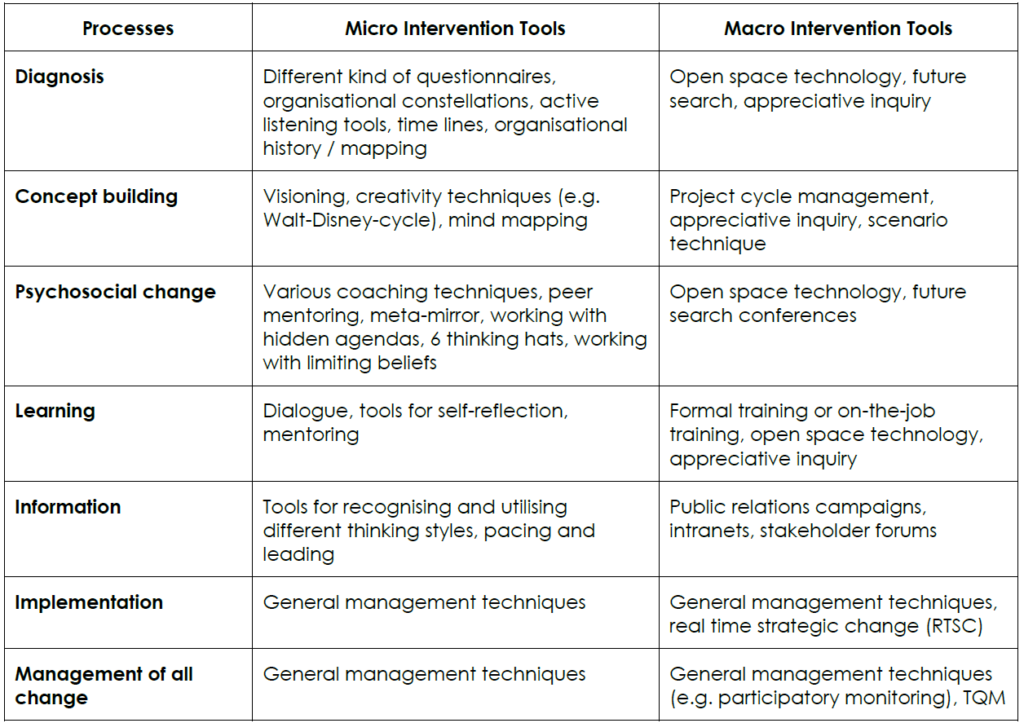
Change management focuses on these two tasks by proposing, designing and subsequently executing effective interventions at individual, group, organisational and environmental levels.
Interventions refer to a set of planned change activities performed by internal or external people, intended to help an organisation increase its effectiveness. Interventions, which assist in improving productivity and the quality of work life have three characteristics:
They are based on valid information about the organisation’s functioning
They provide employees with opportunities to make free and informed choices
They gain employee’s internal commitment to these choices
Change management tools and interventions are therefore used to assist employees through the change process, by:
Providing real, true and relevant information about the change
Providing the opportunity for employees to safely communicate and assist in the decision-making process
Clarifying any issues or concerns in order to gain employee commitment
Allowing employees to accept ownership of the change intervention and take responsibility for implementing it
Using specific planned interventions, such as a “Change Roadshow” or “Tuesday Change Buzz Sessions” are very powerful tools when implementing change in an organisation. Communication keeps everyone involved. Communication about the change should be:
Carried by management to employees (while allowing safe interaction and feedback from employees)
Done at the employee’s level (what information do they need at their level)
Communicated face-to-face
When creating your project plan, you need to ensure that you plan to implement various interventions at various stages of the change project, so that you achieve the above outcomes of interventions. The following is a list of various interventions17 that you might want to use creatively:
Formulate the decision on addressing the problem
Formulate your decision on how to address the issue/problem with reference to the impact of the decision on the unit and the broader system within which it operates.
Your decision document should include the following components:
Statement of the issue that needed to be addressed
Description of the objectives or decision making criteria
The names and roles of the people involved in making the decision and why they were included
The alternatives considered (and possibly a summary of the analysis in a table form)
An explanation of the final decision and what it means for the key stakeholders
The implementation plan and timeframe
A request for feedback
Describe the actions required to implement the decision
Describe the actions required to implement the decision in the unit with reference to activities, role players, resources and time lines:
Now that you have made a choice and communicated your decision to the appropriate people, it is time to identify the tasks that will be required to put the decision into action, assign resources and establish deadlines. Ideally, your team members will leave your final meeting knowing exactly what they’re expected to do. If not, reconvene the group to identify who will be responsible for each task.
Consider the following when implementing your decision:
Assign reasonable tasks with sufficient resources
Clarify expectations
Provide feedback on the implementation and recognise people’s contributions
You should take five steps to ensure that the solution is implemented correctly:
Create the action plan
Consult the affected personnel
Adjust the plan
Outline the final plan to appropriate personnel
Track the implementation
Creating the action plan
You should develop and document the action plan before implementing the solution. Attempting to implement the solution “on the fly” can permit mistakes, specifically communication errors. Documenting the action plan can help prevent communication errors.
Consulting the affected personnel
After you document the entire action plan, you should present the plan to the individuals who will implement it and will be affected by the solution. This presentation should be a collaborative effort to gain support for the plan. You should be prepared to discuss the entire problem-solving process with the affected personnel and ask for their feedback. Be ready to answer their questions about how you arrived at your solution.
Adjusting the plan
Based on the input and suggestions of the affected personnel, you might need to adjust your action plan to accommodate any worthwhile suggestions that you receive. You should consider everything that was suggested. If you decide not to accept the suggestions, be prepared to discuss and explain your rationale.
Outlining the final plan to appropriate personnel
You should present the final plan to the employees affected by the decision. Address each of the concerns that were raised during consultation and any additional concerns that might be raised at this time. It is essential that the individuals responsible for implementing the solution understand and accept it. After outlining the plan and gaining the acceptance of the responsible individuals, you are ready to implement the solution.
It is possible that some individuals will resist change. If this happens, you cannot permit their resistance to stall or cancel your plan. If these resisting individuals report to you, they will need to accept the plan based on your authority. If they report to someone else, you’ll need to enlist the cooperation of that manager to ensure the completion of their responsibilities.
Track implementation
Depending on the complexity and time span of your solution, there are several ways to track its progress. The more the time and effort needed to implement a solution, the more detailed your tracking plan needs to be. You can track your solution by using these tools:
Meetings – Meetings are the standard for tracking many business functions. They help you collect information from your problem-solving team or from the people affected by the solution. This information is critical because the perception of the involved parties will determine the success of the solution.
Milestones – Milestones are small goals that lead to the implementation of the solution. They are established points in time or in the process that permit you to measure the success of the implemented solution. Milestones are tasks that are specific, quantifiable and measurable. If a task is complicated and contains many steps, it should contain milestones that reflect the sub-steps needed to complete it.
Describe the change processes required to support the implementation
Describe the change processes that are required to support the implementation of the decision with reference to their impact on the success of the implementation:
Change management entails thoughtful planning and sensitive implementation, and above all, consultation with, and involvement of, the people affected by the changes. If you force change on people, problems normally arise.
Check that people affected by the change agree with, or at least understand, the need for change, and have a chance to decide how the change will be managed, and to be involved in the planning and implementation of the change.
If you’ve done your planning properly, your envisaged change processes will be realistic, achievable and measurable.
American John P Kotter is a Harvard Business School professor and leading thinker and author on organisational change management. Kotter’s highly regarded books ‘Leading Change’ (1995) and the follow-up ‘The Heart Of Change’ (2002) describe a helpful model for understanding and managing change.
Each stage acknowledges a key principle identified by Kotter relating to people’s response and approach to change, in which people see, feel and then change.
Kotter’s eight step change model18 can be summarised as:
Step 1: Increase urgency – inspire people to move, make objectives real and relevant.
Step 2: Build the guiding team – get the right people in place with the right emotional commitment, and the right mix of skills and levels.
Step 3: Get the vision right – get the team to establish a simple vision and strategy, focus on emotional and creative aspects necessary to drive service and efficiency.
Step 4: Communicate for buy-in – Involve as many people as possible, communicate the essentials, simply, and to appeal and respond to people’s needs. De-clutter communications – make technology work for you rather than against.
Step 5: Empower action – Remove obstacles, enable constructive feedback and lots of support from leaders – reward and recognise progress and achievements.
Step 6: Create short-term wins – Set aims that are easy to achieve – in bite-size chunks. Manageable numbers of initiatives. Finish current stages before starting new ones.
Step 7: Don’t let up – Foster and encourage determination and persistence – ongoing change – encourage ongoing progress reporting – highlight achieved and future milestones.
Step 8: Make change stick – Reinforce the value of successful change via recruitment, promotion, new change leaders. Weave change into culture.
Communicate the decision: present the change management plan
Change announcement
You have spent some time thinking about:
The purpose of the change
What the future state will look like
Defining what is over and what must remain
How to capture these ideas in a change purpose statement
You should now be ready to call everyone together and inform them of the change. The thinking you have done should prepare you for the content of what you need to tell your people.
The checklist below acts as a set of prompts in setting up the Change announcement meeting:
Who should be present at the meeting? (Everyone who is directly or indirectly affected by the change)
Who will ensure that everyone is invited / informed about the meeting?
Has a large enough venue been booked?
Who needs to be present to show commitment and support for this change?
Have we set aside enough time for a presentation as well as any questions that may need to be answered?
Is the announcement to be delivered in total or will it be split into several announcements?
Who should present the message?
In what style or tone should this message be conveyed?
What format should the message be presented in?
What supporting media can be used to convey the message?
Communicate the decision in a user-friendly format. Refer back to Module 2 section 2.3.5 – we discussed how to communicate effectively and the fundamental rules that you should apply to written presentation of your decision.
Conclusion
Applying problem-solving techniques to make a decision or solve a problem in a real life context is a skill that can benefit every person in their personal lives and their careers. It provides you with an awareness of the differences between problems, challenges and everyday matters that need to be solved and that need you to make a decision about.
This programme also provides you with various techniques that can assist you to solve problems and make effective decisions. It provides you with techniques to become more creative and processes to become more effective and efficient in everyday life and work related issues.
Problem solving is a life skill that can be learnt and applied in various contexts. In fact, companies pay people to solve problems – that is what most JOBS are about. You will be an asset to your organisation by becoming a creative and effective problem-solver and decision-maker.
Remember that your positive attitude towards problems will benefit the outcome of a problem solving and decision making process.
Some final comment on communication during this period:
Announce the changes as far in advance as possible
Engage in “information overkill”. Give people more information than they want. It is important that people be thinking and talking about the changes, and getting used to the idea of change itself. The normal practice of keeping changes secret as long as possible because people may be disturbed by them is like not telling the family that one of its members is dying – on the day the person does die, the trauma is much worse than if the family had some notice! A relevant research finding is that patients given full information about the pain and discomfort they were likely to experience following a surgical procedure healed faster than those who were not so informed
Do a lot of “MBWA” (management by walking around) and use contacts with employees to dialogue about the change. The conversations about change don’t have to be particularly well done; there just need to be a lot of them.
Getting support for change
Once you have set the goals and/or objectives of the change that you want to implement, you need to get support for the change from all the various stakeholders, especially those that would be directly affected by the change.
Stakeholders would include:
Employees
Management
Shareholders
Customers, etc.
Tools for stakeholder analysis
Prepare a matrix in which you rank stakeholders according to their stake in the process versus their influence:
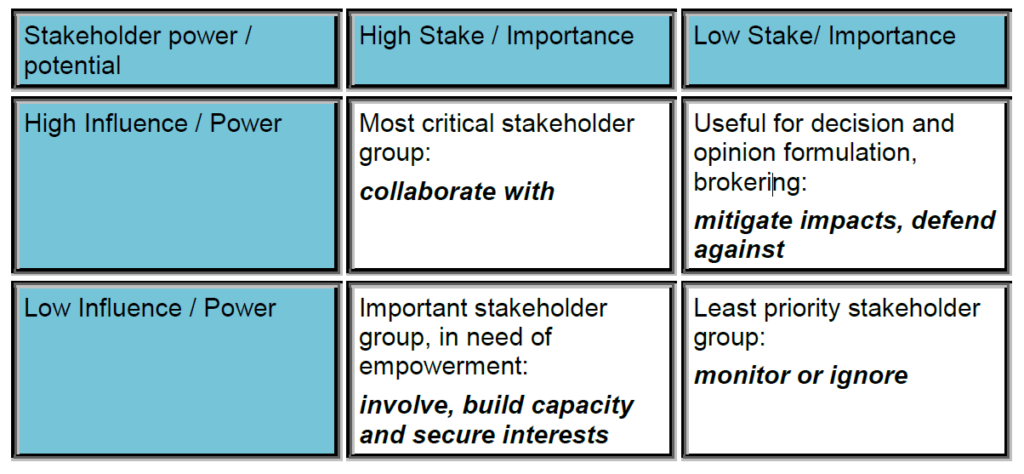
Marketing your change project has to address demanding and dangerous stakeholders and try to win dominant, dependent and definite stakeholders.
Stakeholder evaluations make preferences and expectations explicit. Evaluations help anticipate responses to change by providing data on sources of support for, indifference to, or hostility toward proposed changes. If employees give an existing practice low marks, they are likely to support a change. Conversely, if they do not support a change they will likely give an existing practice high marks. They may require new incentives to support new proposals.
People performance approach
Another way to view the change that you need to implement, would be by using the ADKAR approach. Effective management of the people dimension of change requires managing five key phases that form the basis of Prosci’s ADKAR model:
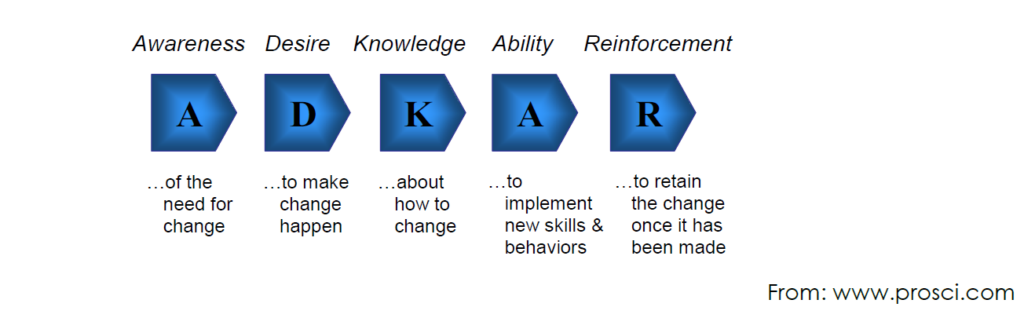
Awareness of the need to change (why)
Desire to participate and support the change (choice)
Knowledge of how to change (and what the change looks like)
Ability to implement the change on a day-to-day basis (turning knowledge into action)
Reinforcement to keep the change in place (celebrating success)
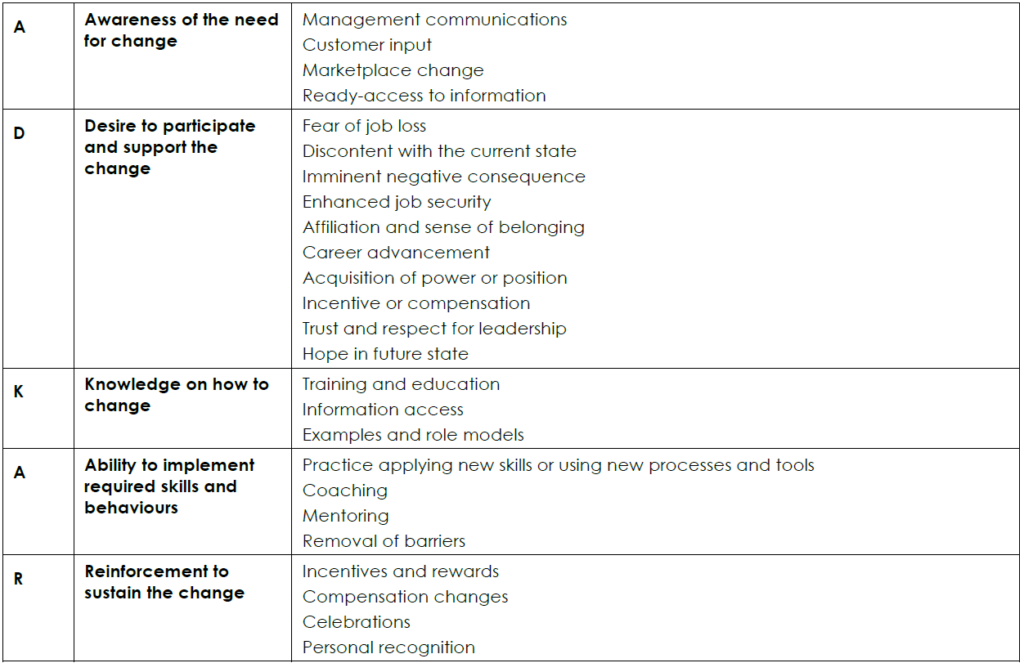
The power of the ADKAR model is that it creates focus on the first element that is the root cause of failure. When you approach change using this model, you can immediately identify where the process is breaking down and which elements are being overlooked. This avoids generic conversations about the change that rarely produce actionable steps. This results-oriented approach helps focus energy on the area that will produce the highest probability for success.
ADKAR can help you plan effectively for a new change or diagnose why a current change is failing. In some cases, corrective action can be taken and the change successfully implemented.
The following shows the ADKAR Model mapped to enablers and management activities:
Propose actions for managing the anticipated human responses to the change process
It is human nature to resist change. It is important that the leader understands that it is perfectly normal for individuals to resist change.
Causes of Resistance to Change would include:
Assault on the status quo which alters organisational norms
Loss of organisational control
Redistribution of authority
Clash of ideologies
Personal threat
Worry, fear, distrust, uncertainty about job
Disagreement how objectives should be achieved
Costs
Disagreement about specifications, technical procedures and performance
People resist change because they perceive some threat to themselves and those they care about:
Threat to one’s self-esteem
Physical threat
Economic threat
Threat to autonomy, power, status
Threat to stability
People often resist change because the change or need for the change hasn’t been sufficiently explained.
Human responses to change
Employee resistance
We have already seen that change happens continuously, and often at rapid speed. Because change has become an everyday part of organisational dynamics, employees who resist change can actually cripple an organisation.
In its usual description change resistance refers to change within organisations, although it is also found elsewhere in other forms.
In order to understand the concept of employee resistance, it is critical to define what is meant by the term resistance. Zander defines resistance to change as “behaviour which is intended to protect an individual from the effects of real or imagined change”19 Resistance to change is the action taken by individuals and groups when they perceive a change that is occurring as a threat to themselves.
Key words here are ‘perceive’ and ‘threat’. The threat need not be real or large for resistance to occur.
Resistance can also be defined as “any conduct that serves to maintain the status quo in the face of pressure to alter the status quo”20
According to Dent and Goldberg (1999), individuals aren’t really resisting the change, but rather they may be resisting the loss of status, loss of pay, or loss of comfort. They claim that, “it is time that we dispense with the phrase resistance to change and find a more useful and appropriate model for describing what the phrase has come to mean – employees are not wholeheartedly embracing a change that management wants to implement” (p. 26).
Resistance is an inevitable response to any major change. Individuals naturally rush to defend the status quo if they feel their security or status is threatened.
“Organisational change can generate scepticism and resistance in employees, making it sometimes difficult or impossible to implement organisational improvements”21
Resistance may take many forms, including active or passive, overt or covert, individual or organised, aggressive or timid. Symptoms are the specific behaviours individuals exhibit when they are resistant to change.
According to Hultman (1995), it is important to distinguish between the symptoms of resistance to change, and the causes behind it. These behaviours fall into two categories: active-resistance or passive-resistance. Symptoms of active-resistance include finding fault, ridiculing, appealing to fear, subtle acts of non-cooperation, manipulating and even industrial sabotage. Passive-resistance symptoms include agreeing verbally but not following through, feigning ignorance and withholding information.

These different types of resistance would vary at different times during the implementation of change.
This is illustrated below:
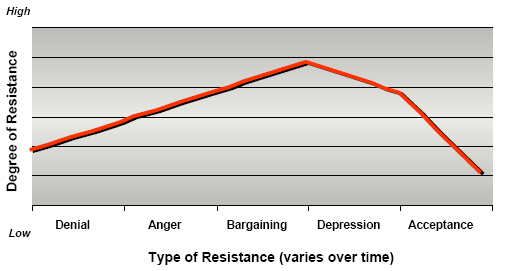
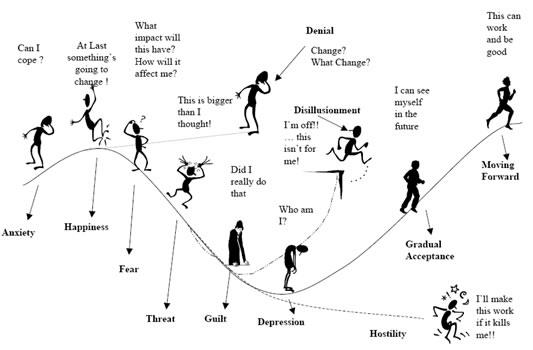
In order to assist individuals to overcome resistance to change, you need to understand the transition process that people experience during change. The following is an illustration thereof:
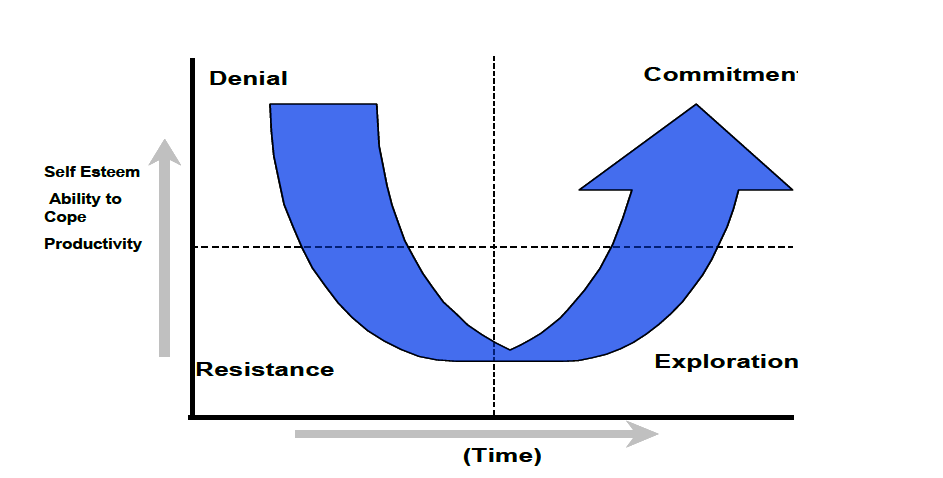
Even though the illustrations show that the reactions to change seem to follow a process over time, it is natural for a person to go forward and backward as per the illustration below:
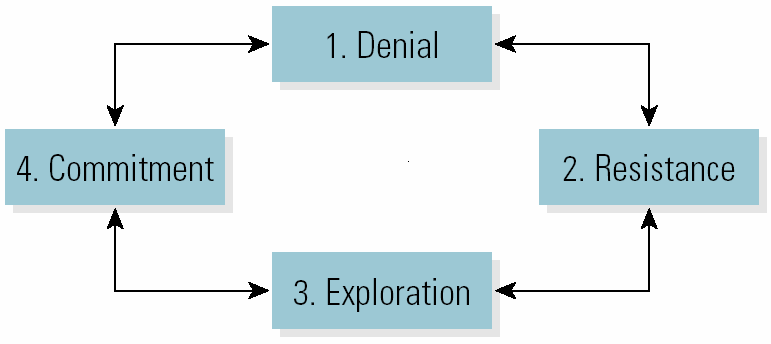
If management does not understand, accept and make an effort to work with resistance, it can undermine even the most well-intentioned and well-conceived change efforts. “Any management’s ability to achieve maximum benefits from change depends in part on how effectively they create and maintain a climate that minimises resistant behaviour and encourages acceptance and support”22 In order to facilitate a smooth transition from the old to the new, organisations must be competent in effective change management. The process of change management consists of getting those involved and affected to accept the introduced changes as well as manage any resistance to them. Top ten reasons people resist change:23 Reason 1: The risk of change is seen as greater than the risk of standing still Making a change requires a kind of leap of faith: you decide to move in the direction of the unknown on the promise that something will be better for you. But you have no proof. Taking that leap of faith is risky, and people will only take active steps toward the unknown if they genuinely believe – and perhaps more importantly, feel – that the risks of standing still are greater than those of moving forward in a new direction. Making a change is all about managing risk. If you are making the case for change, be sure to set out in stark, truthful terms why you believe the risk situation favours change. Use numbers whenever you can, because most people pay attention to numbers. At the very least, numbers get our attention, and then, when the rational mind is engaged, the emotional mind (which is typically most decisive) can begin to grapple with the prospect of change. But if you only sell your idea of change based on idealistic, unseen promises of reward, you won’t be nearly as effective in moving people to action. The power of the human fight-or-flight response can be activated to fight for change, but that begins with the perception of risk.
Reason 2: People feel connected to other people who are identified with the “old way”
We are a social species. We become, and like to remain, connected to those we know, those who have taught us, those with whom we are familiar – even at times to our own detriment. Loyalty certainly helped our ancestors hunt antelope and defend against the aggressions of hostile tribes, and so we are wired to form emotional bonds of loyalty. If you ask people in an organisation to do things in a new way, as rational as that new way may seem to you, you will be setting yourself up against all that wiring, all those emotional connections to those who taught your audience the old way – and that’s not trivial. At the very least, as you design your change message, you should make statements that honour the work and contributions of those who brought such success to the organisation in the past, because on a very human but seldom articulated level, your audience will feel asked to betray their former mentors (whether those people remain in the organisation or not). A little good diplomacy at the outset can stave off a lot of resistance.
Reason 3: People have no role models for the new activity
Never underestimate the power of observational learning. If you see yourself as a change agent, you probably are something of a dreamer, someone who uses the imagination to create new possibilities that do not currently exist. Well, most people don’t operate that way. It’s great to be a visionary, but communicating a vision is not enough. Get some people on board with your idea, so that you or they can demonstrate how the new way can work. Operationally, this can mean setting up effective pilot programs that model a change and work out the kinks before taking your innovation “on the road.” For most people, seeing is believing. Less rhetoric and more demonstration can go a long way toward overcoming resistance, changing people’s objections from the “It can’t be done!” variety to the “How can we get it done?” category.
Reason 4: People are afraid that they lack the competence to change
This is a fear people will seldom admit. But sometimes, change in organisations necessitates changes in skills, and some people will feel that they won’t be able to make the transition very well. They don’t think that they, as individuals, can do it. Some of them may be right, but in many cases, their fears will be unfounded, and that’s why part of moving people toward change requires you to be an effective motivator. Even more, a successful change campaign includes effective new training programs, typically staged from the broad to the specific. This could mean that initial events should be town-hall type information events, presenting the rationale and plan for change, specifying the next steps, outlining future communication channels for questions, etc., and specifying how people will learn the specifics of what will be required of them, from whom, and when. Then, training programs must be implemented and evaluated over time. In this way, you can minimise the initial fear of a lack of personal competence for change by showing how people will be brought to competence throughout the change process.
Reason 5: People feel overloaded and overwhelmed
Fatigue can really kill a change effort, for an individual or for an organisation. If, for example, you believe you should quit smoking, but you’ve got ten projects going and four kids to support, it can be easy to put off your personal health improvement project (until your first heart attack or cancer scare, when suddenly the risks of standing still seem greater than the risks of change!). When you’re introducing a change effort, be aware of fatigue as a factor in keeping people from moving forward, even if they are telling you they believe in the wisdom of your idea. If an organisation has been through a lot of upheaval, people may resist change just because they are tired and overwhelmed, perhaps at precisely the time when more radical change is most needed! That’s when you need to do two things: re-emphasise the risk scenario that forms the rationale for change (as in the cancer scare example), and also be very generous and continuously attentive with praise, and with understanding for people’s complaints, throughout the change process. When you re-emphasise the risk scenario, you’re activating people’s fears, the basic fight-or-flight response we all possess. But that’s not enough, and fear can produce its own fatigue. You’ve got to motivate and praise accomplishments as well, and be patient enough to let people vent (without getting too caught up in attending to unproductive negativity).
Reason 6: People have a healthy scepticism and want to be sure that the new ideas are sound
It’s important to remember that few worthwhile changes are conceived in their final, best form at the outset. Healthy sceptics perform an important social function: to vet the change idea or process so that it can be improved upon along the road to becoming reality. So listen to your sceptics, and pay attention, because some percentage of what they have to say will prompt genuine improvements to your change idea (even if some of the criticism you will hear will be based more on fear and anger than substance).
Reason 7: People fear hidden agendas among would-be reformers
If you seek to promote change in an organisation, not only can you expect to encounter resentment for upsetting the established order and for thinking you know better than everyone else, but you may also be suspected of wanted to increase your own power, or even eliminate potential opposition through later stages of change.
What’s the solution? If you want to minimise and overcome resistance, you’d better be as open with information and communication as you possibly can be, without reacting unduly to accusations and provocations, in order to show your good faith, and your genuine interest in the greater good of the organisation. And if your change project will imply reductions in workforce, then be open about that and create an orderly process for outplacement and in-house retraining. Avoid the drip-drip-drip of bad news coming out in stages, or through indirect communication or rumour. Get as much information out there as fast as you can and create a process to allow everyone to move on and stay focused on the change effort.
Reason 8: People feel the proposed change threatens their notions of themselves
Sometimes change on the job gets right to a person’s sense of identity. When a factory worker begins to do less with her hands and more with the monitoring of automated instruments, she may lose her sense of herself as a craftsperson, and may genuinely feel that the very things that attracted her to the work in the first place have been lost.
Change can get right to a person’s sense of identity, the sense of self as a professional. As a result, people may feel that the intrinsic rewards that brought them to a particular line of work will be lost with the change. And in some cases, they may be absolutely right. The only answer is to help people see and understand the new rewards that may come with a new work process, or to see how their own underlying sense of mission and values can still be realised under the new way of operating. When resistance springs from these identity-related roots, it is deep and powerful, and to minimise its force, change leaders must be able to understand it and then address it, acknowledging that change does have costs, but also, (hopefully) larger benefits.
Reason 9: People anticipate a loss of status or quality of life
Real change reshuffles the deck a bit. Reshuffling the deck can bring winners . . . and losers. Some people, most likely, will gain in status, job security, quality of life, etc. with the proposed change, and some will likely lose a bit. Change does not have to be a zero sum game, and change can (and should) bring more advantage to more people than disadvantage. But we all live in the real world, and let’s face it – if there were no obstacles (read: people and their interests) aligned against change, then special efforts to promote change would be unnecessary.
Some people will, in part, be aligned against change because they will clearly, and in some cases correctly, view the change as being contrary to their interests. There are various strategies for minimising this, and for dealing with steadfast obstacles to change in the form of people and their interests, but the short answer for dealing with this problem is to do what you can to present the inevitability of the change given the risk landscape, and offer to help people to adjust. It may result in some people choosing to leave the organisation, and sometimes that’s best for all concerned. When the organisation changes, it won’t be to everyone’s liking, and in that case, it’s best for everyone to be adult about it and move on. Reason 10: People genuinely believe that the proposed change is a bad idea Sometimes people are not being difficult, or afraid, or muddle-headed, or nasty, or foolish when they resist. They just see that the change is wrong. So it’s important not to ignore people who have genuine,
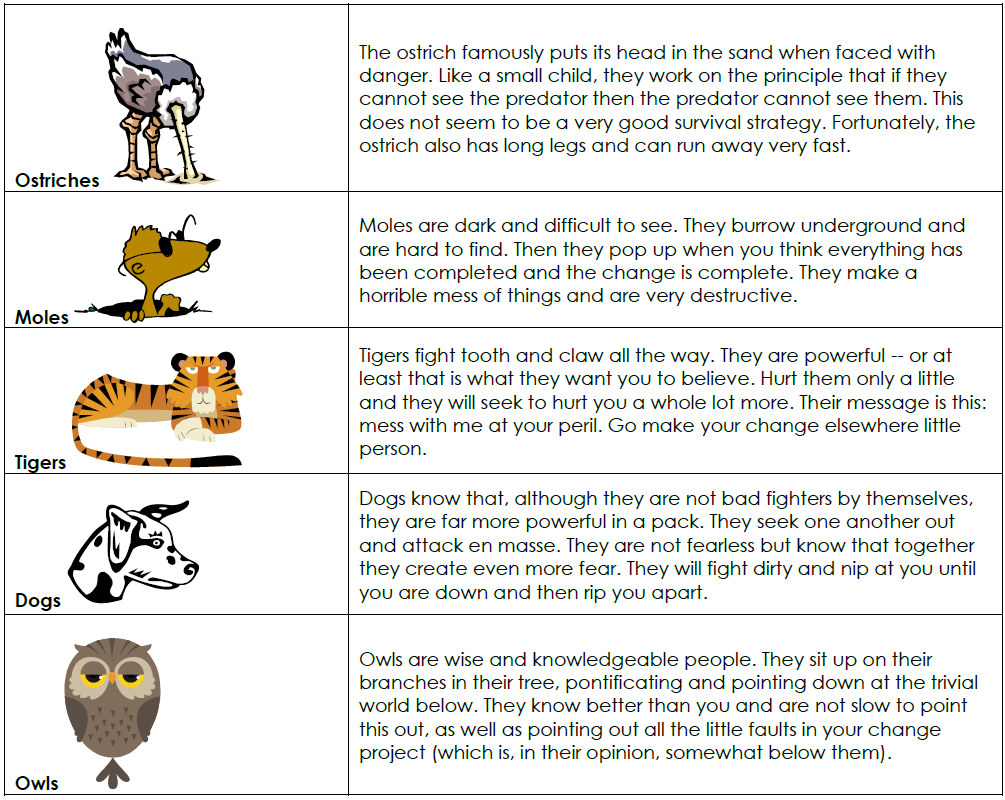
rational reservations or objections. Not all resistance is about emotion. To win people’s commitment for change, you must engage them on both a rational level and an emotional level. A failure to listen to and respond to people’s rational objections and beliefs is ultimately disrespectful to them. The resistance zoo24 This is a bit of fun and a lot of serious. It is surprising how many animals you can spot in change. Using animals is an entertaining and useful metaphor that you can use in many situations to break the ice and tell home truths:

Dealing with negative resistance to change
Kotter and Schlesinger set out the following six (6) change approaches to deal with negative resistance to
change:
Education and communication – Where there is a lack of information or inaccurate information and analysis. One of the best ways to overcome resistance to change is to educate people about the change effort beforehand. Up-front communication and education helps employees see the logic in the change effort. This reduces unfounded and incorrect rumours concerning the effects of change in the organisation.
Participation and involvement – Where the initiators do not have all the information they need to design the change and where others have considerable power to resist. When employees are involved in the change effort they are more likely to buy into change rather than resist it. This approach is likely to lower resistance and those who merely acquiesce to change.
Facilitation and support – Where people are resisting change due to adjustment problems. Managers can head-off potential resistance by being supportive of employees during difficult times. Managerial support helps employees deal with fear and anxiety during a transition period. The basis of resistance to change is likely to be the perception that there some form of detrimental effect occasioned by the change in the organisation. This approach is concerned with provision of special training, counselling, time off work.
Negotiation and agreement – Where someone or some group may lose out in a change and where that individual or group has considerable power to resist. Managers can combat resistance by offering incentives to employees not to resist change. This can be done by allowing change resistors to veto elements of change that are threatening, or change resistors can be offered incentives to leave the company through early buyouts or retirements in order to avoid having to experience the change effort. This approach will be appropriate where those resisting change are in a position of power.
Manipulation and Co-option – Where other tactics will not work or are too expensive. Kotter and Schlesinger suggest that an effective manipulation technique is to co-opt with resisters. Co-option involves the patronising gesture in bringing a person into a change management planning group for the sake of appearances rather than their substantive contribution. This often involves selecting leaders of the resisters to participate in the change effort. These leaders can be given a symbolic role in decision making without threatening the change effort. Still, if these leaders feel they are being tricked they are likely to push resistance even further than if they were never included in the change effort leadership. Manipulation can be a tempting solution, but is morally questionable and, if employees sense what you are doing, it could lead to a very dangerous backlash. Only consider this when change is necessary in the short term and all other avenues have been explored.
Explicit and implicit coercion – This is even more extreme than subtle manipulation. This is where the manager can explicitly or implicitly force employees into accepting change by making it clear that resisting change can lead to losing jobs, transferring or not promoting employees. One sits the employee down and makes overt threats, for example that if they do not comply they will lose their jobs. This should only be used when speed is of the essence or when the other persons themselves have taken to public and damaging actions.
Dealing with positive Resistance
Managers often perceive resistance negatively, and employees who resist are viewed as disobedient and obstacles the organisation must overcome in order to achieve the new goals. However, in certain instances, employee resistance may play a positive and useful role in organisational change. Insightful and well-intended debate, criticism, or disagreement do not necessarily equate to negative resistance, but rather may be intended to produce better understanding as well as additional options and solutions. “The idea that anyone who questions the need for change has an attitude problem is simply wrong, not only because it discounts past achievements, but also because it makes us vulnerable to indiscriminate and ill-advised change”25
Piderit (2000) points out that what some managers may perceive as disrespectful or unfounded resistance to change might be motivated by an individual’s ethical principles or by the desire to protect what they feel are the best interests of the organisation. Employee resistance may force management to rethink or re-evaluate a proposed change initiative. It also can act as a gateway or filter, which can help organisations select from all possible changes the one that is most appropriate to the current situation.
Motivate the role and competencies of the change leader
Most senior and executive managers strongly support their major change projects, but many fail to take the proper steps to communicate that support. A survey of 57 companies showed that excellent executive sponsorship was one of the primary reasons projects succeed. A change management benchmarking study involving 102 companies from 20 countries captured those activities that executive managers should do at each phase of their change initiatives.
What top-management sponsors should do during the planning phase:
Explain why the change is happening; discuss the business reasons for the change and the costs or risks of not changing
Define and communicate the project objectives and scope; tell employees what they can expect to happen and when
Help select the right people for the team and ensure adequate time availability of these resources; provide the needed budget for the design phase
Enlist the support of other senior managers and stakeholders in the project objectives and scope; provide a channel for key managers to provide direction at key decision points in the process
Help the project team select their approach and timeline, and resolve start-up issues for the team
What top-management sponsors should be doing during the design phase:
Reinforce why the change is happening; help employees understand the business reasons for the change
Listen and respond to feedback from the organisation; actively seek input from all levels of management
Create a positive network of conversation about the project with peers and managers at all levels
Provide updates on the project’s progress; let employees know what they can expect and when
Stay engaged and up-to-date on the project; attend key project meetings and training sessions
Keep other senior managers and stakeholders informed on project status and issues; help clear calendars for key decision-making meetings with these stakeholders
Enable employees to attend change management training; personally attend as well
Remove obstacles encountered by the team
What top-management sponsors should be doing during the implementation phase:
Reinforce why the change is happening; explain the business reasons and the priority for the business.
Share the change with all levels in the organisation.
Provide answers to, “What does this change mean to me?” and “What is expected of me?”
Listen to resistance and respond to feedback from the organisation.
Create a positive network of conversation about the project with peers and project stakeholders.
Actively participate in implementation planning; stay involved with the project; monitor progress and remove obstacles.
Ensure that adequate resources are available or adjust the implementation plan to fit available resources.
Engage middle managers in transition planning; define their role for the transition and set clear expectations.
Keep other senior managers and stakeholders informed on project status and issues.
Recognise behaviour and results that are consistent with the change and reward role models.
Expect results and measure performance toward results.
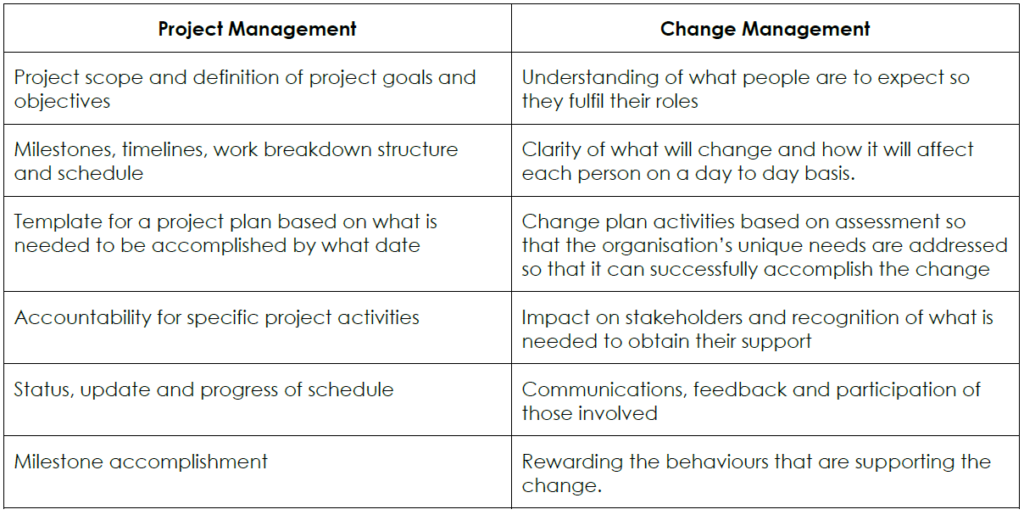
The role of the change manager
The following table describes the role of the change manager by focusing on two main areas: Project and Change Management:
Leadership and change26
“Leadership requires integrity and courage”
As a leader that needs to manage change, you need to ensure that you are comfortable with the 5 core leadership capabilities, as described in the Sloane Model for Leadership:
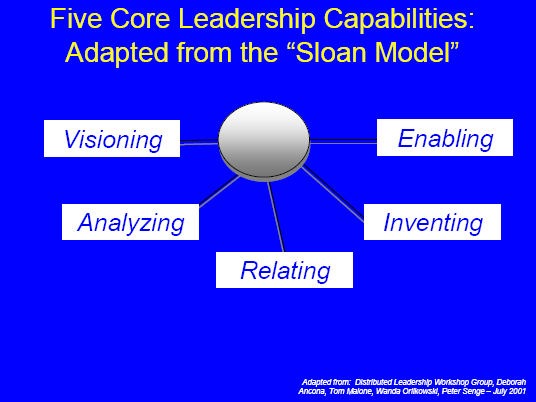
Visioning – Fostering individual and collective aspiration toward a shared vision
Analysing – Sense-making and strategic planning in complex and conflicting settings
Relating – Building relationships and negotiating change across multiple stakeholders
Inventing – Inventing new ways of working together – social and technical systems
Enabling – Ensuring the tools and resources to implement and sustain the shared visions
Management styles during change
Working with a broad selection of the target population adds time and cost to the project. The degree to which you involve them will depend on the magnitude of the change. A straightforward non-controversial change may require no previous contact. If, for example, you are simply introducing a new set of expense codes you can publish the message “with effect from 1st April, new codes must be used as per the attached book”. Conversely, if you are making huge changes to the job and lifestyle of the target population you will need to work with them to gain their co-operation, for example, if you wish them to re-locate voluntarily and re-train for substantially altered jobs.
Some change management styles that may be appropriate include:
Collaborative – The target population are engaged in the change process, typically through cascading workshops or meetings. They will be kept up to date on the issues. Their views will be actively sought and acted upon. Feedback will demonstrate how their input has been acted upon.
Consultative – The target population is informed about the changes and their views are sought
Directive – The workforce is informed about the changes and why those changes are important
Coercive – The workforce is told that they must obey the new instructions
A conclusion analogy
This analogy is about being ‘bound to the past’.
When elephant trainers shackle a young elephant to a stake in the ground, the elephant learns to stay in place, giving up any attempt to pull up the stake. After a while, all that is required to keep the elephant in its place is a small metal bracelet around one of its feet, even when it is not attached to any stake at all. Having once got the idea the bracelet is chained to a stake; the elephant will stay – all because of an inconsequential bracelet.
Organisations, like elephants, are often bound by restraints, however insignificant they may be. Research has shown that individuals and organisations resist change, especially as they get older.