
MODULE 2 – PART 3: Analyse the factors that influence economic activity.
INTRODUCTION
Economic activity can be seen as a circle, or a series of circles. A firm pays their employees, the employees spend money to buy products and services, the businesses that they buy products and services from pay their employees so they can buy more products and services. The cycles go on and on. Every time the money changes hands it is an economic activity and the more economic activity there is, the healthier the economy is. If enough people save money, rather than spending or investing it, it causes an economic slowdown that reverses the cycle; individuals stop spending, companies take in less money and so spend less themselves. Eventually this can lead to recession. A number of factors can cause people to stop spending. These factors will be discussed in detail in this section.
THE EFFECTS OF CYCLICAL MOVEMENTS IN A MARKET SYSTEM
When entire industries and the companies within them are characterized as cyclical or non-cyclical it is typically, but not always, with respect to the overall business cycle.
A cyclical pattern is one that has wave-like trends or cycles.
▪
Demand for industrial products like heavy machinery and consumer durables are affected by macro-economic conditions, making companies in these sectors cyclical.
▪
In contrast, basic consumer necessities such as food and pharmaceuticals are non-cyclical. Mature companies and industries tend to be more cyclical than young ones.
▪
Debt causes earnings for the cyclical company to be even more volatile than the cyclical demand for the company’s products because debt service increases fixed cost structure.
▪
Because cyclical companies tend to be mature and mature companies tend to keep at least some debt on their balance sheet, the earnings pattern of a cyclical company will often be the most cyclical characteristic of that company.
▪
When the market senses bad times coming in the economy, it will move toward non-cyclical or defensive stocks and away from cyclical issues.
▪
The stock prices of cyclical and non-cyclical stocks relate to how the business cycle changes. Cyclical stocks move more dramatically, both up and down, with the cycle, while non-cyclical stocks show little movement relative to the cycle.
The idea behind cyclical and non-cyclical stocks is simple. When money is tight, what can you do without or put off, and what do you really need? You may want a new car, but if your budget is very tight, it may have to wait. However, toothpastes, toilet paper, and electricity can’t wait.
▪
Cyclical stocks represent those items and services for consumers and businesses that they buy when confidence in the economy is high.
▪
Non-cyclical stocks represent those items and services for consumers and businesses that they can’t put off no matter what the state of the economy.
NON-CYCLICAL STOCKS
Non-Cyclical Stocks or defensive stocks do well in economic downturns, since demand for their products and services continue regardless of the economy. The classic example of non-cyclical stocks is utilities.
Everyone from consumers to businesses needs water, gas, and electricity. When the economy is growing, these stocks tend to lag behind, however during economic downturns; their steady returns may look good. Another classic example of non-cyclical stocks is household non-durable goods, such as toothpaste, toilet paper, cleaning materials.
CYCLICAL STOCKS
Cyclical stocks follow an upward turn in the business cycle when businesses and consumers are spending money. Automobile companies are classic cyclical stocks. When the economy is good and people are working, car sales do well. However, if there are layoffs and uncertainty or high interest rates, people may decide to hold on to their car another year. Businesses expand during good times. They buy new equipment and build new facilities, so equipment sales and construction are cyclical stocks. When the economy cools, businesses run down inventory, put off expansions, and delay purchases. Cyclical stocks such as steel manufacturing and sales suffer when business slows down.
It pays to keep an eye on the business cycle and know where it is and where it is going. An entrepreneur should understand that this relative safety comes with a price like everything else in the market and that is missing growth opportunities in an up market
THE CONCEPT OF INFLATION
Inflation is a rise in the general level of prices of goods and services in an economy over a period of time.
When the price level rises, each unit of currency buys fewer goods and services; consequently, inflation is also erosion in the purchasing power of money- a loss of real value in the internal medium of exchange and unit of account in the economy.
A chief measure of price inflation is the inflation rate, the annualised percentage change in a general price index (normally the Consumer Price Index) over time.
Effects of inflation
Inflation can have many effects that can simultaneously have positive and negative effects on an economy.
Negative effects of inflation include a decrease in the real value of money and other monetary items over time; uncertainty about future inflation may discourage investment and saving, or may lead to reductions in investment of productive capital and increase savings in non-producing assets e.g. selling
stocks and buying gold. This can reduce overall economic productivity rates, as the capital required to retool companies becomes more elusive or expensive.
High inflation may lead to shortages of goods if consumers begin hoarding out of concern that prices will increase in the future.
Positive effects include a mitigation of economic recessions, and debt relief by reducing the real level of debt.
Inflation is a process. The real problem is thus to define those factors that cause inflation- those factors that are “inflationary.”
That which increases demand without immediate relationship to supply, and that which reduces supply without immediate relationship to demand, is “inflationary.”
Also, that which prevents or inhibits the growth of supply to meet increased demand, and that which prevents or inhibits the reduction of demand to conform to a supply reduction is “inflationary.” Such government policies as expansion of the money supply, restraints on international or domestic commerce, and controls on prices, profits, rents or interest, all fit this definition.
REASONS FOR THE DECLINE IN THE VALUE OF MONEY
There are many causes of currency collapse. These include;
INFLATION
Inflation reduces the value of money. If there is rampant inflation, then a currency will depreciate in value. Inflation makes a country’s currency worth less (as was the case with the Zimbabwean currency, for instance), so people will try to exchange the country’s currency for other currencies which will hold its value.
What causes inflation?
Printing Money. Note printing money doesn’t always cause inflation. It will occur when the money supply is increased faster than the growth of real output. The link between printing money and causing inflation is not straightforward. The money supply doesn’t just depend on the amount the government prints. The US has been increasing the monetary base substantially, but, as of yet, it hasn’t led to inflation because of other factors influencing inflation.
Large National Debt. To finance large national debts, governments often print money and this can cause inflation. This was the case in Zimbabwe. But, national debt doesn’t have to cause inflation. Japan borrowed 195% of GDP, yet has very low inflation.
Current Account Deficit
A current account deficit means that a country imports more goods and services than it exports. To finance this deficit, they will require a surplus on the financial / Capital account.
For example, in 2008, Iceland had a current account deficit of around 7% of GDP. They were able to finance this deficit by attracting capital flows.
To give one example, their banks had high interest rates which attracted UK councils to save their money in Icelandic banks.
Because they were getting capital inflows from abroad, the Icelandic economy could continue to finance its current account deficit.
However, the problem comes when you can no longer finance this deficit-when you can no longer attract capital flows. The global credit crisis meant Icelandic banks were losing money. Therefore, people started to withdraw their savings from Iceland.
The capital flows were drying up, this will cause depreciation in the exchange rate. Basically there is more money leaving Iceland coming in. This will be reflected by the fall in the exchange rate.
COLLAPSE OF CONFIDENCE
If there is a collapse of confidence in an economy or financial sector, this will lead to an outflow of currency as people don’t want to risk losing their currency. Therefore, this causes an outflow of capital and depreciation in the exchange rate. Collapse in confidence can be due to political or economic factors.
LOWER GROWTH AND LOWER INTEREST RATES
Lower rates make it less attractive to save in a country and therefore, there will be a modest depreciation. Lower rates don’t usually cause a collapse in a currency, but, they will make the currency less attractive.
PRICE OF COMMODITIES
If an economy depends on exports of raw materials, a fall in the price of this raw material can cause a fall in export revenue and depreciation in the exchange rate.
The 7 main reasons for the decline in money are:
I.
Lower interest rates
II.
Natural disasters or world crisis.
III.
Current Account deficit.
IV.
Market Confidence.
V.
Government Responses.
VI.
Strength of other currencies
VII.
Low savings Ratio
THE ROLE OF FOREIGN CURRENCY AND EXCHANGE RATES IN THE ECONOMY
The exchange rate expresses the national currency’s quotation in respect to foreign one. Aside from factors such as interest rates and inflation, the exchange rate is one of the most important determinants of a country’s relative level of economic health. Exchange rates play a vital role in a country’s level of trade, which is critical to most every free market economy in the world. For this reason, exchange rates are among the most watched, analysed and governmentally manipulated economic measures. But exchange rates matter on a smaller scale as well: they impact the real return of an investor’s portfolio.
▪
A higher currency makes a country’s exports more expensive and imports cheaper in foreign markets; a lower currency makes a country’s exports cheaper and its imports more expensive in foreign markets.
▪
A higher exchange rate can be expected to lower the country’s balance of trade, while a lower exchange rate would increase it.
DETERMINANTS OF EXCHANGE RATES
Numerous factors determine exchange rates, and all are related to the trading relationship between two countries. The following are some of the principal determinants of the exchange rate between two countries.
Differentials in Inflation: As a general rule, a country with a consistently lower inflation rate exhibits a rising currency value, as its purchasing power increases relative to other currencies.
Differentials in Interest Rates: Interest rates, inflation and exchange rates are all highly correlated. By manipulating interest rates, central banks exert influence over both inflation and exchange rates, and changing interest rates impact inflation and currency values. Higher interest rates offer lenders in an economy a higher return relative to other countries. Therefore, higher interest rates attract foreign capital and cause the exchange rate to rise. The impact of higher interest rates is mitigated, however, if inflation in the country is much higher than in others, or if additional factors serve to drive the currency down. The opposite relationship exists for decreasing interest rates- that is, lower interest rates tend to decrease exchange rates.
Current-Account Deficits: The current account is the balance of trade between a country and its trading partners, reflecting all payments between countries for goods, services, interest and dividends. A deficit in the current account shows the country is spending more on foreign trade than it is earning, and that it is borrowing capital from foreign sources to make up the deficit. In other words, the country requires more foreign currency than it receives through sales of exports, and it supplies more of its own currency than foreigners demand for its products. The excess demand for foreign currency lowers the country’s exchange rate until domestic goods and services are cheap enough for foreigners, and foreign assets are too expensive to generate sales for domestic interests.
Public Debt: Countries will engage in large-scale deficit financing to pay for public sector projects and governmental funding. While such activity stimulates the domestic economy, nations with large public deficits and debts are less attractive to foreign investors. A large debt encourages inflation, and if inflation is high, the debt will be serviced and ultimately paid off with cheaper real dollars in the future.
Terms of Trade: a ratio comparing export prices to import prices, the terms of trade is related to current accounts and the balance of payments. If the price of a country’s exports rises by a greater rate than that of its imports, its terms of trade have favourably improved. Increasing terms of trade shows greater demand for the country’s exports; this in turn, results in rising revenues from exports, which provides increased demand for the country’s currency (and an increase in the currency’s value). If the price of exports rises by a smaller rate than that of its imports, the currency’s value will decrease in relation to its trading partners.
Political Stability and Economic Performance: Foreign investors inevitably seek out stable countries with strong economic performance in which to invest their capital. A country with such positive attributes will draw investment funds away from other countries perceived to have more political and economic risk. Political turmoil, for example, can cause a loss of confidence in a currency and a movement of capital to the currencies of more stable countries.

By many measures, the dollar is the most prominent currency in the world. It plays a central role in international trade and finance as both a store of value and a medium of exchange.
Many countries maintain an exchange rate regime that anchors the value of their home currency to that of the dollar.
Dollar holdings make up a large share of official foreign exchange reserves, the foreign currency deposits and bonds maintained by central banks and monetary authorities.
In international trade, the dollar is widely used for invoicing and settling import and export transactions around the world.
ISSUES INFLUENCING THE ECONOMY
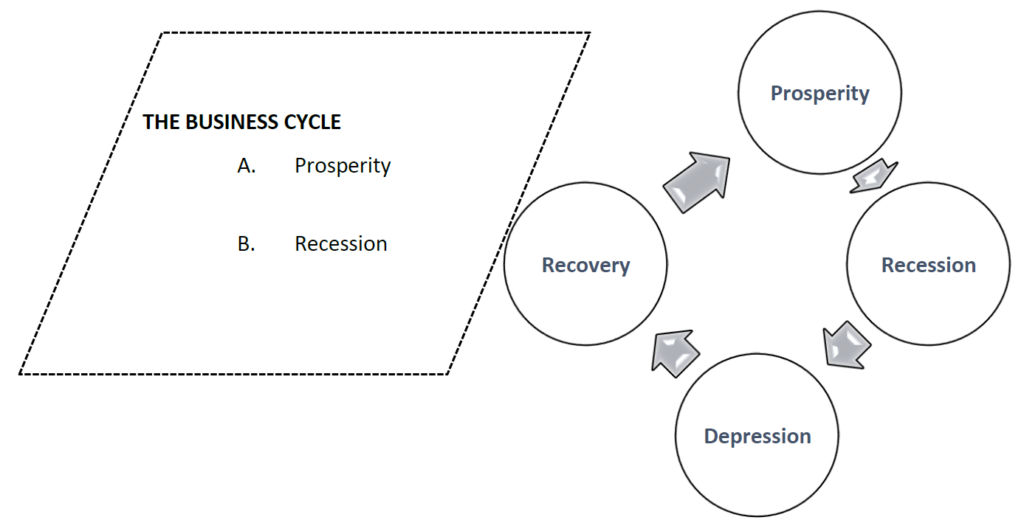
The diagram below illustrates a typical business cycle:
MEASURING ECONOMIC ACTIVITY
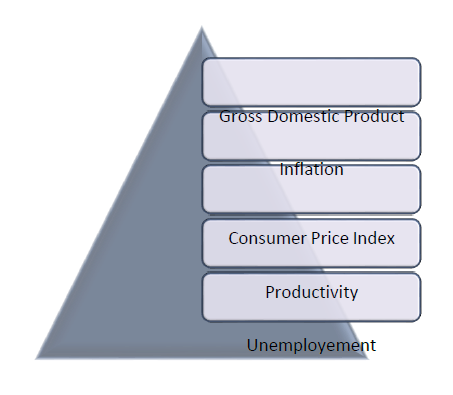
Economic activity is measured as follows:
GROSS DOMESTIC PRODUCT
GDP: The gross domestic product (GDP) or gross domestic income (GDI) is a basic measure of a country’s overall economic output. It is the market value of all final goods and services made within the borders of a country in a year.
It is often positively correlated with the standard of living, though its use as a stand-in for measuring the standard of living has come under increasing criticism and many countries are actively exploring alternative measures to GDP for that purpose. GDP can be determined in three ways, all of which should in principle give the same result. They are the product (or output) approach, the income approach, and the expenditure approach.
▪
The most direct is the product approach, which sums the outputs of every class of enterprise to arrive at the total.
▪
The expenditure approach works on the principle that all of the product must be bought by somebody, therefore the value of the total product must be equal to people’s total expenditures in buying things.
▪
The income approach works on the principle that the incomes of the productive factors (“producers,” colloquially) must be equal to the value of their product, and determines GDP by finding the sum of all producers’ income
Example: the expenditure method:
GDP = private consumption + gross investment + government spending + (exports − imports)
INTEREST RATE
An interest rate is the price a borrower pays for the use of money they borrow from a lender, for instance a small company might borrow capital from a bank to buy new assets for their business, and the return a lender receives for deferring the use of funds, by lending it to the borrower. Interests rates are fundamental to a Capitalist society. Interest rates are normally expressed as a percentage rate over the period of one year
BANKERS ACCEPTANCE RATE (BA)
A banker’s acceptance, or BA, is a negotiable instrument or time draft drawn on and accepted by a bank. Before acceptance, the draft is not an obligation of the bank; it is merely an order by the drawer to the bank to pay a specified sum of money on a specified date to a named person or to the bearer of the draft. Upon acceptance, which occurs when an authorized bank accepts and signs it, the draft becomes a primary and unconditional liability of the bank. If the bank is well known and enjoys a good reputation, the accepted draft may be readily sold in an active market. A banker’s acceptance is also a money market instrument- a short-term discount instrument that usually arises in the course of international trade.
BALANCE OF PAYMENT
The balance of payment is a record of all transactions made between one particular country and all other countries during a specified period of time. BOP compares the rand difference of the amount of exports and imports, including all financial exports and imports. A negative balance of payments means that more money is flowing out of the country than coming in, and vice versa.
▪
Balance of payments may be used as an indicator of economic and political stability. For example, if a country has a consistently positive BOP, this could mean that there is significant foreign investment within that country. It may also mean that the country does not export much of its currency.
▪
This is just another economic indicator of a country’s relative value and, along with all other indicators, should be used with caution. The BOP includes the trade balance, foreign investments and investments by foreigners.
An entrepreneur should have first-hand information about exchange rates, interest rates, inflation etc. this will help him in making informed decisions about the type of business to invest in, whether to import goods etc.
SUMMARY
SYNOPSIS
In this section you learnt to analyse the factors that influence economic activity. REFLECTION
Note what you have learnt in this section in relation to:
▪
The effects of cyclical movements in a market system
▪
The concept of inflation and its impact on the new venture
▪
The reasons for the decline in the value of money
▪
The role of foreign currency and exchange rates in the general economy
▪
The role of the BA rate, Gross Domestic Product and Balance of Payments in the operations of the new venture