
MODULE 3 – PART 1: Develop specific techniques for releasing creativity in developing ideas / opportunities.
INTRODUCTION
Creative thinking is essential for any organization to prevent stagnation and to keep the business moving forward. The process of creative thinking is not always easy, and some stimulation may be necessary.
The good news is that even if you don’t think of yourself as a “creative person”, creativity is a natural part of how the brain works. It’s like a muscle you can strengthen with the right tools. These aren’t skills many of us learned in school, but anyone can master them.
UNDERSTANDING THINKING

Thinking is what every human being does when confronted with a difficulty or problem, that is, an unfamiliar situation to which we have no response ready, either instinctive or habitual, then we ‘put on our thinking cap’. For example, what you do when your car doesn’t start.
In essence, thinking is the human method of seeking a solution, as opposed to the haphazard, hit or miss, trial and error method
common in the rest of the animal world. It is this power of dealing with a novel situation by reflection.
Thinking should be distinguished from day-dreaming, in which we allow our minds to wander at random or to indulge in idle fancies or to build castles in the air without the direction exercised by the will-power.
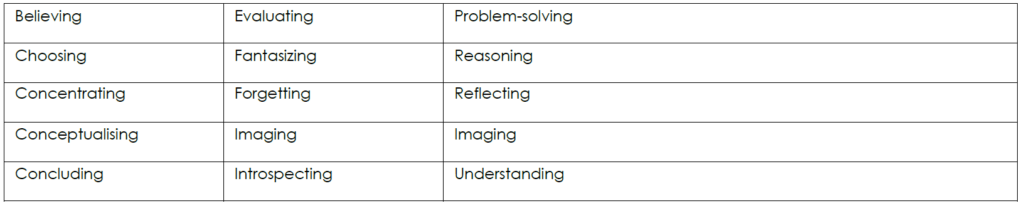
There is a variety of mental processes that may be subsumed under the word thinking. The following list highlights over 30 mental processes:

THE HUMAN MIND
The brain is the most complex biological structure known to man. The twelve billion neurons of the brain interlock which makes the brain a phenomenal information processor.
Each neuron has hundreds of thousands of branching, threadlike extensions that connect it to other neurons, and each connection plays a part in the transmission of signals throughout your brain and your body.
Your thought processes arise from an incredibly complex pattern of electro-chemical signals flitting rapidly through this blob of tissue: a biological computer of awesome capability.
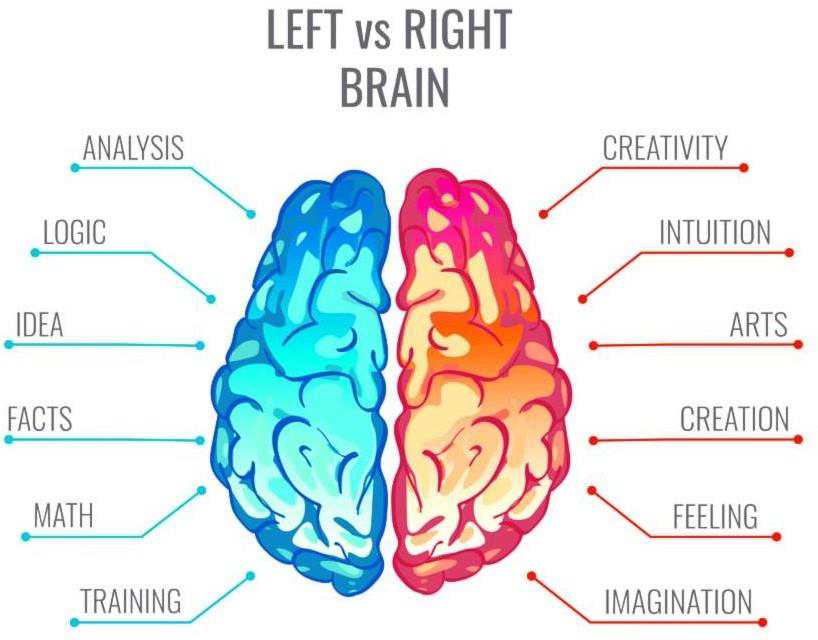
The brain may be regarded as a special channel through which information flows. The information comes in as data, evidence and appreciation of a situation, and goes out as action, choice, decision, and problem solving.
TYPES OF THINKING
The following are the different forms of thinking;
▪
Creative thinking
▪
Lateral thinking
▪
Critical or analytical thinking
CONCEPT OF CREATIVE THINKING
Creative thinking can be defined in the context of an ability, attitude or process.
An Ability. A simple definition is that creativity is the ability to imagine or invent something new. As we will see below, creativity is not the ability to create out of nothing (only God can do that), but the ability to generate new ideas by combining, changing, or reapplying existing ideas. Some creative ideas are astonishing and brilliant, while others are just simple, good, practical ideas that no one seems to have thought of yet. Believe it or not, everyone has substantial creative ability. Just look at how creative children are. In adults, creativity has too often been suppressed through education, but it is still there and can be reawakened. Often all that’s needed to be creative is to make a commitment to creativity and to take the time for it.
An Attitude. Creativity is also an attitude: the ability to accept change and newness, a willingness to play with ideas and possibilities, a flexibility of outlook, the habit of enjoying the good, while looking for ways to improve it. We are socialized into accepting only a small number of permitted or normal things, like chocolate-covered strawberries, for example. The creative person realizes that there are other possibilities, like peanut butter and banana sandwiches, or chocolate-covered prunes.
A Process. Creative people work hard and continually to improve ideas and solutions, by making gradual alterations and refinements to their works. Contrary to the mythology surrounding creativity, very, very few works of creative excellence are produced with a single stroke of brilliance or in a frenzy of rapid activity. Much closer to the real truth are the stories of companies who had to take the invention away from the inventor in order to market it because the inventor would have kept on tweaking it and fiddling with it, always trying to make it a little better.
IMPORTANCE OF CREATIVITY IN BUSINESS
The following are 10 reasons why creativity is important in a small business.
1.
Creative thinking helps you to see opportunities in the marketplace or come up with a unique solution to a problem-and isn’t this the cornerstone of any business?
2.
Creativity is the key to innovation. When issues come up, you’ll be able to think of ways over, under, or through the roadblocks.
3.
Creativity stimulates the brain and helps us to wake up and pay attention. Noticing more of what’s around us an aid in developing novel approaches to help your business stand out.
4.
Creative thinking helps you keep your business presence fresh. You’ll be able to constantly reinvent your business in order to stay in your customers’ awareness.
5.
Creativity helps you shift your perception so you can better understand your customers’ point of view.
6.
Creativity gives you a higher tolerance for risk-you’re used to working through fear of failure.
7.
Creativity improves your leadership skills. Being an effective leader means being creative in your approach and problem-solving. When you have the capacity to let go of the outcome and be open to out
-of-the-box thinking, you free your business team up for generating new ideas.
8.
Creativity helps you to broaden your vision of what it means to be successful in your business-what it can offer to the world.
9.
Creativity strengthens your resilience. When those inevitable stressful periods come up, you’re able to bounce back faster instead of getting derailed.
10.
Creativity invites flow and feels good, and when you feel good, you attract your ideal customers and clients.
METHODS OF CREATIVE THINKING
Several methods have been identified for producing creative results. Here are the five classic ones:
- Evolution.
This is the method of incremental improvement. New ideas stem from other ideas, new solutions from previous ones, the new ones slightly improved over the old ones. Many of the very sophisticated things we enjoy today developed through a long period of constant incrimination. Making something a little better here, a little better there gradually makes it something a lot better–even entirely different from the original.
For example, look at the history of the automobile or any product of technological progress. With each new model, improvements are made. Each new model builds upon the collective creativity of previous models, so that over time, improvements in economy, comfort, and durability take place. Here the creativity lies in the refinement, the step-by- step improvement, rather than in something completely new. Another example would be the improvement of the common wood screw by what are now commonly called drywall screws. They have sharper threads which are angled more steeply for faster penetration and better holding. The points are self-tapping. The shanks are now threaded all the way up on lengths up to two inches. The screws are so much better that they can often be driven in without pilot holes, using a power drill.
The evolutionary method of creativity also reminds us of that critical principle: Every problem that has been solved can be solved again in a better way. Creative thinkers do not subscribe to the idea that once a problem has been solved, it can be forgotten, or to the notion that “if it ain’t broke, don’t fix it.” A creative thinker’s philosophy is that “there is no such thing as an insignificant improvement.” - Synthesis.
With this method, two or more existing ideas are combined into a third, new idea. Combining the ideas of a magazine and an audio tape gives the idea of a magazine you can listen to, one useful for blind people or freeway commuters.
For example, someone noticed that a lot of people on dates went first to dinner and then to the theatre. Why not combine these two events into one? Thus, the dinner theatre, where people go first to eat and then to see a play or other entertainment. - Revolution.
Sometimes the best new idea is a completely different one, which is a significant change from the initial or previous idea. While an evolutionary improvement philosophy might cause a professor to ask, “How can I make my lectures better and better?” a revolutionary idea might be, “Why not stop lecturing and have the students teach each other, working as teams or presenting reports?” For example, the evolutionary technology in fighting termites eating away at houses has been to develop safer and faster pesticides and gasses to kill them. A somewhat revolutionary change has been to abandon gasses altogether in favour of liquid nitrogen, which freezes them to death or microwaves, which bake them. A truly revolutionary creative idea would be to ask, “How can we prevent them from eating houses in the first place?” A new termite bait that is placed in the ground in a perimeter around a house provides one answer to this question. - Reapplication.
Look at something old in a new way. Go beyond labels. One creative person might go to the junkyard and see art in an old model T transmission. He paints it up and puts it in his living room. Another creative person might see in the same transmission the necessary gears for a multi-speed hot walker for his horse. He hooks it to some poles and a motor and puts it in his corral. The key is to see beyond the previous or stated applications for some idea, solution, or thing and to see what other application is possible.
For example, a paperclip can be used as a tiny screwdriver if filed down; paint can be used as a kind of glue to prevent screws from loosening in machinery; dishwashing detergents can be used to remove the DNA from bacteria in a lab; general purpose spray cleaners can be used to kill ants. - Changing Direction.
Many creative breakthroughs occur when attention is shifted from one angle of a problem to another. This is sometimes called creative insight.
A classic example is that of the highway department trying to keep kids from skateboarding in a concrete-lined drainage ditch. The highway department put up a fence to keep the kids out; the kids went around it. The department then put up a longer fence; the kids cut a hole in it. The department then put up a stronger fence; it, too, was cut. The department then put a threatening sign on the fence; it was ignored. Finally, someone decided to change direction, and asked, “What really is the problem here? It’s not that the kids keep getting through the barrier, but that they want to skateboard in the ditch. So how can we keep them from skateboarding in the ditch?” The solution was to remove their desire by pouring some concrete in the bottom of the ditch to remove the smooth curve. The sharp angle created by the concrete made skateboarding impossible and the activity stopped. No more skateboarding problems, no more fence problems.
This example reveals a critical truth in problem solving: the goal is to solve the problem, not to implement a particular solution. When one solution path is not working, shift to another. There is no commitment to a particular path, only to a particular goal. Path fixation can sometimes be a problem for those who do not understand this; they become overcommitted to a path that does not work and only frustration results.
EVERY PROBLEM HAS ONLY ONE SOLUTION (OR ONE RIGHT ANSWER)
The goal of problem solving is to solve the problem, and most problems can be solved in any number of ways. If you discover a solution that works, it is a good solution. There may be other solutions thought of by other people, but that doesn’t make your solution wrong. What is THE solution to putting words on paper? Fountain pen, ball point, pencil, marker, typewriter, printer, Xerox machine, printing press?
THE BEST ANSWER/SOLUTION/METHOD HAS ALREADY BEEN FOUND
Look at the history of any solution set and you’ll see that improvements, new solutions, new right answers, are always being found. What is the solution to human transportation? The ox or horse, the cart, the wagon, the train, the car, the airplane, the jet, the SST? Is that the best and last? What about pneumatic tubes, hovercraft, even Star Trek type beams?
What is the best way to put words on paper? The word processor? Is that the last invention? How about voice recognition, or thought wave input?
On a more everyday level, many solutions now seen as best or at least entrenched were put in place hastily and without much thought–such as the use of drivers’ licenses for ID cards or social security numbers for taxpayer ID numbers. Other solutions are entrenched simply for historical reasons: they’ve always been done that way. Why do shoe laces still exist, when technology has produced several other, better ways to attach shoes to feet (like velcro, elastic, snap buttons, and so on)?
CREATIVE ANSWERS ARE COMPLEX TECHNOLOGICALLY
Only a few problems require complex technological solutions. Most problems you’ll meet with require only a thoughtful solution requiring personal action and perhaps a few simple tools. Even many problems that seem to require a technological solution can be addressed in other ways.
For example, what is the solution to the large percentage of packages ruined by the Post Office? Look at the Post Office package handling method. Packages are tossed in bins when you send them. For the solution, look at United Parcel. When you send a package, it is put on a shelf. The change from bin to shelf is not a complex or technological solution; it’s just a good idea, using commonly available materials.
As another example, when hot dogs were first invented, they were served to customers with gloves to hold them. Unfortunately, the customers kept walking off with the gloves. The solution was not at all complex: serve the hot dog on a roll so that the customer’s fingers were still insulated from the heat. The roll could be eaten along with the dog. No more worries about disappearing gloves. (Note by the way what a good example of changing direction this is.
Instead of asking, “How can I keep the gloves from being taken?” the hot dog server stopped thinking about gloves altogether.)
IDEAS EITHER COME OR THEY DON’T. NOTHING WILL HELP
There are many successful techniques for stimulating idea generation. We will be discussing and applying them.
DIFFERENCE BETWEEN CREATIVE THINKING AND ANALYTICAL THINKING
Analytical thinking is logical and leads to unique or few answers, which can be implemented. Creative thinking requires imagination, and leads to many possible answers or ideas. While the sorts of thinking are different, they are linked because one sort complements the other. This is evident in creative thinking where the many idea must later be analysed. To sort out the few that can be implemented. Analytical thinking consolidated ideas and practices and must be followed by creative leaps if progress is made.
Analytical thinking is convergent, narrowing down to unique answers or a small number of ideas which can be further analysed and implemented. Creative thinking is divergent, starting from the description of the problem and diverging to give many ideas for solving it or possible answers to it. In effect, analytical thinking produces solutions and creative thinking produces ideas- large numbers of them from which the solution can be selected. Convergent and divergent are appearing more frequently in the literature of creative thinking. The two words are more colourful than analytical and creative and they do convey a mental picture of the process being followed as shown below.

The two words vertical and lateral- are less known but are equally applicable in the context of analytical and creative thinking. Tackling a problem in the analytical way requires deep and possibly narrow, probing to identify all aspects- hence vertical thinking. On the other hand, creative thinking requires a wide ranging examination of all the options, including those which might be considered to be wild or foolish and those which appear to be outside and not linked at all with the problem-hence lateral thinking.
EXAMPLE TO EXPLAIN THE TWO TYPES OF THINKING
A South Africa man was celebrating his golden wedding anniversary with a family reunion. He had arranged a dinner party in a private room in a hotel with an events coordinator to welcome his guests. Shortly after the party started, he looked around the family and noticed that there were present:
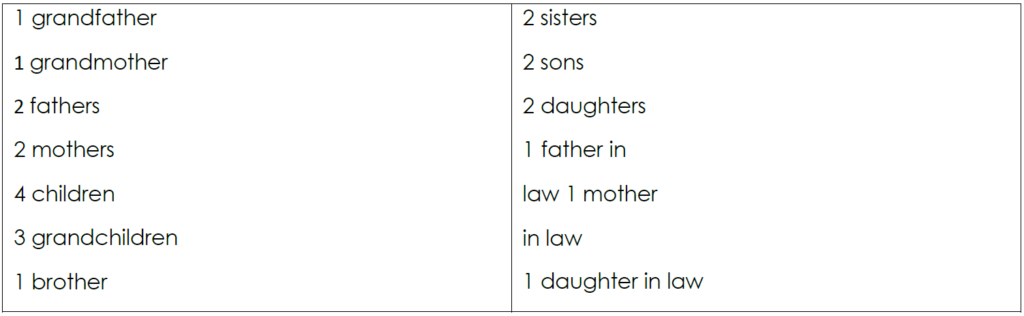
Being a canny man, he had budgeted carefully, and had the exact money to pay for the party. Assuming that the events coordinator was included in the cost of R10 per head, how much money did the man have?
A swift glance at the list of the guests and adding up the numbers would lead to a figure of R230. Not believing that the man would be so rash as to spend R239 on a dinner with his relatives, a second and possibly more suspicious look at the family leads to the realisation that some family members of the party may have dual roles i.e as a father and a son. This leads to a reconsideration of the family and saves the man considerable money.
Apart from a slight feeling of being led up the garden path or being fooled, the solution to this problem requires logical thinking or counting and it leads to a unique answer. Because logical thinking or counting is involved, let us define this problem as analytical problem.
BARRIERS TO CREATIVE THINKING
The following are mental blocks to Creative Thinking and Problem Solving
1.
PREJUDICE. The older we get; the more preconceived ideas we have about things. These preconceptions often prevent us from seeing beyond what we already know or believe to be possible. They inhibit us from accepting change and progress.
Example problem: How to connect sections of airplanes with more ease and strength than using rivets. A modern solution is to use glue–glue the sections together. We probably wouldn’t think of this solution because of our prejudice about the word and idea of glue. But there are many kinds of glue, and the kind used to stick plane parts together makes a bond stronger than the metal of the parts themselves.
Another problem: How can we make lighter weight bullet proof windows? Thicker glass is too heavy. Answer: Use plastic. Again, we are prejudiced against plastic. But some plastics are not flimsy at all and are used in place of steel and in bullet proof windows.
Another problem: Make a ship’s hull that won’t rust or rot like steel or wood. Solution: Use concrete. Our prejudice is that concrete is too heavy. Why not make lightweight concrete? That’s what’s done.
Final example: How to divide a piece of cake equally between two kids so they won’t complain that one kid is preferred over the other: “You gave him the bigger piece; you like him better! Waaaah!” Solution: Put the kids in charge of dividing the cake. Our prejudice is that immature; selfish kids can’t do the job. But the solution, one cuts the cake, the other has first choice of pieces, works very well.
2.
FUNCTIONAL FIXATION. Sometimes we begin to see an object only in terms of its name rather in terms of what it can do. Thus, we see a mop only as a device for cleaning a floor, and do not think that it might be useful for clearing cobwebs from the ceiling, washing the car, doing aerobic exercise, propping a door open or closed, and so on.
There is also a functional fixation of businesses. In the late nineteenth and early twentieth centuries the railroads saw themselves as railroads. When automobiles and later airplanes began to come in, the railroads didn’t adapt. “That’s not our business,” they said. But if they had seen themselves as in the people transportation business rather than in the railroad business, they could have capitalized on a great opportunity.
Similarly, when the telephone began its rise, some of the telegraph companies said, “That’s not our business; we’re telegraph companies.” But if they had said, “Hey, we’re in the communication business, and here’s a new way to communicate,” they would have grown rather than died. Compare Western Union to AT&T. And have you heard of those big calculator companies Dietzgen or Pickett? No? Well, they were among the biggest makers of slide rules. But when electronic calculators began to rise, they didn’t know what business they were in. They thought they were in the slide rule business, when they were really in the calculator business. They didn’t adapt, they didn’t accept the challenge of change and opportunity, and they fell.
And there’s a functional fixation of people, too. Think a minute how you react when you see your pastor mowing his lawn, or your auto mechanic on a television show promoting a book. Stereotyping can even be a form of functional fixation–how many people would laugh at a blonde quoting Aristotle? Too often we permit only a narrow range of attitudes and behaviours in other people, based on bias, prejudice, hasty generalization, or limited past experience. Think of those statements like, “I can’t believe he said that,” or “Imagine her doing that,” and so on. But recall the proverb, “The goal of my life is not to live down to your expectations.”
3.
LEARNED HELPLESSNESS. This is the feeling that you don’t have the tools, knowledge, materials, ability, to do anything, so you might as well not try. We are trained to rely on other people for almost everything. We think small and limit ourselves. But the world can be interacted with.
If you are in need of information, there are libraries, bookstores, friends, professors, and, of course, the Internet. And there are also city, country and state government agencies with addresses and phone numbers and web sites. There are thousands of government agencies that really exist and that will talk to you.
If you are technologically poor, you can learn. Learn how to cook, use tools, make clothes, use a computer. You can learn to do anything you really want to do. All you need is the motivation and commitment. You can learn to fly an airplane, drive a truck, scuba dive, fix a car–name it.
4.
PSYCHOLOGICAL BLOCKS. Some solutions are not considered or are rejected simply because our reaction to them is “Yuck.” But icky solutions themselves may be useful or good if they solve a problem well or save your life. Eating lizards and grasshoppers doesn’t sound great, but if it keeps you alive in the wilderness, it’s a good solution.
Perhaps more importantly, what at first seem to be icky ideas may lead to better solutions? When doctors noted that some unsophisticated natives were using giant ant heads to suture wounds, they imitated this pincer-closing technique by inventing the surgical staple.
Psychological blocks prevent you from doing something just because it doesn’t sound good or right, which is a pretty ridiculous thing. Overcoming such blocks can be really beneficial. Navy commandos in Vietnam overcame their blocks and put on women’s panty hose when they marched through the swamps and jungle. The pantyhose cut down on the friction and rubbing from the plants and aided in removing the dozens of leeches after a mission.
Overcoming the block to using your own blood to write a help note could save your life someday if you got kidnapped.
NEGATIVE ATTITUDES THAT BLOCK CREATIVITY
1.
OH NO, A PROBLEM! The reaction to a problem is often a bigger problem than the problem itself. Many people avoid or deny problems until it’s too late, largely because these people have never learned the appropriate emotional, psychological, and practical responses. A problem is an opportunity. The happiest people welcome and even seek out problems, meeting them as challenges and opportunities to improve things. Definition: a problem is
(1) seeing the difference between what you have and what you want or (2) recognizing or believing that there is something better than the current situation or (3) an opportunity for a positive act. Seeking problems aggressively will build confidence, increase happiness, and give you a better sense of control over your life.
2.
IT CAN’T BE DONE. This attitude is, in effect, surrendering before the battle. By assuming that something cannot be done or a problem cannot be solved, a person gives the problem a power or strength it didn’t have before. And giving up before starting is, of course, self fulfilling. But look at the history of solutions and the accompanying skeptics: man will never fly, diseases will never be conquered, rockets will never leave the atmosphere. Again, the appropriate attitude is summed up by the statement, “The difficult we do immediately; the impossible takes a little longer.”
3.
I CAN’T DO IT. OR THERE’S NOTHING I CAN DO. Some people think, well maybe the problem can be solved by some expert, but not by me because I’m not (a) smart enough, (b) an engineer, or (c) a blank (whether educated, expert, etc.) Again, though, look at the history of problem solving.
Who were the Wright brothers that they could invent an airplane? Aviation engineers? No, they were bicycle mechanics. The ball point pen was invented by a printer’s proofreader, Ladislao Biro, not a mechanical engineer. Major advances in submarine design were made by English clergyman G. W. Garrett and by Irish schoolmaster John
P. Holland. The cotton gin was invented by that well known attorney and tutor, Eli Whitney. The fire extinguisher was invented by a captain of militia, George Manby.
And so on. In fact, a major point made by recent writers about corporate excellence is that innovations in industry almost always come from individuals (not research groups) outside of the area of the invention. General Motors invented Freon, the refrigeration chemical, and tetraethyl lead, the gasoline additive. Kodachrome was invented by two musicians. The continuous steel casting process was invented by a watchmaker (fooling around with brass casting). Soap making chemists turned down the problem of inventing synthetic detergents: those detergents were invented by dye making chemists.
In a nutshell, a good mind with a positive attitude and some good problem solving skills will go far in solving any problem. Interest in and commitment to the problem are the keys. Motivation–a willingness to expend the effort–is more important than laboratory apparatus. And remember that you can always do something. Even if you cannot totally eradicate the problem from the face of the earth, you can always do something to make the situation better.
4.
BUT I’M NOT CREATIVE. Everyone is creative to some extent. Most people are capable of very high levels of creativity; just look at young children when they play and imagine. The problem is that this creativity has been suppressed by education. All you need to do is let it come back to the surface. You will soon discover that you are surprisingly creative.
5.
THAT’S CHILDISH. In our effort to appear always mature and sophisticated, we often ridicule the creative, playful attitudes that marked our younger years. But if you solve a problem that saves your marriage or gets you promoted or keeps your friend from suicide, do you care whether other people describe your route to the solution as “childish?” Besides, isn’t play a lot of fun? Remember that sometimes people laugh when something is actually funny, but often they laugh when they lack the imagination to understand the situation.
6.
WHAT WILL PEOPLE THINK? There is strong social pressure to conform and to be ordinary and not creative.
Here are some overheard examples: Creative Person: “I like to put water in my orange juice so it’s less sweet.”
Ordinary Person: “You’re weird, you know?”
Ordinary Person: “What are you doing?” Creative Person: “We’re painting our mailbox.” Ordinary Person: “You’re crazy.”
Creative Person: “Why don’t we add a little garlic?”
Ordinary Person: “Because the recipe doesn’t call for garlic.”
Ordinary Person: “Why are you going this way? It’s longer.”
Creative Person: “Because I like the drive.”
Ordinary Person: “Did anyone ever tell you you’re strange?”
The constant emphasis we see in society is toward the ruthlessly practical and conformist. Even the wild fashions, from those in Vogue to punk rock, are narrowly defined, and to deviate from them is considered wrong or ridiculous. Some peoples’ herd instinct is so strong that they make sheep look like radical individualists.
So, what will people think? Well, they’re already talking about you, saying that your nose is too big or your shoes are funny or you date weird people. So, since others are going to talk about you in unflattering ways anyway, you might as well relax and let your creativity and individualism flow.
Almost every famous contributor to the betterment of civilization was ridiculed and sometimes even jailed. Think about Galileo. And look what happened to Jesus. Quotation: “Progress is made and new ideas, being strange, are usually greeted with laughter, contempt, or both. That’s just a fact of life, so make up your mind not to let it bother you. Ridicule should be viewed as a badge of real innovative thinking.
7.
I MIGHT FAIL. Thomas Edison, in his search for the perfect filament for the incandescent lamp, tried anything he could think of, including whiskers from a friend’s beard. In all, he tried about 1800 things. After about 1000 attempts, someone asked him if he was frustrated at his lack of success. He said something like, “I’ve gained a lot of
knowledge–I now know a thousand things that won’t work.”
Fear of failure is one of the major obstacles to creativity and problem solving. The cure is to change your attitude about failure. Failures along the way should be expected and accepted; they are simply learning tools that help focus the way toward success. Not only is there nothing wrong with failing, but failing is a sign of action and struggle and attempt–much better than inaction. The go-with-the- flow types may never fail, but they are essentially useless to humanity, nor can they ever enjoy the feeling of accomplishment that comes after a long struggle.
Suppose you let your fear of failure guide your risk taking and your attempts. You try only three things in a year because you are sure of succeeding. At the end of the year the score is: Successes 3, Failures 0. Now suppose the next year you don’t worry about failing, so you try a hundred things. You fail at 70 of them. At the end of the year the score is Successes 30, Failures 70. Which would you rather have–three successes or 30–ten times as many? And imagine what 70 failures will have taught you. Proverb: Mistakes aren’t fun, but they sure are educational.
POSITIVE ATTITUDES FOR CREATIVITY
CURIOSITY.
Creative people want to know things–all kinds of things– just to know them. Knowledge does not require a reason. The question, “Why do you want to know that?” seems strange to the creative person, who is likely to respond, “Because I don’t know the answer.” Knowledge is enjoyable and often useful in strange and unexpected ways.
For example, I was once attempting to repair something, without apparent success, when an onlooker asked testily, “Do you know what you’re doing?” I replied calmly, “No, that’s why I’m doing it.”
Next, knowledge, and especially wide ranging knowledge, is necessary for creativity to flourish to its fullest. Creativity arises from what you know and have experienced. The best ideas flow from a well-equipped mind. Nothing can come from nothing.
In addition to knowing, creative people want to know why. What are the reasons behind decisions, problems, solutions, events, facts, and so forth? Why this way and not another? And why not try this or that?
The curious person’s questioning attitude toward life is a positive one, not a destructive one reflecting skepticism or negativism. It often seems threatening because too often there is no good reason behind many of the things that are taken for granted–there is no “why” behind the status quo.
So ask questions of everyone. Ask the same question of different people just to be able to compare the answers. Look into areas of knowledge you’ve never before explored, whether cloth dying, weather forecasting, food additives, ship building, the U.S. budget, or the toxicity of laundry detergents.
- CHALLENGE.
Curious people like to identify and challenge the assumptions behind ideas, proposals, problems, beliefs, and statements. Many assumptions, of course, turn out to be quite necessary and solid, but many others have been assumed unnecessarily, and in breaking out of those assumptions often comes a new idea, a new path, a new solution.
For example, when we think of a college, we traditionally think of a physical campus with classrooms, a library, and some nice trees. But why must college be a place (with congregated students and faculty) at all? Thus, the electronic college now exists, where students “go” to college right at home, online. Correspondence courses have existed for years, too, beginning with the challenging of the school-as-centralized-place idea.
When we think of an electric motor, we automatically think of a rotating shaft machine. But why assume that? Why can’t an electric motor have a linear output, moving in a straight line rather than a circle? With such a challenged assumption came the linear motor, able to power trains, elevators, slide locks, and so on.
Problem: We make brandy, and for this special edition of our finest kind, we want a fully-grown pear in one piece inside each bottle. The bottle is narrow necked. How can we do it? As you think, watch for the assumptions you are making. Possible solutions (assuming fully grown pear): close the neck or bottom after insertion, use a plastic bottle like heat-shrink tubing, change to a wide mouth bottle. If we do not assume a fully grown pear: grow the pear from a bud inside the bottle. - CONSTRUCTIVE DISCONTENT.
This is not a whining, griping kind of discontent, but the ability to see a need for improvement and to propose a method of making that improvement. Constructive discontent is a positive, enthusiastic discontent, reflecting the thought, “Hey, I know a way to make that better.”
Constructive discontent is necessary for a creative problem solver, for if you are happy with everything the way it is, you won’t want to change anything. Only when you become discontent with something, when you see a problem, will you want to solve the problem and improve the situation.
One of the hallmarks of the constructively discontented person is that of a problem seeking outlook. The more problems you find, the more solutions and therefore improvements you can make. Even previously solved problems can often be solved again, in a better way. A constructively discontent person might think, “This is an excellent solution, but I wonder if there isn’t another solution that works even better (or costs less, etc).”
Another mark of constructive discontent is the enjoyment of challenge. Creative people are eager to test their own limits and the limits of problems, willing to work hard, to persevere and not give up easily. Sometimes the discontent is almost artificial–they aren’t really unhappy with the status quo of some area, but they want to find something better just for the challenge of it and the opportunity to improve their own lives and those of others.
- A BELIEF THAT MOST PROBLEMS CAN BE SOLVED.
By faith at first and by experience later on, the creative thinker believes that something can always be done to eliminate or help alleviate almost every problem. Problems are solved by a commitment of time and energy, and where this commitment is present, few things are impossible.
The belief in the solvability of problems is especially useful early on in attacking any problem, because many problems at first seem utterly impossible and scare off the fainter hearted. Those who take on the problem with confidence will be the ones most likely to think through or around the impossibility of the problem. - THE ABILITY TO SUSPEND JUDGMENT AND CRITICISM.
Many new ideas, because they are new and unfamiliar, seem strange, odd, bizarre, even repulsive. Only later do they become “obviously” great. Other ideas, in their original incarnations, are indeed weird, but they lead to practical, beautiful, elegant things. Thus, it is important for the creative thinker to be able to suspend judgment when new ideas are arriving, to have an optimistic attitude toward ideas in general, and to avoid condemning them with the typical kinds of negative responses like, “That will never work; that’s no good; what an idiotic idea; that’s impossible,” and so forth. Hospital sterilization and antiseptic procedures, television, radio, the Xerox machine, and stainless steel all met with ho-hums and even hostile rejection before their persevering inventors finally sold someone on the ideas.
Some of our everyday tools that we now love and use daily, were opposed when they were originally presented: Aluminium cookware? No one wants that. Teflon pans? They’ll never sell. Erasers on pencils? That would only encourage carelessness. Computers? There’s no market for more than a few, so why build them?
Remember then that (1) an idea may begin to look good only after it becomes a bit more familiar or is seen in a slightly different context or clothing or circumstance and (2) even a very wild idea can serve as a stepping stone to a practical, efficient idea. By too quickly bringing your judgment into play, these fragile early ideas and their source can be destroyed. The first rule of brainstorming is to suspend judgment so that your idea-generating powers will be free to create without the restraint of fear or criticism. You can always go back later and examine–as critically as you want–what you have thought of.
Proverb: “A crank is a genius whose idea hasn’t yet caught on.” - SEEING THE GOOD IN THE BAD.
Creative thinkers, when faced with poor solutions, don’t cast them away. Instead, they ask, “What’s good about it?” because there may be something useful even in the worst ideas. And however little that good may be, it might be turned to good effect or made greater.
Example problem: How can we get college students to learn grammar better? Solution: Spank their bottoms with a hickory stick. This isn’t a good solution, partly because it’s probably illegal. But should we just toss it out? Why not ask what’s good about it? (1) it gives individual, attention to the poor performers, (2) it gives them public attention, (3) it motivates other students as well as the student being spanked, (4) it’s easy and costs nothing. The next question is, Can we adapt or incorporate some of these good things into a more acceptable solution, whether derivative of the original or not? We easily fall into either/or thinking and believe that a bad solution is bad through and through, in every aspect, when in fact, it may have some good parts we can borrow and use on a good solution, or it may do inappropriately something that’s worth doing appropriately. And often, the bad solution has just one really glaring bad part, that when remedied, leaves quite a good solution. In the above example, changing the physical spanking to a verbal spanking changes the entire aspect of the solution while keeping all the good points we identified. - PROBLEMS LEAD TO IMPROVEMENTS.
The attitude of constructive discontent searches for problems and possible areas of improvement, but many times problems arrive on their own. But such unexpected and perhaps unwanted problems are not necessarily bad, because they often permit solutions that leave the world better than before the problem arose.
For example, the first margarine was made from beef fat, milk, water, and chopped cow udder. It wasn’t extremely tasty or healthy. Then about the turn of the century a shortage of beef fat created a problem. What to use? The margarine makers turned to vegetable fats from various plants and the soybean, corn, and sunflower oils they used are still used today. The margarine is healthier and tastes better.
Or think about exams or papers. When you don’t do as well as you want, you think, “Oh no!” But actually, you have a good insight into what you don’t know and still need to learn. You are aware of the geography of your knowledge in a much more detailed form than before the errors showed up. - A PROBLEM CAN ALSO BE A SOLUTION.
A fact that one person describes as a problem can sometimes be a solution for someone else. Above we noted that creative thinkers can find good ideas in bad solutions. Creative thinkers also look at problems and ask, “Is there something good about this problem?”
For example, soon after the advent of cyanoacrylate adhesives (super glue), it was noted that if you weren’t careful, you could glue your fingers together with it. This problem–a permanent skin bond–was soon seen as a solution, also. Surgeons in Viet Nam began to use super glue to glue wounds together.
Another example, also involving glue: 3M chemists were experimenting with adhesives and accidentally came up with one that was so weak you could peel it right back off. Hold strength, shear strength, all were way below the minimum standards for any self-respecting adhesive. A glue that won’t hold? Quite a problem. But this problem was also a solution, as you now see in Post-It Notes. - PROBLEMS ARE INTERESTING AND EMOTIONALLY ACCEPTABLE.
Many people confront every problem with a shudder and a turn of the head. They don’t even want to admit that a problem exists–with their car, their spouse, their child, their job, their house, whatever. As a result, often the problem persists and drives them crazy or rises to a crisis and drives them crazy.
Creative people see problems as interesting challenges worth tackling. Problems are not fearful beasts to be feared or loathed; they are worthy opponents to be jousted with and unhorsed. Problem solving is fun, educational, rewarding, ego building, helpful to society.

NOTE:
Characteristics of the Creative Person
▪
curious
▪
seeks problems
▪
enjoys challenge
▪
optimistic
▪
able to suspend judgment
▪
comfortable with imagination
▪
sees problems as opportunities
▪
sees problems as interesting
▪
problems are emotionally acceptable
▪
challenges assumptions
▪
doesn’t give up easily: perseveres, works hard
THE SIX THINKING HATS
Six Thinking Hats is a time tested tool that boosts creative performance. It provides s a framework to focus and broaden thinking. Participants learn how to separate emotion from facts, the positive from the negative and critical thinking from creative thinking. The method helps to put opinions aside so stronger solutions can be developed, without endless discussion and argument.
INCREASE CREATIVE AND INNOVATIVE PERFORMANCE BY LEARNING HOW TO
▪
Reduce inefficient, wasteful meetings that are plagued by divisive arguments, lack of preparation, side conversations, and inaction.
▪
Break the idea killer habit that shuts down the creative process.
▪
Generate powerful new ideas that are outside of the mainstream.
▪
Follow a practical process for idea evaluation.
▪
Consider a broader range of possible solutions and select the ones that best meet the business need.
▪
Select opportunities to pursue based on balancing value against risk.
▪
Develop action plans to minimize risk.
▪
Sell well thought out ideas to management and clients with more confidence. Each ‘Thinking Hat’ is a different style of thinking. These are explained below:
WHITE HAT:
With this thinking hat you focus on the data available. Look at the information you have, and see what you can learn from it. Look for gaps in your knowledge, and either try to fill them or take account of them. This is where you analyse past trends, and try to extrapolate from historical data.
RED HAT:
‘Wearing’ the red hat, you look at problems using intuition, gut reaction, and emotion. Also try to think how other people will react emotionally. Try to understand the responses of people who do not fully know your reasoning.
BLACK HAT:
Using black hat thinking, look at all the bad points of the decision. Look at it cautiously and defensively. Try to see why it might not work. This is important because it highlights the weak points in a plan. It allows you to eliminate them, alter them, or prepare contingency plans to counter them. Black Hat thinking helps to make your plans ‘tougher’ and more resilient. It can also help you to spot fatal flaws and risks before you embark on a course of action. Black Hat thinking is one of the real benefits of this technique, as many successful people get so used to thinking positively that often they cannot see problems in advance. This leaves them under-prepared for difficulties.
YELLOW HAT:
The yellow hat helps you to think positively. It is the optimistic viewpoint that helps you to see all the benefits of the decision and the value in it. Yellow Hat thinking helps you to keep going when everything looks gloomy and difficult.
GREEN HAT:
The Green Hat stands for creativity. This is where you can develop creative solutions to a problem. It is a freewheeling way of thinking, in which there is little criticism of ideas. A whole range of creativity tools can help you here.
BLUE HAT:
The Blue Hat stands for process control. This is the hat worn by people chairing meetings. When running into difficulties because ideas are running dry, they may direct activity into Green Hat thinking. When contingency plans are needed, they will ask for Black Hat thinking, etc.
A variant of this technique is to look at problems from the point of view of different professionals (e.g. doctors, architects, sales directors, etc.) or different customers