
MODULE1 PART 3: OUTLINE PROCESSES AND PRINCIPLES FOR COMPLETING BASIC QUOTES
PROCESSES AND PRINCIPLES FOR COMPLETING BASIC QUOTES
In order to manage marketing and selling processes of a new venture, processes and principles for completing basic quotes must be applied. A quote is a formal statement of promise (submitted usually in response to a request for quotation) by potential supplier to supply the goods or services required by a buyer, at specified prices, and within a specified period. A quotation may also contain terms of sale and payment, and warranties. Acceptance of quotation by the buyer constitutes an agreement binding on both parties.
DIFFERENT TYPES OF OFFERS TO SECURE BUSINESS TRANSACTIONS
Most businesses sell a product or service to a customer to make money. However, it can be much more complicated than that simple model; some businesses serve as the middle man from manufacturer to customer; others sell to other businesses, and some organizations do not follow a financial model that generates a profit for them. All of these business models lead to different types of business transactions.
Retail to Customer, in Person
An in-person retail-to-customer transaction is one of the simplest forms of business transactions. It involves a customer going into a store, selecting items to purchase and buying the items using cash, check or a credit card. The retailer charges the customer a price based on the retail price of the items plus sales tax if applicable.
Retail to Customer, Not in Person Retailers can also sell products to customers without ever interacting in person. Customers can order products from a catalogue by calling the business, placing an order over the phone and paying for the retail price, applicable sales tax and applicable shipping charges. The product is then shipped to the customer in the mail. Customers can also make purchases from retailers online through the retailer’s website or from another retail website. Online transactions typically are paid for using a credit card or online merchant service like Google Checkout. Again, sales tax and shipping charges often apply in addition to the retail purchase price.
Wholesaler to Retailer
Another type of business transaction is when a retailer buys products from a manufacturer or wholesaler. Many retailers do not manufacture the products they sell. Instead, they buy products directly from manufacturers or wholesalers, then mark the prices up from what they paid to sell to customers to make a profit. Products are often ordered in bulk, and the transaction is typically paid for by an invoice sent from the wholesaler to the retailer after the order is filled. Retailers then have a certain amount of time, such as 30 days, to make payment to the wholesaler. In some cases, wholesalers require payment via credit card when the order is placed before they fill the order. Shipping charges might apply, though discounts for buying in bulk are one way retailers can save money on these transactions.
Business to Business
Many companies sell products or services to other businesses and exclude end consumers from the business model completely. For example, a company might sell cloud storage to other companies, which are virtual servers that power websites and other technology. The companies that purchase this cloud storage use it to store data from their website or other company data securely. The seller in this transaction (for example, the cloud storage provider) markets its services to other businesses and often sells its services exclusively to the buyer for a set period of time. Transaction details are usually laid out in contracts or business agreements. Payment details vary from monthly invoices to other payment arrangements like quarterly or annual payments.
Wholesale to Consumer
Some wholesalers also sell products directly to consumers. Most of these transactions are done online from various wholesaler websites, or over the phone, since wholesalers rarely have warehouses open to the public for browsing and making purchases. These transactions are attractive to consumers because consumers are able to get lower prices on products that have not been marked up by retailers.
Consumer to Consumer
Consumers also are able to make transactions with one another. For example, if someone lists a car or other product or service in the classifieds section of a newspaper, another consumer can buy that car directly from the seller. These transactions typically do not involve wholesalers, retailers or other business. Online auction sites and classified sites have made this model even more popular since people have more resources to buy and sell things between other consumers. In-person transactions are often in cash, while online sites typically use online merchant services.
DIFFERENT TYPES OF BUSINESS AGREEMENTS
A business agreement is a formally drawn written document or oral promise between two or more parties that details a particular business venture.
A typical business agreement specifies details such as cost of goods sold, the product or service required, milestones, insurance, and work completion deadlines.
Unilateral Agreement
A unilateral agreement or contract is a legal binding one in which one party undertakes a promise without securing a similar promise or undertaking from another party. A unilateral agreement is a one-sided contract between an offeror (or promisor) and an offeree (or promisee). The party making the promise in exchange for goods or service is the offeror. The party acting on the offeror’s promise is the offeree. An example of a unilateral agreement is a newspaper ad offering reward for a lost item, such as a passport. The offeree is under no legal obligation to look for the passport, but if he does find and return the lost item, the offeror is legally bound to pay the reward money.
Bilateral Agreement
A bilateral agreement or contract is one in which two parties exchange legally binding promises. Most business transactions undergo bilateral agreements, in which buyers and sellers exchange promises to buy and deliver a product or service. A sales contract is a bilateral agreement. One party promises to deliver a good or service, and another is legally bound to incur the cost of the good or service purchased.
Partnership
A partnership is a type of business agreement that is made between two or more parties or general partners (owners). A partnership agreement is a formal document that details the general provisions, capital, profit and loss, salaries and withdrawals, interest, managerial duties and restrictions, banking, books, voluntary termination, death and arbitration. The general provisions include the name of the partnership, purposes, place and term of business. Capital refers to financial or other contributions by the partners. The profit and loss incurred by a partnership is shared between its partners. All partnership funds are commonly deposited in bank checking or saving accounts. All partnership information–such as assets, liabilities and others–are maintained in partnership books that are equally accessible to all partners.
PRINCIPLES AND PROCEDURES FOR COMPILING QUOTES
When managing marketing and selling processes of a new venture principles and procedures for compiling quotes must be identified and implemented. These differ from organisation to organisation but they include:
▪
Costing and pricing calculations
▪
Terms and conditions (including payment terms)
▪
Legal implications of quotes
▪
An outline of a typical quotation
▪
Basic marketing and financial principles incorporated into quotes
COSTING AND PRICING CALCULATIONS
Costing and pricing are an important part of the product development processes. It is important that you know what the actual costs of making a product are before you begin negotiating orders with buyers.
Costing is the process of working out how much it costs to provide a product of service.
Pricing is the process of working out what price you will sell your product or service, taking into account costs, profit margins and what the market will bear. To cost a product you add the profit margin you want to the cost of labour, overheads and materials.
Pricing and Costing are important on-going activities for any business. If a business does not know the true cost of making a product, they may be selling at a loss. If a business prices their product without looking at the current situation in the market, they may price the product too high, and have difficulty selling.
Costing and Pricing are important:
▪
to be profitable
▪
to be competitive in the marketplace
▪
to make good business decisions
▪
to be successful

Determining the Cost of your Products
The cost of a product includes both direct costs, like materials and labour, and indirect costs (also known as fixed costs or overhead) which include things like rent, wages, electricity and other expenses a business might have even if they are not doing any production. Your profit margin should also be added into the total cost of the product. Let’s look at what should be included as direct and indirect costs:
CALCULATE DIRECT COSTS:
Raw Material Costs
▪
Raw materials used in product (glaze, paint, clay, thread, buttons, cloth, wood for kiln)
▪
Labels, tags and packaging
▪
Cartons and packing materials
Labour Costs
▪
Labour to produce item – this may be calculated by either an hourly or piece rate basis
▪
Labour for inspection and quality control
▪
Labour for packaging and packing
CALCULATE INDIRECT COSTS (OVERHEAD)
▪
Rent
▪
Utilities
▪
Communication (fax, phone, internet)
▪
Office supplies
▪
Salaries
▪
Professional services (like customs broker, accountant)
▪
Marketing expenses (trade fair, promotional materials)
▪
Equipment repair
▪
Transportation (fuel)
▪
Other expenses
These indirect costs can be calculated by piece or as a percentage of direct costs.
CALCULATE PROFIT MARGIN
Your profit is what you earn after all costs have been covered. Most businesses calculate a profit margin of between 10% – 15% of total costs. This margin will also help to protect you against any unexpected costs, such as a sudden increase in the cost of materials, or a change in the exchange rate.
DETERMINE SELLING PRICE
Once you have added your costs and your profit, you will have your Ex-Works price (also known as the Ex-Factory price). This is the cost of the product as it leaves the factory or warehouse. However, most export prices are quoted as F.O.B prices (Free On Board). The F.O.B. price includes the Ex-Works price plus all additional costs related to getting the product to the port of export, such as transporting the product from the workshop to the port, export documentation costs, customs fees, bank charges, and other additional costs These charges can add an additional 10%- 25% to the price.
Raw Materials + Labour (wage) + Overhead + Profit (10-15%) = Ex Works Price + (10 – 25%) = F.O.B Price.
TERMS AND CONDITIONS
Terms and conditions are general and special arrangements, provisions, requirements, rules, specifications, and standards that form an integral part of an agreement or contract. These requirements must be met when compiling quotes and they may include payment terms. These are conditions under which a seller will complete a sale. Typically, these terms specify the period allowed to a buyer to pay off the amount due, and may demand cash in advance, cash on delivery, a deferred payment period of 30 days or more, or other similar provisions.
LEGAL IMPLICATIONS OF QUOTES
Sales people talk or send e-mails to customers and prospects all day long. They make sales presentations, handle objections, quote price and delivery, write proposals, and close orders. After a while it almost becomes automatic or second nature since this is what sales people do. Yet, sales people probably don’t think of themselves as acting as a legal agent of the company.
Legal terms should be incorporated on the back of or attached to any quotation given to a customer on behalf of the business where the supply of goods does not depend on the subsequent completion of an order form. The quotation itself should be signed by a representative on behalf of the business and provide the company / business details.
The actual quotation should contain details of the price, (including deposit, VAT and delivery charges) and should include a delivery schedule and specification of any works to be completed. The quotation should also be dated. These standard terms may not suitable for hire purchase, credit or conditional sales where the Consumer Credit Act would apply.
CLAUSES IN THIS AGREEMENT:
▪
Details of how long the quotation will remain valid.
▪
The amount of notice the customer must give to cancel their order.
▪
When the customer must pay for their order.
▪
Details of guarantees (if any) provided by the business.
▪
When title and risk in the goods pass to the customer.
▪
Complaint details for goods damaged on delivery and losses suffered.
▪
When the customer can cancel order due to non-delivery.
Reasons to buy:
All businesses need to have clear terms and conditions of business to reassure customers they are dealing with a professional organisation. For the organisation it provides commercial certainty and clear terms that can be enforced against the customer.
AN OUTLINE OF A TYPICAL QUOTATION
Sales are the part of many businesses and there are lots of parties that always have their interests in the sales from a certain entity. There are organizations who are involved in exchange with selling parties but at times the individuals have interest in sales offers. The sales quotation is what most of the people look for, the exchange of things of value usually happens after witnessing the quotation offers. This is reason why the sales quotations are so important to structure around people interest.
The following sales quotation template is also devised to help people in structuring a sales quotation in attractive style. You can simply use this free sales quotation template to get your jobs done in smart style. It will let you structure your offers around people interest after proper usage and you will be able to see things happening in your way. This template includes almost everything that may be required in a sale quotation.
SALES QUOTATION TEMPLATE
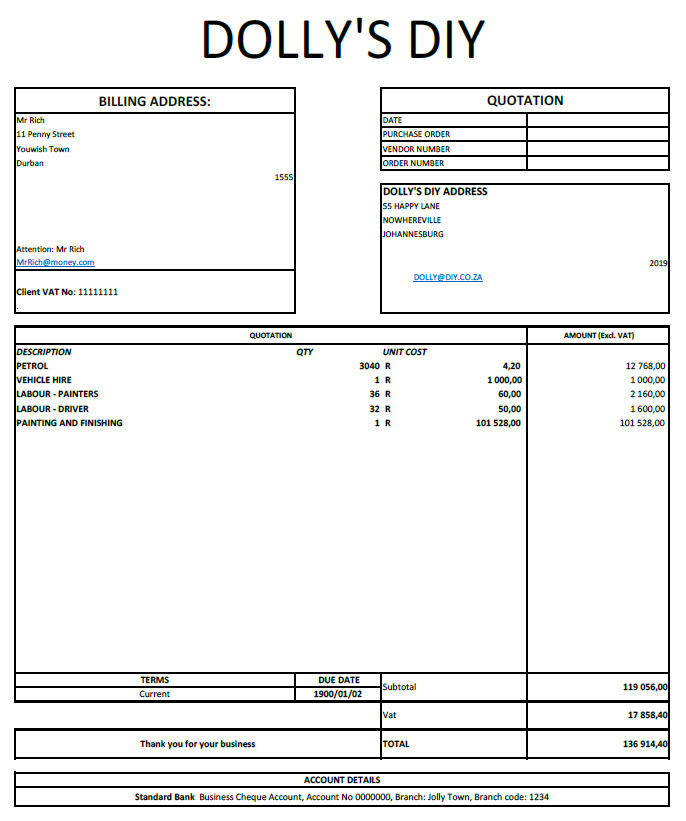
Basically you can divide the quotation into 3 main parts: The Header, Body and Footer. The following is some basic information that you can include in your quote.
QUOTATION HEADER (TOP PART)
▪
Your letterhead: Your business name, address, telephone & email and web address if available. In some countries, you must also include your business registration number.
▪
The words “Quotation”, “Quote”, “Estimate” or your preferred term clearly written towards the top of the page.
▪
If you are registered to bill and collect tax, you may also need to include your Tax Registration Number. This can usually be indicated just below the words “Quotation” or at your letterhead.
BILLING ADDRESS:Mr RichDATE11 Penny StreetPURCHASE ORDERYouwish TownVENDOR NUMBERDurbanORDER NUMBER1555Attention: Mr [email protected] VAT No: 11111111. AMOUNT (Excl. VAT) DESCRIPTIONQTYUNIT COSTPETROL 3040 R 4,20 12 768,00 VEHICLE HIRE 1 R 1 000,00 1 000,00 LABOUR – PAINTERS 36 R 60,00 2 160,00 LABOUR – DRIVER32 R 50,00 1 600,00 PAINTING AND FINISHING 1 R 101 528,00 101 528,00 TERMS DUE DATE Current 1900/01/02SubtotalACCOUNT DETAILSStandard Bank Business Cheque Account, Account No 0000000, Branch: Jolly Town, Branch code: 1234Vat 17 858,40 Thank you for your businessTOTAL 136 914,40 119 056,00 [email protected]’S DIYJOHANNESBURGQUOTATIONDOLLY’S DIY ADDRESS 55 HAPPY LANE NOWHEREVILLE
Title and Section LEARNER GUIDE: MARKETING MANAGEMENT PROGRAMME
Next revision 09-10-2022 Created 09-10-2020
Page number
Page 41 of 138 Reference LG-MMP-01
© Copyright Phakamani Impact Capital 2020 Revision Number 4
▪
The Quotation Number. This a running serial number that you maintain. You should only have one number per quotation issued. Hence, no 2 quotations should have the same number.
▪
The Quotation Date.
▪
Your Payment Terms or how soon you expect to be paid. Some example include: “COD”, “Cash”, “Cash on Delivery” “30 days”, “Full Payment on Delivery”, “50% To Start, balance on completion”. The payment terms can also be placed on the footer if preferred.
▪
Your Customer or Client Name and Address.
QUOTATION BODY (MIDDLE PART)
▪
A description of the goods you are supplying, quantity, unit of measure, price per unit and total amount for individual items. In the case of services, your scope of work and amount for individual items. It is important to be as specific as possible to avoid confusion and misunderstandings between the vendor and the customer. If it will help make things clearer, you may need to add drawings or specification etc in attached sheet or sheets.
QUOTATION FOOTER (BOTTOM)
▪
Total Amount of all individual items
▪
If applicable, a tax amount and total after tax
▪
Validity of the Quote. For example, “This quote is valid for 60 days”
▪
Other comments you may have like delivery instructions, goods return policy, overdue payment policy etc. If necessary, you can also seek legal advice when drafting the terms and conditions for your quotation.
▪
Your business authorised signature if necessary
▪
Options for customer to sign and stamp if your quote is accepted (this is optional)
SEEKING SUPPORT IN COMPILING QUOTES
A sales quote allows a prospective buyer to see what costs would be involved for the work they would like to have done. Many businesses provide services that cannot have an upfront price, as the costs involved can vary. This can be due to the materials that would be used (which can differ depending on the individual needs of the customer), and the manpower that would be necessary. Therefore, it is common practice for these companies to provide the potential customer with a quote (or estimate) of how much it should cost. This quotation will be made by the company using the information that the potential customer provides, regarding the relevant elements that may affect the price. A quote can help the prospective buyer when deciding which company to use, and which services they are looking for.
When considering the information provided on a quote, not only the price should be important; it is also advisable to look at quality and professionalism within a company. This is why it is common practice for most companies to provide prospective customers with portfolios and examples of previous work. This can also help the potential customer when deciding which company to choose for the work they need to have done.
You can use any word processor or spreadsheet software program to create a quotation. However, these programs have limitations in that you cannot easily generate a quotation lists report. Also searching for a quotation means searching files in your hard disk and opening them one at a time. You can overcome these limitations by using a designated quotation or invoicing software product such as our own Instant Invoice 2007 or Ezy Invoice 7. Alternatively, external or internal support may be sought where necessary in order to ensure full understanding of the criteria that apply. A quote must be accurate, complete and understandable. In order to achieve this, support is needed when compiling quotes especially when the person involved is not “knowledgeable” enough. This will save the reputation of the organisation as a whole.
THE COMMON PITFALLS IN QUOTING AND ORDER TAKING
Rules for import request are pretty much on same lines as that of export offer. A request for quotation must be precise, quantified, practical and convincing. Learning the rules not only help buyers get good response from authentic sellers but also help sellers and agents to judge the requester.
Here’s few points to remember while requesting quotation:
Identity
The buyer must state his/her full contact details including name of contact person, mailing address, telephone, fax, e-mail and www home address (if any).
If you receive a request for quotation (RFQ) with no or insufficient details about identity of the sender – then request more information before sending quotation. Any request with scant details on buyer’s identity is perhaps not worth pursuing.
Background
Some information about context or background is extremely helpful for timely and knowledgeable response. It not only helps sellers to respond with relevant information but also helps buyers in cutting down negotiation time by avoiding un-necessary exchange of mails. A RFQ for same product may come from
▪
End-user (e.g. manufacturer requesting a component or ingredient)
▪
Wholesaler
▪
Retailer
▪
Agent/Distributor
The nature of response from seller may vary considerably for each of the above groups though product may be same. Buyers can save considerable time by providing a brief context of the request.
Supporting Information/Documents
Mention your official export-import registration number, bank name, affiliation etc. wherever necessary. A link to corporate web-site saves considerable time and effort. Generally, all information that contributes to establish your credibility will support your business. You may be well known in your country but not necessarily abroad!
Product Specification
This is the most important and core of any import request. Nothing frustrates a seller more than an incomplete and imprecise request for quotation. Insufficient or improper product description/specifications reflects poorly on credibility of buyer and fails to evoke response from authentic sellers.
Quantity
Remember, price depends on quantity to a great extent. It will be difficult for a seller to quote price without knowing minimum order quantity
Mode of Shipment / Destination / Delivery Period
Without clear statement or preference of buyer on above the seller may quote something default (for example, FOB) – leading to waste of time and money in exchanging mails.
COMMON MISTAKES
▪
Insufficient contact details
▪
To ask a quotation without specifying quantity, exact quality, delivery time etc.
▪
Offer of several completely different products
Title and Section LEARNER GUIDE: MARKETING MANAGEMENT PROGRAMME
Next revision 09-10-2022 Created 09-10-2020
Page number
Page 43 of 138 Reference LG-MMP-01
© Copyright Phakamani Impact Capital 2020 Revision Number 4
▪
Too low or too expensive prices visa-versa market prices
▪
Offer of quasi non-existent products in a country
▪
To propose a factory for 5 million Rands with Hotmail address and portable phone or a tel/fax contact
▪
To ask for financing without any contribution except an idea
▪
To ask a 100% financing
▪
To ask for a financial partnership without an appraisal and financial report from a recognized specialized accounting firm
▪
To ask for goods on credit in first transaction
▪
To ask for samples on introduction

The above also applies when taking orders. Noise when taking orders leads to incorrect orders being taken and wrong goods being delivered. When taking orders one must ensure that there are proper communication channels in place and the “seller” must endeavour to write down every customer’s order neatly and confirm the details with the client before processing the order/quotation.