
1: MODULE 1 – PART 2: NEGOTIATE A DEAL WITH A CUSTOMER
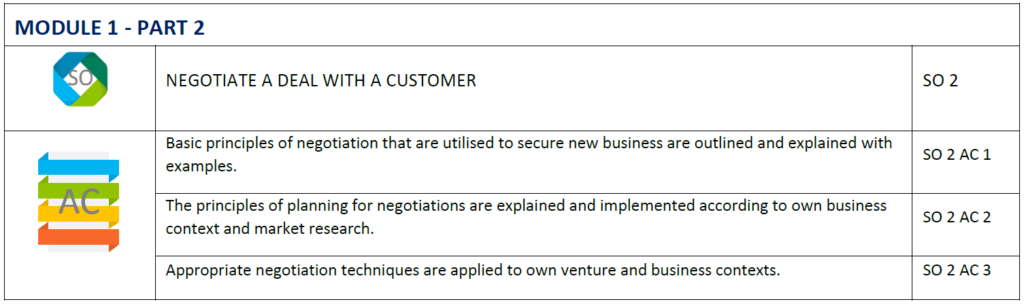
NEGOTIATING A DEAL WITH A CUSTOMER
Negotiating is the process by which two or more parties with different needs and goals work to find a mutually acceptable solution to an issue. Because negotiating is an inter-personal process, each negotiating situation is different, and influenced by each party’s skills, attitudes and style. We often look at negotiating as unpleasant, because it implies conflict, but negotiating need not be characterized by bad feelings, or angry behaviour. Understanding more about the negotiation process allows us to manage our negotiations with confidence increases the chance that the outcomes will be positive for both parties.
BASIC PRINCIPLES OF NEGOTIATION
Negotiation is an art that requires both study and practice. However, there are some basic guidelines that can help you when negotiating. Here are the twelve basic principles.
Know when to negotiate and when to walk away
Sometimes people walk away too soon because they do not realize that they are still in a negotiation. An example of this is a person who makes an offer to a client and the client rejects their offer. Just because the client says no it doesn’t mean that the matter has ended. Saying no to your offer is quite likely to be the start of a negotiation on price. On the other hand, some people keep negotiating when the show is over. They haven’t learned the difference between the “no” that means “I’m open to further offers” and the “no” that means “I’m no longer interested” and so they don’t walk away when they should. Walking away can also be used as a ploy during a negotiation. This can be very effective, provided that you are more willing to walk away from the negotiation than the other party is.
Negotiate for outcome not ego
A skilled negotiator has learned how to manipulate the emotional state of the other party. If you find yourself negotiating on a point of ego this is usually a sign that you are losing.
Negotiate issues not personalities
Often time the person you are negotiating with can be annoying, frustrating or even downright rude. This may be a ploy on their part or it may be their genuine personality.
Either way it is a distraction that you can’t afford to fall into. Keep your focus on the issues at hand and leave their personality out of it.
Know, at all times, what is relevant and what is irrelevant
Know and remember what is important to you. This will help you get what you want and it will also guide you as to what concessions you can make. Of course it is often a part of negotiating strategy to have the other person believing that your important issues are the irrelevant ones and your irrelevant issues are the important ones. Try to gauge what is actually important to the other party and what is not. Knowing the true value of their issues gives you leveraging power.
Talk in terms of benefits rather than features
Often the other person will try to dazzle you with features that, at the end of the day, have no true benefit to you. Keeping your mind focused on your benefits will help you from being distracted by such ploys. Knowing what the real benefits are for the other person helps you promote your desired outcome with more power.
Ask questions rather than make statements
The person asking the question is the person who is leading the direction of the conversation. However, when you make a statement it can leave you open to criticism. Rather than saying “Our software program will really enhance your bottom line profits” which opens you to be challenged, you could ask “would you be interested in a software solution that will enhance your bottom line profits?”.
Use your strengths and manage your weaknesses
In every negotiation each party has strengths and weaknesses. If one party held all the cards then it would not be a negotiation, they would simply be dictating the terms. Be aware of your strengths and how you can best use them and be aware of your weaknesses and know how to manage them. Part of managing your weaknesses is to disguise them as strengths wherever possible. Strength in a negotiation comes from things like willingness to walk away, low perceived need, no or low time constraints or having something that the other party needs but can’t easily get elsewhere. Weakness comes from strong need for what the other party is offering, short time constraints, or low need on the part of the other party.
Respond rather than react
A reaction implies that it is a reflex and doesn’t involve thought or strategy. Skilled negotiators try to get their opponents reacting. Responding on the other hand is keeping your control and not doing anything that is not a thoughtful application of your strategy. If you have the habit of reacting, then it is very easy for a skilled negotiator to manipulate you during the negotiation.
Attract rather than chase
It is very difficult for you to win a negotiation if you are doing the chasing. The idea is to make your proposals in such a way that they draw the other party toward your desired result. This is achieved by a combination of having a good offer and presenting it with good negotiation skills.
Break complicated issues into simple elements and then negotiate the elements
The human brain can only process so much information in one bite. If you are involved in a complex negotiation it will be better to break it down into several components and negotiate them as separate issues. Some negotiators have, as a strength, the ability to mentally hold large amounts of information and they will try to keep the negotiation complicated. If this is not your strength, then don’t fall into this trap.
Know when to negotiate concepts and when to negotiate details
There are times when the details are extremely important but there are other times when they are just a distraction. Develop the skill of being able to see the difference. It also may be a good strategy in many negotiations to gain agreement on a general concept first and then move on to negotiate the details.
Have a system to look after the details
Negotiations by their nature are generally verbal. Once the negotiation is over it is important to get the agreement into writing and signed as soon as possible. The simplest way to achieve this is to already have a system in place, before the negotiation even starts. For a salesman this could be accomplished by having an official order form. Keep in mind that the longer the time between the negotiation and the signing of the formal agreement the more likely it will be that the negotiation will reopen. Negotiation is not a skill that you can master in five minutes, but these twelve basic principles are a good place to start.
SUMMARY
Principled Negotiation
Negotiations are usually seen to be confrontational, because each party is trying to get the best deal they can at the expense of the other person. However, negotiations can take on a more positive light. You are not battling with the person across the table. You are building a relationship and perhaps the start of a great partnership. It helps to approach the process with a win-win goal in mind.
One method of non-adversarial bargaining is principled negotiation. Follow the four steps to principled negotiation:
1.
Separate the people from the problem – Make the discussion about what is being negotiated, not who is doing the negotiating.
2.
Focus on interests, not positions – Both sides want something. Focus on the goals rather than on how you want to accomplish those goals.
3.
Invent options for mutual gain – Do not approach the negotiations with the goal of getting what you want. Make the goal something that benefits both sides.
4.
Use objective criteria – Base the negotiations on market values or traditional practices rather than on what you think things are worth.
THE PRINCIPLES OF PLANNING FOR NEGOTIATIONS
Negotiating is an inevitable part of doing business. You negotiate with suppliers, distributors and customers. Good negotiations can lead to prosperity, while bad negotiations can damage your business profitability. In any kind of negotiation, the planning stage is probably the most important. Too often in sales negotiations we go in badly prepared and end up giving too many concessions that reduce the overall profitability of the final deal and give the customer unrealistic expectations for what they can achieve in future negotiations.
Generally, the more time that is spent in planning and preparing for the negotiation, the more beneficial will be the final outcome.
KEY ISSUES TO CONSIDER WHEN PREPARING FOR A NEGOTIATION
There are five key issues to consider when preparing for a negotiation:
1.
What are my objectives?
2.
What information will influence the final outcome of the negotiation?
3.
What concessions have I got to trade with. What is the cost and value of each concession?
4.
What is the most appropriate strategy for this negotiation? What is my plan of action?
5.
What tasks will you and other members of your team be responsible for in the negotiation?
Objectives
Before entering into the negotiation, you need to have a clear idea of your objectives and those of the other side. Ask yourself the following questions:
a)
What exactly do I wish to achieve from this negotiation?
b)
What is my best outcome?
c)
What other outcomes may be acceptable?
d)
Would is my worst acceptable outcome?
e)
What options or alternatives would be acceptable to me?
f)
What are the other sides’ objectives?
g)
What options or alternatives might be acceptable to them?
Information
It has often been said that information is power. In any negotiation, there will be 5 types of information that will influence the final outcome.
a)
What information do I have that the other side also has?
b)
What information do I have that the other side does not have?
c)
What information do I need to find out before negotiating with the other side?
d)
What information does the other side need before it can negotiate with me?
e)
What information am I prepared to reveal to the other side?
Concessions
When preparing for negotiations, ask yourself the following questions:
a)
What concessions are available to me other than price?
b)
What is the cost of each possible concession?
c)
How much value does the other side place on each concession?
d)
What is non-negotiable in this negotiation?
e)
What is the limit of my authority?
Strategy
Ask yourself the following questions:
a)
How am I going to achieve my objectives in this negotiation? What is my plan of action?
b)
What is the strategy of the other side likely to be? How do I expect them to behave?
c)
What tactics should I use within the negotiation?
d)
What tactics are the other side likely to use?
Tasks
If you go into negotiation with a colleague or colleagues, you need to decide during the preparation phase:
a)
What role will each team member take in the negotiation?
b)
How can we work together in the most effective way?
Some teams of negotiators appoint team leaders, note takers, observers and specialists, each with their own clearly defined authority and roles to perform. Having a clear understanding of roles within the negotiation will make the team approach much more effective.
Before the negotiation
1.
Do your research. Look at their website and any information you have on the other side and the outcomes of previous negotiations.
2.
Speak with your manager. Make sure he, or she is involved in the planning process and that you have their full support.
Have a pre-negotiation meeting with the client, if possible, to find out information on:
1.
The people on their side with whom you will be negotiating
2.
Their organisation; issues happening in their business that will influence the final outcome
3.
Their decision making process; who is involved, how they will decide and what timescales they are working to?
4.
Current supplier, or suppliers with whom they currently do business
5.
Competition; others who may have been invited to quote for the business
6.
Problems that they are looking to solve as a result of the negotiation
7.
Their needs. What are they looking for from the company that is successful in the negotiation? What are their main needs; price, service, product features?
8.
Financial issues such as budgets, discounts and payment terms
9.
Make a list of information you will need to find out during the negotiation
10.
Practise the negotiation with colleagues
The more preparation you do the better the outcome will be. My most important tips to any negotiators are:
▪
Try to be confident. Look and feel as confident as possible. Remember, they have as much to gain as you from reaching agreement Take your time. Most salespeople negotiate too quickly and give concessions too easily. Slow down
▪
Calculate the cost of concessions. Don’t agree a concession until you understand the cost of agreeing to it
▪
Adopt a low key approach. Try not to look too eager
SUMMARY
The first step to a successful negotiation is to be prepared.
▪
Have a plan. Decide on your desired outcome before you negotiate and set your boundaries. It is easy to define your best case scenario, but what is the minimum you are willing to agree to, before you walk away from the negotiating table?
▪
Find out what you can about who the other side is. Understanding their situation can give you the leverage you need to negotiate a favourable deal.
▪
Take stock of everything you have to offer. You have more than just money to offer. Other things that can be desirable to offer in your negotiations can include:
✓
Level of service
✓
Payment schedule
✓
Contacts and introductions
✓
Partnerships with third parties
✓
Contract lengths and durations
✓
Expertise and knowledge sharing
Smart Negotiating
Preparation and planning are not the only elements of smart negotiating. Handling yourself well at the negotiation table is also key. Some things to keep in mind are:
Emotions – Your emotions can work for or against you. Sending out the right emotional response at the right time can signal your opinion of an offer. This can prompt the person making the offer to make adjustments without your having to make a counter-offer. Too much emotion, on the other hand, can work against you. If you let your emotions guide your negotiation, you could easily accept a bad deal or throw away a good one.
Patience – No negotiation is so important that it must be rushed. Let the people you are negotiating with finish what they are saying. Try not to interrupt. This gives the other side an opportunity to make a full offer and it gives you the time you need to fully consider what is being proposed.
Silence – We are generally uncomfortable with silences during conversations. When there is silence, we want to speak up just to break the tension. However, silence during a negotiation can be a good thing. It gives you a chance to think and compose yourself. Use silence to your advantage.
Take a break – It is okay to step away from the negotiating table for a while. A break can give you the time you need to compose yourself or give an offer or counter-offer the thought it deserves. At the very least, a break can relieve the pressure, if you feel you are being pushed into a deal you do not like.
Walk away – At the end of the day, you do not have to make a deal. A bad deal can be worse than no deal. If you cannot find a way to get the minimum deal you planned on before sitting down, then get up from the table and walk away. The deal you are looking for can be found elsewhere.
APPROPRIATE NEGOTIATION TECHNIQUES
The following general principles must be remembered and applied when negotiating with a customer.
Win-Win Solutions
When negotiating, always look for win-win solutions, and present them as such. The aim of win-win negotiation is to find a solution that is acceptable to both parties, and leaves both parties feeling that they have won, in some way, after the event. There are different styles of negotiation, depending on circumstances.
Where you do not expect to deal with people ever again and you do not need their goodwill, then it may be appropriate to “play hardball”, seeking to win a negotiation while the other person loses out. Many people go through this when they buy or sell a house – this is why house-buying can be such a confrontational and unpleasant experience. Similarly, where there is a great deal at stake in a negotiation, then it may be appropriate to prepare in detail a legitimate “gamesmanship” to gain advantage. Anyone who has been involved with large sales negotiations will be familiar with this.
Neither of these approaches is usually much good for resolving disputes with people with whom you have an ongoing relationship: If one person plays hardball, then this disadvantages the other person – this may, quite fairly, lead to reprisal later. Similarly, using tricks and manipulation during a negotiation can undermine trust and damage teamwork. While a manipulative person may not get caught out if negotiation is infrequent, this is not the case when people work together routinely. Here, honesty and openness are almost always the best policies
Exclude Competition
If you could exclude competition in any negotiation, you’ll have a better chance of getting what you want, right? How do you do that? Start by never mentioning competition to the other side. It’s possible they don’t know all their options, and it’s not your job to enlighten them. At the negotiating table, be ready to confront the competition head-on, when the other side brings it up. In the carpet cleaning business for example, an owner could politely dismiss the competition when it is brought up. He could say something like, “They’re okay, if price is all that’s important to you. Of course, they can’t clean as deep with their machines. If you want the deepest cleaning and at a temperature that kills dust mites and other things in the carpet, you have to have a machine like ours, and fully trained technicians.”
Extreme Initial Positions
Everyone knows this technique, but most are afraid to use it. Someone once said, “If you aren’t embarrassed by your offer, it isn’t low enough.” For example, many years ago Tom sold a car. A nice guy, after crawling under and inside the car, offered Tom half of what I was asking. Tom rejected the offer, and the guy left his phone number, in case Tom changed his mind. As he drove away, Tom wondered what was wrong with the car, and he was suddenly hoping if he could get just a bit more than that half-price offer. Tom’s expectations had been altered quickly. Fortunately, another person gave him the full price before he decided to pick up that phone.
There are dozens of good negotiation techniques that you can profitably use.
Start-up entrepreneurs are not always the best negotiators. They step into the shoes of a business owner for the first time and find — to their surprise — that nearly everything involves negotiation of some kind, and they may not always have those negotiation techniques down.
Starting a business requires, quite literally, hundreds of negotiations. Some are small, like securing the best price on printing your letterhead and business cards. Others are far bigger deals that can make or break your start-up business from the get-go. Sometimes you are the buyer; other times the seller. Either way, the skills you need to be a good negotiator are the same.
For some small business owners, it comes naturally. They’re the ones who started negotiating an allowance and extra TV time with their parents at age four. For most of us, however, it comes through effort and experience. Rarely is it something you learned as part of a formal education. Here are ten tactics that can make you a better, more confident negotiator on behalf of your small business:
Ten Negotiation Techniques:
1.
Prepare, prepare, prepare. Enter a negotiation without proper preparation and you’ve already lost. Start with yourself. Make sure you are clear on what you really want out of the arrangement. Research the other side to better understand their needs as well as their strengths and weaknesses. Enlist help from experts, such as an accountant, attorney or tech guru.
2.
Pay attention to timing. Timing is important in any negotiation. Sure, you must know what to ask for. But be sensitive to when you ask for it. There are times to press ahead, and times to wait. When you are looking your best is the time to press for what you want. But beware of pushing too hard and poisoning any long-term relationship.
3.
Leave behind your ego. The best negotiators either don’t care or don’t show they care about who gets credit for a successful deal. Their talent is in making the other side feel like the final agreement was all their idea.
4.
Ramp up your listening skills. The best negotiators are often quiet listeners who patiently let others have the floor while they make their case. They never interrupt. Encourage the other side to talk first. That helps set up one of negotiation’s oldest maxims: Whoever mentions numbers first, loses. While that’s not always true, it’s generally better to sit tight and let the other side go first. Even if they don’t mention numbers, it gives you a chance to ask what they are thinking.
5.
If you don’t ask, you don’t get. Another tenet of negotiating is “Go high, or go home.” As part of your preparation, define your highest justifiable price. As long as you can argue convincingly, don’t be afraid to aim high. But no ultimatums, please. Take-it-or-leave-it offers are usually out of place.
6.
Anticipate compromise. You should expect to make concessions and plan what they might be. Of course, the other side is thinking the same, so never take their first offer. Even if it’s better than you’d hoped for, practice your best look of disappointment and politely decline. You never know what else you can get.
7.
Offer and expect commitment. The glue that keeps deals from unravelling is an unshakable commitment to deliver. You should offer this comfort level to others. Likewise, avoid deals where the other side does not demonstrate commitment.
8.
Don’t absorb their problems. In most negotiations, you will hear all of the other side’s problems and reasons they can’t give you what you want. They want their problems to become yours, but don’t let them. Instead, deal with each as they come up and try to solve them. If their “budget” is too low, for example, maybe there are other places that money could come from.
9.
Stick to your principles. As an individual and a business owner, you likely have a set of guiding principles — values that you just won’t compromise. If you find negotiations crossing those boundaries, it might be a deal you can live without.
10.
Close with confirmation. At the close of any meeting — even if no final deal is struck — recap the points covered and any areas of agreement. Make sure everyone confirms. Follow-up with appropriate letters or emails. Do not leave behind loose ends.
Appropriate negotiation technique also include:
▪
Spiralling agreements: Begin by reaching a minimum agreement even though it is not related to the objectives, and build, bit by bit, on this first agreement.
▪
Changing of position: Formulate the proposals in a different way, without changing the final result.
▪
Gathering information: Ask for information from the other party to clarify their position.
▪
Making the cake bigger: Offer alternatives that may be agreeable to the other party, without changing the terms.
▪
Commitments: Formalize agreements orally and in writing before ending the negotiation.
When it comes to entrepreneurial talents that spell success in the world of start-ups, the ability to negotiate well is one of the most vital attributes you can possess. Take care to develop this skill. Some people think they are good negotiators, but in reality are not. From bringing in good people, to arranging financing or nailing that first big deal, sound negotiating techniques will be essential.