Procedures for the identification of emergencies
Organizations are frequently required to have written emergency procedures in place to comply with statutory requirements; demands from their insurers, their regulatory agency, shareholders, stakeholders and unions; to protect staff, the public, the environment, the business, their property and their reputation. The emergency procedure is a plan of actions to be conducted in a certain order or manner, in response to an emergency event.
Establishing safety policies and work rules is a critical process in any industry. Without safety policies and procedures, would safety even be part of your company’s culture? Your expectations must be clear, both verbally and in writing. Great businesses know how to get their work done effectively, efficiently, and safely. Formalizing your expectations, including step-by-step instructions for job tasks or emergency procedures, is a very effective way to emphasize to your employees that you are as serious about their safety and health as you are about production, quality, profitability, and customer service.
Workplace emergency is an unforeseen situation that threatens your employees, customers, or the public; disrupts or shuts down your operations; or causes physical or environmental damage. Emergencies may be natural or manmade and include the following:
Floods,
Hurricanes,
Tornadoes,
Fires,
Toxic gas releases,
Chemical spills,
Radiological accidents,
Explosions,
Civil disturbances, and
Workplace violence resulting in bodily harm and trauma.
The best way is to prepare to respond to an emergency before it happens. Few people can think clearly and logically in a crisis, so it is important to do so in advance, when you have time to be thorough.
Brainstorm the worst-case scenarios. Ask yourself what you would do if the worst happened. What if a fire broke out in your boiler room? Or a hurricane hit your building head-on? Or a train carrying hazardous waste derailed while passing your loading dock? Once you have identified potential emergencies, consider how they would affect you and your workers and how you would respond. An emergency action plan covers designated actions employers and employees must take to ensure employee safety from fire and other emergencies. Not all employers are required to establish an emergency action plan. Even if you are not specifically required to do so, compiling an emergency action plan is a good way to protect yourself, your employees, and your business during an emergency. Putting together a comprehensive emergency action plan that deals with all types of issues specific to your worksite is not difficult.
You may find it beneficial to include your management team and employees in the process. Explain your goal of protecting lives and property in the event of an emergency, and ask for their help in establishing and implementing your emergency action plan. Their commitment and support are critical to the plan’s success. When developing your emergency action plan, it’s a good idea to look at a wide variety of potential emergencies that could occur in your workplace. It should be tailored to your worksite and include information about all potential sources of emergencies. Developing an emergency action plan means you should do a hazard assessment to determine what, if any, physical or chemical hazards in your workplaces could cause an emergency. If you have more than one worksite, each site should have an emergency action plan.
At a minimum, your emergency action plan must include the following:
A preferred method for reporting fires and other emergencies;
An evacuation policy and procedure;
Emergency escape procedures and route assignments, such as floor plans, workplace maps, and safe or refuge areas;
Names, titles, departments, and telephone numbers of individuals both within and outside your company to contact for additional information or explanation of duties and responsibilities under the emergency plan;
Procedures for employees who remain to perform or shut down critical plant operations, operate fire extinguishers, or perform other essential services that cannot be shut down for every emergency alarm before evacuating; and
Rescue and medical duties for any workers designated to perform them.
You also may want to consider designating an assembly location and procedures to account for all employees after an evacuation.
There are a number of possible examples of emergency procedures for your workplace.
Evacuation/Escape
Develop a plan for evacuation of your building in the event of a fire or chemical spill. Your procedure should identify conditions that warrant an evacuation as well as the location of emergency exits. If your place of business is open to customers, you need a plan to assist them in exiting the building. Determine which employees may need to stay behind to shut down your facility if necessary.
Reporting Emergencies
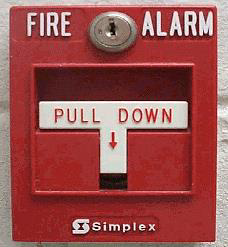
Develop a plan to contact the proper emergency personnel. For example, if there is a medical emergency, the procedure may be to call 10111. If there’s a fire, your workers should know the location of any fire alarms and the circumstances that may require their use. In a manufacturing operation, there may be an internal number to call that alerts emergency and management personnel.
Medical Aid
Situations may arise where medical attention is required while emergency responders are on the way. Have staff members trained in CPR and first-aid procedures, and supply work areas with a fully stocked first-aid kit. Contact agencies such as your local Red Cross chapter to provide the training as well as tips for your workplace.
Power Outage
A power outage can cause an entire operation to shut down or result in injury if dangerous processes are involved. Have backup power sources such as generators available, and keep several flashlights on hand. Have a list of utility companies available and a procedure to account for any visitors to your workplace.
Dangerous Weather Locations
Your business may be located in an area that is susceptible to dangerous weather conditions like tornadoes or hurricanes. If so, have a procedure in place so that everyone knows what to do if one of these situations arises. In the case of tornadoes, for example, designate a safe place in your building such as a basement where everyone should gather until the danger has passed.
Responding to fire or incident emergencies
Sound the alarm and leave the site or building immediately, closing all doors behind you.
If you have been trained as a fire fighter, you must try to extinguish the fire but if it is to big then exit the building or site and join up with the other fire fighters.
If smoke blocks your primary exit, use another one. If you must exit through the smoke, stay low by crawling on your hands and knees. Help the injured and lead others to the exits.

Alert emergency services
Alerting the emergency services or telephoning for the fire brigade during a crisis situation can turn out to be a very complex procedure, unless a pre-plan is made, as to how you go about reporting the necessary facts and information.
By making use of a systematic approach, the information can be reported in a “to the point” manner without wasting any time or causing any further confusion, which enviably is present during emergency situations. As a First Responder you must know your local fire department’s number and have clearly marked on all telephones at work and at home.
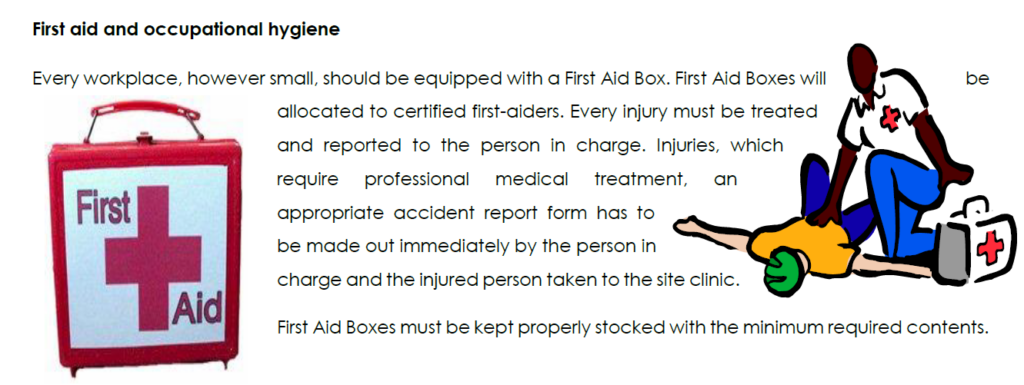
Follow these rules in an emergency:
Stop work and leave the building IMMEDIATELY when the fire alarm sounds or when you are instructed to do so!
Follow instructions, avoid panic, and cooperate with those responding to the emergency.
Proceed to the designated or nearest exit.
Turn off computers, equipment, fans and close desk drawers.
Do NOT delay your exit from the building by looking for belongings or other people.
When leaving the building, go to a clear area well away from the building. Do not obstruct fire hydrants or the responding fire/rescue workers and their equipment.
Do not re-enter the building until instructed to do so by your supervisor or fire/rescue worker.
The above rules will be enforced. Periodic fire emergency drills may be conducted. Your life and the lives of others will depend on your cooperation.
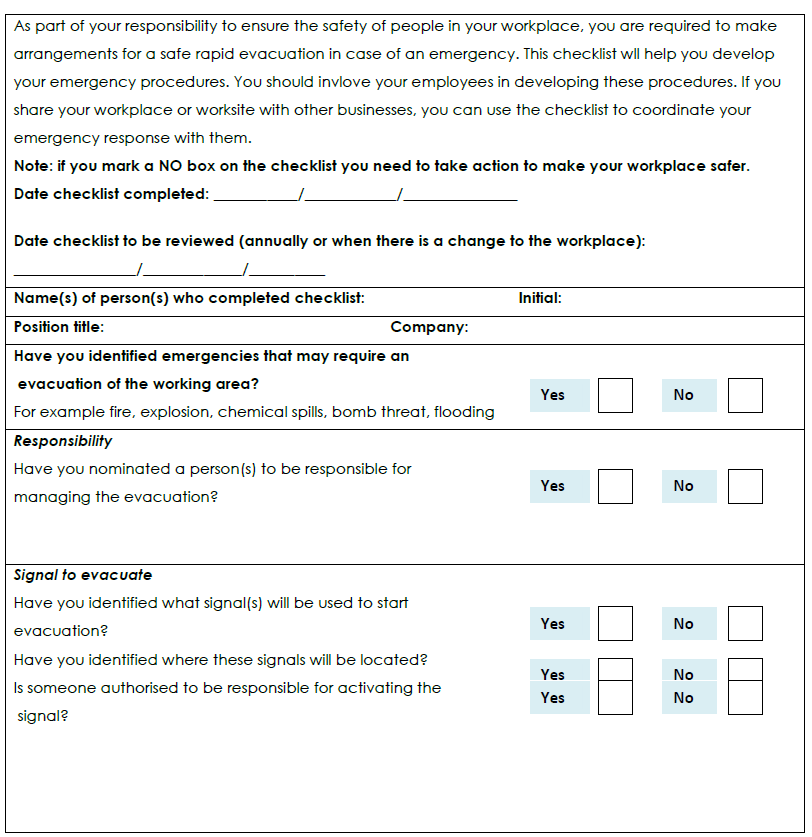
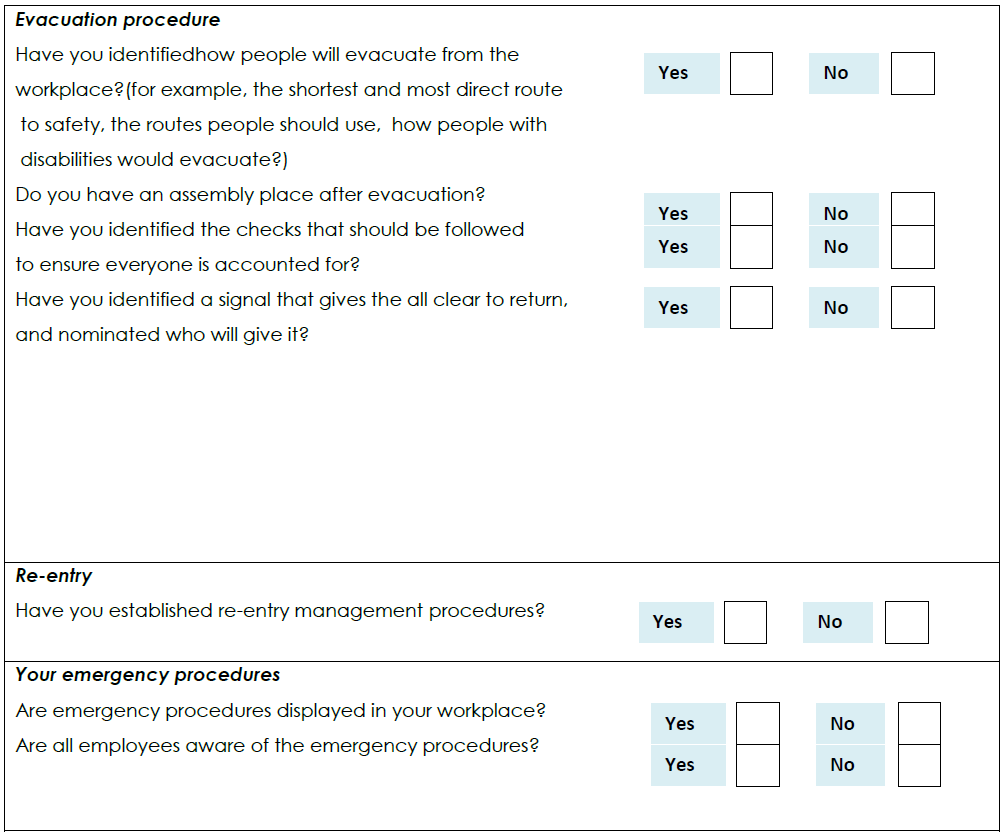
EMERGENCY PROCEDURES
Safety checklist
REPORTING INJURIES INVOLVING INDIVIDUALS
First Aid Personnel
The first aid personnel on duty should be notified of any emergency where there is the risk of casualties or in any life threatening emergency. They should proceed to the scene of the emergency if safe to do so. They should liaise with the ambulance service.
External Emergency Services
The emergency authorities that may be utilized by the workplace include:
Fire and Rescue Service
Ambulance
Police
Local Council

When contacting any of these services, always makes sure you are the last person to hang up so they receive all the necessary information. Each of these authorities will assume control of the emergency once they arrive at the premises. The Chief Warden or Deputy Chief Warden should remain as a liaison to the authority and the emergency personnel.
Help is always useful in an emergency situation. Anytime you need help just call out. Someone can be called over to phone for medical help. Others can bring blankets if needed, get water etc. A bystander can help with any of the following:
Make the area safe
Find all the casualties
Find a first aid kit, or any useful medical supplies
Control the crowd
Call for medical help
Help give first aid, under your direction
Gather and protect the casualty’s belongings
Take notes, gather information, be a witness
Reassure the casualty’s relatives
Lead the ambulance attendants to the scene of the emergency
You must always notify Emergency Services as soon as you can. Either send a bystander or call yourself. Emergency professionals never get involved in an emergency scene without back-up and neither should you.
If you have a First Aid kit, take it out of your vehicle. Put on the rubber gloves that are inside the first aid kit. Calm and reassure the people that have been involved in the accident. Make them aware you have called the emergency services and that help is on the way. This may be the only thing and the most important thing you can do to help someone involved in an accident. The most important principles when helping an accident victim are the following:
Safety: Do not attempt heroics which may potentially jeopardize your own safety. Your safety comes first, before that of the injured. You are of no use to anyone if you become injured while attempting to help others.
If there is any fire/ flames and you have a fire extinguisher, use it and direct the foam/ water at the base of the flames.
Do Not move the patient or attempt to remove them from the vehicle unless there is an immediate threat to life (e.g. the car is on fire and you are unable to extinguish it). There may be an underlying injury to the neck or spine and unnecessary movement could make this worse.
If the person is unconscious, open the mouth and check there is nothing inside causing obstruction.
Check if the person is breathing.
If the patient is breathing leave them in the position you find them and monitor them regularly.
If the patient is NOT breathing and you have been trained to do so, you may begin CPR and rescue breathing as necessary.
If a person is bleeding heavily from a wound, take any available material e.g. a t-shirt/ gauze from the first aid kit/ a towel/ a blanket/ etc, and place it over the open bleeding wound. Then press tightly applying direct pressure to the wound. Maintain that pressure until the emergency services arrive. Do not stop pressing to check if there is continued bleeding or to look at the wound. This procedure may save a person’s life.
Being a first aider at an accident scene is invariably a stressful event. However if you remain calm, keep your head and follow the above principles, you could be instrumental in assisting, reassuring and even saving the lives of the accident victims.
Employees must be trained on emergency situations and what to do during emergencies in order to limit damage to persons or property.
PROCEDURES THAT APPLY TO ILLNESS AND INJURY IN THE WORK AREA
An accident or incident is an occurrence where injury has occurred in the workplace or where an event has taken place that can cause injury or illness. For example, someone has slipped on a staircase or boxes of files have tipped over obstructing a passageway. When accidents or incidents occur, an accident/incident report should be completed, and given to your Occupational Safety and Health Representative or your Supervisor, team Leader or Manager. This should happen as soon after the accident/incident as possible. Providing proper amenities and first aid are essential parts of workplace health and safety. The OSH Act requires employers to provide adequate facilities for the welfare of employees. First aid facilities should be available at all times where there are people at work. If an incident occurs that results in injury, first aid can help reduce the severity of the injury and, in extreme cases, a quick response could mean the difference between life and death. The provision of information on first aid in the workplace should be an integral part of the induction of employees. This should include the location of first aid kits and the names and location of trained first aiders.
No two workplaces are exactly the same, so employers, in consultation with employees, need to assess their workplace to determine the first aid requirements appropriate for their situation. A systematic approach needs to be made, taking into account:
The nature of hazards and the severity of risk
The size, layout and location of the workplace
The number of employees and their work arrangements, including location, shift work, overtime and flexible hours
Access to medical services
Any previous injuries or illnesses
Depending on the information collected, employers will need to provide some or all of the following:
First aid kits – these should be clearly identifiable and well stocked, and the contents, number and location of kits should be determined having regard to the above factors in the workplace
First aid rooms – these must be easily accessible, well lit, ventilated and temperature controlled, contain a sink or wash basin and a supply of hot and cold running water, as well as a means of boiling water, and should not be used for any other purposes
First aid policies and procedures – which have been developed in consultation with staff
Trained first aiders – the number of first aiders and training needs will vary between workplaces. As a general rule, persons designated as first aid officers will need to have undertaken training leading to a Senior First Aid certificate.
PROCEDURES FO REPORTING AND RECORDING
Recording and reporting accidents and ill health at work is a legal requirement. Regulations place a legal duty on: employers, self-employed people and people in control of premises. These “responsible persons” must record and report certain incidents, injuries, diseases and dangerous occurrences
involving employees, self-employed workers and members of the public. The information provided through recording and reporting enables the enforcing authorities to identify where and how risks arise, and to investigate serious accidents. With this information, the enforcing authorities are able to help and provide advice on how to reduce injury, and ill health in the workplace. Such surveillance data can also be used to put forward an evidence-based rationale for the introduction of new legislation and/or guidance.
Accident reporting
An accident is an unplanned event that results in injury, damage to property or some other loss. The law requires that certain work-related accidents are reported to the local authority or the Health and Safety Executive.
All accidents to employees, however minor, should be recorded. This is a requirement under social security legislation. As a result of a workplace injury an employee may need to claim for benefits in the future, and the relevant checks will be made to confirm that the accident occurred at work.
Reporting and recording procedures vary. Employers need to be sure that they satisfy all legal reporting requirements for employees and non-employees, and take measures to monitor accidents. As part of the reactive monitoring process, accident records are needed to assess whether the existing controls are adequate or to identify if trends are developing and to implement new procedures.
Records may also have to be produced for the Health and Safety Executive, to parents/guardians, or in the course of civil proceedings if a claim is brought following an incident.
The organisation should have clear guidelines on incident reporting and this should be conveyed to staff on the first day of their employment.
Accidents legally reportable to the enforcing authority certain accidents that occur on or off site must be reported to the Health and safety Executive or the local authority, whichever is in the circumstances the enforcing authority.
Employers must report the following accidents if they:
prevent the injured person from continuing his or her normal work for more than three consecutive days (excluding the day of the accident); or
Result in death or “major injury”.
Major injuries include:
fractures, except to fingers, thumbs or toes
amputation
dislocation of the shoulder, hip, knee or spine
temporary or permanent loss of sight
penetrating injury/chemical/hot metal burn to the eye
electric shock or electrical burn resulting in unconsciousness or requiring resuscitation or admittance to hospital for more than 24 hours
loss of consciousness caused by asphyxia, or exposure to harmful substances or biological agents
acute illness requiring medical treatment caused by exposure to a biological agent or its toxins or infected material
any other injury resulting in admittance to hospital for more than 24 hours, hypothermia, heat-induced illness, unconsciousness or the need for resuscitation.
Accidents to employees are work-related if they are attributable to:
work organisation
the conditions of the premises
plant or substances (e.g. machinery, equipment, etc)
Acts of physical violence.
Where employees and other people who are not at work are concerned, an accident must be reported if the person involved is killed or taken to hospital and the accident arises in connection with work.
Near Misses
Near misses are incidents that have a potential for harm but result in no injury, e.g. a contractor’s tool falling from a height and narrowly missing an employee. Research shows that an injury accident is often preceded by several near misses, which are not reportable to the HSE. Although not part of the legal duties mentioned above, it is also good practice to record non-reportable “near-miss” incidents, workplace accidents and occurrences where no-one has actually been hurt or become ill, but where the consequences could have been serious for workers. In this way, it is possible to learn from such incidents so that workers are protected from harm, using the old adage “prevention is better than cure”.
What do responsible persons have to do?
Details of all reportable incidents, injuries, diseases and dangerous occurrences must be recorded, including:
The date when the report is made
The method of reporting
The date, time and place of the event
Personal details of those involved
A brief description of the nature of the event or disease.
How to report an accident
All accidents can be reported to the Department of Labour or other relevant organisations. Fatal accidents, major injuries and dangerous occurrences must be reported without delay (e.g. by telephone to ER24 on 084 124 or 10111). This should be followed by a report in writing within 10 days, using form. The advice of the HSE can be sought if there is doubt as to whether the accident is reportable.

A reportable injury to a peripatetic worker must be reported by that person’s employer, wherever the accident causing the injury happens. Examples of peripatetic workers are: goods or postal delivery workers, refuse collectors, sales representatives, community health nurses, building workers who travel from site to site, social workers and service engineers. For example, if a mobile refrigeration engineer is seriously injured while working in a supermarket, the engineer’s employer must make the report, not the operator of the supermarket. The report must be made to the local office of the relevant enforcing authority for the premises where, or in connection with the work at which, the injury occurred. Where a workplace is shared, co-operation between employers (and self-employed persons) is required. Where there is a reportable accident involving a mobile employee working away from their base, the employer in control of the premises should inform that person’s employer about it as soon as possible.
If you are an employee that has been injured at work, seen a dangerous occurrence, or your doctor has certified that you have a work-related reportable disease, you must inform your employer or the person in control of the premises as it is their responsibility to report the incident.
PROCEDURES TO BE FOLLOWED IF AN INJURY MAY LEAD TO A CLAIM AGAINST WORKMAN’S COMPENSATION
Workers must notify their employers of an accident immediately. Employers must submit certain documents to the Compensation Commissioner within 7 days of being notified. Compensation claims for occupational injuries are calculated according to the degree of disablement. Disablement caused by the employer’s negligence may result in increased compensation.
Application
The Compensation for Occupational Injuries and Diseases Act applies to:
All employers; and
Casual and full-time workers who, as a result of a workplace accident or work-related disease:
o Are injured, disabled, or killed; or
o Become ill.
This excludes;
Workers who are totally or partially disabled for less than 3 days;
Domestic workers;
Anyone receiving military training;
Members of;
o The South African National Defence Force, or
o The South African Police Service;
Any worker guilty of willful misconduct, unless they are seriously disabled or killed;
Anyone employed outside the RSA for 12 or more continuous months; and
Workers working mainly outside the RSA and only temporarily employed in the RSA.
Workers who are affected by occupational injuries and diseases are entitled to compensation.
What is an Occupational Injury?
Occupational injuries are injuries sustained by workers in the workplace or while performing any activities related to the business of the employer.
Procedure for Reporting Injuries
Workers
Workers, or someone on their behalf, must report an accident and any injuries, verbally or in writing, to the employer immediately. If a worker does not report an injury to his employer, the Commissioner or mutual association within 12 months of being injured, he will lose any right to benefits.
Employers
All employers must report any accidents that result in medical expenses and/or a worker’s absence from work for longer than 3 days by submitting the required documents to the Compensation Fund within 7 days. Employers who delay in reporting an accident are guilty of a criminal offence, and will have to pay a penalty.
What is an Occupational Disease?
An occupational disease is a disease caused by a worker’s job. Workers who contract a Schedule 3 disease can claim compensation.
Procedure for Reporting Diseases
Workers
A worker, or someone on his behalf, must report a disease, in writing, to the employer as soon as possible after a doctor’s diagnosis. If a worker does not report a disease to his employer, the Commissioner or mutual association within 12 months of being diagnosed, he will lose any right to benefits.
Employers
Employers must fill in the required forms and submit them to the Compensation Commissioner within 14 days.
Compensation Commissioner
Once the Commissioner receives the forms, a claim will be registered and the decision to accept liability or not will be made.

When dealing with clients, there still seems to be a lot of uncertainty relating to the correct reporting and recording procedures of work related injuries. The Compensation for Occupational Injuries and Diseases Act, Act 130 of 1993, is the governing Act that deals with occupational injuries and diseases. The aim of the COIDA is to provide for Compensation in the case of disablement caused by occupational injuries or diseases, sustained or contracted by employees in the course of their employment, or death resulting from such injuries or disease; and to provide for matters connected therewith. The COIDA basically prevents employees covered by the Act from suing their employers for damages in terms of common law.
Anyone who employs one or more workers must register with the Compensation Fund and pay annual assessment fees. Claims for employees employed in the mining and building industries must be referred to the relevant mutual associations. Claims by employees working for individually liable employers (the state, parliament, the provincial authorities and local authorities which have been exempted from making payments to the compensation fund) must be referred to the employer. The following steps should be followed when reporting to and claiming from the Compensation Fund.
of an injury at work is to be given to the employer before the completion of the shift. Good practice on the side of the employer will be to make a list of all witnesses of the accident for the investigation of the incident. The official form that needs to be completed is W.Cl 2 – Notice of Accident and Claim for Compensation. This form should be completed whenever an employee meets with an accident out of or in course of employment that leads to personal injury or where medical treatment is required or in the case of death. It is the employer’s duty to submit the W.Cl 2 within a period of 7 days to the Compensation Commissioner.
Guidelines relating to the completion of the form:
a) Firstly, complete ”Part A”, page 1 of the form by providing the full details, sign and date from where indicated.
b) Secondly, detach ”Part B” (an automatic copy of ”Part A”, page 1) by tearing it at the perforation, hand “Part B” to the employee and request him/her to hand it to the doctor/hospital concerned. In serious cases, “Part B” must be handed to the emergency services personnel who have responded to the emergency. The employee making the claim must submit to a medical examination at a reasonable time and place nominated by the commissioner or mutual association concerned, or by arrangement if the employee cannot go to the office of the nominated medical practitioner.
c) Thirdly, complete ”Part A”, page 2 of the form by providing the full details.
After the completion of the form, send the form with a certified copy of the employees ID and the first medical report (W.Cl 4) (if available) to Compensation Commissioner. The doctor should complete the W.Cl 4 form, stating how serious the injury was and how long the employee is likely to be off work. This is sent to the employer who sends it to the Commissioner.
Please note that employers are obligated to report all alleged accidents to the Compensation Commissioner, even if they don’t believe the employees report. Good practice on the employers side should included the keeping of partially completed W.Cl 2 forms as well as certified copies of all employees’ identity documents. Employees are not responsible for the payment of medical cost. If an employee request a second doctor’s opinion, he/she will be responsible for the payment of medical cost for the second opinion.
Step 2:
After receiving and registering the claim, the Compensation Commissioners office should forward a postcard (W.Cl.55) to the employer. A claim number (reference number) is provided on the postcard (W.Cl.55). This number should be used for all paperwork relating to a claim. When the first doctor’s report has been submitted with the accident report, the Compensation Commissioner will consider the claim and make a decision.
After the Compensation Commissioner has considered the claim a postcard (W.Cl.56) be sent to the employer. The W.Cl.56 will only be used by the Commissioner when liability is accepted for payment of the
claim. Where a W.Cl.56 is not issued, it normally indicates that the Compensation Commissioner has not accepted liability for any payment. If the worker disagrees with the decision, they can appeal the decision within 90 days by submitting form W929 to the Commissioner.
Step 3:
If the injury continues for a long time (prolonged absence), the medical practitioner must send a Progress Medical Report (W.Cl 5) to the Commissioner. The progress report should be submitted on a monthly basis until the condition is fully stabilised. This informs the Commissioner of how long the employee is off work.
Step 4:
Once the medical practitioner handling the case is satisfied that the employee is fit for duty, the practitioner will issue a Final Medical Report (W.Cl 5), which must be sent to the Compensation Commissioner. In this report the doctor states either that the worker is fit to go back to work or that the worker is permanently disabled. The practitioner must send this form to the employer who sends it to the Commissioner. Please note that the Progress Report and Final Medical Report are on the same form (W.Cl 5).
Step 5:
When the employee resumes work, a Resumption Report (W.Cl 6) must be completed and submitted to the Commissioner. Only after every one of these forms has been submitted will the Compensation Commissioner make all of the payments and close the case.
Step 6:
The worker and the employer should keep copies of all the forms.
WRITING AN INCIDENT REPORT
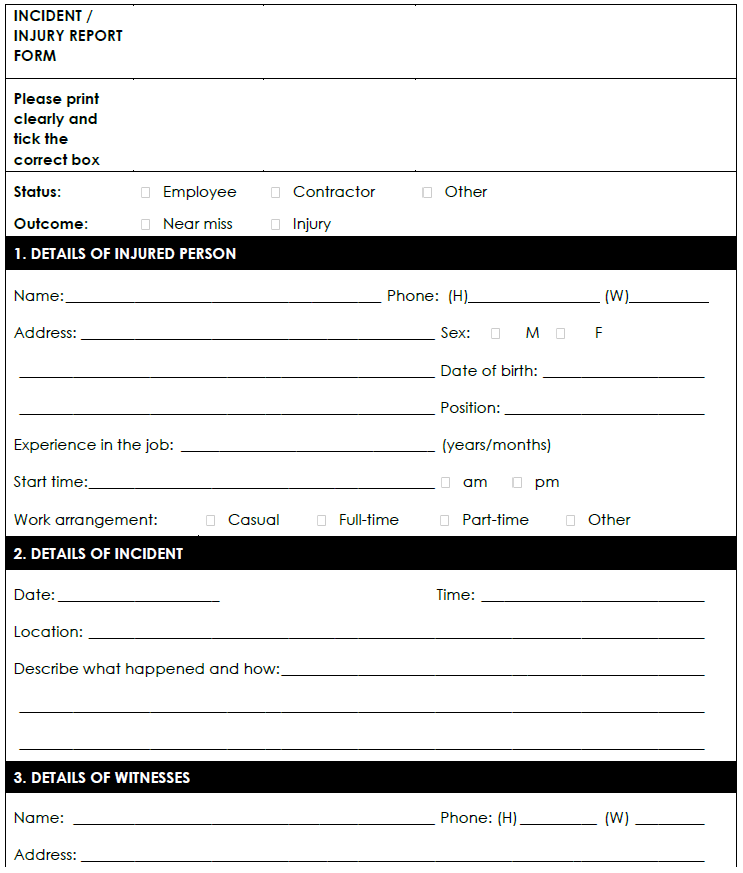
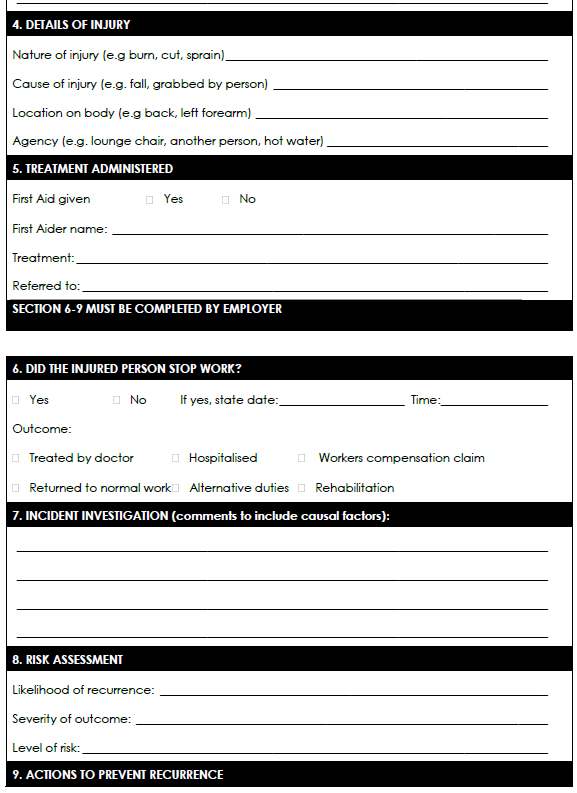
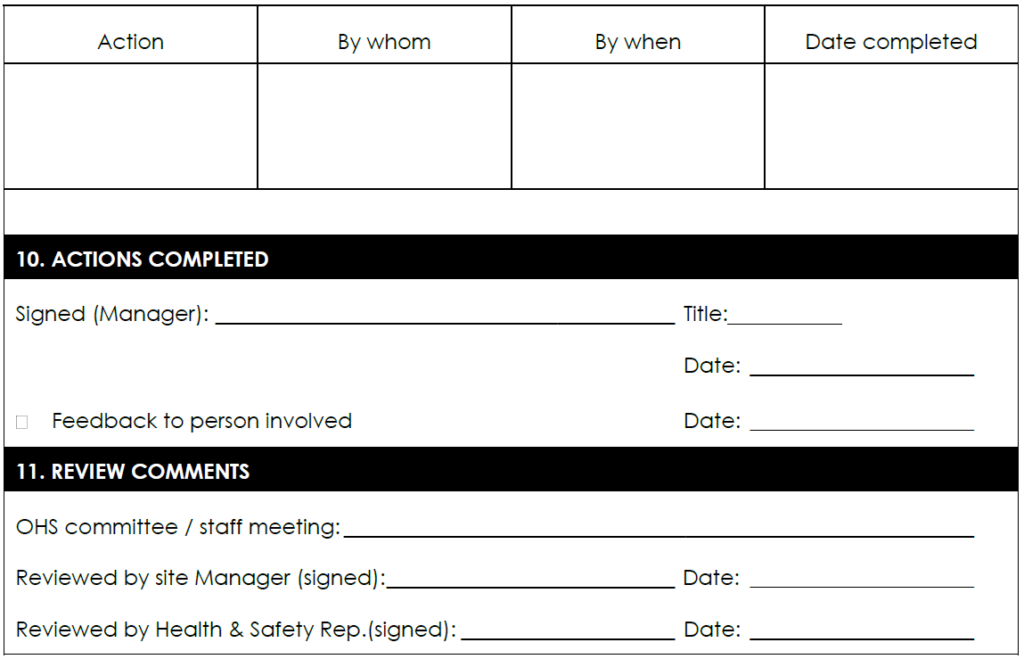
Reports serve as a permanent record of incidents, events, problems, and so forth. An incident report is simply a written statement of the events and how they occurred. It isn’t hard to write an incident report, but there are a few things you should know that will help you to write a good one.
- Contact the proper authorities. Schools, government organizations and workplaces each have their own policies and practices related to reporting an incident. You may be required to fill out a form, follow a specific incident report format or first discuss the incident with designated enforcement officials.
- Provide your contact information. Indicate your name, address, phone number, email address and age. Explain how you may be contacted for more information and the best times to reach you.
- List the names of the person(s) involved in the incident. If unknown, describe the appearance and characteristics of the person(s), such as height, weight, hair color and approximate age. Limit the description to factual observations and avoid adjectives that express your negative feelings about the person. If any witnesses were present, include their information as well.
- Provide details about the event. Indicate what happened by describing the offending action. Include the exact nature of the injury, the description of items stolen or the damages incurred. Physical or verbal abuse, ongoing late-night noises from a neighbor’s home, and road rage from an aggressive driver are a few examples. Explain the facts of the incident in chronological order.
- Describe the location. Include the exact address and room number, if applicable. Explain exactly where in a building, on the road or outdoors the incident occurred. If the incident is related to an online offense, document the website and email addresses.
- Report the date and time of the incident. Be as exact as possible. When unsure about the time, write down your best guess and state that it is an approximation. If you do not remember the time, try to recall your activities before the incident. Maybe just prior to the incident you ate lunch at a specific time with a friend, and can approximate the time accordingly. When unsure, you might indicate a general approximation, such as “late morning” or “early evening.”
- Explain how you handled the incident. If you verbally reported it to a school teacher, security guard or other administrator or official, write down the names and titles of all involved. Explain what the reporting contacts instructed you to do and the steps you took as a result. If you acted on your own to address the situation, write down your exact actions.
- Submit your incident report. Find out the name of the person to whom your report must be sent. When possible, submit an incident report in person and make yourself available to answer further questions and provide clarification. In situations where an incident report must be mailed or emailed, follow up with a phone call within a week to 10 days to ensure that your report was received.
Write the incident report in complete sentences and use simple language. Because you do not know if a third-party may be reviewing your incident report, keep the explanation of the events easy to understand and avoid using expertise language that could confuse the examiner who reads your report. State what happened in chronological order. Begin with what was happening just prior to the incident (if it is relevant), then list details of the event in the sequence they occurred. Notate whether you were the witness of the event or if the details were reported to you. If you did not see the incident or did not arrive until after it occurred, explain in your report who informed you about the incident and what steps you took after you were notified. List all witnesses and parties involved. Since the person that reviews the incident report may have further questions, include contact information for everyone that was involved and remember to notate any fire, ambulance or police units that responded, as well as when they arrived. - You can use the following template to write a brief incident report.