1: MODULE 1 – PART 1: MANAGE MARKETING AND SELLING PROCESSES OF A NEW VENTURE
IMPLEMENTING MARKETING PLAN
INTRODUCTION
It doesn’t matter what size your business is; Marketing Plan Success can help you take your Marketing Plan from paper to profits. Planning good strategies is only the beginning. A brilliant Marketing Strategy is pointless if your company doesn’t know how to implement it properly. Marketing Implementation is what turns marketing plans into marketing actions. Implementation is the day-to-day activities that will effectively put your plan into action. In your marketing plan you focus on the what and why, but in the implementation process you focus on the who, where, when, and how. Proper implementation can give a company the edge in a market with similar market plans. If a company is better and faster at execution, they are sure to have the advantage in terms of market share.
In order to properly implement your marketing plan you must:
- Be sure to always check your progress. Know what’s working and what isn’t. Doing so will help you stay on top of programs that need work and can build from programs that are working
- Be sure and reward employees for jobs well done. When goals are met, deadlines, and so on, make sure to congratulate your people
- Always try new things. Never sit on your hands. The market is always changing, as such, so should you.
- Not jump ship too soon. Give you plan time to work. If it’s not working, don’t give up. Work with your team, let them help you succeed
- Ask for feedback. Ask companies you work with how you are doing. Ask team members if they are pleased with how the “plan” is going and how it may be improved
A successful marketing plan depends upon how well a company can blend its people and get the job done. If everyone is on the same page and know what it is they are striving to accomplish, the possibilities of success, are endless.
DEFINITION OF KEY TERMS

Marketing: is the management process through which goods and services move from concept to the customer. As a practice, it consists in coordination of four elements called 4P’s: (1) identification, selection, and development of a Product, (2) determination of its Price, (3) selection of a distribution channel to reach the customer’s Place, and (4) development and implementation of a Promotional strategy. As a philosophy, marketing is based on thinking about the business in terms of customer needs and their satisfaction. Marketing view the entire business process as consisting of a tightly integrated effort to discover, create, arouse, and satisfy customer needs.
Marketing concepts: is a management philosophy according to which a firm’s goals can be best achieved through identification and satisfaction of the customers’ stated and unstated needs and wants.
Marketing plan: product specific, market specific, or company-wide plan that describes activities involved in achieving specific marketing objectives within a set timeframe. A market plan begins with the identification (through market research) of specific customer needs and how the firm intends to fulfil them while generating an acceptable level of return. It generally includes analysis of the current market situation (opportunities and trends) and detailed action programs, budgets, sales forecasts, strategies, and projected (pro-forma) financial statements.
Business plan: is a written document that describes in detail how a new business is going to achieve its goals. A business plan will lay out a written plan from a marketing, financial and operational viewpoint. Sometimes a business plan is prepared for an established business that is moving in a new direction. A business plan includes a description of a company or small business, its services and/or products and how the business will achieve its goals. The plan includes the overall budget, current and projected financing, a market analysis and its marketing strategy approach. In a business plan, a business owner projects revenues and expenses for a certain period of time and describes operational activity and costs related to the business. The idea behind putting together a business plan is to enable owners to have a more defined picture of potential costs and drawbacks to certain business decisions and to help them modify accordingly before implementing these ideas.
Customer: is a person, company, or other entity which buys goods and services produced by another person, company, or other entity.
INTEGRATING MARKETING CONCEPTS INTO BUSINESS ACTIVITIES
The marketing concept holds that the key to achieving organizational goals consists of being more effective than competitors in integrating marketing activities toward determining and satisfying the needs and wants of target markets. The marketing concept rests on four pillars:
- Target market
- Customer needs
- Integrated marketing
- Profitability
Target market
No company can operate in every market and satisfy every need nor can it always do a good job within one broad market.
Customer needs
Marketing is about meeting needs of target markets profitably. The key to professional marketing is to understand their customers’ real needs and meet them better than any competitor can. Some marketers draw a distinction between responsive marketing and creative marketing. A responsive marketer finds a stated need and fills it. A creative marketer discovers and produces solutions that customer did not ask for but to which they enthusiastically respond.
Integrated Marketing
When all the company’s departments work together to serve the customer’s interests, the result is integrated marketing. Integrated marketing takes on two levels. First, the various marketing functions-sales force, advertising, product management, marketing research, and so on – must work together. Second, it must be well coordinated with other company departments. The company is doing proper marketing only when all employees appreciate their impact on customer satisfaction. To foster teamwork among all departments, the company carries out internal marketing as well as external marketing. External marketing is marketing directed at people outside the company. Internal marketing is the task of successfully hiring, training, and motivating employees who want to serve the customers well. In fact internal marketing must precede external marketing. It makes no sense to promise excellent service before the company’s staff is ready to provide excellent service.
Profitability
The ultimate purpose of the marketing concept is to help organizations achieve their goals. In the case of private firms, the major goal is profit. Marketing managers have to provide value to the customer and profits to the organization. Marketing managers have to evaluate the profitability of all alternative marketing strategies and decisions and choose most profitable decisions for long-term survival and growth of the firm.
BUSINESS ACTIVITIES
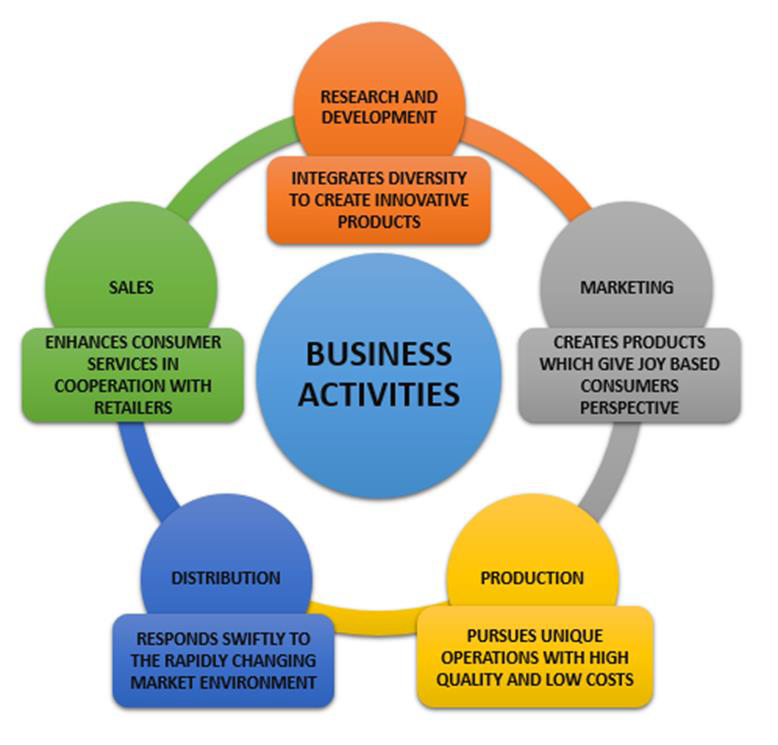
Business activities is any activity that is engaged in for the primary purpose of making a profit. Business activities can include things like operations, marketing, production and administration (as illustrated in diagram below). Business activities are also known as “business operations”. This is a general term that encompasses all the economic activities carried out by a firm during the course of business. Business activities are ongoing and are focused on creating value for shareholders.
RESEARCH AND DEVELOPMENT
Research and Development in any organisation is committed to creating innovative products. Research activities cross-functionally bring together research functions of product development research and fundamental research. Through such matrix management, knowledge of each specialized area is dynamically and flexibly combined leading to the development of products that drives consumer satisfaction.
MARKETING
Consumer Driven is the marketing cornerstone of the many organisations. This is when organisations ascertain the needs of consumers, and create products using innovative technologies in response to those needs. In addition, organisation properly communicate the benefits of products conceived through this process, and offer them in the point of purchase that have been created for convenient selection and purchase. As part of these marketing efforts, companies work together to offer new value as they respond to changing times.
PRODUCTION
In order to deliver products that can be used safely and with peace of mind, companies work with global production bases and are committed to efficient production in pursuit of high quality at reduced costs.
DISTRIBUTION
A lot of companies implement Supply Chain Management (SCM) in the efforts to get products to consumers/customers without delay. This involves maintaining a single workflow from the procurement of raw materials to sales of final products, linking production with distribution, and working to avoid stock-out and reduce inventories.
SALES
To get valuable products, brands, and information to consumers, organisations develop comprehensive means of selling products. To this end organisations maintain information and product distribution networks, provide support with product displays and sales methods, and offer consumer communication know-how through advice given to those involved in sales. Moreover, organisations attempt to uncover issues that affect both consumers and retailers from their perspective, and pursue customer satisfaction through a proactive sales approach that mutually addresses these issues.

Your marketing plan must do more than just say what you want to happen. It must describe each step required to make sure that it happens. The plan should therefore include a schedule of key tasks. This sets out what will be done, and by when. Refer to the schedule as often as possible to avoid losing sight of your objectives under the daily workload.
Resources
Resources
It should also assess what resources you need. For example, you might need to think about what brochures you need, and whether they need to be available for digital distribution (by email or from your website). You might also need to look at how much time it takes to sell to customers and whether you have enough salespeople.
Cost
The cost of everything in the plan needs to be included in a budget. If your finances are limited, your plan will need to take that into account. Don’t spread your marketing activities too thinly – it is better to concentrate your resources to make the most of your budget. You may also want to link your marketing budget to your sales forecast. See our guide on how to forecast and plan your sales.
Control
As well as setting out the schedule, the plan needs to say how it will be controlled. You need an individual who takes responsibility for pushing things along. A good schedule and budget should make it easy to monitor progress. When things fall behind schedule, or costs overrun, you need to be ready to do something about it and to adapt your plan accordingly. From time to time, you need to stand back and ask whether the plan is working. What can you learn from your mistakes? How can you use what you know to make a better plan for the future?
SUITABLE WAYS IN WHICH TO PROMOTE PRODUCT/SERVICE OF A NEW VENTURE
Marketing is more than just an advertising campaign; it should result in revenue for your business. Understanding the different ways to promote your product or service can help you make the right choice for your business. Suitable ways in which to promote product/service of a new venture must be determined and implemented according to the organisation’s marketing plan. Promotion of a product/service includes advertising, launches, informal selling, formal selling and other various activities undertaken to make customers aware of a product/service.

A product is a good or service that most closely meets the requirements of a particular market or segment and yield enough profit to justify its continued existence.
Services are intangible products such as accounting, banking, cleaning, consultancy, education, insurance, expertise, medical treatment, or transportation. Sometimes services are difficult to identify because they are closely associated with a good; such as the combination of a diagnosis with the administration of a medicine. No transfer of possession or ownership takes place when services are sold, and they (1) cannot be stored or transported, (2) are instantly perishable, and (3) come into existence at the time they are bought and consumed.
Promotion refers to the various methods you use in order to convey the message about your product to potential consumers. There are innumerable promotional devices – word of mouth, press releases, paid advertisements, and sponsorship of sports or special events only to name a few – but to determine which devices will be most effective to use, you must first choose the image that you desire your product to convey to the consumers. You can choose and develop this image based upon what would be most attractive and appealing to your target market group.
PRINT AND GRAPHIC ARTS MEDIA
Depending on the type of message you want to communicate to your customers, print media offers different options, including: brochures, business cards, newspaper ads and magazines.
- Brochures, posters and packaging are a cost effective way to provide a variety of messages and detailed information about your products and services.
- Business cards can be used to support your networking activities and give potential customers the information they need to contact you.
- Local newspaper advertising is a way to reach people in your community and repeatedly exposes them to your message in order to create a stronger local presence for your business.
- Magazines have the advantage of targeting a more specific audience of subscribers who are interested in the topics it covers.
ELECTRONIC MEDIA
Electronic media is a general term for any media that requires an electronic device for the content to be accessed. Some of the most common forms of electronic media include television, radio, internet and content for mobile devices.
- Television content captures more audience time than any other media and is targeted at home audiences.
- Radio is cost effective, and the audience is usually loyal to a station’s program format.
- The internet offers you a variety of different ways to market your product or service on a website or by email.
- Cell phones and smartphones allow for marketing tactics that let you reach customers directly on their mobile devices.
- Social media marketing encourages online interaction between your customers and your business using various social networking sites.
BILLBOARDS AND PUBLIC TRANSIT
Other effective mediums of advertising can include such means as billboards or public transportation advertising. Billboards are a form of advertising outdoors, and they are very effective because of the frequent public exposure that they receive. An advantage to advertising with billboards is that, due to their often bright colours and large size, they are somewhat ‘intrusive’ and thus will not go un-noticed in public. They are very costly, though, and thus will not be a feasible advertising means for every business. They also often fall victim to vandals and in some places are or have become banned.
Transportation advertisements, like those seen on taxi cabs, delivery trucks, or on busses, are effective tools for businesses that are centrally based out of specific towns or cities. In this way, people from your target market will get much exposure to your business and product on a daily basis. Like billboards, these signs can fall victim to vandalism, and are not used in every area or market. Both billboards and transit advertisements should be bold and attractive, but also simple so that quickly moving viewers will be able to read and be persuaded by the advertisements.
LAUNCHES
Product launch is the debut of a product into the market. The product launch signifies the point at which consumers first have access to a new product. Product/service launch passes through the stages illustrated in the diagram below.
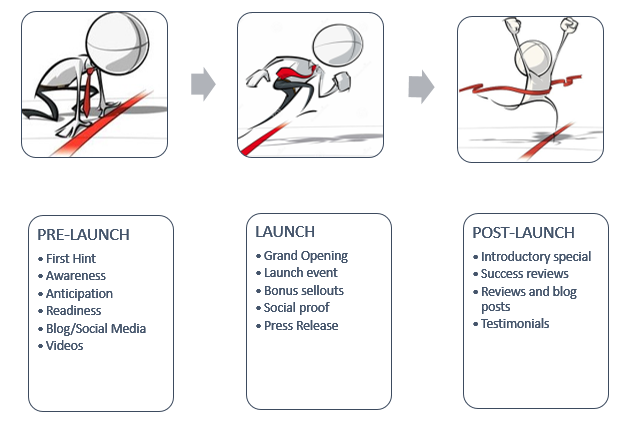
Launches may be divided into Soft Launches or Hard Launches.
- A Soft Launch is the process of bringing a minor revision of a product to market where an investment in generating sales velocity isn’t justified.
- A Hard Launch is the process of bringing a major revision of a product to market where an investment in generating sales velocity is necessary.
Sometimes the term Soft Launch is used to describe when a product isn’t really launched but has escaped from the building, or to justify why minimal effort has gone into planning for a real product launch. With either a Soft or Hard Launch planning is essential. The key difference is in the goals. For a Soft Launch focus on updating marketing collateral, web content, sales tools, and educating the sales channels on buyers, buyer criteria, sales process and competition. Minimal effort is needed for promotion activities.
For a Hard Launch build on the Soft Launch activities but put a more emphasis on activities that will create a better awareness of the product in the market from a buyer perspective. The primary goal is generating sales velocity so there must be activities around training the sales channels to be as efficient as possible.
INFORMAL SELLING
Informal selling is a type of market test in which one or a few salespeople make calls on intended market users and full presentations are made. There is actual request for the order. However, product has not been released to the full sales force.
ADDITIONAL PROMOTIONAL IDEAS
Promotional gifts, like pens, key rings and calendars, can be given to individuals and groups that you know personally to help create a positive opinion of your company and improve its reputation.
Networking and community involvement can also support the promotion of your business. You can make new contacts and reach out to potential customers by participating in trade shows, conferences, community activities and other networking events. Speaking to people about your business can be one of the most effective ways of promoting your product or service.
Planning your marketing strategy will help you determine the best way to promote your product or service, allow you to measure your success against set goals and provide you with a clearer idea of where your strategy may need adjustments.
USING SELLING TECHNIQUES TO PROMOTE PRODUCT/SERVICE
In order to promote your product/service you will use a whole range of types of selling techniques in your business. Selling techniques include; establishing selling networks, the AIDA principle (Attention, Interest, Desire, Acceptance), direct selling, cold calling, principles of negotiation.
AIDA PRINCIPLE
Many marketing models have tried and failed over the years, but “AIDA” is one that works, and works well. AIDA has been used for many years. It is a process in which marketers gain a potential customer’s Attention, generate Interest, Desire and a specified Action. Here is a detailed overview of the process.
ATTENTION
To get your customers’ attention, you need to know what they want. What they want are benefits – they want to know how your product will benefit them or solve one of their problems. Once you know what your biggest benefits are, tell your prospects outright by printing headlines in big, bold font on your brochures or poster printing pieces. Use words that pique people’s attention naturally, like “free” or “discount.” One good method to use is to ask a question, such as “Is your back pain keeping you up at night?” Whatever words you use, just make sure you are specific. Asking “Do you have back pain?” might work, but the first, more detailed version is better because people will have a specific reference to think about. You can also do something a little more hands-on, such as sending a sample of your product in the mail (or offer free samples in your store) to garner attention.
INTEREST
After you get a customer’s attention with your headline, you need to hold that interest. Short sentences that are simple to read keep a reader’s interest best. Also, be sure to use clear language – don’t use too much jargon or “big words” that you think will impress your audience. No one wants to look up a word just to be able to read your marketing materials. Also try to avoid clichés, like “best in the business.” Give honest promises that you can deliver on.
DESIRE
What makes a person desire your product is her picturing herself using your product or service. Give the customer a chance to imagine how her life would be easier or more convenient with your product. Show a professional-looking picture of your product, or show the results of your service. A dry cleaner, for instance, could show a dirty jacket before being dry cleaned and then show a picture of the clean jacket after being dry cleaned.
You can also give the customer ideas of how much money she will save by purchasing from you. Give her concrete terms, like showing items she could buy with the money she saved. Whatever you decide to use to incite desire, make sure you focus on showing benefits, not features.
ACTION
Finally, you need to include a “call to action” – tell the customer what step to take next. If you want the customer to call you, say so! Explicitly write “Call now” and make sure to give your phone number. To encourage the customer to take action even more, include an expiration date on your call to action. Something like “Call before Sunday to receive this special offer.” People tend to procrastinate, so including a sense of urgency will compel them to take action when they otherwise wouldn’t.

AIDA is popular for over a hundred years as a sales training tool, AIDA stands for Attention, Interest, Desire and Action as the names for steps to be taken in sequence in a selling process. The salesperson must (1) first make the prospect aware of the product, (2) foster any interest shown, (3) stimulate the desire to buy and possess the product and, finally, (4) encourage action to purchase.
As per AIDA model, a salesperson can achieve most effective results by following the four sequential steps while interacting with a prospective customer.
- Attract attention: In this step the sales person only attracts the customers attention so that the customer will agree to continue the meeting with sales person and pay attention to what is being said.
- Create interest: In this the step the salesperson provides information about the product that arouses the customer’s interest. This means that customer is interested to know more about the product, but is not really thinking of buying it.
- Kindle Desire: Here the salesperson links the product and its features to the needs and wants of the customer. This results in customer perceiving the product as a means of satisfying his needs and wants, and doing this better than other competing products.
- Take action: Just because the customer is convinced about utility of a product and desires to buy it does not mean that he or she will actually decide to buy it immediately. The salesperson must further lead the prospect to place the order. This is also called the process of closing the sale.
DIRECT SELLING
This is when the business sells its products or services directly to the customer. Through this method you can build a good relationship with your clients, use your selling skills to communicate the benefits of your offering, and access valuable information through communicating with the customer, for example regarding their needs, their opinion of the product, experiences with the competition and so on.
A key decision a business has to make about distribution is whether to sell “direct”. This method of distribution is usually called “direct marketing”. Direct marketing means selling products by dealing directly with consumers rather than through intermediaries.
Traditional methods include mail order, direct-mail selling, cold calling, telephone selling, and door-to-door calling. More recently telemarketing, direct radio selling, magazine and TV advertising, and on-line computer shopping have been developed. The main advantages of selling direct are that there is no need to share profit margins and the producer has complete control over the sales process. Products are not sold alongside those of competitors either.
There may also be specific market factors that encourage direct selling:
There may be a need for an expert sales force, to demonstrate products, provide detailed pre-sale information and after-sales service
Retailers, distributors, dealers and other intermediaries may be unwilling to sell the product.
Existing distribution channels may be owned by, or linked to, competing producers (making it hard to obtain distribution by any other means than direct).
However, there are significant costs associated with selling direct which may be higher than the costs associated with using an intermediary to generate the same level of sales.
There are several potential advantages of using an intermediary:
- More efficient distribution logistics
- Overall costs (even taking into account the intermediaries’ margin or commission) may be lower
- Consumers may expect choice (i.e. the products and brands of many producers) at the point of sale
- Producers may not have sufficient resources or expertise to sell direct
COLD CALLING
Cold calling is soliciting potential customers who were not expecting to speak with you. The term ‘cold’ refers to the fact that you haven’t laid any groundwork for your call. If you are calling prospects who have already expressed interest in your products, such as a prospect who fills out a postcard or website request for information, then it’s referred to as “warm calling.” In other words, cold calling is (1) visiting a prospect (who may not know the visitor) without a prior appointment. (2) Calling a prospect (who does not know the caller) for a sales appointment. Called also cold canvassing. (3) Making unsolicited phone calls to strangers, usually to generate a sale or seek a donation. Such practices are illegal in several countries.
The obituary for cold calling is premature. While in the perfect world, your phone would be ringing off the hook all day with clients interested in your business, the reality is that if you want business, you need to go after it, and cold calling is an effective sales tactic if it’s done properly.
But many small business people would rather spend an entire day in a dentist’s chair than go cold calling. Does the thought of cold calling make your stomach drop to your toes? These cold calling tips won’t eliminate your fear, but they will help you make cold calling a more successful experience.
Focus on the goal when cold calling
Beginners tend to think that cold calling is about making the sale. It’s not. It’s about getting the chance to make the sale. Specifically, the purpose of a cold call is to set an appointment to make the pitch.
Research your markets and prospects
You need to target your cold calling to the right audience. Use market research to focus on your target market. Then find out as much as you possibly can about the company or individual you’re going to cold call in advance.
This gives you the huge advantage of being able to talk about their business and their needs when you call them.
Prepare an opening statement for your cold call
This lets you organize your thoughts before cold calling, and helps you avoid common mistakes in the cold call opening that would give the person you’re calling the chance to terminate the conversation. For instance, you should never ask, “Is this a good time to talk?” or “How are you today?” Don’t read your opening statement into the phone, but use it as a framework to get the cold calling conversation off to a good start.
What should be in the opening statement of your cold call?
This organizational scheme for cold calling works well: “Include a greeting and an introduction, a reference point (something about the prospect), the benefits of your product or service, and a transition to a question or dialogue. For example, ‘Good afternoon, Ms. Marshall. This is Ken Brown with Green Works. I read in the local paper that you recently broke ground for a new office complex. We specialize in commercial landscape services that allow you to reduce in-house maintenance costs and comply with the city’s new environmental regulations. I’d like to ask a few questions to determine whether one of our programs might meet your needs.”
PRINCIPLES OF NEGOTIATION
Negotiation is an art that requires both study and practice. However, there are some basic guidelines that can help you when negotiating. The principles of negotiation are:
- The greatest failure in negotiation is failing to negotiate
- The most important person to know in a negotiation is yourself
- Everyone has power in a negotiation
- Single-issue bargaining leaves both parties unsatisfied
- Urgency drives decisions
- Agreement is the end; trading off is the means
- Even in a collaborative environment, best results are obtained by keeping the other party on a “need to know” basis
- The value of something is always in the eye of the beholder
- Success in negotiation is directly related to the amount and kind of preparation preceding the negotiation
- The ability to walk away or select another alternative to a negotiated agreement puts a negotiator in a very strong position
- Even when two sides are far apart on major issues, there are always things they can agree upon
- Meaningful negotiation involves conflicts. The person who has a strong need to be liked, or who tends to avoid conflict, is likely to be at a disadvantage
SELLING TECHNIQUES MAY ALSO INCLUDE THE FOLLOWING:
Selling wholesale
If you’re not selling directly to the customer, you could be selling to a wholesaler or reseller, who then sells the products on to the consumers. If you’re selling to businesses for example, some might prefer to buy only from a large supplier. This is more complicated than direct selling, since you have to think about the supply relationship, how you set prices, and choosing the right wholesaler.
Telesales or online sales
If your products can be bought over the phone or online, the sale is very time and cost efficient. This is a good way of selling to repeat customers, who you have already built a relationship with and who trust your business. Using the telephone means that you can still have contact with the customer to help the relationship develop.
Network Marketing
Network marketing Direct selling method in which independent-agents serve as distributors of goods and services, and are encouraged to build and manage their own sales force by recruiting and training other independent agents. In this method, commission is earned on the agent’s own sales revenue, as well as on the sales revenue of the sales-force recruited by the agent and his or her recruits (called down-line). Also called multi-level marketing (MLM), cellular marketing, or by other such names, it is a multi-billion-dollar worldwide industry that distributes practically any portable item, although restricted or banned in several countries due to its history as a vehicle for consumer fraud.
IMPLEMENTING CUSTOMER RELATIONS PRACTICES
Customer relations, or customer service, is the front line between an organization and its customers. How customers are initially greeted and treated can influence their decisions to do business with your company. Effective customer relations strategies include listening skills, oral and written communication, analytical and problem solving skills and teamwork based on the organization’s commitment to meet customer needs while making customers feel welcome and valued.
Initial Contact
First impressions may not always be accurate, but they do create a lasting influence on customers. Friendly greetings and a sincere interest in customer needs creates a basis for solving problems and meeting customers’ needs.
Positive Impressions
Customers expect to have their concerns addressed quickly and efficiently. Customer relations staff must be knowledgeable and courteous. Bad experiences stay with customers; front line employees can make or break customer relationships.
Listening Skills
Listening skills help customer relations staff determine how to approach each customers’ needs and meet their expectations. Using listening skills to identify problems and determine how to help and calm irate customers can establish customer confidence.
Effective Communication
Customer relations depends on effective communication. Problems can escalate when communication fails. Communicating clearly verbally and in writing can prevent misunderstandings and misinterpretations of information by customers and co-workers.
Problem Solving
Problem solving and analytical skills support customer relations; the ability to listen, interpret and act appropriately when addressing customer needs is essential to successful customer relations. Knowing when to escalate customer concerns to the next level of customer support staff is an important aspect of problem solving.
Teamwork
Working together to meet customer needs establishes excellent customer service and provides learning opportunities for customer relations staff. A customer relations department counts on support from all employees and departments when necessary.
Follow-Up
Follow-up can help re-establish customer confidence after resolving major problems. Calling customers to ensure their satisfaction lets customers know that they’re valued.
Customer relations practices also includes after-sale service and customer surveys to determine levels of customer satisfaction.
CUSTOMER SATISFACTION SURVEY
Customer satisfaction surveys are important tools to measure a clients’ satisfaction with your business.
The best way to discover whether or not your customers are pleased with the service they received is to ask them! 95% of complaining customers will do business with you again if you resolve the complaint instantly. Customer satisfaction surveys are fast and easy ways to gather information about all aspects of the purchasing process and to discover how and where your business can improve. An average organization loses about 15% of its customers every year. But if this can be reduced to 10% with customer satisfaction surveys, bottom line profits improve 35% to 85%.
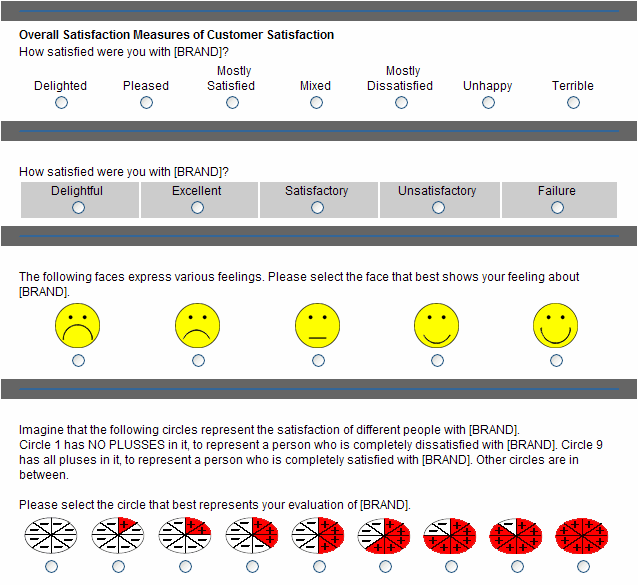
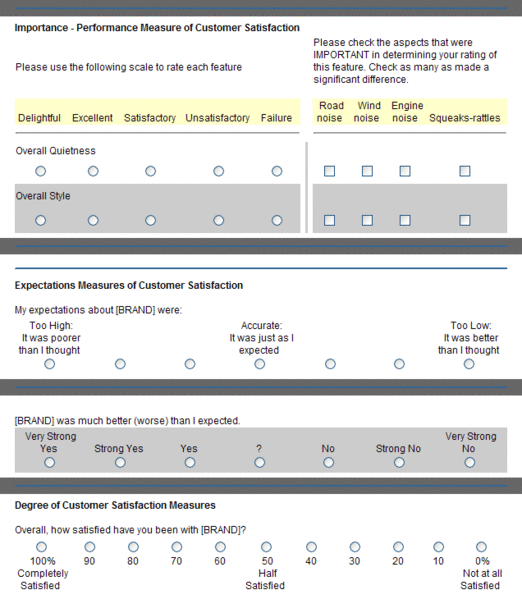
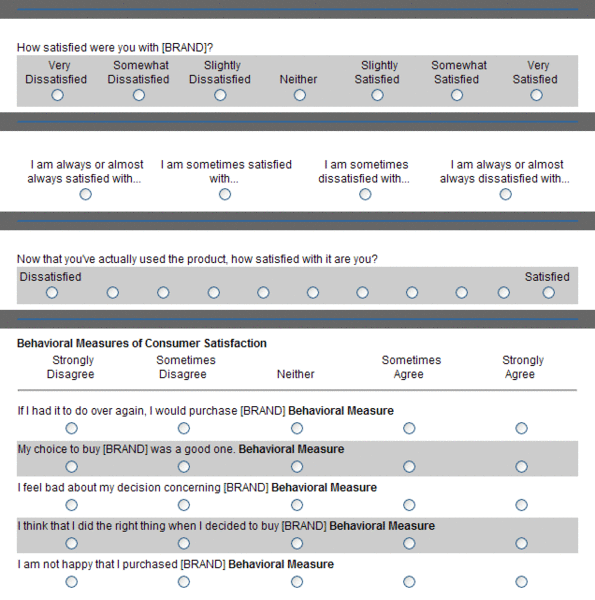
Quick and inexpensive, Customer satisfaction surveys can help your business or organization close the gap between a customers’ initial expectations and their actual experience. Satisfied customers are more likely to spread free advertising for your business through word-of-mouth, return and buy more, and remain loyal customers. 96% of dissatisfied customers will not return to your business. An example of a customer satisfaction survey is shown in the diagram below.
Customer satisfaction is the degree of satisfaction provided by the goods or services of a company as measured by the number of repeat customers. Customer satisfaction usually leads to customer loyalty and product repurchase. But measuring satisfaction is not the same as measuring loyalty. Satisfaction measurement questions typically include items like:
- Overall, how satisfied are you with (brand name)?
- Would you recommend (brand name)?
- Do you intend to repurchase (brand name)?
When building customer satisfaction surveys, these measures may be implemented through a variety of measures, including:
- Overall measures of customer satisfaction
- Affective measures of customer satisfaction
- Cognitive measures of customer satisfaction
- Behavioural measures of customer satisfaction
- Expectancy value measures of customer satisfaction
EXAMPLE CUSTOMER SATISFACTION SURVEY (QUESTIONS)
After sales service is the ongoing relationship between the company and customer where services are rendered to the customer throughout the product life cycle to the end of life. This type of support typically includes warranty, upgrade and repair services.
Many sales people do not see the importance of an after sales service. The majority of people will feel that when the sale has been closed and commissions spent then further time invested in the client is a waste. At the end of the day the sales person is not being paid to “hold a customers’ hand.” However, effective sales follow ups will bring you more sales, say experts and business coaches. Whilst you follow up you are also seen to be providing a value greater than the customer has paid and you are more likely to guarantee yourself repeat business and referrals.
The three simple steps you should follow are:
▪
Continue selling
▪
Try and make yourself available as much as possible
▪
Be a central liaison if the customer has a problem with account management
Continue to Sell
After you have formed your relationship and sold your product/service, should you drop your enthusiasm in your clients’ eyes, you are in danger of promoting “buyers’ remorse” detrimental to your customers and services. Keep in touch with your client and the trust will grow and the customer starts to “open up” and inform you of other business needs.
Be available
Tell your client that you will be “available” at any time for them. Instigating the occasional telephone call or email shows your customer that you are “there.” It is critical NOT to try and sell on these occasions.
Customer liaison
This is the most effective way to maintain the customer’s account management experience. If you follow up with the client, you also become an information point and liaison for their other services and needs.