
Project Planning
DEVELOP A PROJECT PLAN
The word project 27comes from the Latin word projectum, “to throw something forwards”, which is made up of the prefix pro-, which denotes something that precedes the action of the next part of the word in time and jacere, “to throw”. Thus the original meaning of “project” is something that has, in a figurative sense, been thrown forward, i.e. a proposal. The meaning has gradually been extended to include the process of realising or actualising the proposal, as well as the people who perform the realisation.
We can therefore see that the concept of people working together or “organisation” forms an integral part of the definition of a project. The kind of tasks solved by the organisation of people working together distinguishes a project from other organisational units.
APM28 define a project as follows:
“…a unique set of co-ordinated activities, with definite starting and finishing points, undertaken by an individual or organisation to meet specific objectives within defined time, cost and performance parameters….human, material and financial resources are organised in a novel way to deliver a unique scope of work of given specification, often within constraints of cost and time, and to achieve beneficial change defined by quantitative and qualitative objectives.”
In this Module we are going to investigate how to identify a unique and complex task that requires us to develop a project plan.
Select a work-based project for a unit – implementing the operational plan
Based on the definitions of a project in the introduction, we can see that we need to consider the following when selecting a project:
Is there a problem that is affecting you/your workplace/your team, or is there an opportunity to make an improvement?
Is it one that you are motivated to complete?
Is it critical or of strategic importance?
Consider feasibility. What are the time constraints, risk issues and politics involved?
Finding a problem to solve should not be too difficult as there is not a single workplace that is not plagued by problems- both big and small. The challenge lies in finding the “right” problem to solve:
How do you know it is a problem (what are the data or indicators)?
Define the problem in terms of causes not solutions. What are the causal factors?
Deal with the problem and not the symptoms.
Consider Project Alternatives
Projects are started because a problem creates a need. In order to solve the problem or fulfil the need, you need to formulate a measurable goal. Once a goal is set, you can develop a strategy to meet it. A project is the strategy to meet this goal.
Therefore, we can say that a project is a temporary endeavour undertaken to achieve a particular aim.
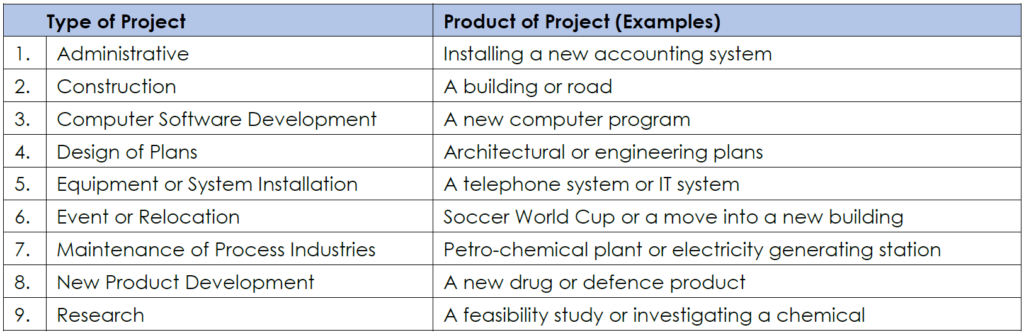
Projects can range from a relatively simple relocation to another section of the building to a complete overhaul of processes and procedures:
When considering project alternatives, you and your team need to firstly decide which of the work unit’s problems is both urgent and important and requires an innovative solution.
Variables that you will have to take into account are:
Size of the intended project
Duration (Length of project time)
Number of workers that will be involved
Cost (do you have the budget, or will you be able to motivate the expenditure?)
Complexity of the implementation
The collective activities associated with building the project deliverables are referred to as the project life cycle.
The project life cycle can be defined as “the complete set of time periods through which a project passes sequentially in a logical and orderly manner”.
While there are many different versions of the project life cycle, all essentially contain the steps of:
Germination of the idea
Proposal and initiation
Design and appraisal
Mobilisation of the team
Execution and control
Integration of the team and their work
Testing
Handover of the project’s product
Closeout of the work.
In its simplest form the life cycle consists of four major periods or phases:
Concept (the project concept as a need solution is selected and defined)
Development/ Definition (the concept is verified and developed into a workable plan for implementation)
Implementation (the implementation plan is carried out)
Closeout (the project process is completed and documented, and the finished product is transferred to the care, custody and control of the owner).
This model provides a basic outline that can be used on any project. You start off understanding the requirement of the solution, designing a solution, building and testing a solution and then implementing the solution. Each of these major areas of focus is called a phase.
The figure below30 shows a typical project life cycle separated into its generally accepted four fundamental phases. The figure also lists the activities to be expected in each phase.
The phase separations correspond to key decision points for purposes of executive level control.
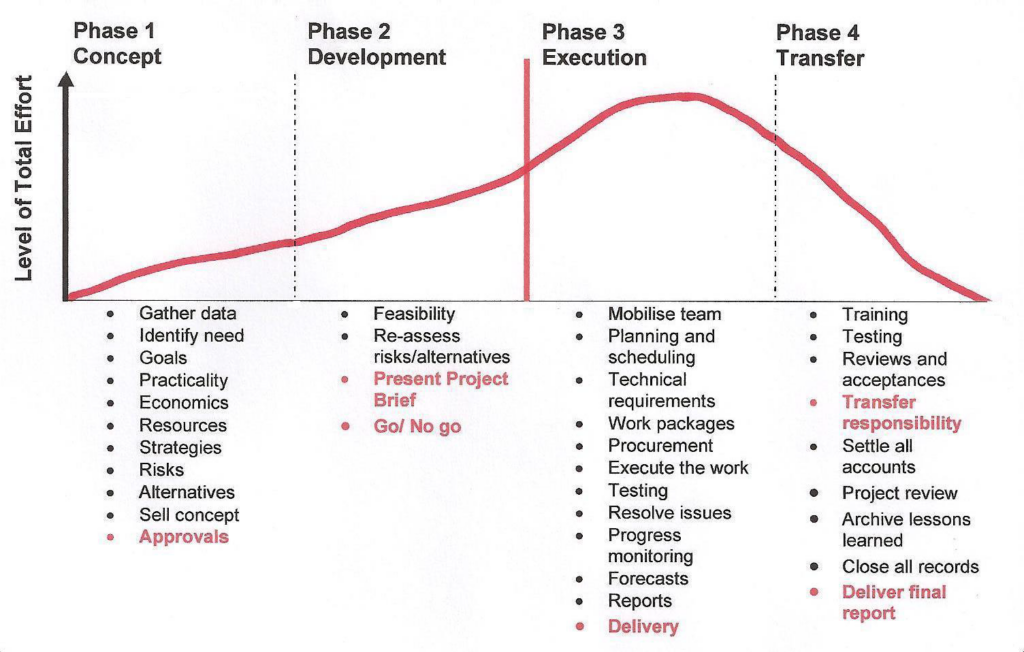
Not all projects, of course, conform rigorously to the stages shown and the activities within each may vary somewhat. However, less than satisfactory project performance and lack of control can frequently be traced to significant departures from the division of activities as shown.
The simple model described above can be applied to all projects. Even if you have a small project, you still have to go through these basic steps, although some of them may only be a mental exercise.
When you receive some type of service request, it describes the work required (analysis and requirements), which you take and mentally map into the work to be performed (design). You then make the changes required, test them (test) and implement them (construct, test, implement).
This approach is the life cycle model you would probably end up with even if you knew nothing about methodology and just had to build a project work plan from scratch.
The important point is that a common, scalable project management process can be used effectively on all your projects. The detailed work to build your deliverables is referred to as the “project life cycle”.
Based on our model above, you can see that you and your team now need to do a proper needs analysis, gathering data to determine what the root causes are that will need to be addressed.
Steps in the problem-solving process include:
- Identify the problem
- Clearly define the problem
- Define the options
- Identify possible solutions
- Implement and evaluate the results.
- Identify the Problem
The first step in the problem-solving process is to identify or acknowledge that there is a problem. This may be a problem such as missing stock, poor turnaround times in service delivery, continuous errors, not getting things right the first time, bad behaviour, problems with technology etc. Once the problem has been identified, the next step is to clearly define the problem. - Clearly Define the Problem
In order to clearly define a problem you need to gather information and evidence. Ask questions to determine the true source of the problem. For example, if a customer phones in to say that his calls are not being returned by a staff member, the immediate response is to attribute the problem to the staff member. However, upon investigation, you may establish that the call answer facility on the PABX is faulty and does not save messages.
You can use one or a combination of the many problem-solving techniques available, e.g.:
Root cause analysis
Ishikawa or fishbone diagram.
Root cause analysis
A technique that can be used to identify the root cause of a problem is to use the 5 Why’s. When you use this technique you look at a situation, or at a person’s behaviour and you ask why a situation or behaviour has occurred. You continue to ask the question why, until you get to the root cause of the problem.
The following example 31demonstrates the basic process:
My car will not start. (the problem)
- Why? – The battery is dead. (first why)
- Why? – The alternator is not functioning. (second why)
- Why? – The alternator belt has broken. (third why)
- Why? – The alternator belt was well beyond its useful service life and has never been replaced. (fourth why)
- Why? – I have not been maintaining my car according to the recommended service schedule. (fifth why, a root cause)
- Why? – Replacement parts are not available because of the extreme age of my vehicle.(sixth why, optional footnote)
I will start maintaining my car according to the recommended service schedule. (solution)
Ishikawa or fishbone diagram
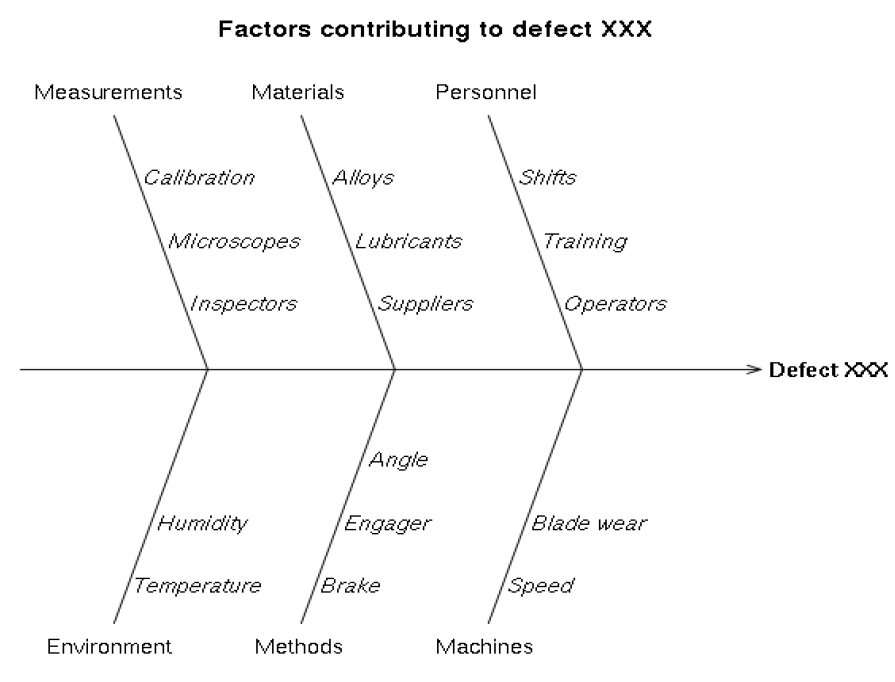
Ishikawa diagrams (also called fishbone diagrams or cause-and-effect diagrams) are diagrams that show the causes of a certain event. Common uses of the Ishikawa diagram are product design and quality defect prevention, to identify potential factors causing an overall effect. Each cause or reason for imperfection is a source of variation. Causes are usually grouped into major categories to identify these sources of variation. The categories typically include:
People: Anyone involved with the process
Methods: How the process is performed and the specific requirements for doing it, such as policies, procedures, rules, regulations and laws
Machines: Any equipment, computers, tools etc. required to accomplish the job
Materials: Raw materials, parts, pens, paper, etc. used to produce the final product
Measurements: Data generated from the process that are used to evaluate its quality
Environment: The conditions, such as location, time, temperature, and culture in which the process
- Define the Options
Once you’ve determined the root causes of the problem, you need to come up with solutions to each cause, to determine which solutions will be do-able and sustainable.
Brainstorming
Brainstorming32 can be an effective way to generate lots of ideas on a specific issue and then determine which idea is the best solution. Brainstorming is most effective with groups of 8-12 people from various departments across the organisation, who have different backgrounds and expertise. Even in specialist areas, outsiders can bring fresh ideas that can inspire the experts.
Define your problem or issue as a creative challenge. A well designed creative challenge generates the best ideas to solve your problem. Creative challenges typically start with: “In what ways might we…?” or “How could we…?” Your creative challenge should be concise, to the point and exclude any information other than the challenge itself. For example: “In what ways might we improve product X?”
Once your brainstorming session is concluded, select the five ideas which you like best. Make sure everyone involved in the brainstorming session is in agreement.
Write down about five criteria for judging which ideas best solve your problem. Criteria should start with the word “should”, for example, “it should be cost effective”, “it should be legal”, “it should be possible to finish before July 15”, etc.
Give each idea a score of 0 to 5 points depending on how well it meets each criterion. Once all of the ideas have been scored for each criterion, add up the scores.
The idea with the highest score will best solve your problem. But you should keep a record of all of your best ideas and their scores in case your first-choice best idea turns out not to be workable.
Once you have narrowed all the possible solutions down into one preferred solution, you need to determine how to achieve that solution. Which activities will lead to the achievement of your objective in the most cost-effective and efficient manner?
Several important considerations should be made when developing the range of alternative actions:
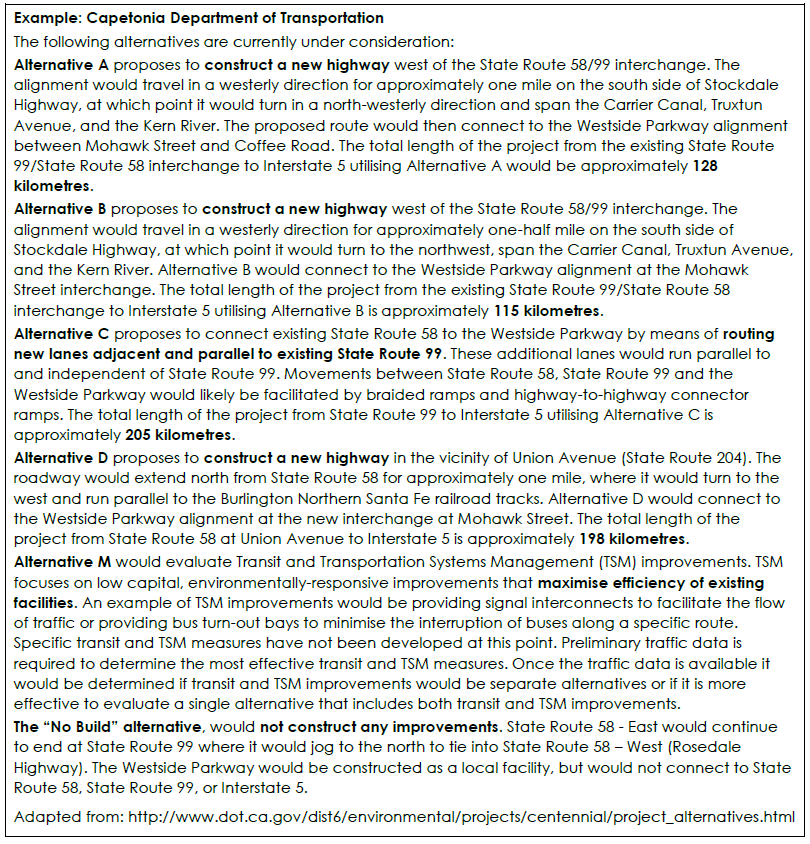
Number of alternatives: A limited number of alternatives (e.g., 10) should be analysed and presented to the decision-maker. These alternatives should span as wide a range of management scenarios as possible. (If decision-makers are interested in an alternative that is intermediate between two or more of those presented, they can request it as they narrow their preference of alternatives.)
Uncertainty and alternatives: An alternative should not be rejected from consideration because its effects on some objectives are uncertain, as shall be discussed later.
Standard alternatives: In addition to a creative range of alternatives, several standard alternatives can be presented and analysed. These alternatives help “bound” the extremes of management alternatives. Examples include:
o a “no action” alternative, in which no active management occurs;
o a “continue previous action” alternative, in which the previous management plan (formal or informal) is continued;
o alternatives which maximise single objectives of concerned, single-issue stakeholders.
Naming alternatives: Value-neutral names (e.g., Alternative A, Alternative B) should be used. This will help decision-makers and stakeholders focus on the consequences of the alternatives.
Motivate the Decision on the Preferred Alternative
Determine how well each alternative meets each objective
A matrix showing the relation of each alternative to each objective with the summary values listed where the question marks are shown is a useful tool for evaluating the alternatives and making a decision as to the most suitable alternative.
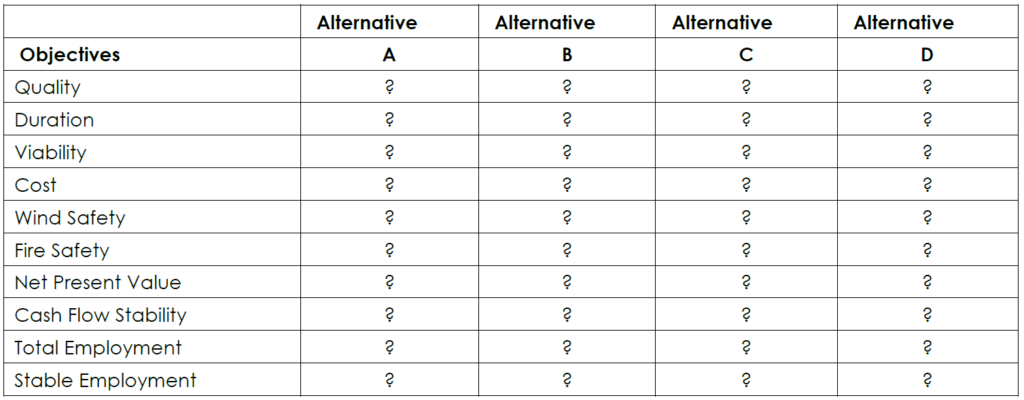
The interpretation of how well each alternative meets each objective is judged by specialists – people who are learned in various subsystems and have a clear conception of how the subsystems will react when treated with various, alternative inputs.
Specialists use tools, such as computer models and decision keys, and their expert opinion (“mental models”) in providing their assessment of the relation of each action to meeting a given objective. The necessary qualifications of the experts depend on the significance of the decision being made. For a relatively non-contentious decision, a unit manager may serve as the expert on all objectives- from economics to processes.
For more potentially contentious decisions, experts from a range of disciplines may be required. Since all analysis tools are imperfect, the expert is responsible for interpretation of the results and, thus, should know the relative strengths and weaknesses of different analysis tools and is responsible for appropriately addressing uncertainty in the consequences of each alternative.
The best analysis occurs if the experts maintain their objectivity regarding the eventual choice of alternatives: the driving force should be which alternative is best for achieving the unit’s goals and not “which is my preferred alternative?”
Note: The following steps in the problem solving process are covered later in this manual:
Identify possible solutions
Implement and evaluate the results.
SCOPE A WORK-BASED PROJECT FOR A UNIT
Projects deliver outputs/ deliverables/ products. These outputs blend together over time to deliver outcomes. For a project to be effectively planned and controlled, i.e. managed, it needs to be broken down (decomposed) into a detailed and measurable plan of the management and control processes involved in the completion of the project.
Running a project without a plan is foolish. It is like trying to find your way in a strange city without a map. Working without knowing where you are going and how you are going to get there is likely to lead to problems and possible failure: “If you fail to plan, you are planning to fail.”
Methods and Techniques for the Planning of Projects
Clear and accurate definition of a project is one of the most important actions you can take to ensure the project’s success. The clearer the target, the more likely you are to hit it. Defining a project is a process of selection and reduction of the ideas and perspectives of those involved into a set of clearly defined objectives, key success criteria and evaluated risks.
This definition process should culminate in the production of a Project Definition document, sometimes called The Project Definition document should be approved and issued by a manager with the authority to apply organisational resources to the project activities. Therefore, the seniority of the manager or the management team will be commensurate with the size, cost and business value of the project.
As a minimum, the Project Definition should include a statement of the business need that the project seeks to address and the description of the product, service or deliverable business objectives that will be its output.
The way to define a project is to ask a standard set of questions of yourself (as project leader) the project team, colleagues with particular expertise and senior managers. The questions fall into the categories given below:
The Purpose (or Mission)
This is the reason for doing the project
What is the project about in broad terms?
Who wants it done and why?
What is its title?
The Goals
These are the targets we want to meet
What is it we want to achieve?
When do we want to achieve it?
What are our specific aims?
Why are these goals essential to the project?
Goals are high-level statements that provide the overall context for what the project is trying to accomplish. For example one of the goals of a project might be to “increase the overall satisfaction levels for clients calling the company helpdesk with support needs”.
A goal may take more than one project to achieve. In the above example, for instance, there may be a technology component to increasing client satisfaction. There may also be new procedures, new training classes, reorganisation of the helpdesk department and modification of the company rewards system. It may take many projects over a long period of time to achieve the goal.
The goal should reference the business benefit in terms of cost, speed and / or quality. In this example, the focus is on quality of service.
Even if the project is not directly in support of the business, there should be an indirect tie. For instance, an IT infrastructure project to install new web servers may ultimately allow faster client response, better performance or some other business benefit. If there is no business value to the project, the project should not be started.
The Beneficial Gains or Scope
This is how our business unit will gain. Here we define our performance criteria and set our quality standards for the project.
How will things be different if the project is successfully completed?
Is there a clear need and can it be quantified?
Who will benefit, how will they benefit and what will they gain?
Do the beneficiaries agree about the need and the proposed solution?
Is the project to identify that need and/or that solution?
How will they react to that solution?
What are the alternatives?
Are those alternatives more or less acceptable (satisfactory)?
Is how we are going to achieve the goals an important part of the beneficial gain?
What is it worth to you or to others to have the need satisfied?
Objectives
Objectives are concrete statements that describe the things the project is trying to achieve. An objective should be written at a lower level, so that it can be evaluated at the conclusion of a project to see whether it was achieved.
Goal statements are generally rather vague. A well-worded objective will be Specific, Measurable, Attainable/Achievable, Realistic and Time-bound (SMART).
(Remember, SMART is a technique for wording the objective. An objective does not absolutely have to be SMART to be valid.)
An example of an objective statement might be to “upgrade the helpdesk telephone system by December 31 to achieve average client wait times of no more than two minutes”.
The objective is measurable in terms of the average client wait times the new phone system is trying to achieve.
You can assume that the objective is achievable and realistic.
The objective is time-bound, and should be completed by December 31.
Objectives should refer to the deliverables of the project. In this case, the objective refers to the upgrade of the telephone system.
If you cannot determine the deliverables that are created to achieve the objective, the objective may be written at too high a level.
On the other hand, if an objective describes the characteristics of the deliverables, it is written at too low a level. If the statements describe the features and functions, they are requirements, not objectives.
If the project is a part of a larger program, the objectives of all the underlying projects should be in alignment with the program objectives.
The project objectives and the business goals they support should be defined and agreed upon before the project starts. The deliverables of the project are created based on the objectives – not the other way around. That is, you don’t agree on the deliverables first and then establish objectives to match. You must understand the objectives of a project and then determine what deliverables are needed to achieve them.
From our list of specific goals for the project we must develop a set of measurable objectives that will confirm that we have reached certain project milestones (or way points) including the final one of project completion.
The measurable objectives (when achieved) demonstrate the extent to which the beneficial gains have been achieved, the goals have been met and the purpose of the project has been achieved.
Key Success Criteria (KSC)
These are the objectives that, if all else fails, we must meet and/or those that we must meet for the project to be deemed successful even if other objectives are met and achieved.
From the list of objectives, select those that are critical or key to the success of the project. These are the items that are critical to those who will benefit from the project and those with the responsibilities for judging success criteria (Managers, Customers, Members, Shareholders, Stakeholders, etc.).
The purpose of this is twofold. Firstly, to clarify in the minds of the project team and managers what the essential benefits that the project will deliver are.
Secondly, if circumstances change within the life of the project, then it is often extremely useful to see what the agreed success criteria were at the start of the project.
The project may then be replanned to ensure the KSC are met, or the KSC may be formally changed (by Senior Managers in the light of changed circumstances) and the project redefined and replanned to ensure they are met.
Define the Scope of Work and Deliverables
Defining scope is perhaps the most important part of the upfront definition and planning process. If you don’t know for sure what you are delivering and what the boundaries of the project are, you have no chance for success. If you have not done a good job of defining scope, managing scope will be almost impossible.
The purpose of defining scope is to clearly describe and gain agreement on the logical boundaries of your project.
Scope statements are used to define what is within the boundaries of the project and what is outside those boundaries. The more aspects of scope you can identify, the better off your project will be.
In the project context, the term scope refers to:
Product scope: The features and functions that characterise a product, service, or result
Project scope: The work that needs to be accomplished to deliver a product, service, or result with the specified features and functions.
Scope is used to define what the project will deliver and what it will not deliver. For larger projects, it can include the affected organisations, the transactions impacted, the data types included, etc.
Project Scope Management34 includes the processes required to ensure that the project includes all the work required, and only the work required, to complete the project successfully. Project scope management is primarily concerned with defining and controlling what is and is not included in the project.
Defining and managing the project scope influences the project’s overall success. Each project requires a careful balance of tools, data sources, methodologies, processes and procedures, and other factors to ensure that the effort expended on scoping activities corresponds with the project’s size, complexity, and importance. For example, a critical project would require formal, thorough, and time-intensive scoping activities, while a routine project could require much less documentation and examination.
The project management team documents these scope management decisions in the project scope management plan.
The project scope management plan is a planning tool describing how the team will:
Define the project scope
Develop the detailed project scope statement
Define and develop the work breakdown structure (WBS)
Verify the project scope, and
Control the project scope.
The project scope management plan provides guidance on how project scope will be defined, documented, verified, managed and controlled by the project management team.
Project Management Procedures are defined and approved. Procedures must be in place to describe how the project manager will manage issues, communication, risks, quality, scope, etc. This is especially true for large projects and less important as a project gets smaller.
Project team resources are assigned. You must have the right people to staff and execute the project. Sometimes valid, approved projects must be delayed because people with the right skills are not available.
The project scope statement describes, in detail, the project’s deliverables and the work required to create those deliverables. The project scope statement also provides a common understanding of the project scope among all project stakeholders and describes the project’s major objectives.
Deliverables
The fundamental objective of a project is to deliver something new.
It is not always easy to distinguish between aims (goals), objectives and deliverables. If the project is to create new products or modify existing ones, then the list of deliverable items may be as simple as a set of part or product numbers. It may be 3 sets: new parts or products, obsolete parts or products and products or parts not affected by the project. These deliverables are easily distinguishable from the goal; which may be to increase market share by 7%, and the objectives; to have the product shipping by the 3rd quarter of the year, at a works cost price of R300, with shipments reaching or exceeding 5000 per month by end of the year.
However, the deliverable items may be less easy to distinguish in some projects. A project to deliver the implementation of a new integrated housing management computer system will deliver parameter set-up, data transfer, staff training, etc. But these look very little different from the objectives; parameter set-up by 30th March, data conversion by 15th June, and staff training by the end of July.
In the first example, a new product will have a specification (or a set of specifications) which defines its essential elements, its functions, its quality standards, its marketing requirements, etc. These will form part of the project’s deliverables, or they may have been deliverables of a previous research project. Thus the deliverables may be reduced to a simple set of inventory numbers.
The deliverables of the second project should concentrate on the qualitative and quantitative aspect of the project. In effect, the deliverables list becomes a set of specified outputs (a quantity and quality specification) for each milestone or way point of the project.
Determine the Principal Work Activities
An activity is any subdivision of project tasks. The set of activities defined for a project should be comprehensive or completely exhaustive so that all necessary work tasks are included in one or more activities. Typically, each design element in the planned
project will have one or more associated project activities. Execution of an activity requires time and resources, including manpower and equipment.
Each phase of a project is composed of a number of major activities that will lead to achieving one or more deliverables. Activities are composed of a series of tasks that are the lowest level of detail that can comfortably be managed. Team members who will be performing the tasks should be involved in the activity/task planning process.
The time required to perform an activity is called the duration of the activity. The beginning and the end of activities are signposts or milestones, indicating the progress of the project.
Occasionally, it is useful to define activities which have no duration to mark important events. For example, receipt of equipment on site may be defined as an activity since other activities would depend upon the equipment availability and the project manager might appreciate formal notice of the arrival. Similarly, receipt of regulatory approvals would also be specially marked in the project plan.
Estimates of time to complete each task should be based on typical work effort required and then may be adjusted to reflect “real world” conditions.
How much detail is enough?
The ultimate goal in breaking the work tasks down is to ensure that all of the work that is needed to meet the project’s objectives is recognised and planned for accurately from the beginning
The following are guidelines to establish how much detail is required:
One owner per task: The tasks must be defined such that they can be assigned to one person who will be doing that work.
Clear measurable deliverable with measurement specified: The tasks must be defined such that the task owner can be given completion criteria that are clear and measurable.
Small enough task duration for tracking: Task duration at lowest level should be less than 5% of total project time, to ensure visibility into task progress, at a small enough resolution to recognise quickly if the project is off track (e.g. 2 weeks if 1 year; 2 days if 2 months).
Greater levels of detail are generally required for projects which are:
Larger
More risky
Dissimilar to past projects
Difficult to define (susceptible to change)
Performed by internal work groups
Planned for the near future
The extent of work involved in any one activity can vary tremendously in project plans. Indeed, it is common to begin with fairly coarse definitions of activities and then to further sub-divide tasks as the plan becomes better defined.
As a result, the definition of activities evolves during the preparation of the plan. A result of this process is a natural hierarchy of activities with large, abstract functional activities repeatedly sub-divided into more and more specific sub-tasks.
For example, in the construction industry the problem of placing concrete on site would have sub-activities associated with placing forms, installing reinforcing steel, pouring concrete, finishing the concrete, removing forms and others.
Even more specifically, sub-tasks such as removal and cleaning of forms after concrete placement can be defined. Even further, the sub-task “clean concrete forms” could be subdivided into the various operations, as follows:
Transport forms from on-site storage and unload onto the cleaning station.
Position forms on the cleaning station.
Wash forms with water.
Clean concrete debris from the form’s surface.
Coat the form surface with an oil release agent for the next use.
Unload the form from the cleaning station and transport to the storage location.
This detailed task breakdown of the activity “clean concrete forms” would not generally be done in standard construction planning, but it is essential in the process of programming or designing a robot or computerised machine to undertake this activity, since the various specific tasks must be well defined for robot implementation; it would also be necessary with an inexperienced, new team on a new project.
The number and detail of the activities in a project plan is a matter of judgment or convention. Project plans can easily range between less than a hundred to many thousand defined tasks, depending on the planner’s decisions and the scope of the project.
It is useful to define separate work tasks for:
Those activities which involve different resources, or
Those activities which do not require continuous performance.
For example, the activity “prepare and check drawings” should be divided into a task for preparation and a task for checking since different individuals are involved in the two tasks and there may be a time lag between preparation and checking.
It is important to keep in mind that task definition will serve as the basis for scheduling, for communicating the project plan and for project monitoring. Completion of tasks will also often serve as a basis for progress payments from the client. Thus, more detailed task definitions can be quite useful. But more detailed task breakdowns are only valuable to the extent that the resources required, durations and activity relationships are realistically estimated for each activity.
Providing detailed work task breakdowns is not helpful without a commensurate effort to provide realistic resource requirement estimates.
Identify and Analyse the Potential Risks
We need to identify, quantify and make contingency plans to deal with project risks.
The constraints on a project are one form of risk. The project may well have specific constraints that lead to identifiable risks.
What do we mean by project risk? A risk is anything that will have a negative impact on any one or all of the primary project constraints, namely time, resources and Performance Criteria.
Some examples might be:
A key person with specialist skills is required for several projects. If one of those projects over runs then that person will be required to work on several projects at the same time. If this is not practical, then the other projects will be delayed.
A person selected to do work on a project may not have the skills to do the work. If this risk is identified then the project plan can allow for training time and learning curve time. Alternatively, another resource may be identified.
A vital machine may be scheduled for maintenance during the time it is required for the project. The maintenance schedule must be known and the effect of early or late maintenance or even machine substitution must be assessed and built into the project plan.
Let’s take the example of a new computer system implementation and look at what is often one of the most time-consuming tasks (one that is so often prone to increased duration) and see how we might reduce the associated risks:
When implementing a new computer system the quantity and difficulty of data transfer (extracting data from the existing system, reformatting it and importing it into the new system) is often grossly underestimated.
The time the work will take has a great sensitivity to:
IT staff programming skills, their technical knowledge of both systems as well as their knowledge about how the old and new systems will be operated
The similarity of previous transfers by the supplier for other customers (even similar ones will not be exactly the same)
The similarity between the data in the old and new systems
The quality of the data to be transferred
The knowledge and skill of the staff who must validate the transferred data.
The importance of historic data to the satisfactory operation of the new system or the service level provision to customers.
All of these will almost certainly be untried to some extent. The greater the quantity and type of data transferred, the greater the work in constructing the data transfer programs and in validating the take-on data.
What are the risks?
That the cost of data transfer will increase.
That the ‘live’ date will be delayed.
That the system may not operate correctly.
That the customers will be dissatisfied.
That, in consequence, the organisation will lose income or market share.
Risk can be reduced by analysing what is essential data, what is accurate data and what is merely nice to have.
Risk is minimised by transferring only essential data that is also accurate. Re-enter essential but inaccurate data and store the rest on CD-ROM when the data transfer part of the project is complete. You may never use this data but you will feel more secure for having done it.
Obviously, putting only your best people on the project will also substantially reduce the risk of delay and the consequences of having inaccurate data.
Describe the Change Processes essential to the Project Success
If you look at the reasons that projects fail, it is usually the result of two problems. Either the team did not spend enough time defining the work and/or there was a lack of scope management. Even if the project manager did a good job of defining scope, the hard part comes in having to manage the project to that agreed-upon scope.
The purpose of scope change management is to protect the viability of the approved Project Definition and the approved business requirements.
In other words, the Project Definition defines the overall scope of the project, and the business requirements define the deliverables in detail.
The project team committed to a deadline and budget based on this high-level and detailed scope definition. If the deliverables change during the project (and usually this means that the client wants additional items), the estimates for cost, effort and duration may no longer be valid.
If the sponsor agrees to include the new work into the project scope, the project manager has the right to expect that the current budget and deadline will be modified (usually increased) to reflect this additional work. This new estimated cost, effort and duration now become the approved target.
Sometimes the project manager thinks that scope management means having to tell the client ‘no’. That makes the project manager nervous and uncomfortable. However, the good news is that managing scope is all about getting the sponsor to make the decisions that will result in changes to project scope.
This is very important. Few clients can see and express every requirement up-front. Therefore, there are usually changes that need to be introduced during the project. These changes may be very necessary for the solution and there may be valid business reasons why they should be included.
The project manager and project team must recognise when these changes are requested. Then they must follow a predefined scope change process.
This process ultimately brings the appropriate information to the project sponsor and allows the sponsor to decide if the modification should be approved based on the business value and the impact to the project in terms of cost and schedule.
DEVELOP A PROJECT PLAN
The Project Planning Phase is the most important phase in project management. The effort spent in planning can save countless hours of confusion and rework in the subsequent phases.
The second phase should include a detailed identification and assignment of each task until the end of the project. It should also include a risk analysis and a definition of criteria for the successful completion of each deliverable. The governance process is defined, stake holders identified and reporting frequency and channels agreed.
The main purpose of project planning is to guide execution.
Describe the Overall Objectives of the Plan
You need to plan how you are going to manage the project, by planning to:
Assign people, explain tasks and allocate responsibilities for deliverables: In the planning phase you already plan the human resources required. You will see that the phases do overlap, because in this phase you need to be sure that your team are aware of what it is each one needs to accomplish to achieve their part of the project.
It is important to encourage questions and concerns from team members until everyone is comfortable that their roles and expectations are feasible and appropriate
Define how the team will perform together: Develop procedures that you and your team will use to support your day-to-day work. These procedures allow people to effectively and efficiently perform their tasks, as well as contribute to a positive team atmosphere. At a minimum develop procedures for the following:
Communication:
When and how to use email to share project information
Which types of information should be in writing
When and how to document informal discussions
How to set up regular scheduled reports and meetings to record and review progress
How to address special issues that arise
Conflict Resolution
Standard approaches that you would encourage people to develop a mutually agreeable solution
Escalation procedures (steps you take if the people involved can’t readily resolve their differences.
Decision-making:
How will team decisions be made according to the situation? Majority rule, consensus, Nominal Group Technique, decision by technical expert, etc.
Set up tracking systems: Effective project control means ving accurate and timely information to help you identify problems promptly to take corrective action. Throughout the project you need to track the following information:
Schedule achievement: How well you are meeting established dates?
Personnel resource use: The level of effort people are spending on their assignments
Financial expenditure: Funds you’re spending of project resources.
Furthermore you need to satisfy your information needs and those of your project audience. To this end schedules of reports and meetings will be helpful:
Reports that will be issued
Meetings that will be held and their specific purposes
When reports will be issued and meetings will be held
Who will receive the reports and attend the meetings
The formats and content of the reports and meetings
Plan to communicate the start and progress of the project: Notify the key project audience (team members, drivers and supporters) that the project has been approved and when it will start. Announce it to others who may be interested – Stakeholders. Consider one or more of the following approaches:
Email selected individuals or departments
Announcement in organisation’s newsletter
A flyer on a prominent bulletin board
A formal kick-off meeting
Tell them the purpose and scope, intended outcomes and results and key dates. Invite them to contact you if they have questions or require detailed information
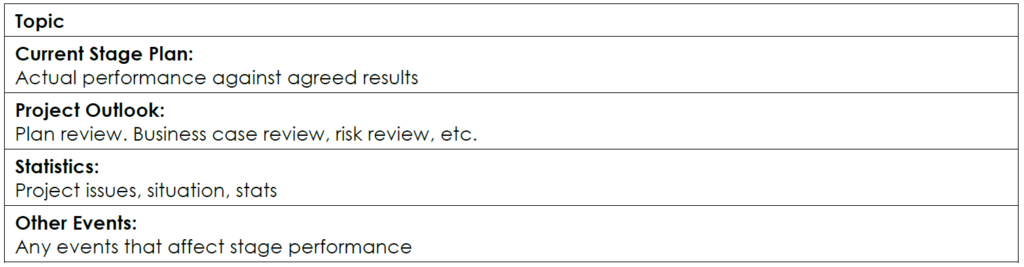
Plan to do a phase review at the end of major phases / milestones in the project: At the end of every phase of a project it is important to have a record of progress and issues as well and how they have or will be dealt with. The End Stage Report will assist you achieve this purpose. Summarise progress to date, the overall project situation and sufficient information to; for example, ask for a Project Board decision on what to do next with the project.
The key outputs of the planning phase include:
A team contract
A finalised scope statement
A work breakdown structure (WBS)- see 3.3.3
A project schedule, in the form of a Gantt chart with all dependencies and resources entered- see 3.4.1
A list of prioritised risks.
Describe the Project Stakeholders
Projects are strongly stakeholder-driven. It’s their wishes, fears, dreams, their “stakes” that determine and drive the course of projects. For successful projects, it’s not enough to deliver on the customer’s demand; projects have to meet all stakeholder expectations.
Identifying stakeholders is a primary task because all the important decisions during the initiation, planning and execution stages of the project are made by these stakeholders.
Project stakeholders are individuals and organisations that are actively involved in the project, or whose interests may be affected as a result of project execution or project completion. Stakeholders may also exert influence over the project’s objectives and outcomes. A stakeholder can be a project team member, an employee of the user organisation, or a senior manager; anyone who has an interest in the project. The following are examples of project stakeholders35 :
Project leader (or project manager) – The person responsible for managing the project; the head of the project; defines, plans, controls, and leads the project
Project team members – The group that is performing the work of the project; they produce the outputs (deliverables) for the project; participate in the project management process; contribute their skills and effort to perform tasks
Sponsor (or upper manager) – The person or group that provides the financial resources, in cash or in kind, for the project; the person with formal authority who is ultimately responsible for the project; oversees the project; acts as a liaison between the upper management team and the project leader; provides authority, guidance, and maintains project priority
Project customer – The person or organisation that will use the project’s product; the person or group whose needs and requirements drive the project; receives the final output(s) that the project produces; provides product requirements and funding. There may be multiple layers of customers. For example, the customers for a new pharmaceutical product can include the doctors who prescribe it, the patients who take it and the insurers who pay for it. In some application areas, customer and user are synonymous, while in others, customer refers to the entity acquiring the project’s product and users are those who will directly utilise the project’s product.
Functional managers (also known as resource managers or line managers) – provide company policy and resources, particularly people who are involved in the project
Performing organisation. The enterprise whose employees are most directly involved in doing the work of the project.
Project management team. The members of the project team who are directly involved in project management activities.
Influencers. People or groups that are not directly related to the acquisition or use of the project’s product, but due to an individual’s position in the customer organisation or performing organisation, can influence, positively or negatively, the course of the project.
In addition to these key stakeholders, there are many different names and categories of project stakeholders, including internal and external, owners and investors, sellers and contractors, team members and their families, government agencies and media outlets, individual citizens, temporary or permanent lobbying organisations, and society-at-large. The naming or grouping of stakeholders is primarily an aid to identifying which individuals and organisations view themselves as stakeholders. Stakeholder roles and responsibilities can overlap, such as when an engineering firm provides financing for a plant that it is designing.
Stakeholders have varying levels of responsibility and authority when participating on a project and these can change over the course of the project’s life cycle. Their responsibility and authority range from occasional contributions in surveys and focus groups to full project sponsorship, which includes providing financial and political support. Stakeholders who ignore this responsibility can have a damaging impact on the project objectives. Likewise, project managers who ignore stakeholders can expect a damaging impact on project outcomes.
The stakes are the wants or needs of the holders. They stick to them; they defend them; they are married to them. The stakeholders will take all actions necessary to defend their stakes, or to get as near to their realisation as possible.
Stakes can be two-fold: they can either relate to stakeholder fears or wishes. With the former, there is something to lose; with the latter, there is something to gain. Either way, stakes are important to the stakeholders and no-one, not even the project manager, should ignore or underestimate them. Therefore, the project management team must identify the stakeholders, determine their requirements and expectations, and, as far as possible, manage their influence in relation to the requirements to ensure a successful project.
Develop a Work Breakdown Structure
The WBS is a deliverable-oriented hierarchical decomposition of the work to be executed by the project team, to accomplish the project objectives and create the required deliverables.
The WBS organises and defines the total scope of the project.
The WBS subdivides the project work into smaller, more manageable pieces of work, with each descending level of the WBS representing an increasingly detailed definition of the project work.
The planned work contained within the lowest-level WBS components, which are called work packages, can be scheduled, cost estimated, monitored, and controlled.
The WBS represents the work specified in the current approved project scope statement. Components comprising the WBS assist the stakeholders in viewing the deliverables of the project.
Although each project is unique, a WBS from a previous project can often be used as a template for a new project, since some projects will resemble another prior project to some extent. For example, most projects within a given organisation will have the same or similar project life cycles and, therefore, have the same or similar deliverables required from each phase. Many application areas or performing organisations have standard WBS templates.
The Project Management Institute Practice Standard for Work Breakdown Structures provides guidance for the generation, development, and application of work breakdown structures. This publication contains industry-specific examples of WBS templates that can be tailored to specific projects in a particular application area.
Decomposition
Decomposition is the subdivision of project deliverables into smaller, more manageable components until the work and deliverables are defined to the work package level. The work package level is the lowest level in the WBS, and is the point at which the cost and schedule for the work can be reliably estimated. The level of detail for work packages will vary with the size and complexity of the project.
Decomposition may not be possible for a deliverable or subproject that will be accomplished far into the future. The project management team usually waits until the deliverable or subproject is clarified so the details of the WBS can be developed. This technique is sometimes referred to as rolling wave planning.
Different deliverables can have different levels of decomposition. To arrive at a manageable work effort (i.e., a work package), the work for some deliverables needs to be decomposed only to the next level, while others need more levels of decomposition. As the work is decomposed to lower levels of detail, the ability to plan, manage, and control the work is enhanced. However, excessive decomposition can lead to non-productive management effort, inefficient use of resources, and decreased efficiency in performing the work. The project team needs to seek a balance between too little and too much in the level of WBS planning detail.
Decomposition of the total project work generally involves the following activities:
Identifying the deliverables and related work
Structuring and organising the WBS
Decomposing the upper WBS levels into lower level detailed components
Developing and assigning identification codes to the WBS components
Verifying that the degree of decomposition of the work is necessary and sufficient.
Identifying the major deliverables of the project and the work needed to produce those deliverables requires analysing the detailed project scope statement. This analysis requires a degree of expert judgment to identify all the work including project management deliverables and those deliverables required by contract.
Structuring and organising the deliverables and associated project work into a WBS that can meet the control and management requirements of the project management team is an analytical technique that may be done with the use of a WBS template or even using Post-Its:
It might surprise you to know the number of people that use yellow sticky pads and a blank wall to create the first draft of the Work Breakdown Structure. This technique is very easy. You first get the appropriate people into the same room. These are the project team members and clients who have the expertise to build the WBS. Typically you start off by writing the names of the major deliverables on Post-it notes – one deliverable per note. Make sure the attendees agree on the major deliverables to begin with. If any of the deliverables are very large, you can create new Post-it notes that describe the deliverables at a lower level, or individual work products. These are arranged under the higher-level deliverable. The deliverable needs to be identified at a level low enough that you understand what it takes to build it. In general two levels should be enough. One level is typical.
Next, for each deliverable, describe the activities that must take place to complete it. Each activity goes on a separate Post-it note. Again, these are arranged under the specific deliverable they refer to. If you have a sense for the order that the activities need to be completed, you can arrange the Post-it notes sequentially. However, this is not important at this point. The important thing is to identify all the work.
Look at the activities that are required to build each deliverable (or work product) and estimate the work associated with each activity. If the effort associated with an activity is larger than your estimating threshold, identify the more detailed activities that make up the higher-level one. Each of these activities is represented by new Post-it notes under the higher-level activity (which now becomes a summary activity). Continue with this process until the work required to complete all of the deliverables is defined, as best you know today. The levels of activities will not be the same for each deliverable. Some simple deliverables may meet the threshold criteria in one or two levels. Others may take three or four, or more.
The advantage of this approach is that your team can visually see the work and they can help ensure all the work is identified to complete the project. The Post-it sheets also give you the ability to easily move things around. If you add an activity and then decide to remove it, you just pick up the Post-it sheet. Likewise, if a deliverable or group of activities is in the wrong place, you just move the Post-it notes to where they need to be.
When you are all done, you can enter the summary and detailed work activities into your work plan management tool.
The resulting structure can take a number of forms, such as:
Using the major deliverables and subprojects as the first level of decomposition
Using subprojects, where the subprojects may be developed by organisations outside the project team. For example, in some application areas, the project WBS can be defined and developed in multiple parts, such as a project summary WBS with multiple subprojects within the WBS that can be
contracted out. The seller then develops the supporting contract work breakdown structure as part of the contracted work.
Using the phases of the project life cycle as the first level of decomposition, with the project deliverables inserted at the second level.
Using different approaches within each branch of the WBS, where test and evaluation is a phase, the air vehicle is a product, and training is a supporting service.
Decomposition of the upper level WBS components requires subdividing the work for each of the deliverables or subprojects into its fundamental components, where the WBS components represent verifiable products, services, or results.
Each component should be clearly and completely defined and assigned to a specific performing organisational unit that accepts responsibility for the WBS component’s completion.
The components are defined in terms of how the work of the project will actually be executed and controlled. For example, the status reporting component of project management could include weekly status reports, while a product to be manufactured might include several individual physical components plus the final assembly.
Verifying the correctness of the decomposition requires determining that the lower-level WBS components are those that are necessary and sufficient for completion of the corresponding higher-level deliverables.
Note: There are a number of ways to create the Work Breakdown Structure (WBS). Remember that the WBS is the first step toward creating the project work plan. It is not the work plan itself. It is important to use the WBS to identify all the major work to be done. It is not important to break the work down into levels or patterns that provide a sense for the timing and sequencing. This will all be done later.
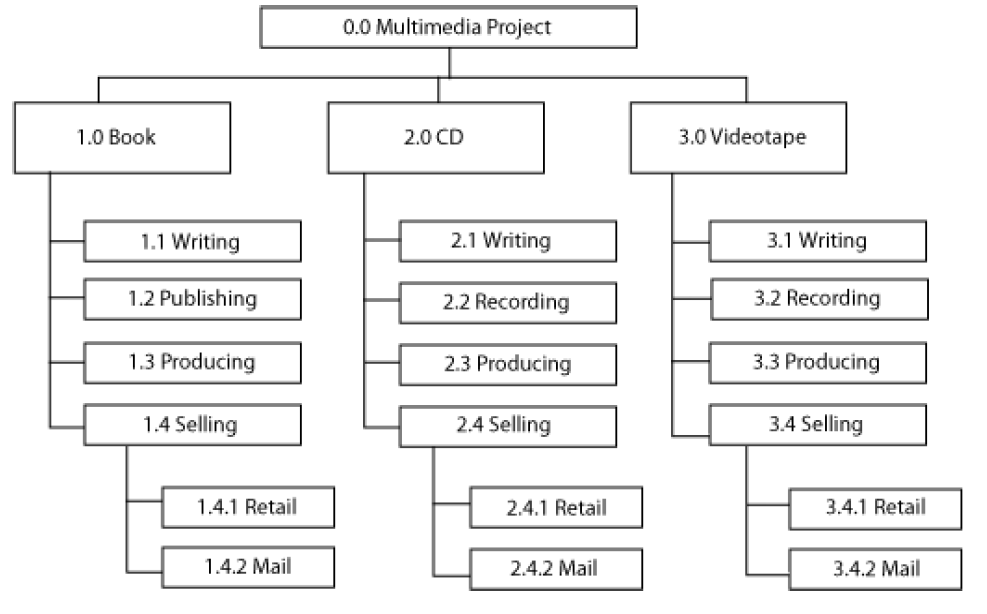
Here are some examples of how the WBS can be structured.
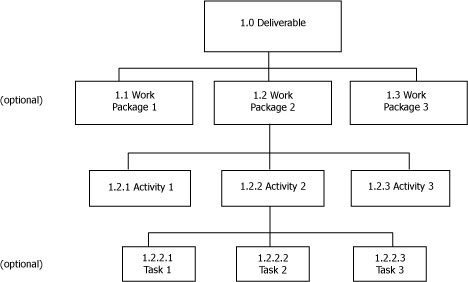
Generic (classic) WBS:
This example shows a generic example of breaking down a deliverable into work packages, and then breaking work components into activities, and then breaking activities down into tasks. Remember that you can break the work into deliverables first or into other categories first. However, regardless of how you start the top level WBS, you will have to transition to deliverables and then to activities. The activities of the project are usually for the purpose of building deliverables, so at some point this deliverable activity breakdown needs to occur. Notice that the Work Package level and the Task level are both optional. Your WBS may go from deliverable to activities and stop there.
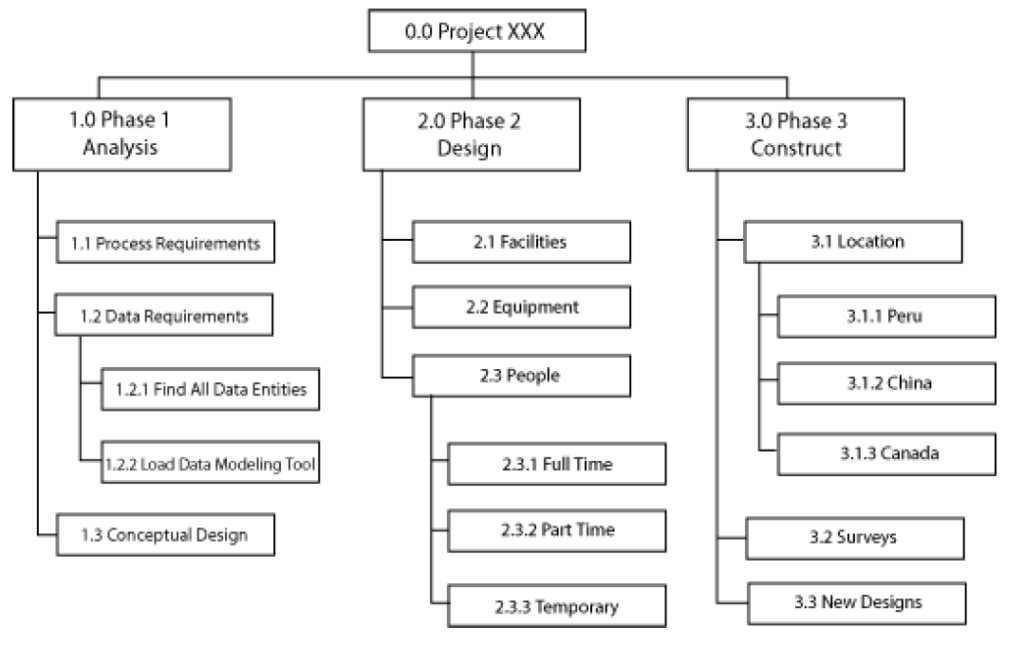
WBS by major project phase or stage
This example shows the major phases required for a project. They do not have to be in the correct time-sequence. Just determine what the major pieces of work are and break each one down further. (Many of these boxes will be broken down much further into the activities required to execute the work.)
WBS by timeline
In this example, the team has built a WBS-based on the order in which the major work components should be performed. This may be easier to think through in some projects where there is some experience in knowing how the timeline will lay out.
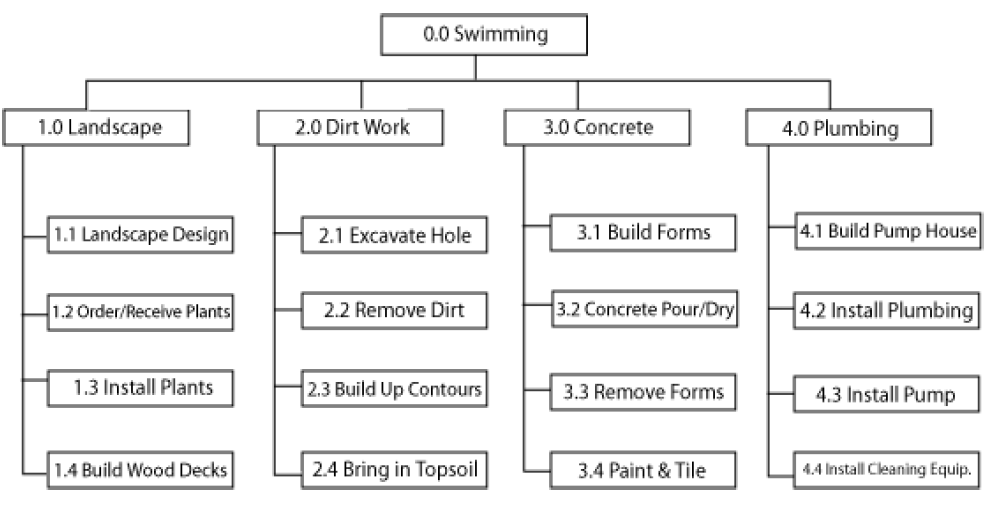
WBS by deliverable
First determine all the deliverables that the project will produce, and then break them down into the work required. Again, this does not imply sequencing. Many of these activities may end up being executed in parallel.
Stipulate and Communicate the Project Activities, Performance Levels and Quality Criteria
Communicating regularly and effectively is a key to successful projects. This entails sharing the right information with the right people in a timely manner. Informative communication supports the following:
Continued buy-in and support from key audiences and team members
Prompt problem identification and decision-making
A clear project focus
Ongoing recognition of project achievements
Productive working relationships among team members.
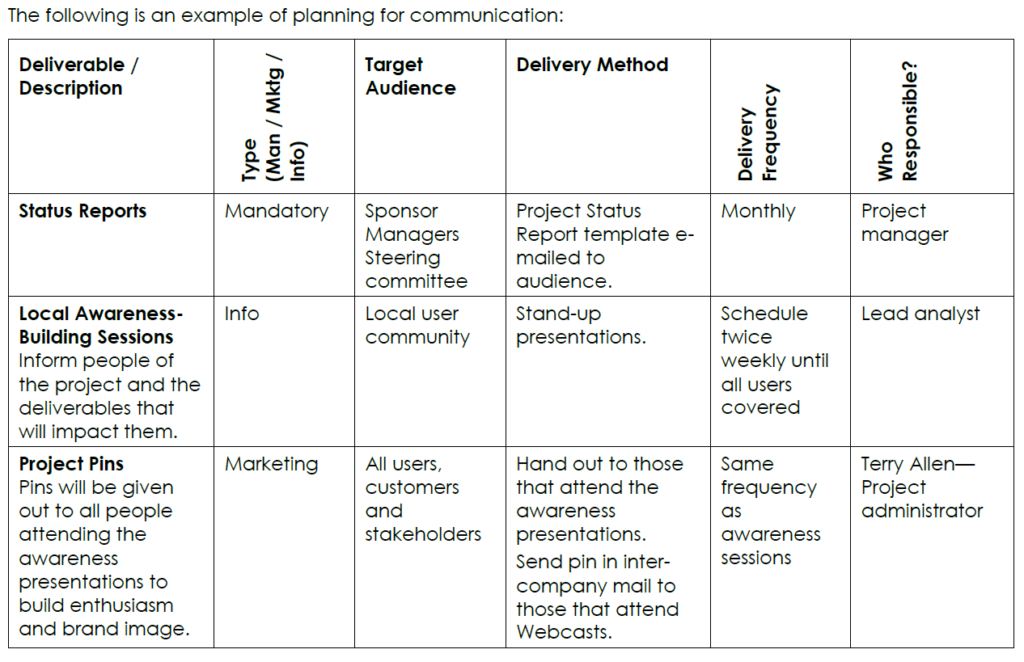
Design a communication plan by asking the following questions:
Who needs to receive information?
What kind of information is required?
When is the information needed?
How should the information be presented?
How is the team going to work together?
How are status meetings going to run?
Choosing the appropriate medium
Project communication comes in two forms:
Formal communications are pre-planned, conducted in a standard format in accordance with an established schedule. Examples include weekly team meeting and monthly progress reports.
Informal meetings occur as people think of information that needs to be shared. These forms of communication occur during the normal course of business and include brief conversations in the corridor, emails, and chats over lunch. Take note of the following guidelines:
o Confirm in writing any important information shared in informal discussions.
o Avoid informal discussions with only some of the people who are involved in the topic.
Manage Quality
Quality is ultimately defined by the customer and represents how close the project and deliverables came to meeting the customer’s requirements and expectations. Our goal is to meet the customer’s requirements and expectations. This is a critical point. Sometimes there is a tendency to think that ‘quality’ means the best material, the best equipment and absolutely zero defects.
However, in most cases, the customer does not expect and cannot afford a perfect solution.
The purpose of the quality management step is to first understand the actual expectations of the customer in terms of quality and then put a proactive plan and process in place to meet those expectations. A faulty process cannot produce a consistently high quality product.
There needs to be a repetitive cycle of measuring quality, updating processes, measuring, updating processes, etc. To make the quality management process work, collecting metrics is vital.
One of the purposes of quality management is to find errors and defects as early in the project as possible. Therefore, a good quality management process will end up taking more effort hours and cost up-front in the project. However, there will be a large payback as the project progresses.
Small projects do not require much more than basic quality control, but for medium and large projects, a Quality Plan should be constructed to make sure that the project is being completed to standards.
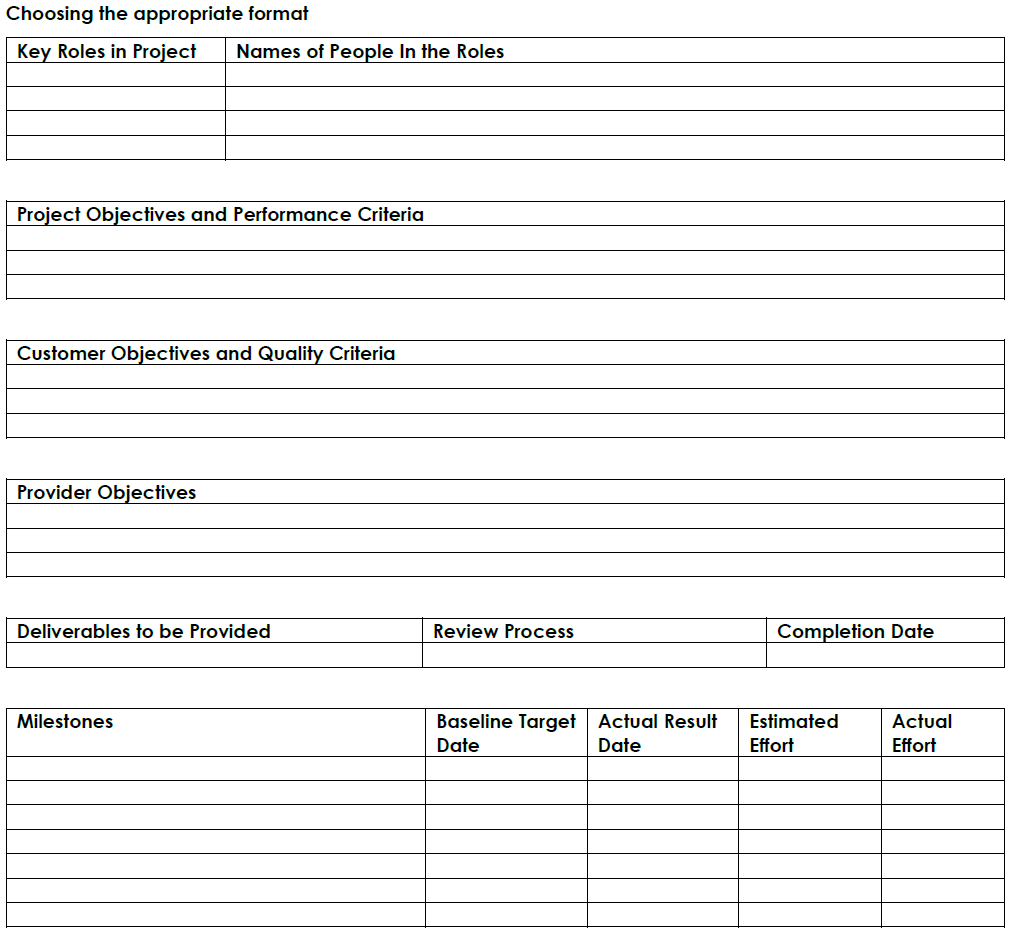
[List any special practices or processes used by this project. Include new types of risk management, project estimating, progress review, management review, customer interactions, or other practices not used on projects in the past. Describe an item in additional text, if needed to explain the item.]

Check the Project Plan
The end result of your planning phase is a document called the project plan.
Once the Project Plan has been drawn up, it must be checked for accuracy, completeness and compliance to internal and external requirements.
Your project plan needs to include enough information to make sure that you know exactly what processes and procedures need to be followed and who needs to be involved.
A Guide to the Project Management Body of Knowledge (PMBOK Guide) says that the project plan in made up of lots of subsidiary plans. These include:
A plan for managing the human resources on the team both in terms of availability and skills
A plan for managing costs and the budgeting elements of the project including any procurements or supplier engagements you might have.
A communications plan setting out who is going to receive messages about the project, when and in what format
A plan for dealing with project risk including the processes for logging and tracking risks
A quality plan that specifies the quality targets for the project.
Get your project plan approved by your stakeholders and project sponsor, as well as the team themselves, so there are no surprises later.
DEVELOP TOOLS TO MEASURE KEY PERFORMANCE PARAMETERS
Performance measurement is the process whereby a project team establishes the parameters within which they can measure if the project is achieving the desired results. The purpose behind measuring is to improve performance. Behn36 gives the following reasons for adopting performance measurements:
To evaluate how well the initiative is performing – In order for the project team to evaluate its performance it requires standards to compare its actual performance against past performance/ / industry standards/client expectations.
To Control – Managers need to ensure that their subordinates are doing the right thing.
To Budget – Budgets can be tools in improving performance. Sometimes budget increases could be the answer to improving performance; for example, purchasing better technology because the current technology is outdated and affects operational processes negatively.
To Motivate – Giving people significant goals to achieve and then use performance measures- including interim targets- to focus people’s thinking and work, and to provide a periodic sense of accomplishment. Performance targets may also encourage creativity in developing better ways to achieve the goal.
To Celebrate – People need to commemorate their accomplishments- such rituals bind people together, and give them a sense of their individual and collective relevance.
To Learn – By analysing information, the project team is able to understand the reasons behind its poor or good performance.
To Improve – What exactly should the team do differently to improve performance?
Develop a Gantt Chart
The Gantt chart is a graphic planning and control method in which a project is broken down into separate tasks. Estimates are then made of how much time each task requires, as well as the total time needed to complete the whole project. The planner also indicates the start and end dates of the tasks on this chart.
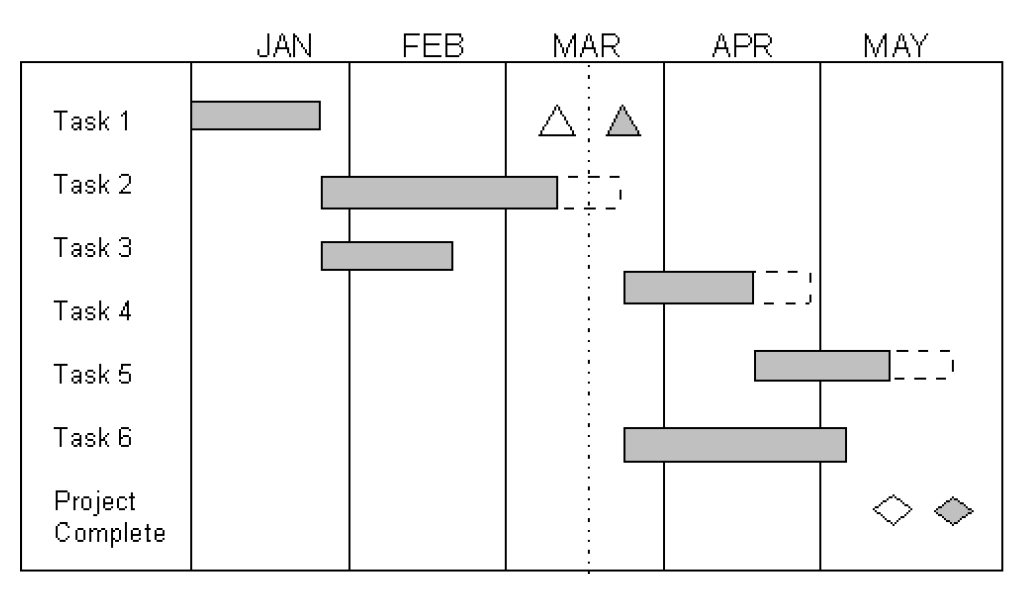
The basic Gantt chart is an easy way to document schedules. It is shows activity start, duration, and completion. It shows the connection between events and the calendar, and provides a graphical analogue of the activity duration. The Gantt schedule can illustrate the relationship between work activities having duration, events without duration that indicate a significant completion and milestones that represent major achievements, or decision points. Various annotations can be used to communicate the progress of the project effort compared to the baseline plan, as well as to depict in a graphical way areas where there are modified expectations from the baseline plan. Once a Gantt schedule has been established for a project, progress should be periodically plotted against the baseline schedule. If different functional areas are involved in a project, each area may need its own detailed schedules to support the project master schedule. In such cases, it is important that working schedules be linked to a common master schedule in a way that they can be easily updated. Each activity or event on the schedule should have a responsible individual assigned, so there is clear ownership and so schedule status can be updated without a lot of fuss.
During World War 1 Henry Laurence Gantt, an industrial engineer, developed the first production control chart. To this day, most organisations use some or other form of it to plan and chart output performance.
Example:
The planning for a training session was broken up into the essential activities.
These are depicted on the vertical axis in the figure that follows:
Writing
Proofreading and editing
Printing and binding
Marketing and selling the course
Sourcing trainers
Arranging the facility
Training
It is clear from the chart that some of the activities require the completion of other activities before they can begin (for example, the course must be written before it can be edited and proofread).
Once the basic activities have been determined, a target completion date must be set. This is depicted on the horizontal axis.
The next step is to determine the duration of each activity. If the training is scheduled for 29 June, the venue must be booked at least a month in advance. Therefore 29 May is the latest date for booking the venue.
Once the activities, activity duration, completion time and latest starting time have been determined, the Gantt chart can be drawn. You can monitor the progress of a project by comparing actual progress with planned progress
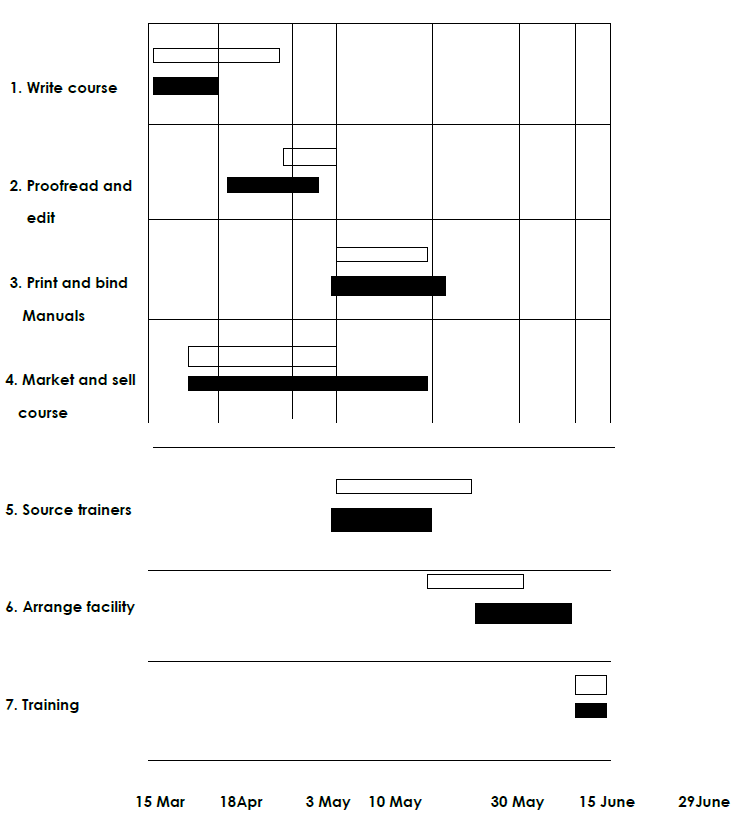
Now you can see at a glance:
Where the activities are ahead of schedule
Where the activities are behind schedule
Where the activities are exactly on schedule
To construct a Gantt chart:
Identify the list of tasks to be completed
Determine the duration of each task and when it must start and end
Determine which tasks overlap and which are dependent on one another
Number and list the tasks down the left (vertical) axis
Write the time period in days, weeks, or months under the horizontal axis
For each task draw a white horizontal bar to show when each task starts and ends
When an activity is completed, fill in a black bar. One will be able to see at a glance how the project is progressing.
Develop a Budget
For a project to be successful, it is important that the four basic elements of a project, namely resources, time, money and scope are managed correctly, because all these elements are interrelated. For this, you need to remember that:
Resources include people, equipment and material.
Time includes task durations.
Money refers to costs, contingencies and profit.
Scope refers to the project definition, the size of the project, goals and the requirements needed to accomplish the project within a budget.
The key issues that must be considered with regard to project finances are:
Resource Planning – determining what resources (people, equipment, materials) and what quantities of each should be used to perform project activities.
Cost Estimating – developing an approximation (estimate) of the costs of the resources needed to complete project activities.
Cost Budgeting – allocating the overall cost estimate to individual work items.
Cost Control – controlling changes to the project budget.
Project cost management requires an understanding of basic principles of revenues and expenses. It includes the processes required to ensure that the project is completed within an approved budget.
There are several types of costs to understand in project cost management.
Direct Costs
Direct costs are costs that can be traced back to specific project activities. Examples of direct costs are costs for materials used on the project and costs for labour expended in project-related activities. Direct costs are:
Labour (the cost of people that are working on the project)
Materials (cost of items purchased for use in carrying out the project)
Supplies and equipment (cost of items consumed by the project)
Training (specifically in relation to the project – to ensure the project is successful)
Travel and miscellaneous costs
Indirect Costs
Indirect costs are costs that cannot be traced back to specific project activities. These costs are often called the “cost of doing business”. Examples of indirect costs are the costs associated with lighting and heating (or cooling) the workplace. Another indirect cost is the everyday cost of doing all the administrative tasks associated with running a business (e.g., paperwork related to human resources management or filing taxes).
It is natural to tend to focus on direct costs, but the allocation of indirect costs to projects can determine which projects are initiated.
There are many ways to allocate a company’s indirect costs, so the total “cost” of a project can vary depending on the accounting method employed. Indirect costs include the following:
Fringe benefits (this is the non-payroll portion of the workers’ salaries for the project, e.g. medical aid, pension, etc.)
General and Administrative (costs of management and support services, e.g. secretarial services, purchasing department, legal services, human resources, etc.
Fixed Costs
A fixed cost does not vary with quantity. In making a new product, there are large costs in setting up the project and especially if there are not many units. For example, if it costs R500,000.00 for a manufacturing machine, and one only builds three units, the fixed cost is still R500,000.00 to set-up, whereas if one builds 1,000,000 units, the fixed cost is still R500,000.00, but it is worthwhile because the cost is counted against all the units manufactured. Obviously it is important when deciding on what project to undertake to consider the fixed costs that will have to be incurred.
Variable Costs
Variable costs are those costs that vary with the number of units that are produced, because there are some costs associated with material for each item, the production time for each unit, as well as the cost of assembling an item.
A budget checklist provides a list of possible costs chargeable to a sponsored project. In order to avoid costly omissions when preparing application/proposal budgets, be sure to consider the following:
Salaries
Fringe benefits
Equipment (non-expendable equipment, accessories, freight, installation)
Consultants (fees, travel)
Supplies and expendable equipment (questionnaires, chemicals, glassware, electronic components, brochures and announcements, audio and video tapes, film and film processing supplies, etc.)
Travel (domestic and foreign, field work, conferences, subsistence costs, transportation)
Publications
Sub-contracts
Other direct costs (space or equipment rental, alterations or renovations, human subjects or informant fees, service contracts, communications, stipends for participants, vehicle lease or purchase)
Facilities and Administrative costs (on-site and off-site).
Let’s look at some of these costs in more detail:
Resource rates
The cost of a work resource based on the amount of time that the resource spends working.
The budget should include all direct costs, including personnel, equipment, supplies, travel and other costs for activities required for the project.
Most costs may be adjusted for inflation in future project years.
In most instances, equipment purchases are made toward the beginning of the project.
Project Personnel:
Personnel costs are usually the largest component of a budget, so this section warrants the most attention. Once you have a specific idea of what you hope to accomplish, determine what types and levels of personnel you will need to accomplish your goals.
Benefit Rates:
Benefit rates include:
Unemployment insurance
Workers’ compensation insurance.
Equipment
Equipment is defined as tangible assets with a useful life of more than one year. Shipping and transportation costs associated with the equipment are treated as part of the total equipment cost. Examples: chairs, desks, computers, filing cabinets, fax machines, printers, refrigerators, microscopes, incubators, projectors, computer software; office furnishings; scientific or medical equipment; alarm/monitoring system hardware, etc.
Materials and Supplies
Supplies should be subdivided into major categories: state the type, the number to be used, their unit purchase cost, etc.
Travel
An individual on the project might have to travel to present data, or to attend a conference or class.
Properly preparing your budget will show how cash flows in and out of your project. Also, it may then be used in planning your short-term credit needs. In today’s financial world, you are required by most financial institutions to prepare budgets before making capital expenditures for new assets, as well as for expenditures associated with any planned expansion.
The budget determines your future ability to pay debts as well as expenses. For example, preliminary budget estimates may reveal that your disbursements are lumped together and that, with more careful planning, you can spread your payments to creditors more evenly throughout the course of the project. As a result, less bank credit will be needed and interest costs will be lower. Banks and other credit-granting institutions are more inclined to grant loans under favourable terms if the loan request is supported by a methodical cash plan.
Similarly, a project that is run on a casual day-to-day basis is more likely to borrow funds at inopportune times and in excessive amounts. Without planning, there is no certainty that you will be able to repay your loans on schedule. However, once you’ve carefully mapped out a budget, you will be able to compare it to the actual cash inflows and outflows of your project. You will also find that this comparison will go a long way in assisting you during future budget preparation. Also, a monthly budget helps pinpoint estimated cash balances at the end of each month which may foresee short-term cash shortfalls.
To draw up your project budget, you can use the WBS to:
Partition the major project deliverables into smaller components to improve the accuracy of cost estimates
Provide a mechanism for collecting and organising actual costs
Provide a mechanism for performance measurement and control.
The following is an example of a simple cash budget for the first 90 days of a 6-month project:
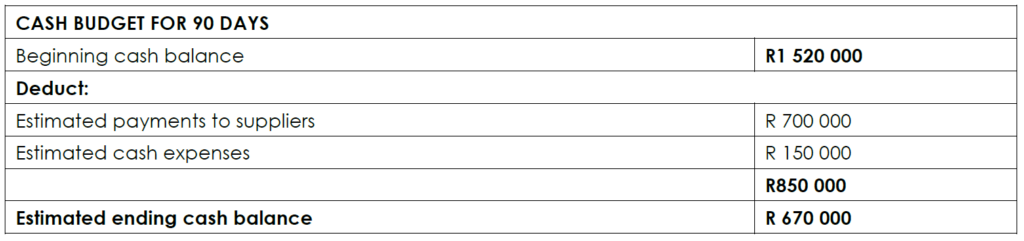
Frequently, the demand for cash is not spread evenly throughout the duration of the project. Several large payments may become due in one particular month, particularly in the execution phase of the project life cycle. It is unlikely that disbursements will be made in every instance when costs are incurred or when materials and services are used. Insurance and rent, for example, are often paid in advance with the cost being absorbed against future operations. A debt of cash disbursements is made by scheduling payments required for materials, labour, other operating costs, debt service, and so forth.
Budgeted cash receipts and disbursements are brought together to form a total cash budget. From this summary of estimated cash flow, it is possible to anticipate future cash balances. In some months, receipts may not be large enough to cover disbursements. If this happens, the cash balance will have to be reduced. If the outflow of cash is too great, plans will have to be made to borrow funds. In other months, when receipts are greater than disbursements, loans can be repaid and cash balances can be built up.
It must be remembered that if you have done several projects, the estimation of each cost element is easier, but if the project and tasks are new, cost estimation is more difficult. For any estimate to be correct for a project, it is important to know these critical points:
- The work elements need to be identified and extracted from verifiable data.
- Cost elements need to be identified and agreed with either the financial or project management authorities.
- Unit costs to be used for cost estimating need to be agreed with all relevant authorities before the project commences.
- The resource requirements for work elements need to be determined in terms of type, quantity and unit cost, and documented in an agreed format.
Before working on the budget, it is important to compile all the estimates into one table, which is basically a summary table of all the figures gathered from different sources. Below is an example:

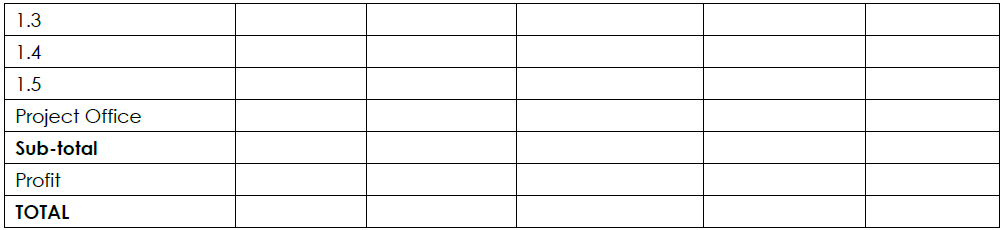
Source: Burke, R. 2006, Project Management Planning and Control Techniques, p88
An example of a proposed project expenditure or cost budget is provided here (remember to include an explanation of how you calculated the cost for each budget item). In the example below, the project manager has to justify each amount s/he intends spending and will request more than the budgeted amount to make provision for contingencies:
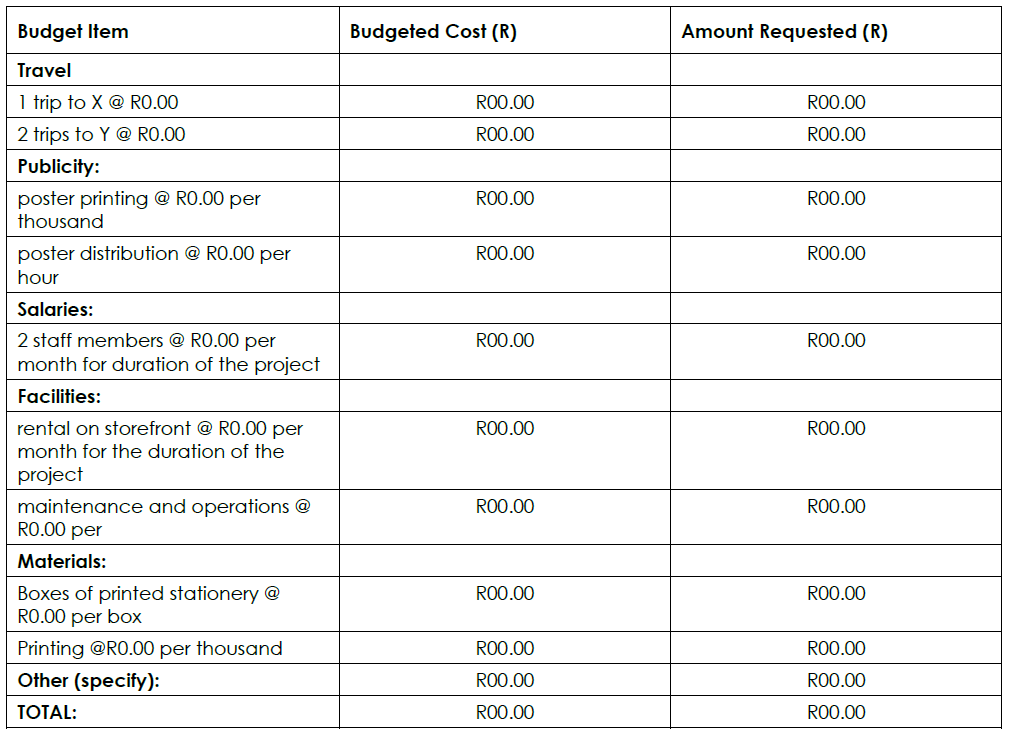
In the following budget (see below), the quantities and cost per unit have been calculated in great detail:
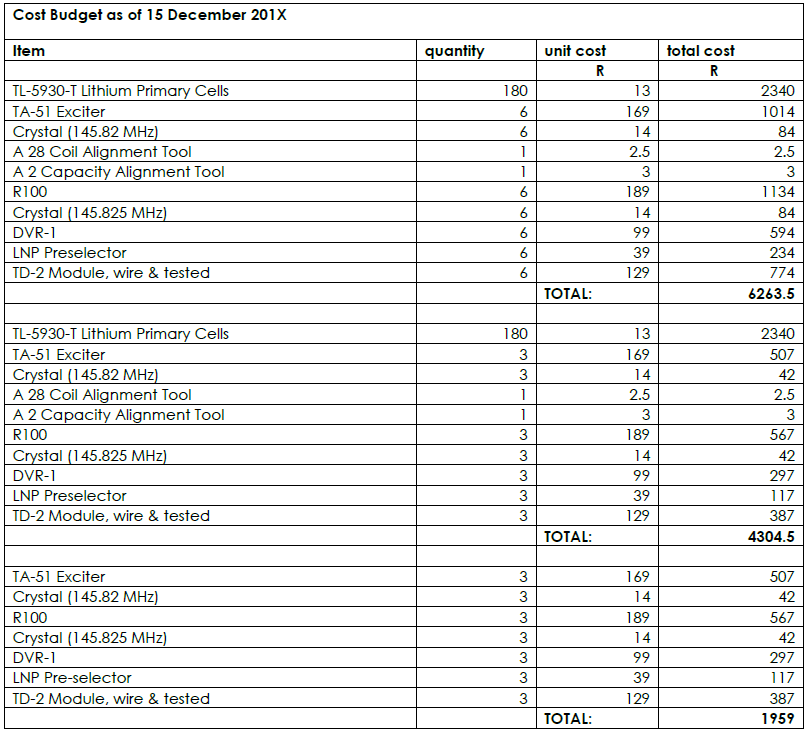
Remember, the budget is not an invoice, so when you have determined the figures involved, leave it up to the organisation’s executive board to make adjustments for profits. The budget is only an estimate until it is approved, and then finalised.
Develop Quality Parameters
Quality and project management are inter-related because there must be a relationship between the supplier and client with regards to project deliverables. The aim should be to:
Establish processes and procedures that will focus on efficiency and effectiveness.
Utilise the art of inspection to ensure quality.
Focus on continually improving processes as opposed to accepting that products are lacking in quality as a normal practice.
Establish close relationships with suppliers that involve trust and an attitude of “can do”.
The aim of quality in project management should be to strive to deliver higher quality, more reliable products and services, even when the resources may become scarce. Quality should also be the framework utilised to enhance negotiations between the client and the suppliers.
Quality in project management is frequently considered to be “conformance to stated requirements.” This necessitates that requirements are adequately stated in the scope of work in project documents, together with a means of demonstrating compliance with requirements.
A Project Quality Plan can be defined as a set of activities planned at the beginning of the project that helps achieve quality in the project being executed.
The purpose of the Project Quality Plan is to define these activities / tasks that are intended to deliver products while focusing on achieving the customer’s quality expectations. These activities / tasks are defined on the basis of the quality standards set by the organisation delivering the product.
A Project Quality Plan identifies which quality standards are relevant to the project and determines how they can be satisfied. It includes the implementation of Quality Events (such as peer reviews, checklist execution) by using various Quality Materials (such as templates, standards and checklists) available within the organisation.
The holding of the Quality Event is referred to as Quality Control. As an output of the various activities, Quality Metrics or Measurements are captured which assist in continuous improvement of quality thus adding to the inventory of Lessons Learned. Quality Assurance, on the other hand, deals with the preparation of the Quality Plan and formulation of organisation-wide standards.
The following definitions will help us understand the different components of the Project Quality Plan:
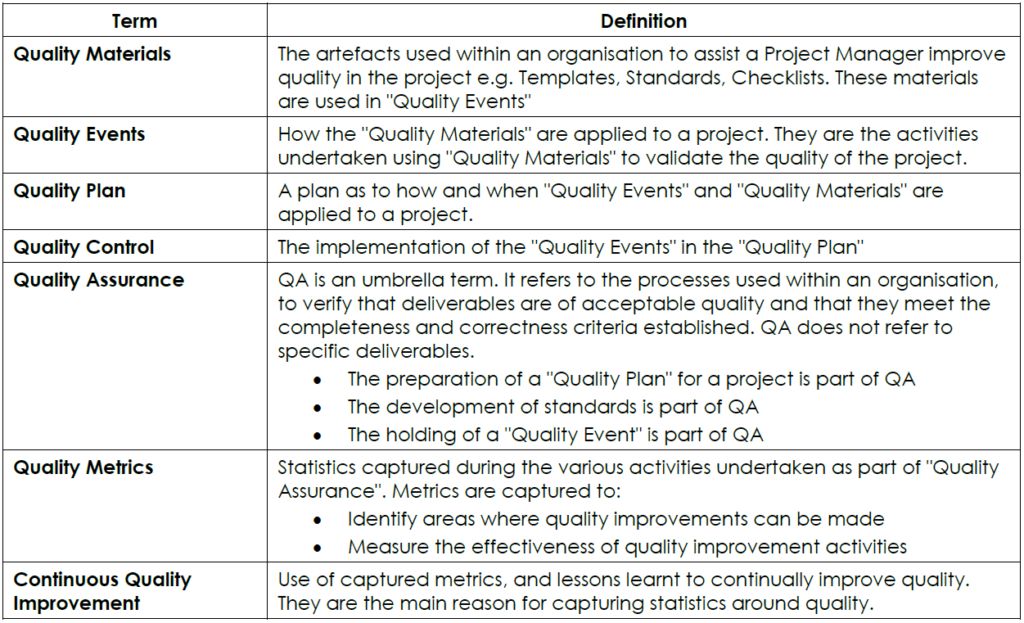
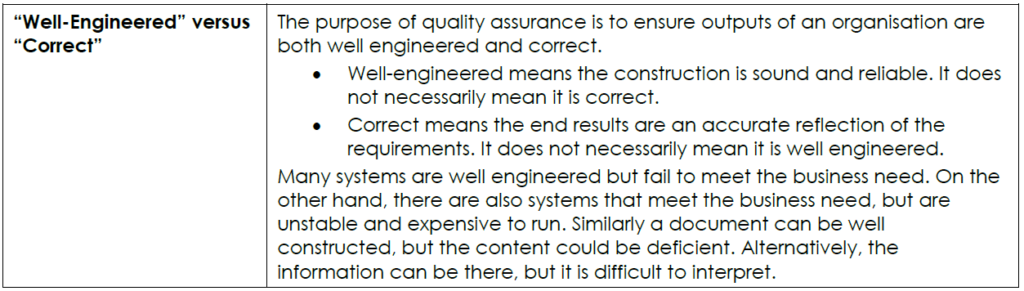
Quality Materials
The following are examples of “Quality Materials” that might be used in a quality plan:
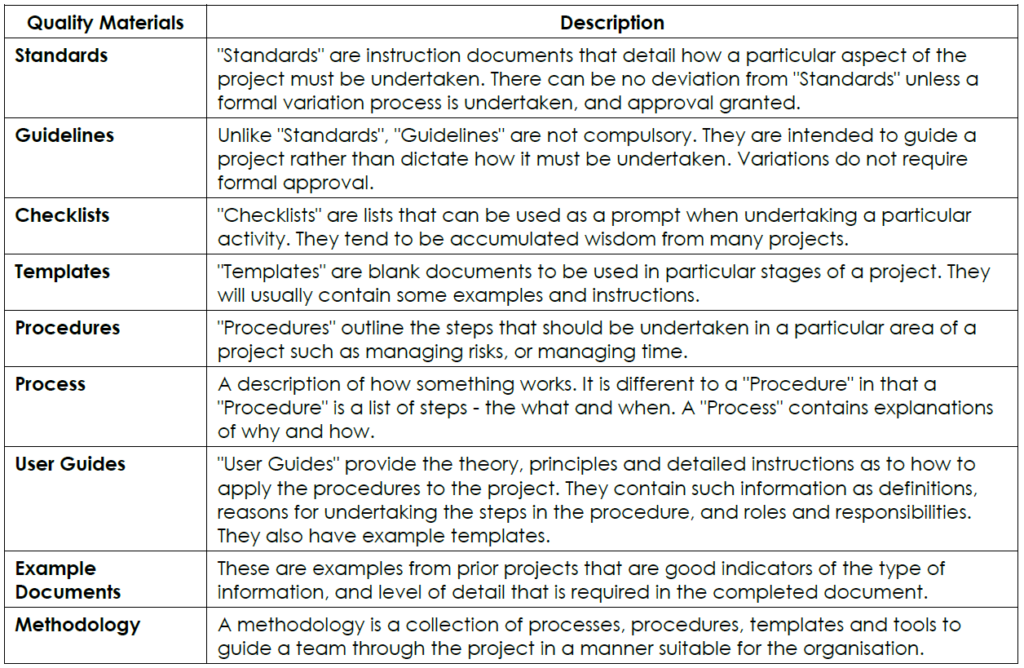
Example Quality Plan
A typical quality plan for a simple project may look something like this:
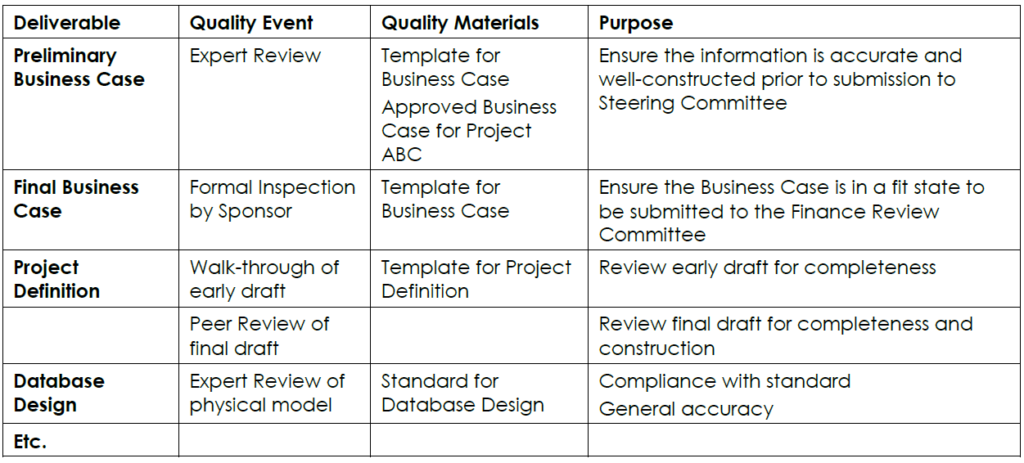
For quality assurance to be effective, two things must be ensured:
The Project Quality plan must be sufficient to achieve the required quality standards expected of the organisation. In this regard the plan must not only be specific and detailed, listing all quality requirements and standards, but also include all the steps taken to ensure that those requirements and standards are met.
Quality assurance (i.e. final product testing) should be independent of the project itself (as well as the project manager). This comes down from the project management guidelines for effective quality assurance, and builds on a broad-based, organisational approach to standards-based product testing.
Communicate the Measurement Tools
Once the measurement tools have been determined, they must be communicated to team members to promote a common understanding of the requirements. Ideally, of course, team members have been involved in drawing up the parameters from the outset and have thus committed to them already.
MONITOR, MEASURE AND EVALUATE AN OPERATIONAL PLAN
The implementation of the operational plan goes hand in hand with measurement, monitoring and evaluation, as implementation requires management to regularly monitor achievement and exert control to reduce any variance from the plan.
This control by managers will involve:
Investigating on a regular basis what has been achieved, and what has not
Implementing corrective action where tasks are not achieved, or achieved on time
Checking that resources will be available when needed
Supervising, supporting and motivating the people of the organisation to ensure that tasks are undertaken
Adjusting the operational plan if there is a need
Reporting problems to superiors, e.g. directors, committee personnel, the Board Members of the organisation.
Monitoring and evaluation enable you to assess the quality and impact of work done, against action and strategic plans.
In this Module we will see that monitoring and evaluation are invaluable internal management tools: If you don’t assess how well you are doing against targets and indicators, you may go on using resources to no useful end, without changing the situation you have identified as a problem at all. Monitoring and evaluation enable you to make that assessment.
Implement an operational plan
The greatest strategic plans and business action plans are not likely to be successful if they are not communicated to your employees. The communication plan should have an equal weighting to the actual strategy!
Communicate the operational plan
Communication is a vital element of a well-managed project. There are two main groups of people with whom the project manager needs to ensure clear and effective communication: the stakeholders and the project team. Every project will be sponsored by a part of the business with a stake in the outcome. They will likely be represented on the project board, which sets the objectives for the project and monitors progress over time. The project board will include others with a stake in the outcome, for example, those who will need to implement the project outcomes and those who will need to supply resources once the project outcomes have been met. All of these stakeholders will need regular updates, and it is imperative that communication with them is planned to be regular, clear and complete.
Begin by building your communication plan as a strategy.
Define your strategic communication goal and objectives. Based on stakeholder analysis, the project manager and the project team can determine the communications that are needed. There is no advantage to supplying stakeholders with information that isn’t needed or desired, and the time spent creating and delivering such information is a waste of resources.
Define a feedback loop to measure results and make improvements.
A communications management plan can organise and document the process, types, and expectations of communications. It provides the following:
The stakeholder communications requirements in order to communicate the appropriate information as demanded by the stakeholders.
Information on what is to be communicated. This plan includes the expected format, content, and detail—thinks project reports versus quick e-mail updates.
Details on how needed information flows through the project to the correct individuals. The communication structure documents where the information will originate, to whom the information will be sent, and in what modality the information is acceptable.
Appropriate methods for communicating include e-mails, memos, reports, and even press releases.
Schedules of when the various types of communication should occur. Some communications, such as status meetings, should happen on a regular schedule, while other communications may be prompted by conditions within the project.
Escalation processes and timeframes for moving issues upwards in the organisation when they can’t be solved at lower levels.
Methods to retrieve information as needed.
Instructions on how the communications management plan can be updated as the project progresses.
A project glossary.
The communications plan may also include information and guidelines for project status meetings, team meetings, electronic meetings and even e-mail. Setting expectations for communications and meetings early in the project establishes guidelines for the project team and stakeholders.
There may be times when knowing whom to contact and with what information could be a security risk. Plan for this possible scenario when crafting your communication plan.
Understanding the communication channels
The project manager may need to be in touch with people in the same location or various other locations in which project work is being performed. It is the project manager’s duty to determine how to do this information sharing; he or she should categorise the means of communication:
In person – The best communication is still face-to-face. The project manager can determine the person’s body language and get their tone and nuances. Very importantly, this often tells more about what is going on in the project.
Telephone – The tone of the voice can be heard. Note that you should always smile into the telephone, which gives a feeling of upbeat and confidence in the project.
Videoconferencing – This is very useful in saving travel costs.
E-mail – The most popular of these is obviously e-mail next to the telephone. It is amazing that people are taught how to use an e-mail system, but are not provided with any guidelines on effective use. Here are some specific guidelines that would help to increase the efficiency of communication via e-mail:
o Avoid using email for any sensitive topics;
o Assume that everyone in the company will read your emails;
o Think about what medium to use for communications before you resort to e-mail;
o Make sure that the title of the email is either very specific or very general; and
o Avoid using email to discuss an issue in any depth. E-mail was never intended to be used as groupware.
Remember:
Explore and recognise the limitations of various channels
Match the channel to your desired level of interaction
Select multiple channels where necessary.
Packaging the communication plan correctly
Use language at the level of the recipient
Reinforce corporate culture through the communication medium.
Consider your own communication strategy for your department. Refer to the example below:
Example of a communication plan template
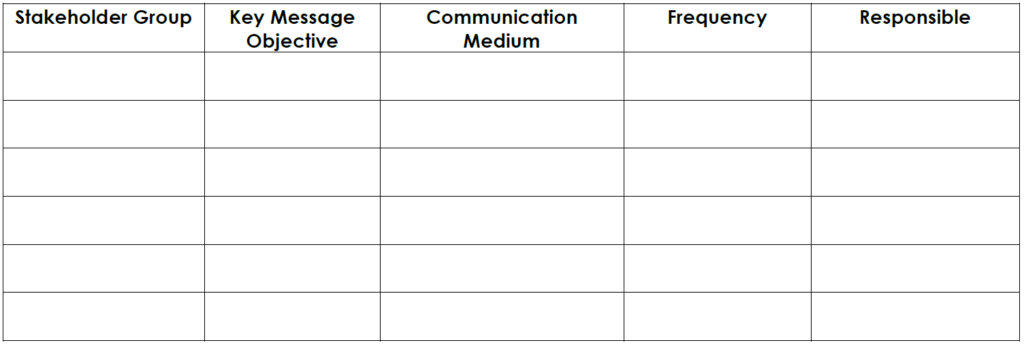
Meet the specified goals, objectives and performance standards
Once your strategy and operational plan have been communicated, you are in a position to implement the operational plan to meet the specified goals, objectives and performance standards.
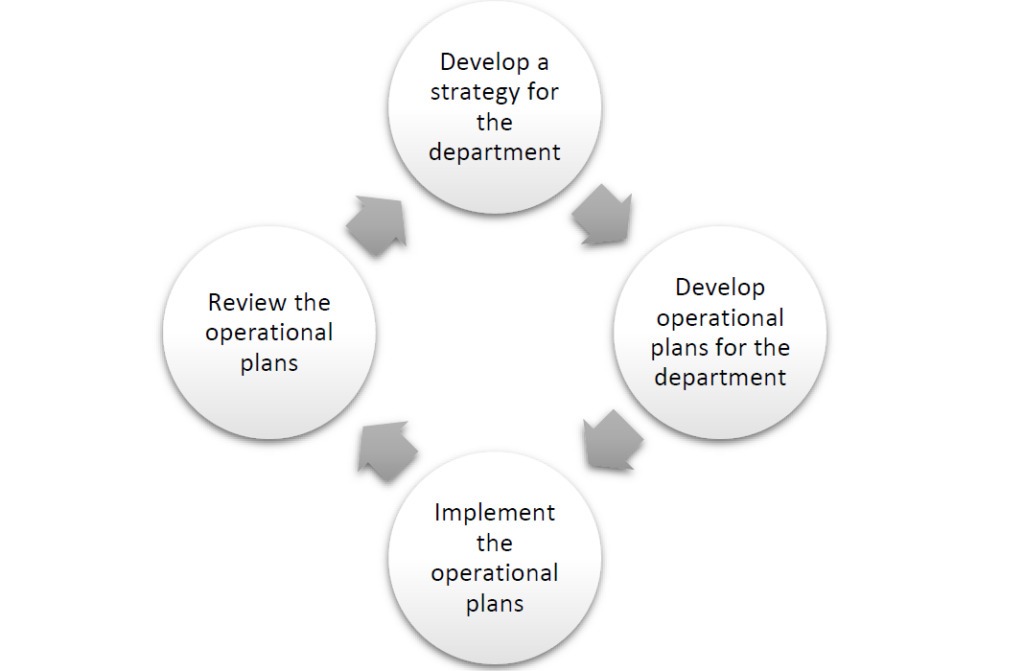
Approaches to and Tools for Implementing Actions
You can align individual performance to the departmental action plan through your existing performance management system, or through the use of a performance contract, or by simply preparing individual action plans. We will look at the example of the balanced scorecard and a performance contract.
The objectives set for your Department as a whole will be achieved through the focused activities of individuals. Therefore, the broad objectives for the business unit must be translated into specific measurable objectives for your department. These objectives in turn are translated into measurable objectives for each job function.
The diagram that follows illustrates how objectives cascade down through the organisation:
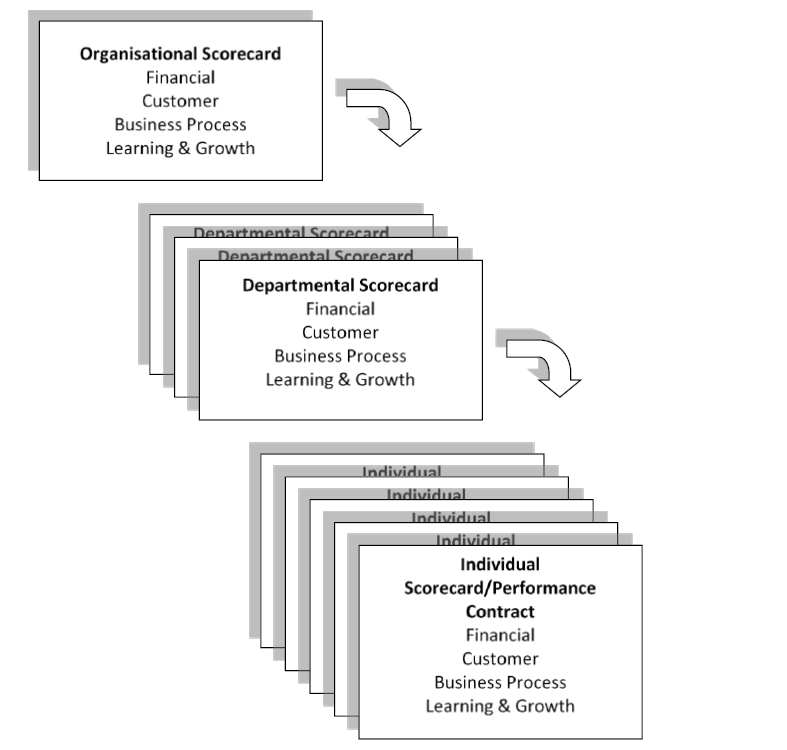
From this we can clearly see how the use of a balanced scorecard focuses the efforts of everyone in the organisation on the same overall objectives. The balanced scorecard eliminates the risk that the efforts of one person might be inadvertently countered by someone else, who is working towards a valid, but very different objective.
The individual scorecard is usually more operationally-based than those of the department. For example, your organisation may have a strategic objective of minimising expenditure. This strategic objective translates into tactical objectives for departments. The tactical objectives in turn translate into day-to-day operational objectives for each individual.
For example, you could be given the objective of “decrease expenditure”, and all departments adopt the objective of “reducing costs”. In terms of individual objectives, an administrator could have “decreasing stationery costs” as “reducing costs” objectives.
In other words, at each level of the scorecard we say, “This is WHAT we want to do”, and then produce the objectives for the next level down by asking, “HOW will we do it?”
Use available resources optimally
During the implementation of your action plan you should work towards making optimal use of your resources. This will ensure you are working both effectively and efficiently.
Preparing a resource plan
A resource plan can be prepared to manage your resources to ensure they are doing the right things right, and you are getting the best out of them. Start by preparing a resource inventory that details all the resources you will require to implement your action plan. Include staff, equipment and physical resources.
Then prepare a list of existing resources, including specifications, quantity and location. Compare the lists and highlight any deficiencies then explore your options for accessing these resources.
Can equipment and physical resources be hired, borrowed or rented as opposed to being purchased?
Can you use temporary staff or contract workers?
Your resource plan should be monitored and updated regularly according to current and future needs.
Example of a template for a resource plan

Labour plan
You can also make use of a labour plan to specifically manage your people resources. Measure the volume of work that each person can manage and allocate responsibilities accordingly. Be wary of performance punishment. In other words, do not overload your good performers because you know they will get the job done, rather delegate responsibility across the team.
Example of a template for a labour plan

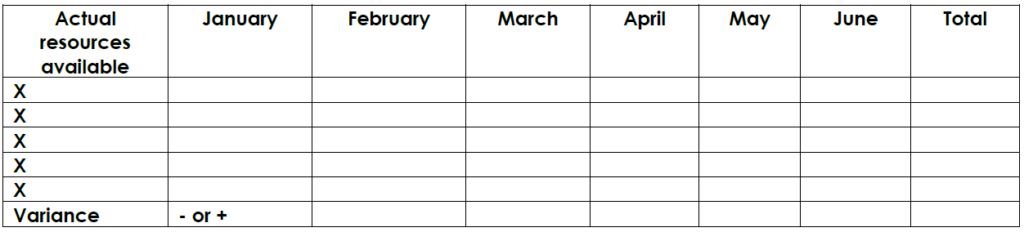
If there is a negative variance (-) you will require people, if there is a positive variance (+), you will have a surplus of resources that can be better allocated.
Encourage the use of Control Measures
Selecting Measures
The objectives set for the department as a whole will be achieved through the focused activities of individuals. Therefore, the broad objectives for the organisation must be translated into specific measurable objectives for your department. These objectives in turn are translated into measurable objectives for each job function.
Measures
Measures provide information that assists us in measuring the accomplishment of results. Some business objectives may have one measure while others may need two or three to truly reflect performance.
Measures should be defined in a manner that makes them measurable. They should include quality, quantity, timeliness and cost measures. Very importantly, measure what really matters and keep it simple. People behaviour is determined by what is measured, so make sure you are measuring the right things!
Quantity measures how much work should be done in a specific amount of time
Quality describes how well the work should be accomplished
Timeliness looks at “by when?” “how soon?” or within what period
Cost looks at money saved, waste reduced, within or under budget.
Formulating Targets
Measures and targets often combine into one. A target should:
Have an appropriate time frame
Be challenging
Be understood by everybody in the organisation
Be communicated to everyone in the organisation.
An example of a template for a performance contract

Your performance contract should be set up in conjunction with the individual once the departmental mission, objectives and action plan have been communicated and understood.
Steps for setting up a Performance Contract37
Step 1: Plan
Look at your business goals for the year ahead. Think about individual performance goals for each employee that will help your business unit reach its goals.
Create a performance agreement template. Prepare some main points to help remember what you want to cover when you meet with each employee.
Step 2: Discuss
Meet with each employee to discuss their individual goals – these should be specific, measurable, realistic and relevant to the employee’s duties.
Agree on and record these goals in a performance agreement, along with the support you’ll provide to help the employee reach their goals (e.g. training).
Set a realistic timeframe for the employees to work towards their goals, and a time for you and the employees to meet to review their performance.
Both you and the employee should keep a copy of the employee’s performance agreement.
Step 3: Monitor
Monitor your employees’ performance and support them while they work towards their goals.
Give regular feedback (both positive and constructive) to the employee, and deal with any performance issues as soon as them come up.
Follow the ‘AID’ approach when giving feedback:
o Action – describe the specific actions you want to give feedback on (ie. the ‘what,’ ‘when’ and ‘where’).
o Impact – explain the impact of the employee’s actions (eg. on their work, co-workers, customers or the business itself).
o Desired outcome – explain what you would like to see continuing or changing. Where change is required, explore with the employee how they can make this change and how you can support them.
Think about the impression that your body language gives – face the employee, adopt an open posture, maintain good eye contact and try to be relaxed.
Step 4: Review
Conduct a review with each employee every 6 or 12 months to assess their performance against their goals and set goals for the new performance cycle.
Arrange to meet with the employee at a time and in a place where you won’t be interrupted, overheard or rushed.
Make sure both you and each employee have time to prepare for the review. You should both read through the employee’s performance agreement and think about how they’ve performed against their goals.
Prepare some main points to help remember what you want to cover in the review.
Ask the employees how they think they’ve performed against each of their goals.
Give the employees feedback about how you think they’ve performed – both what they’ve done well and what they can do to improve. Your feedback shouldn’t come as a surprise to an employee.
Give the employees a chance to share any feedback or concerns they have as well.
You may also want to discuss the employee’s career goals and future within the business.
Finally, agree on and record goals for the next performance cycle (these might be the same goals or new ones) in a new performance agreement.
In summary, why do we need an individual performance contract or action plan?
The individual scorecard or action plan allows us to take the business goals, plans and strategies and operationalise them so that they have meaning and relevance to each individual within the business. The business strategy is defined as business objectives and cascaded down to a department level and then an individual level, ensuring that each employee has clearly defined objectives and measures, which define performance.
Implement the plan and evaluate project progress
The process of evaluation comes in two parts: formative and summative.
Formative evaluation occurs along the developmental path, it helps keep the project on track to a successful completion.
Summative evaluation comes after the implementation of the project and provides the data needed for decision makers to recommend how to improve the product or service delivery in future projects.
Formative evaluation can take many forms, from focus groups to surveys, but all forms have the common goal of testing the end products as they are developed. It is a sort of on-the-fly indicator to revise and improve.
While formative evaluation is ongoing throughout the production stage, it should also continue in the implementation stage.
Summative evaluation is used to gather, analyse, and present data about the effectiveness of the product or service. The results of this evaluation can be used to report to sponsors, and to decision makers who will recommend the adoption of, or the continued use of, the product or service.
Evaluation is definitely the project manager’s friend in spite of the fact it is a tremendous amount of work.
Methods and techniques for the implementation of Projects
The project implementation phase consists of the following steps:
- Mobilise the team
- Implement planning and scheduling
- Specify technical requirements
- Allocate work packages
- Procure goods and services
- Execute the work
- Test the product or service
- Resolve issues
- Monitor progress
- Forecast outcomes
- Report progress.
In order for the project operations to start up smoothly, you would need to ensure that you have set realistic time frames and allocated sufficient and sufficiently skilled and qualified personnel. If this isn’t possible, the timeframe will either have to be extended, or you will have to add additional resources (if these resources are available), both forcing additional costs for the project.
Delegation of Authority, Responsibility and Accountability
We may define delegation as an assignment to another person of formal authority and responsibility for carrying out specific activities. Authority and responsibility can be delegated.
Authority, responsibility and accountability reflect the degree to which people are authorised and encouraged to use their initiative in day-to-day activities as well as assigning the limits to their authority:
Are policies in place that describe business practices, particularly those in relation to risk and compliance?
Do job descriptions specify roles, responsibilities and accountabilities?
Do team members understand their job function and how it contributes to the project objectives?
Do team members know what they are accountable for?
There is an interrelationship between authority, responsibility, and accountability in a task-oriented environment such as a project:
Authority – power to do something
Responsibility – making sure that something gets done
Accountability – answerable for the consequences of doing it.
This raises two questions: Can authority be delegated? Can responsibility and accountability be delegated? There is little doubt concerning the delegation of authority – it can and should be delegated. This forms the basis of the scalar principle, the idea that a clear line of authority runs step by step from the highest to the lowest level of the organisation. This clear line of authority, then, is the basis for all delegation.
Responsibility for the successful completion of a task can be delegated, but accountability is not like an object that can be passed from individual to individual. For example, a loan manager for a bank decided to delegate to his loan officers the responsibility for ensuring that all loans are processed within the 10-day limit stated by policy. The loan manager can certainly make the loan officers responsible for successfully completing the task, but the loan manager is no less accountable for the outcome to his or her boss. In short, we cannot delegate accountability, because accountability always remains with the delegating manager.
Obstacles to effective delegation include:
Personal preferences
Attitudes towards direct reports
Personal insecurities.
Your ability to delegate effectively is critical to your success. As a leader, you should keep the following in mind:
Delegation occurs along a continuum
Delegation involves judgement calls about trust
Trust involves assessing character, competence and influence.
Why you need to delegate
Simply put, your job as a project manager is too big to handle alone. If you are not delegating, something probably isn’t getting done. In some instances, your direct reports may be more knowledgeable than you are. By delegating you will be developing direct reports in the process. Developing people is a key leadership responsibility.
The Delegation Continuum
Delegating is not an all-or-nothing proposition. There is a continuum along which you can delegate assignments and responsibility. To facilitate this process, you should ask your direct reports to:
Gather information
Determine alternative courses of action
Perform one part of a task
Outline a course of action and get your approval before beginning
Perform an entire assignment and report only results.
In deciding how much to delegate, consider:
The task
The direct report and his/her experience level.
Delegation “involves the assignment of a specific task or project by one person to another and the assignee’s commitment to complete the task or project”.
Delegation transfers responsibility to another person along with the responsibility for adhering to and maintaining established standards.
Delegating benefits:
You – It improves the level of trust and communication between you and your team, and helps to achieve goals that require co-operative group effort.
Your Team – Delegation enables team members to enhance existing skills and develop new ones, as well as enhancing motivation and providing team members with an important sense of achievement.
Your Customer – Delegation saves money and time by ensuring that tasks are assigned to the right person at the right level, and can increase overall productivity and efficiency by making the best use of resources.
Having identified the benefits of delegating, the following are “warning signs” indicating that your delegating abilities may need improvement:
You regularly work overtime on tasks that “only you can do”
You are frequently interrupted for guidance requests and work clarification
Delegated assignments are incomplete and deadlines are missed
Team members feel they lack the authority to complete assignments and are ill-prepared
You “second-guess” staff decisions and personally re-do unsatisfactory staff assignments
You frequently intervene in tasks or projects assigned to one of your staff
Your staff are not taking responsibility for tasks or projects you have delegated
Morale is low and staff turnover is on the rise.
To set the right tone and environment, some suggested guidelines for effective delegating are as follows:
Encourage your staff to be proactive and share with you their special interests and time availability for new projects
Delegate projects and tasks that spark staff interest and are enjoyable
Provide possible career opportunities by delegating projects, tasks or functions that involve high visibility with your manager
Delegate to people you trust
Delegation is a learning experience; offer training or coaching as needed
Develop trust in a less skilled staff member by delegating very structured assignments and provide needed support for them so as to develop competence
Try to delegate an entire project or function to increase motivation and commitment
Create clear guidelines for follow-up and feedback and keep open lines of communication
Have clearly defined goals, expected outcomes and success measures.
Delegation Process:
As we have seen, the first step in delegating is to identify what should and should not be delegated:
The manager should delegate any task that a subordinate performs better.
Tasks least critical to the performance of the manager’s job can be delegated.
Any task that provides valuable experience for subordinates should be delegated.
The manager can delegate the tasks that he or she dislikes the most.
The manager should not delegate any task that would violate a confidence.
Preparing includes:
Establishing the objectives of the delegation
Specifying the task that needs to be accomplished
Deciding who should accomplish it.
Planning consists of:
Meeting with the chosen subordinate to describe the task and to ask the subordinate to devise a plan of action. As Andrew Carnegie once said, “The secret of success is not in doing your own work but in recognising the right man to do it.”
Trust between the manager and employee – that both will fulfil the commitment – is most important.
Discussing includes:
Reviewing the objectives of the task
Reviewing the subordinate’s plan of action
Discussing any potential obstacles, and ways to avoid or deal with these obstacles.
The manager should clarify and solicit feedback as to the employee’s understanding.
Clarifications needed for delegation include:
The desired results (“what”, not “how”)
Guidelines
Resources available
Consequences (good and bad).
Delegation is similar to contracting between the manager and employee regarding how and when the work will be completed. The standards and time frames are discussed and agreed upon. The employee should know exactly what is expected and how the task will be evaluated.
Auditing is monitoring the progress of the delegation and making adjustments in response to unforeseen problems.
Appreciating is accepting the completed task and acknowledging the subordinate’s efforts.
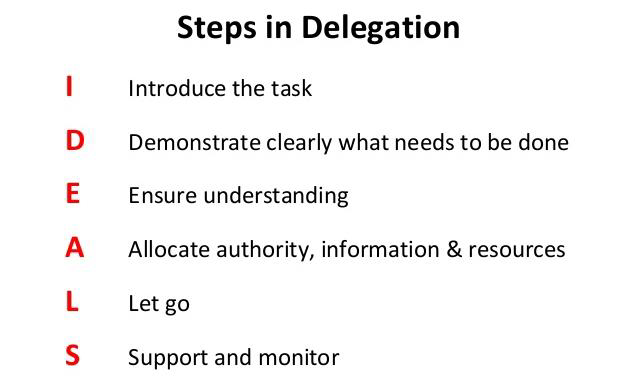
Monitor and evaluate Project Implementation
Monitor performance
The process for monitoring performance is basically a system for managing resources. The performance contract and development plan assist in managing people resources, and the action plan can assist in securing and managing other resources such as equipment.
Labour review
Conduct regular reviews of your manpower plan to ensure that resources are managed effectively and that they are neither under nor over allocated on tasks. Revisit your labour plan on a monthly or quarterly basis or as a new project commences.
Service excellence review
One of the best mechanisms for determining service excellence is to conduct a customer satisfaction survey. This can be conducted with both internal and external customers. The best feedback to obtain on your performance is based on the perception of your customers.
A basic framework for obtaining feedback from customers is the stop, start, continue approach. Ask the customer what you should start doing that you did not do, what you should stop doing in future, and what you should continue to do that you did well.
Monitor what is working and what isn’t
Regular project team meetings provide the opportunity to voice any new ideas that may emerge during the life cycle of the project. New ideas should be recorded in the meetings and the tips and techniques for creative thinking can be used to further develop the ideas and perhaps, to initiate new projects.
Using review findings to increase productivity and service excellence
The data that is gathered from the various reviews that are conducted will assist you in determining what went well and what needs to change. As you evaluate your findings, consider what change is required and how you will effect the change. All of this information can be documented in your progress and lessons learned reports. Making it happen, though, is the most important step. Updating performance contracts, development plans, action plans, labour plans and procuring additional resources are all part of the continuous cycle of improvement.
Monitor Project Results
Performance Reporting
Performance reporting is the process of collecting all baseline data and distributing performance information to stakeholders. An aspect of this report is to clarify how resources are being used to achieve the objectives of the project. This should be done in conjunction with providing information on scope, schedule, cost, risk, procurement, and quality.
The inputs to performance reporting are:
Work performance information – Work performance information details the work that is being executed, recently completed, and next steps. This information is gathered from the Direct and Manage Project execution process.
Performance measurements – Performance measurements, such as Actual Cost, Cost Variance and Schedule Variance assist in reporting unbiased and quantifiable information – an excellent mechanism for accountability.
Forecasted completion – Forecasted completion is the predictor of completion and the expense to get to that state, as well as potential project roadblocks.
Quality control measurements – Quality control measurements result from activities comparing the results to the quality standards and processes. This is the true check to assure a quality product or service has been provided
Project Management Plan – The Project Management Plan contains the Performance measurement baseline which contains the approved measures for management control.
Approved change requests – Approved change requests are requested changes that have been approved and are ready to be implemented. They are used to determine project changes that have been formally approved and must be communicated to stakeholders through integrated change control.
Deliverables – Deliverables comprise the quantifiable actions, results, products, or capabilities that will be produced in order to complete the project.
The inputs to performance reporting are absolutely necessary to providing an accurate quantifiable performance report.
The tools and techniques for performance reporting are:
Information presentation tools – Information presentation tools enable the project team members to present project performance data. Most organisations have software packages which can be used to paint a picture with a graph or a spreadsheet analysis.
Performance information gathering and compilation – The performance information gathering and compilation technique is the organising of all pertinent project information.
Status review meetings – Status review meetings are regularly scheduled meetings to exchange information about a project. Normally there is a team level status review meeting and then an executive review meeting.
Time reporting systems – Time reporting systems record and provide information about the time spent for activities on a project.
Cost reporting systems – Cost reporting systems record and provide information about the costs expended for the project.
Using these tools and techniques helps the project manager implement an efficient reporting process. Imagine if the only way to obtain time spent on a project was to review every team member’s time sheet and then sum up the parts!
The Performance Reporting process provides pertinent and verifiable documentation of project performance. The outputs of the Performance Reporting process are:
Performance reports – Performance reports are presentations and documents that summarise work performance information in the form of bar charts, histograms, and tables.
Forecasts – Forecasts are predictions of what will occur based on the project performance to date. Forecasts are updated and reissued as new work performance information is available during project execution. A project manager might want to conduct a trend analysis of cost and schedule variance to see how on budget and on time the project is likely to be.
Requested changes – Requested changes are project changes affecting scope that are submitted to the Integrated Change Control process. These must be reflected in performance reporting to stakeholders.
Recommended corrective actions – Recommended corrective actions are documented suggestions affecting project execution designed to ensure that expected future project performance will conform to the Project Management Plan. Once a project manager is made aware of a schedule or cost variance, s/he needs to take action to get the project back in line with original objectives. To do so, recommended corrective actions may be offered.
Organisational process assets updates – Organisational process assets updates are changes or updates to formal and informal policies, plans, guidelines, organisational best practices, and lessons learned from project experience.
Project progress reports
Preparation, planning and professional evaluation of the threats to a project ought to be a frequent and regular activity for every project team.
Risk management is not a ‘once and for all’ exercise to be performed during the initiation phase – it is an essential part of everyday activities.
With reasonable and realistic plans, plus regular, weekly (or even daily) review of the threats to success and implementation of effective counter-measures, most projects will reach their targets safely.
One simple and efficient approach that can be used is as follows:
Weekly
The executive sponsor of the project, aided by the senior user and senior supplier management on the board, help clear obstructions and provide the authority to counter any remaining threats.
This approach is certainly not rocket science – but it is efficient and effective at helping a project survive.
SOFT report
Each Team Leader produces a one-page ‘SOFT’ report (reviewing their team’s successes, opportunities, failures and threats).
The Project Manager holds a checkpoint meeting with all the Team Leaders, assessing the project’s RAG status (Red/Amber/Green) and ensuring counter-measures are assigned for those threats that can be handled.
Any issues beyond the project team’s level of authority are identified. If necessary, an Exception Report is produced and escalated to the Project Board.
Bi-weekly or monthly
The Project Manager produces a Highlight Report and discusses status and any remaining threats with the Project Board.
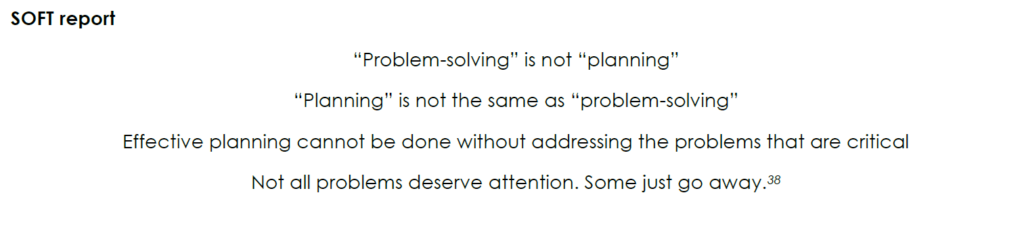
“S-O-F-T” is an acronym which represents “Strengths,” “Opportunities,” “Failures”/ “Flaws” and “Threats.” To undertake an S-O-F-T analysis, ideally, the first step is to make a long list of every factor that defines the project’s current situation.
The next move is to sort this long list into legitimate “planning issues” (List A) and true “problems” (List B). Take List B and determine which of the “problems” are likely “to just go away.”
Put the issues that are likely “just to go away” off to the side and focus on List A (true “planning” issues) plus the balance of List B (problems that are not likely just to go away). Then assign the issues to the specific categories of the “S-O-F-T analysis” – which ones are “Strengths,” which ones are “Opportunities,” which ones are “Flaws,” and which ones are “Threats?”
Note that a project’s “Strengths” and its “Flaws” (its “weaknesses”) are obviously internal considerations. Note that a project’s “Opportunities” and any “Threats” in the operating environment are clearly external considerations.
Equally obvious is the fact that “Strengths” and “Opportunities” are both positive considerations. “Flaws” and “Threats” are both negative considerations. To express these relationships, it can be helpful to think of these factors in a 2 x 2 matrix (see below).
It is therefore clear that the project team should attempt to:
Build on the Strengths
Maximise the response to the Opportunities
Reverse (or disguise) the Flaws
Overcome the Threats.
Example list of factors that define the project’s current situation:
The capability and experience of the project team
The strong commitment from, and depth of knowledge within, the project team
Regular review sessions
The funding and time-line were adequate and supported the project in meeting its goals
Product quality
Product superiority
Price advantage to end user
Effective Maintenance
Valid research model
Timely Procurement/Recruitment
Relatively small number of labourers
Large number of contract workers
Unreliable suppliers
Inadequate sampling methods
Technological incompatibility
Obsolete facilities
Lack of managerial depth and talent
Missing key skills
Inappropriate Technical/Equipment Specifications
Insufficient Training/Knowledge Transfer
Inadequate Monitoring and Supervision
Inadequate coordination at Project Level
Price increases.
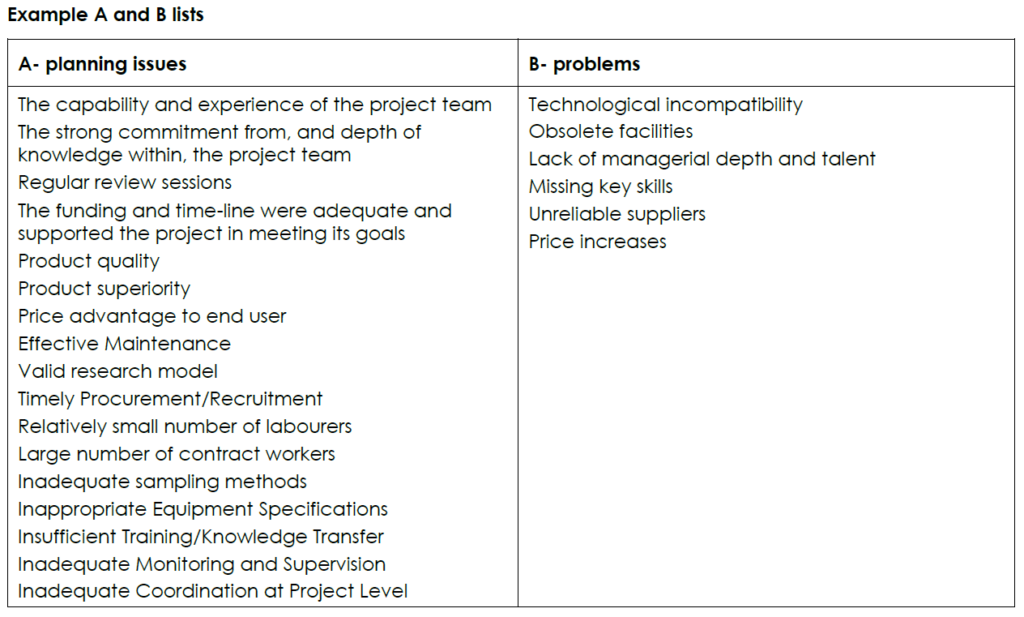
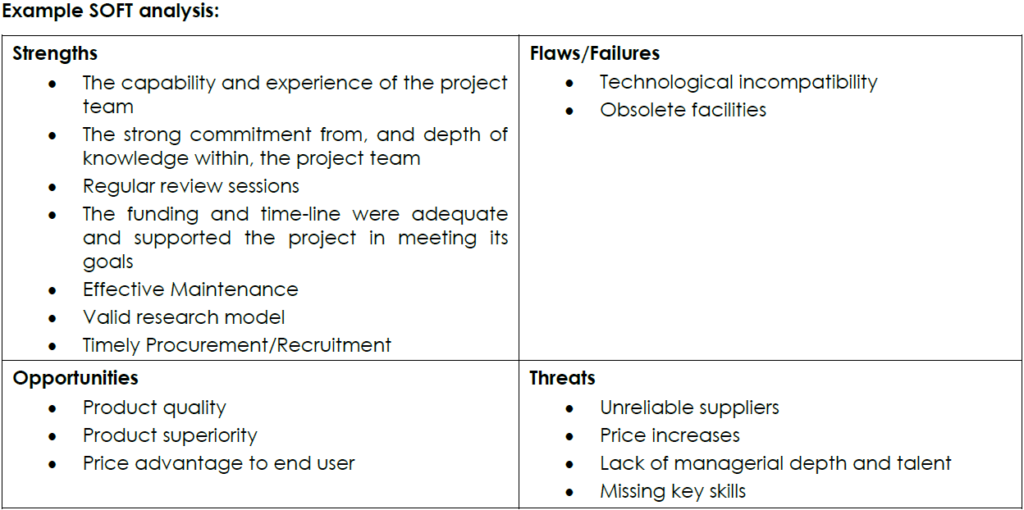
RAG status
Project monitoring depends heavily on accurate RAG status. Red, amber, green (RAG) indicators are often used to portray the status of a project. The criteria can vary from project to project- an individual project may choose to apply its own framework.
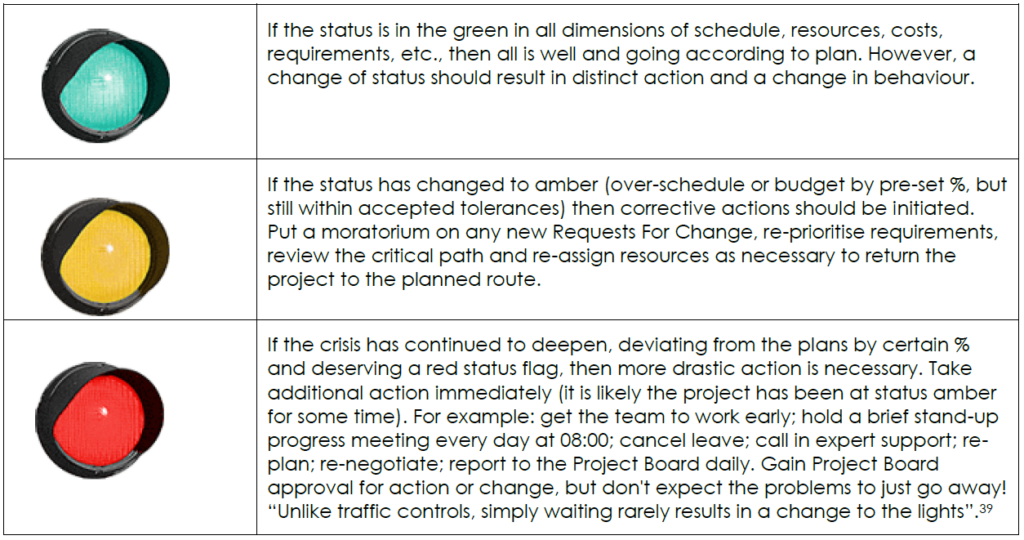
An inappropriate RAG status can lead to issue avoidance and project failure. RAG status must not be used to hide problems, but used as a way of seeking support and guidance.
Project Manager Status Checklist
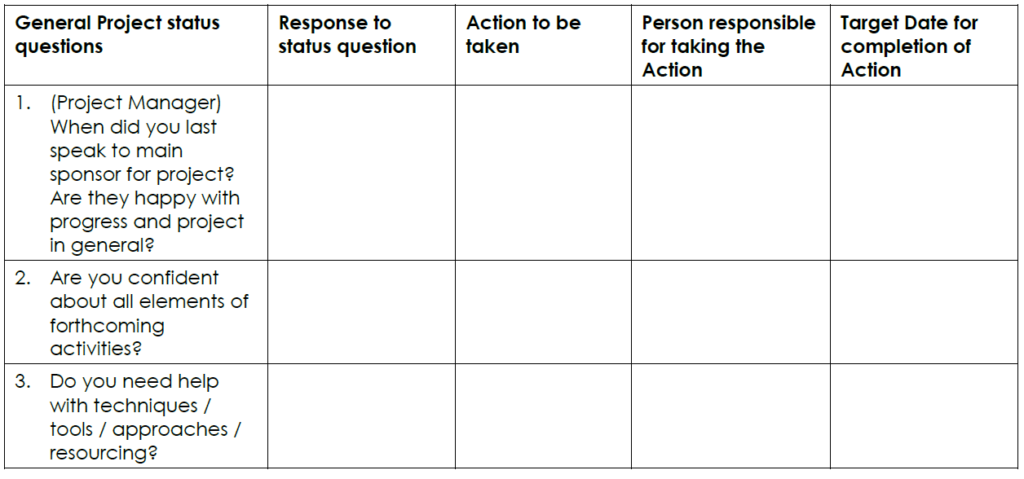
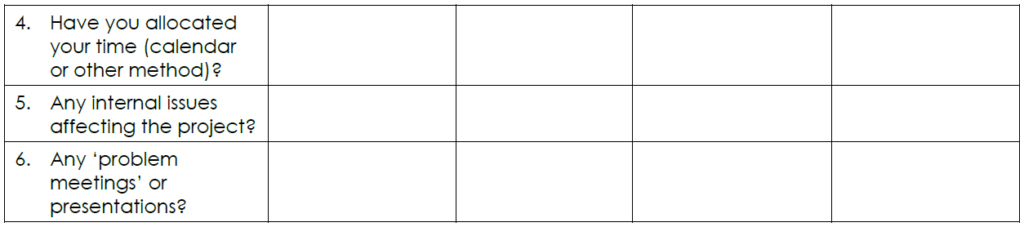
Identify and analyse deviations from the Project Plan
Baseline controls
Most project environments are so volatile that the project manager has to work hard to control the project. S/he needs to manage the scope, cost, and schedule in such a way that s/he understands and can generally quantify anything that changes as the project progresses. The primary way to do this is by various forms of “baseline controls.”
For a project to be under control, it needs to be organised as a closed system (a system whose behaviour is entirely explainable from within, a system without input). This is done by establishing baselines for scope, cost and schedule. Once the project has been contained in these three dimensions, it can be measured, monitored and controlled. If a project does not have such baseline management, it cannot be managed and measured as a closed system, and must be therefore considered to be out of control.40
No meaningful performance measurements can be made where the scope, cost, and schedule are not defined and under some form of change control discipline.
The project manager needs to be able to measure the work that goes into a project in rands and work hours and the productivity that comes out of the project, in percentage completions and tasks accomplished. Without a stable baseline and measurement of input and output, the project cannot be measurable and controlled.
Considering the project effort to be a process, the plans, specifications, resources, and methods are the inputs. The process outputs should be continually monitored and compared to the plan. Adjustments in the process should be made to conform the project output to the desired output. Variance between project results and the plan should be assessed and reported periodically.
If it becomes apparent that the project cannot be managed to its baseline, radical changes may be required. Changes to project scope or the realisation that the project plan is seriously flawed can make the baseline of questionable value for project control.
In such a case, the project may have to be replanned and re-baselined. When a new baseline is established, the same process of monitoring output and controlling the process must be continued.
Establishing the baseline
Establishing the baseline is the formal end of the planning phase and the beginning of project execution and control. Controlling the project baseline is absolutely essential to project success. Other than misunderstood requirements, bad cost and schedule estimates and technical difficulties, the things that will most likely imperil a project are the changes.
It is hard to evaluate what has changed if you don’t know where you
were to start with.
Knowing where you started, and documenting it, establishes your baseline. This baseline is your budget, schedule and project scope. A project without a stable planning baseline is flying blind.
Project baseline definition begins with understanding the user or customer requirements. Understanding requirements involves making judgments about what the organisation, technologies, and markets will be like in the time-frame after project completion. Sometimes a requirements analysis will have to penetrate beyond a mere synthesis of what users think they need. The project requirement may be part of a larger need to improve vital business processes.
After the requirements analysis has resulted in definition of the project’s technical scope, the cost and schedule estimates can be refined.
Project costs and schedules can be estimated with no greater certainty than that inherent in the definition of technical scope. Cost and schedule estimates will require assumptions about labour categories, availabilities, and rates – knowing who will do the work – so assumptions and commitments about organisational involvements are needed. When cost, schedule, and requirements definition are acceptable to the organisation, a project planning baseline must be established.
Very often, establishing the project baseline will be an iterative process involving a number of successive approximations before a baseline is established.
The first attempt may result in a project that is too costly and will take too long. This can happen if the requirements analysis is done well. If the requirements analysis is done incompletely, the project plan may look affordable and achievable, but further emerging requirements may drive the project over budget and prolong the schedule.
A rigorous requirements analysis and a realistic cost and schedule estimate are necessary to establish a project baseline plan that provides a practical map for project success.
Diagram: Planning and Establishing the Project Baseline
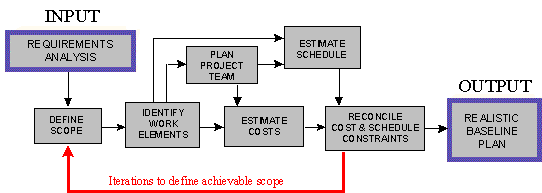
You will never be able to stop changes on a project, but if you don’t manage them methodically, your project will go out of control. Establishing and maintaining control of the schedule, cost, and scope baselines is a continual process.
Implement corrective actions Research conducted by the Eli Broad Graduate School of Management at Michigan State University found that the factors that critically impact team performance include:
The availability of certain organisational resources
The participation and involvement of suppliers when required
Higher levels of internal and external decision-making authority
Effective team leadership, including motivation
Greater effort put forth on team assignments. Using the insights gained from this research, we can conclude that when your team seems to be flagging, you may have to check the following:
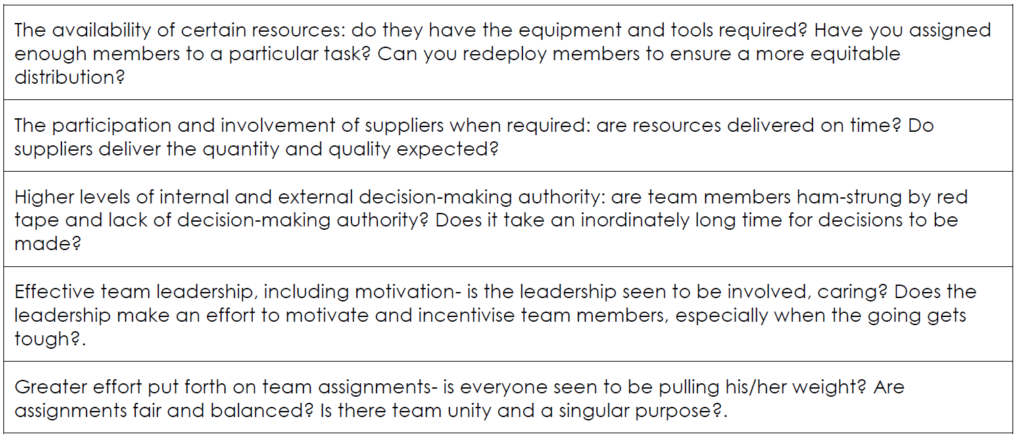
Evaluate results against the Scope and Objectives of the Project
Determining Effectiveness
The overall assessment of effectiveness refers to doing the right thing, in the right way. An innovative project or procedure will have been put in place to address a problem or an opportunity. This addresses the purpose or the need. Alignment to that purpose or need should be monitored and measured accordingly. This is why it is so important to clearly define the purpose and objectives of a project beforehand. The achievement of the milestones in the project plan should result in addressing the purpose or need.
Measuring Effectiveness
Both the effectiveness of the project achieving the purpose and the achievement of the project deliverables should be evaluated. There are short term, medium term and long term measures one can use to measure effectiveness:
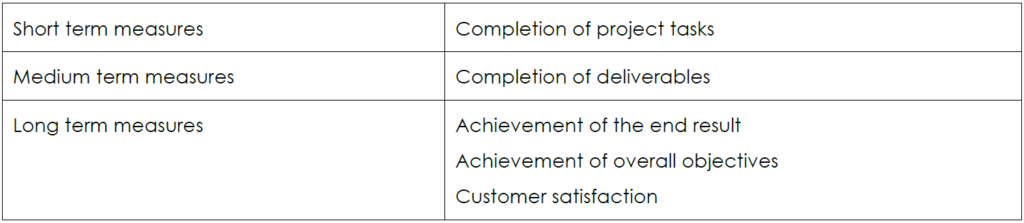
The Importance of Project Reporting
Team meetings, project progress meetings and reporting provide the conduit for measuring the effectiveness of a project. The project should be evaluated from an internal and an external perspective. 1) Does the project meet the business objectives? 2) Does the project meet the customer’s expectations?
Business needs may change as the economic or socio-political climate changes, or as business sectors adopt new innovations. Customer expectations may change accordingly. It is therefore important to constantly monitor trends and changes in your sector to ensure alignment of the project to business and customer needs.
MONITOR, MEASURE AND EVALUATE THE ACHIEVEMENT OF GOALS AND OBJECTIVES
Operational plans need to be monitored and reviewed on a regular basis to ensure that objectives are achieved. A department should be as agile as a flotilla of yachts, staying on track, but changing direction as the strategy of the organisation changes.
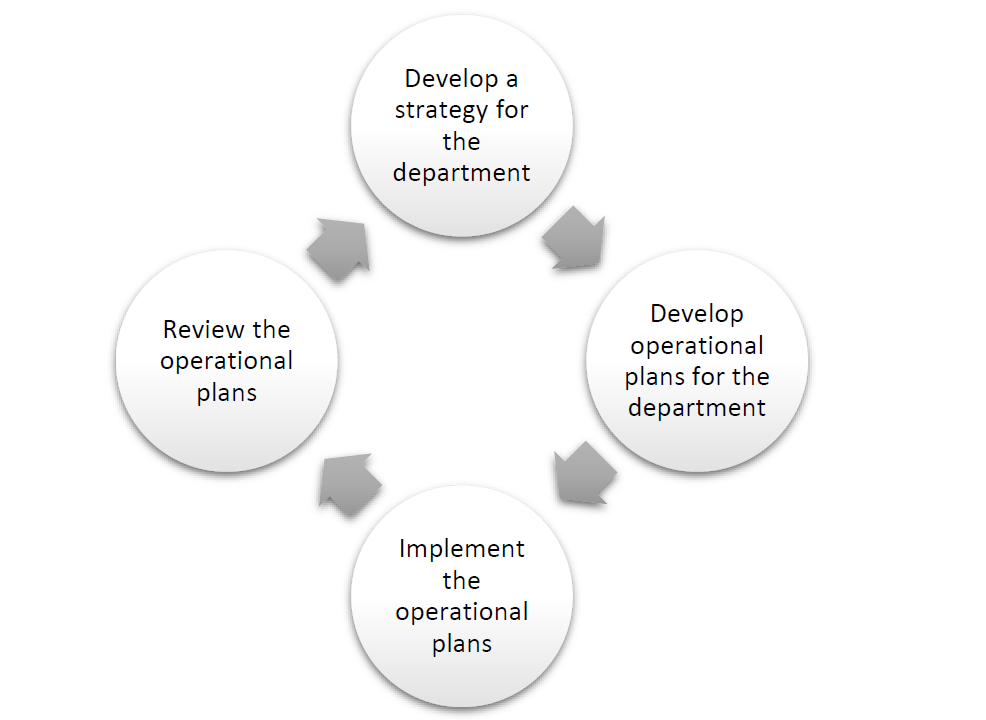
Systems for Monitoring and Evaluating the Implementation of Operational Plans
We have to bear in mind the adage: “You get what you measure”. Therefore, it is extremely important to conduct adequate planning to define appropriate goals, metrics, targets, schedules, data collection processes, and analysis procedures.
When developing organisational performance metrics, one needs to ensure that these instruments have the following features:
They must be able to forecast future trends inside and outside the organisation
Objective and unbiased
Normative – so they can be benchmarked against other organisations
Statistically reliable, with a small margin of error
Unobtrusive; must not disrupt work or trust
Inexpensive to collect – small sample sizes should be adequate
Balanced
Appropriate – measurements of the right things
Quantifiable – for ease of aggregation, calculation and comparison
Efficient – can draw many conclusions out of data set
Comprehensive
Discriminating – small changes are meaningful.
Monitor the performance of the unit
First determine how often your departmental action plan will be reviewed. This will usually be integrated into your existing performance management system. If you do not have a system in place, agree on a regular date for review with stakeholders in the business (management and staff). The achievement of your departmental action plan is directly linked to the achievements made by teams and individuals within your department. Therefore, the measurement of individual performance may need to be completed before reviewing the achievements against your action plan.
Your action plan will have housed information on what should be achieved, how, by whom and by when as well as the associated performance measures. Your reviews should monitor what progress has been made towards this. Milestones that have been achieved should be documented for reporting purposes, and plans should be put in place to address objectives, tasks and performance measures that have not been achieved.
The manager of the department is ultimately accountable for the achievement of the departmental objectives and the direct reports and staff are responsible for completing the tasks. Therefore, as a manager of a department, a performance review can be a dreaded management practice. So how do you prepare for an action plan review?
Know your review system
Communicate the review system to your department and key stakeholders
Identify who you will report progress to (within your department and within the business)
Keep track of your department’s progress
Focus on out of the ordinary contributions
Make compensation goals known
Be prepared.
Results from the individual performance reviews should be communicated by your line managers in the same manner with you.
Let’s look at an example. Let’s say a financial services company that provides short- term lending solutions has a strategic goal of: Sales growth of 15% for the next financial year.
Your department is the sales department and your departmental objective is:
Sales growth of 15% for the next financial year
The individual efforts of your sales staff could equate to desired sales growth. If upon review, however it is noted that in the first quarter there has only been a growth of 2%, warning bells should ring and steps should be taken immediately to establish the cause. Do not make rash assumptions. Reasons attained through proper analysis could reveal a range of reasons from poor credit vetting processes, to incompetent sales staff, to red tape, to lack of willingness and motivation, to poor processes, or even to rewarding poor performance. It could also reveal that the market is not interested and that the objective is unrealistic. It is therefore imperative that action plans are not only monitored, but the reasons for poor performance are explored.
Communicate results to stakeholders throughout the process
Reporting on findings
Communicating your findings is a proven way to keep people involved and informed. Include this in your communication strategy. Define who your target audiences are, what their reporting needs are and select the best medium to convey your departmental results.
In selecting your reporting format, you want to convey desired versus actual targets achieved. If there is a variance, you should support this with a contingency.
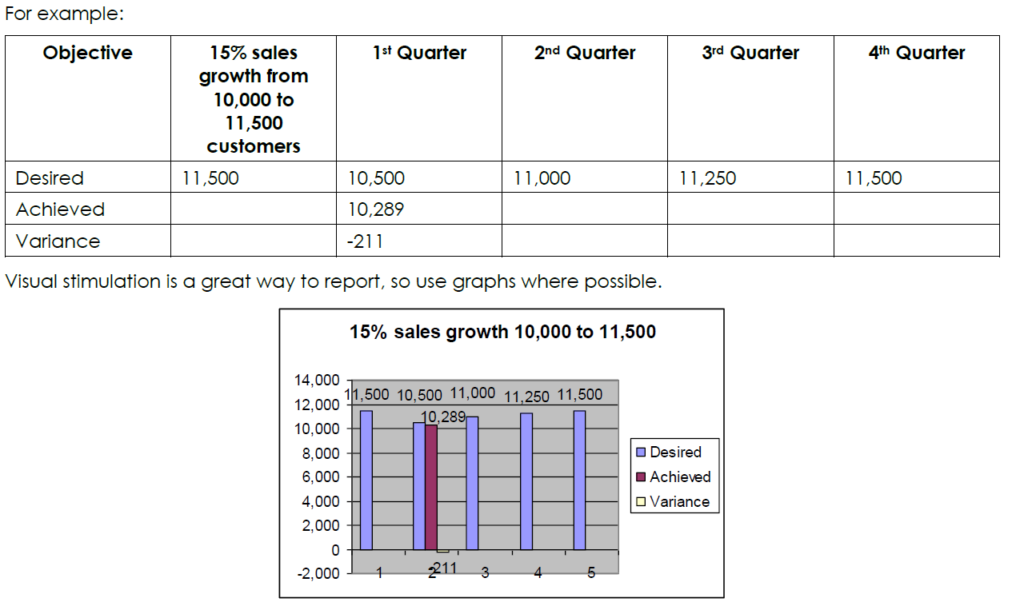
Make amendments to the plan if necessary to ensure efficiency and effectiveness of the department
In the previous example there is a shortfall of 211 sales for the 1st quarter. You would have already established that the reason for the shortfall is due to poor credit vetting processes. Your contingency would therefore be to train sales staff on how to ensure credit worthiness, refine the process and implement consequences for non-conformance. You will also need to raise you targets for the remaining quarters to make up for the shortfall.
Your action plan needs to be amended on an ongoing basis to support the achievement of your departmental goals and the strategic objectives.
Conduct Performance Reviews of Team Members
Monitor performance in terms of performance agreements
A performance review is the process of assessing current performance by an individual by rating the level of achievement of actual outputs against required target outputs, as agreed in the performance agreement, at the end of a specified review period.
The manager holds a discussion with the individual concerned. The results of the performance review are used as input to determine processes that could improve the performance of the individual. Improved individual performance benefits the effectiveness and performance of the whole organisation.

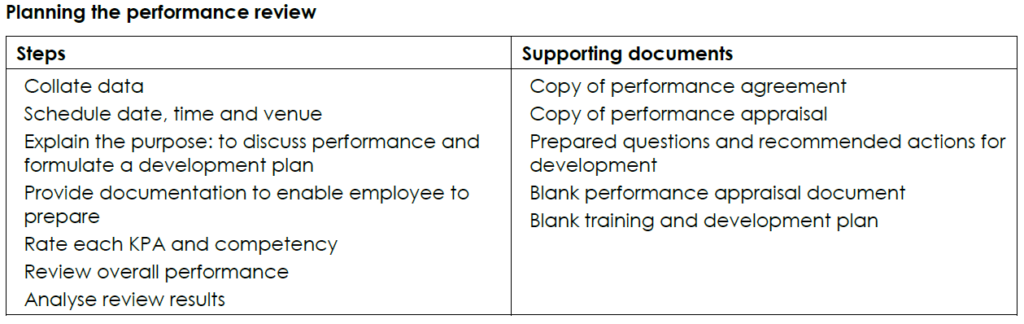
Performance review interview process
Let’s explore the performance review interview process briefly:
Clarify the purpose of the interview:
To discuss performance
To agree on the ratings
To identify areas for development.
Employee feedback:
Gives feedback on his/her performance per output
Gives feedback on his/her performance overall
Provides justifications/examples for his/her ratings, especially those where the manager has different ratings.
Manager feedback:
Gives feedback on his/her performance per output
Gives feedback on his/her performance overall
Clarifies differences with examples
Discusses data gathered as justification.
Reach agreement:
Compare ratings, and based on the justifications provided by both parties, reach agreement on the final rating for each output and overall
If you cannot come to an agreement, confirm final rating based on justifications and inform employee of his/her rights in terms of lodging a grievance/complaint
Schedule a date and time for meeting to formulate training and development plan.
Implement Recommendations on Corrective Action
Address under-performance issues
What is under-performance?
Not meeting the KPA’s and performance outputs against specific standards, despite interventions, such as feedback, review and personal development plans.
The employee is rated as below standard for more than one KPA and output.
The employee does not demonstrate an improvement in performance.
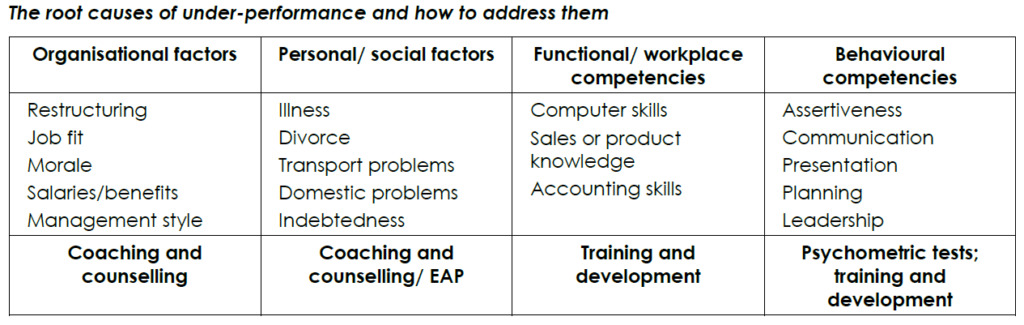
Evaluate Results
High staff morale is a popular goal, but one that is difficult to measure. Therefore, more specific forecasters, such as number of accidents, absenteeism and employee turnover may be evaluated together and serve as a measure for increasing or declining morale.
However, careful evaluation must be used. If the accident rate increases rapidly in the production area, it would suggest declining morale when a significant increase is caused by employee carelessness. However, if the cause is related to equipment that suddenly wears out, then there probably is not a relationship between accident rate and low morale.
It is essential that managers carefully evaluate deviations before taking action. It is also important that they remember that deviations can be positive as well as negative and that they reward employees for positive deviations. Unfortunately, this step is often omitted and only the negative aspects of deviation receive attention.
Who should receive feedback from this evaluation and how often should it be offered?
The person who is accountable for accomplishing the standard should receive the information first.
The employee’s line manager or whoever is in a position to reward the employee should receive the information at about the same time or a little later.
Then peers, colleagues, subordinates and other line people can receive the information. At this time, the manager ought to have some suggestions about how to get back on course if the employee needs help.
The manager’s most important job is coaching subordinates, and a good planning control system provides an excellent framework for such coaching.
Feedback must be reliable, quite frequent, and prompt. The feedback has to be reliable for the employees to be able to change the behaviour or plan in order to get on course. Frequency of information has to do with the interval for which data are received. If, for instance, costs would not normally get out of control in a short period, then monthly reports might be adequate. On the other hand, a delay of six months might allow the situation to get so far out of control that it would be too late to take corrective action.
Sometimes prompt feedback can create problems. Today’s computer-based control systems can provide feedback on a real time basis, but such speed can be harmful from a behavioural standpoint. This kind of speed causes undue pressure because there is no time for the manager to use discretion and make changes.
Take corrective action
Making changes as the activity is in progress is a form of corrective action. The real correction occurs when warnings raised by the forecasters or predictors are confirmed.
The corrective action can be changing objectives, standards, plans, etc., but it can also be penalising employees when the objectives, standards, and plans are determined to be appropriate and employees have not met them.
However, there usually are several alternative corrective actions that can be taken and often more than one will prove effective.
The planning control system is not effective until corrective action is taken and this action begins a new planning-control cycle. Report success
Ce
lebrate success!
Contrary to popular belief that money is a prime motivator of most employees, study after study has shown that what tends to motivate employees to put forth their best efforts and to perform at higher levels are praise and recognition.
People want to feel they are making a contribution at work, and for most individuals this is a function of having the respect of peers and colleagues, having managers who tell them when they do a good job, and being involved and informed about what’s going on in their department or organisation.
It is important to consider that the money employees are paid for the job they are hired to do is compensation, which should be a function of a company’s compensation philosophy and its market and geographic considerations. In addition to salaries, economic incentives are becoming rights rather than rewards. As Peter Drucker pointed out, “Merit raises are always introduced as rewards for exceptional performance. In no time at all they become a right. To deny a merit raise or to grant only a small one becomes punishment. The increasing demand for material rewards is rapidly destroying their usefulness as incentives as managerial tools.”
In some cases, cash awards have even been found to have a demotivating effect. Cecil Hill, corporate manager of improvement programmes at Hughes Aircraft Company, claims, “I have found that certain aspects of the cash awards approach would be counter-productive at Hughes Aircraft. For example, cash awards would reduce teamwork as employees concentrated primarily on individual cash gains. We have also found instances where ‘pay’ for certain types of intellectual performance tends to denigrate the performance.” In short, cash awards seemed to have an overall de-motivating effect.
Recognition, on the other hand, is what you do above and beyond what people are paid to get the best effort from employees. Compensation is a right, recognition is a gift.
Various studies also indicate that employees value personalised, spur of the moment recognition for their contributions. To be effective in recognising employees, managers need to:
Deliver recognition in an open, public way
Tailor recognition to the unique needs of individuals
Recognise them close to the time of the achievement
Establish a clear connection between accomplishments and recognition.
According to Rosabeth Moss Kanter, “Recognition is so easy to do and so inexpensive to distribute, there is simply no excuse for not doing it… Recognition signifies someone has noticed and someone cares.”
At the same time, recognition communicates what the organisation values, that is, what great performance looks like
Here are ten tips for recognising your
employees:
- Personally thank employees for doing a good job – one on one, in writing, or both. Do it timeously, often and sincerely.
- Be willing to take the time to meet with and listen to employees- as much as they need or want.
- Provide specific feedback about performance of the person, the department and the organisation.
- Strive to create a work environment that is open, trusting and fun. Encourage new ideas and initiative.
- Provide information on how the company makes and loses money, upcoming products and strategies for competing in the market-place, and how the person fits into the overall plan.
- Involve employees in decisions, especially as those decisions affect them.
- Recognise, reward and promote people based on their performance; deal with low and marginal performers so that they improve or leave.
- Provide employees with a sense of ownership in their work and the work environment.
- Give people a chance to grow and learn new skills; show them how you can help them meet their goals within the context of meeting the organisation’s goals. Create a partnership with each employee.
- Celebrate successes — of the company, of the department and of individuals in it. Take time for team- and morale-building meetings and activities.