
DEVELOP, IMPLEMENT AND EVALUATE AN OPERATIONAL PLAN
Develop an operation plan for a unit
Results-based management (RBM) is a program/project life-cycle approach to management that integrates strategy, people, resources, processes and measurements to improve decision-making, transparency, and accountability. The approach focuses on achieving outcomes, implementing performance measurement, learning, and adapting, as well as reporting on performance1.
The key steps used in RBM are:
- Assess: What is the current situation?
- Think: What caused it? Who is involved?
- Envision: What are we going to achieve?
- Plan: How are we going to do it? With whom? When? With what resources?
- Do: Get it done. How is it going? Do we need to adapt?
- Review: What went well/badly? What can we learn for next time?
Throughout this programme, we will see the above in action.
Operational planning
Operational planning is the process of linking strategic goals and objectives to tactical/operational goals and objectives. It describes milestones, conditions for success and explains how, or what portion of, a strategic plan will be put into operation during a given operational period.
An operational plan addresses four questions:
Where are we now?
Where do we want to be?
How do we get there?
How do we measure our progress?
Operational plans should be prepared by the people who will be involved in implementation and should contain:
clear objectives
activities to be delivered
quality standards
desired outcomes
staffing and resource requirements
implementation timetables
a process for monitoring progress
In this Module we will investigate how to develop the operational plan for a unit.
Liedtka (1998) developed a model which defines strategic thinking as a particular way of thinking, with very specific and clearly identifiable characteristics. The figure below illustrates the five elements of strategic thinking.
The Liedtka Model of the elements of Strategic Thinking
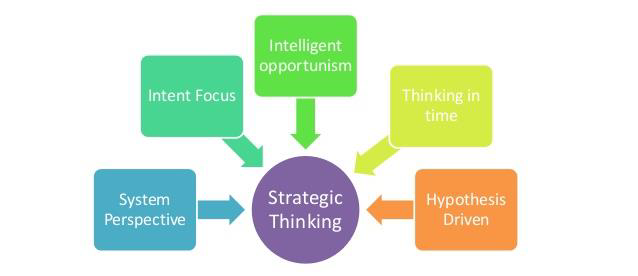
The first element is a systems perspective. A strategic thinker has a mental model of the complete system of value creation from beginning to end, and understands the interdependencies within the chain.
The mental model of how the world works must incorporate an understanding of both the internal and external context of the organisation, i.e. the business functions in a context larger than that of its industry alone; it is part of a “business ecosystem”2 that crosses a variety of industries.
In addition to understanding the external business ecosystem in which a firm operates, strategic thinkers must also appreciate the inter-relationships among the individual internal parts that, together, constitute the whole, as well as the fact that the whole is greater than the sum of its parts. The systems perspective enables individuals to clarify their role within the larger system and the impact of their behaviour on other parts of the system, as well as on the final outcome.
Thus, from a vertical perspective, strategic thinkers see the linkages in the system from multiple perspectives and understand the relationship among the corporate, business, and functional levels of strategies to the external context, as well as to the personal daily choices they make. From a horizontal perspective, they also understand the connections across departments and functions, and between suppliers and buyers.
The second element of strategic thinking is that it is intent-focused and intent-driven.
Strategic intent provides the focus that allows individuals within an organisation to marshal and leverage their energy, to focus attention, to resist distraction, and to concentrate for as long as it takes to achieve a goal. “In the disorienting swirl of change, such psychic energy may well be the scarcest resource an organisation has, and only those who utilise it will succeed”.3
Therefore, strategic thinking is fundamentally concerned with, and driven by, the continuous shaping and re-shaping of intent.
The third element of strategic thinking is intelligent opportunism: the idea of openness to new experience, which allows one to take advantage of alternative strategies that
may emerge as more relevant to a rapidly-changing business environment. In practising intelligent opportunism, it is important that organisations seriously consider the input from lower level employees or more innovative employees who may be instrumental in embracing or identifying alternative strategies that may be more appropriate for the environment.
Mintzberg (1999) points out that it is very hard for a CEO or prospective CEO to say to a board, “Well, we are evolving our strategy. It’s emerging.” The board wants the strategy to be “nice and clear” as do the stock-market analysts, who are part of the same problem. He goes on to say that a healthy strategy system in any company is one in which there’s a tremendous amount of communication and interaction around ideas and possibilities – from the ground, from middle management, from senior management.
The fourth element of strategic thinking is referred to as thinking in time. Strategy is not solely driven by the future, but by the gap between the current reality and the goal for the future, between the current capabilities and resources and ambitions for the future. Thus, by connecting the past with the present and linking this to the future, strategic thinking is always “thinking in time.”
The fifth element of the strategic thinking recognises that the process is hypothesis-driven.
According to Liedtka (1998) this approach is somewhat foreign to most managers: “Yet in an environment of ever-increasing information availability and decreasing time to think, the ability to develop good hypotheses and test them efficiently is critical . . . the ability to work well with hypotheses is the core competence of the best strategy consulting firms”.
Hypothesis generation poses the question, “What if . . .?” Hypothesis testing follows up with the critical question, “If . . . then” and evaluates the data relevant to the analysis.
In summary, Liedtka (1998) states:
“Firms who succeed at embedding a capability for strategic thinking throughout their organisations will have created a new source of competitive advantage. Their whole (holistic) system perspective should allow them to redesign their processes for greater efficiency and effectiveness. Their intent-focus will make them more determined and less distracted than their rivals. Their ability to think in time will improve the quality of their decision-making and speed of implementation. A capacity for hypothesis generation and testing will incorporate both creative and critical thinking into their processes. Intelligent opportunism will make them more responsive to local opportunities”.
The greatest competitive differentiator for organisations is the ability to put strategy into operation.
All too often, a strategy is defined but it is not communicated, understood or implemented by the employees. The strategy that is defined by the business should be tangible by translating it and cascading it horizontally and vertically through the business. All employees and stakeholders should align their performance to achieving the strategic vision, mission and objectives.
The strategic plan determines where the organisation intends going, what it intends achieving and how it will achieve it. It is the future focus for the entire organisation. It involves creating fits between strategy and the way things are done in the business. “Fits” ultimately refer to alignment of your people, processes and technology.
The process that we will be following to achieve this, is depicted in the diagram below:
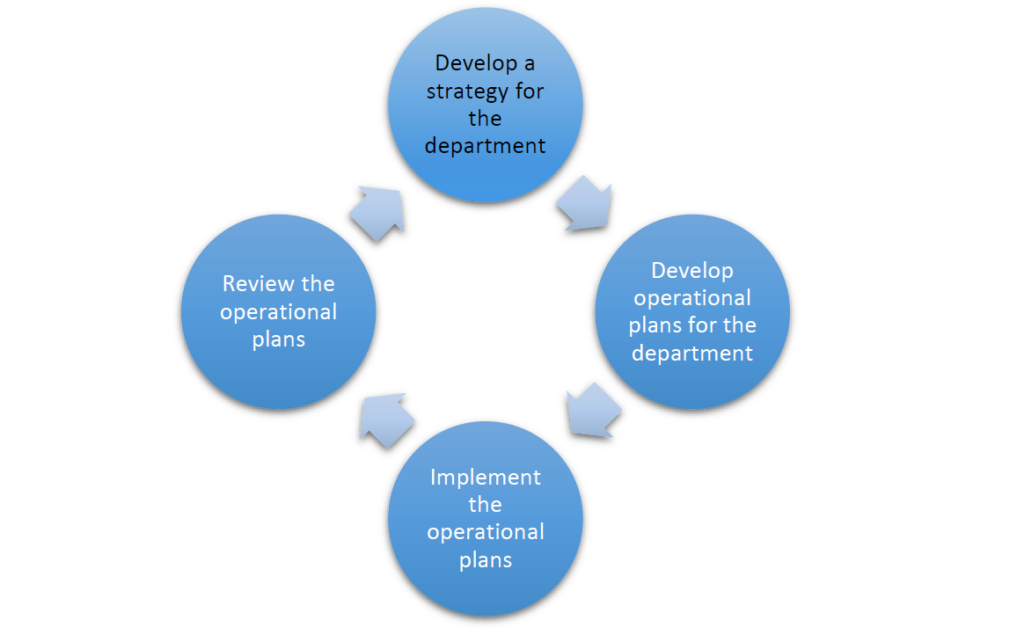
Developing and implementing a strategy and action plans for a team, department or division
Develop Operational Strategies
The first step in aligning operations with the strategic plan is to understand the plan. Begin first by understanding the company vision and mission. The vision explains the preferred future and the mission explains the purpose and function.
Role of the vision and mission statements
An organisation’s mission and vision statements are a description of the goals and objectives of the business. Just as we have a personal value system and goals by which we try to live, an organisation has certain values and goals, which are embodied in its culture and its mission and vision statements. Because values are the basis for organisational decisions, strategy must be driven by a thorough understanding of the dominant values of the enterprise.
The vision statement of a business says what it hopes to achieve in the future. The vision statement describes where the business is going or where it wants to go, in other words, the future of the business.
While the primary objective of a business is to make a profit, it also necessarily
forms a relationship with the
community and environment, and with its customers, employees and shareholders.
There are certain characteristics that most vision statements have in common. In general, vision statements should be:
Understood and shared by all members of the organisation
Broad enough to allow a diverse variety of perspectives to be encompassed within them
Inspiring and uplifting to everyone involved
Easy to communicate – for example, they should be short enough to fit on a T-shirt
The end result, or desired outcome, is clearly stated
It gives a picture of the business’s planned future
It is a plan of action
It expresses the business’s culture and climate
The
mission statement describes why the business exists today . It is a reflection of th e goals of a business and
how it sees its responsibilities to the customer and community. The mission statement describes the purpose
of the business’s existence.
A mission statement:
Gives direction and guidance to everyone in the business
Is realistic a nd achievable
Must not be so vague that it could apply to any other organisation
Is concise. Although not as short a phrase as a vision statement, a mission statement should still get its point across in one sentence
Is outcome-oriented. Mission statements explain the overarching outcomes your organisation is working to achieve
Is inclusive. While mission statements do make statements about your company’s overarching goals, it’s very important that it does so very broadly. Good mission statements are not limiting in the strategies or sectors of the organisation that may become involved in the project.
A good mission statement is made up of three parts:
The key market is defined
The company’s contribution is stated
A distinction is made between your compan y and others
For example:
Key market
To provide discerning , quality minded guests
Contribution
with an exclusive, premier lodging facility
Distinction which is consistently perceived as comfortable, well-maintained and attractive, staffed by friendly, attentive and efficient people
All staff members should know and understand the company’s goals. This will ensure that all staff work as a
team, with a full understanding of the desired direction:
Everyone will have the same focus and there will be no misunde rstandings
Creates a team oriented environment
Improves employee morale
Helps attract and keep the best people
Once you’ve analysed the mission and vision statements, work through the organisation’s strategic objectives.
What are Objectives?
An objective is a target a business sets for itself. The target may be short term (one year) or long term (five years). Targets help a business to measure its success.
Once an organisation has developed its mission statement, its next step is to develop the specific objectives that are focused on achieving that mission. Objectives are the specific measurable results of the initiative. An organisation’s objectives offer specifics of how much of what will be accomplished by when.
For example, one of several objectives for a corporate social responsibility initiative to promote care for older adults might be: “By 201X (by when), to increase by 20% (how much) those elders reporting that they are in daily contact with someone who cares about them (of what).”
Strategic objectives may be classified into the four perspectives of the Balanced Scorecard. The four perspectives of the Balanced Scorecard are:
Financial
Customer
Internal Business Process
Learning and Growth
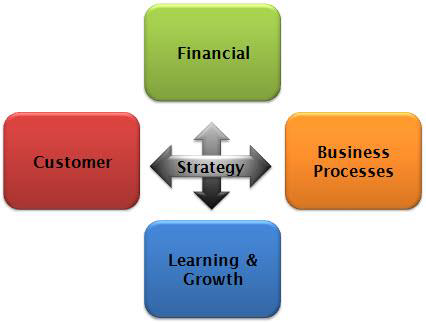
The balanced scorecard provides a mechanism for taking an organisation’s vision and strategy, and translating them into clearly-defined, measurable objectives. Achievement of these objectives adds value to the organisation both immediately and in the long-term. In other words, it captures the organisation’s value-adding activities and focuses people’s efforts on them.
The analysis of the organisation strategic plan should also include external appraisal (how are we viewed by stakeholders outside the business), internal appraisal (how are we viewed by internal stakeholders), corporate culture appraisal (how has I culture contributed towards or hampered progress) and past performance appraisal (how have we performed historically).
The Four Perspectives of the Balanced Scorecard
When working through the organisation’s strategic plan, consider the four business perspectives. These four perspectives present a balanced view of the whole organisation, and if objectives are set under each of these headings for your department, it is unlikely that any important area will be missed.
These perspectives, and the way they stem from the organisation’s strategy, are shown in this diagram4:
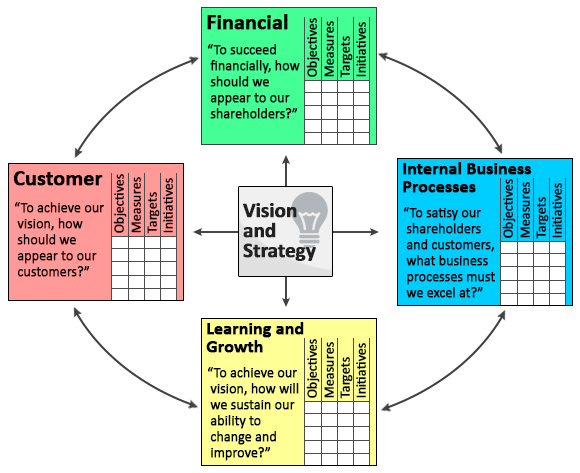
Let’s take a closer look at the concept of a balanced scorecard and each of the perspectives. When the scorecard is complete, it should consist of objectives and measures which reflect the organisation’s mission and strategy. The measures represent a balance between:
External measures for shareholders and customers and internal measures of critical business processes and of learning and growth.
Measures which report the historical performance of the organisation and measures intended to drive future performance.
Objective, quantifiable measures (i.e. we can put a number to them) and subjective measures (i.e. we make a value judgement about them).
A balanced scorecard lists objectives for each business perspective, indicates how each will be measured, and states the target that has been agreed for each one. It is therefore a very simple document, with this layout:
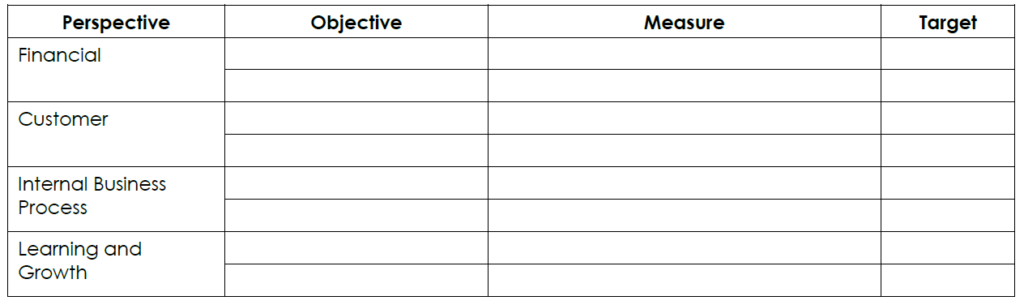
The Financial Perspective
The Financial Perspective helps a company to determine whether the strategy, implementation and execution are contributing to the bottom line.
When defining the financial perspective we need to ask the question, “How should we appear to our shareholders?”
Are we spending more money than we are receiving?
Are structures in place to control financial expenditure?
Financial success is used in addition to the other three perspectives to determine overall success
The Customer Perspective
The Customer Perspective involves evaluating our clients’ needs such as time, quality, performance and service.
When defining the customer perspective we need to ask the question “How do we interact with our customers?”
Internally and externally, what percentage of new services should we offer?
How long should we take to respond to requests?
What are the time, cost and quality requirements expected from our clients?
Internally and externally, what are the customer satisfaction levels and what should they be?
The Internal Business Process Perspective
The internal business process perspective involves applying measurements to internal operations in order to improve efficiency and effectiveness.
When defining the internal business process perspective, we need to ask the question “Where must we excel?”
Consider measures stemming from processes with the greatest impact on customer satisfaction (response time, quality, etc.)
Attempt to identify and measure core competencies and services required to remain a market leader
Use employee ideas and suggestions to improve systems and processes
The Learning and Growth Perspective
The learning and growth perspective addresses the organisation’s ability to innovate, improve, develop and motivate staff.
When defining the learning and growth perspective, we need to ask the question “How will we sustain our ability to change and improve our company?”
Retain and develop the competency set of our people
Improve our employee motivation and morale
Improve the overall organisational culture
Empower people to create value
Strategic models
There is no one perfect strategic planning model for each organisation. Each organisation ends up developing its own model of strategic planning, often by selecting a model and modifying it as it develops its own planning process.
The following models provide a range of alternatives from which organisations might select an approach and begin to develop their own strategic planning process, bearing in mind that an organisation might choose to integrate the models, e.g. using a scenario model to creatively identify strategic issues and goals, and then an issues-based model to carefully strategise to address the issues and reach the goals.5
- “Basic” strategic planning
This very basic process is typically followed by organisations that are extremely small, busy, and have not done much strategic planning before. Planning is usually carried out by top-level management.
The basic strategic planning process includes:
Step 1 – Identify the purpose (mission statement)
This is the statement that describes why an organisation exists, i.e. its basic purpose. The statement should describe what client needs are intended to be met and with what services. Top-level management should develop and agree on the mission statement. The statements will change with time.
Step 2 – Select the goals the organisation must reach if it is to accomplish its mission
Goals are general statements about what the organisation needs to accomplish to meet its purpose, or mission, and address major issues facing the organisation.
Step 3 – Identify specific approaches or strategies that must be implemented to reach each goal
The strategies are often what change the most as the organisation eventually conducts more intensive strategic planning, particularly by more closely examining the external and internal environments of the organisation.
Step 4 – Identify specific action plans to implement each strategy
These are the specific activities that each major function (department, division, etc.) must undertake to ensure it is effectively implementing each strategy. Objectives should be clearly worded to the extent that people can assess if the objectives have been met or not. Ideally, top management develops specific committees that each have a work plan, or set of objectives.
Step 5 – Monitor and update the plan
Planners regularly reflect on the extent to which the goals are being met and whether action plans are being implemented. Perhaps the most important indicator of success of the organisation is positive feedback from the organisation’s customers. - Issue-based (or goal-based) planning
Organisations that begin with the “basic” planning approach described above, often evolve to using this more comprehensive and more effective type of planning.
The following is a step-by-step summary of this type of planning process:
- External/internal assessment to identify “SWOT” (Strengths and Weaknesses; Opportunities and Threats)
- Strategic analysis to identify and prioritise major issues/goals
- Design major strategies (or programmes) to address issues/goals
- Design/update vision, mission and values(some organisations may do this first in planning)
- Establish action plans (objectives, resource needs, roles and responsibilities for implementation)
- Record issues, goals, strategies/programmes, updated mission and vision, and action plans in a Strategic Plan document and attach SWOT, etc.
- Develop the yearly Operating Plan document
- Develop and authorise budget for the year
- Conduct the organisation’s operations
- Monitor/review/evaluate/update Strategic Plan document
- Alignment model
The overall purpose of the alignment model is to ensure strong alignment among the organisation’s mission and its resources to effectively operate the organisation. This model is useful for organisations that need to fine-tune strategies or find out why they are not working. An organisation might also choose this model if it is experiencing a large number of issues around internal efficiencies.
Overall steps include:
- The planning group outlines the organisation’s mission, programmes, resources, and needed support.
- Identify what’s working well and what needs adjustment.
- Identify how these adjustments should be made.
- Include the adjustments as strategies in the strategic plan.
- Scenario planning
Scenario planning or scenario thinking is a strategic planning method that some organisations use to make flexible long-term plans. It is in large part an adaptation and generalisation of classic methods used by military intelligence.
This approach might be used in conjunction with other models to ensure planners truly undertake strategic thinking. The scenario planning model may be useful, particularly in identifying strategic issues and goals.
“Scenario planning isn’t the same thing as strategic planning. Basic strategic planning tends to address the accidents of the day, such as the decision to reduce inventory because of a downturn in the economy. Scenario planning looks at what’s going to happen tomorrow. It’s focused on understanding what the future will look like, so that CEOs can build their organisations accordingly.” 6
In the 1980s Pierre Wack7 wrote about work he was doing for the Royal Dutch Shell Company over the previous decade. Because the price of oil is so volatile, and because it is such an important factor in determining the fortunes of a company like Shell, he worked with his team on developing scenarios for the company’s top executives. Wack invented the practice of scenario planning, which is different from just forecasting the future. Scenario planning is the use of alternative stories about the future, many with improbable and dramatic twists, to develop strategy. By presenting different possible futures to managers, the scenario planner’s hope is get managers, as Wack says, to “question their own model of reality and change it when necessary so as to come up with strategic insights beyond their minds’ previous reach”.
Scenario planning alerted Shell’s managing directors in advance about some of the most dramatic events of their times: the 1973 energy crisis, the more severe price shock of 1979, the collapse of the oil market in 1986, the fall of the Soviet Union, the rise of Muslim radicalism, and the increasing pressure on companies to address environmental and social problems.
As the pace of change in business accelerates, the legacy of Pierre Wack, the father of scenario planning, is more relevant than ever. A clear sense of the future’s obscure challenges and opportunities is the most valuable asset an executive can have. To Mr. Wack, the ability for which managers are most celebrated, namely the ability to get things done, was only one part of their necessary skills. Equally important was the ability to see ahead.
Scenario planning has since become widely popular outside Shell, not just in corporations, but in some governments, as well. In South Africa, for example, scenario planning played a major role in the peaceful transition from a system of apartheid to a stable multiracial government.
Scenario planning is an outstanding learning tool — a way to learn about the future through a deeper understanding of the major driving forces affecting all of us today. In a group setting, executives engaged in scenario planning exchange knowledge and ideas, constructing a selection of “future stories” that expand their understanding of the current business environment and broaden their perception of future events.
“Driving forces,” the most significant trends likely to affect the larger world, generally represent four categories:
Society: Demographics, lifestyle changes, etc.
Economics: Industry changes, competitive forces, changes in workforce, etc.
Politics: Electoral, legislative, regulatory
Technology: Innovations, etc.
Within this overall grouping are predetermined elements (large-scale forces that are relatively stable and predictable, such as population demographics) and critical uncertainties (forces that we can’t predict, such as natural disasters, shifts in consumer tastes, new products devised by the competition, and so on).
“The goal in scenario planning isn’t to create one specific future. Instead, by drawing attention to key drivers and exploring how they push the future in different directions, planners create an array of possible ‘futures’ — resulting in the ability to make crucial decisions today.”8
The basic approach in scenario planning is two-fold:
- Know your core competencies: The starting point for any future thinking is knowing your strengths as they exist right now, as well as your organisation’s strategic advantage in the marketplace.
- Identify forces and trends: Has your company taken the time to seriously pinpoint forces that affect your financial performance; now and in years to come?
In some industries, the driving forces are obvious, for example a good example is the Internet, which facilitates communication to and from any locality in the world. Now we don’t need central meeting spaces any longer. How is your business different when all your customers and suppliers, as well as your competition, are in the same room and can talk to each other at the same time?
Other guidelines to constructing scenarios:
Look for patterns: As you devise different versions of the future, look for common threads and/or underlying similarities.
Tell a story: Convert apparently random scenarios into believable, coherent stories.
Imagine, don’t predict: Don’t confuse scenarios with predictions.
Test the impact: What are the consequences for your company of each different scenario?
Break free of stereotypes: Use scenario planning to challenge inbred or conventional assumptions.
How scenario planning or scenario thinking is done:
- Decide on the key question to be answered by the analysis. By doing this, it is possible to assess whether scenario planning is preferred over the other methods. If the question is based on small changes or a very few number of elements, other more formalised methods may be more useful.
- Set the time and scope of the analysis. Take into consideration how quickly changes have happened in the past, and try to assess to what degree it is possible to predict common trends in demographics, product life cycles, etc. A usual timeframe can be five to 10 years.
- Identify major stakeholders. Decide who will be affected and have an interest in the possible outcomes. Identify their current interests, and whether and why these interests have changed over time in the past.
- Map basic trends and driving forces. This includes industry, economic, political, technological, legal and societal trends. Assess to what degree these trends will affect your organisation. Describe each trend, how and why it will affect the organisation. In this step of the process, brainstorming is commonly used, where all trends that can be thought of are presented before they are assessed, to prevent possible group thinking and tunnel vision.
- Find key uncertainties. Map the driving forces on two axes, assessing each force on an uncertain/(relatively) predictable and important/unimportant scale. All driving forces that are considered unimportant are discarded. Important driving forces that are relatively predictable (e.g. demographics) can be included in any scenario, so the scenarios should not be based on these. This leaves you with a number of important and unpredictable driving forces. At this point, it is also useful to assess whether any linkages between driving forces exist, and rule out any “impossible” scenarios (e.g. full employment and zero inflation).
- Check for the possibility to group the linked forces and if possible, reduce the forces to the two most important. (To allow the scenarios to be presented in a neat xy-diagram)
- Identify the extremes of the possible outcomes of the (two) driving forces and check the dimensions for consistency and plausibility. Three key points should be assessed:
Time frame: are the trends compatible within the time frame in question?
Internal consistency: do the forces describe uncertainties that can construct probable scenarios?
- Define the scenarios, plotting them on a grid if possible. Usually, 2 to 4 scenarios are constructed. The current situation does not need to be in the middle of the diagram (inflation may already be low), and possible scenarios may keep one (or more) of the forces relatively constant, especially if using three or more driving forces. One approach can be to create all positive elements into one scenario and all negative elements (relative to the current situation) in another scenario, then refining these. In the end, try to avoid pure best-case and worst-case scenarios.
- Write out the scenarios. Narrate what has happened and what the reasons can be for the proposed situation. Try to include good reasons why the changes have occurred as this helps the further analysis. Finally, give each scenario a descriptive (and catchy) name to ease later reference.
- Assess the scenarios. Are they relevant for the goal? Are they internally consistent? Do they represent relatively stable outcome situations?
- Identify research needs. Based on the scenarios, assess where more information is needed. Where needed, obtain more information on the motivations of stakeholders, possible innovations that may occur in the industry and so on.
- Develop quantitative methods. If possible, develop models to help quantify consequences of the various scenarios, such as growth rate, cash flow etc.
- Converge towards decision scenarios. Retrace the steps above until you reach scenarios which address the fundamental issues facing the organisation. Try to assess upsides and downsides of the possible scenarios.
One of the leading proponents of scenario planning in South Africa is Clem Sunter, former Chairman of Anglo American:
THE MIND OF A FOX9
To Clem Sunter’s way of thinking, humanity is divided into two categories: the hedgeho
gs and the foxes.
In his new book,
The Mind of a Fox , co written with Chantell Ilbury, Sunter writes, “Foxes are people who
embrace uncertainty and believe that experience doing things is an essential source of knowledge.”
“Foxes need to ask themselves
what do I control?” says Sunter. “What do I not control? Of all the factors that
affect me and my business, what is certain? And what is uncertain?”
Some things are uncertain and will always remain so. There is nothing the entrepreneur can do about the
pr ice of fuel or the interest charged on house bonds. He or she has no control over such matters. And there is
no point wasting time, energy and worry on these factors.
But there are matters of which we can be certain and over which we do have control. “The
real fox expends
his or her energy there,” says Sunter. “That is where there can be a return for the effort that is being expended.”
Clem Sunter is an exponent of the rare art of scenario planning… a way of looking at the future that
encourages you to thin k through a range of possible outcomes best and worst case scenarios and everything
in between. We all need to do it: entrepreneurs, managers, consultants, agents, licensees, franchisees,
professionals, or whatever your line of business. If you operate a factory or workshop and 50% of your staff
contract Aids and either die or become too ill to work, what do you do? What are your options in the good
days and the bad?
The message is to control those elements that you can and survive the others by anticipati
ng them. You have
control over how hard you work, how smart you work, how determined you are, how much knowledge you
acquire before making decisions: you even have control over how you deal with those elements you cannot
control.
The authors use the following example of scenario planning (example 1):
You are in a vehicle travelling towards an intersection on a main road. On a minor road, coming towards the same intersection is another vehicle that you have every reason to believe should stop. This action is out of your control, cannot be guaranteed and is therefore uncertain.
This is a key uncertainty. In your mind you play out different scenarios:
- The driver of the other vehicle sees you and slows to a halt, allowing you to travel through safely.
- The driver of the other vehicle doesn’t see you, drives straight through the intersection, and you have a near miss.
- The driver of the other vehicle doesn’t see you, drives straight through the intersection and you have a crash.
Based on the scenarios, you have a number of options:
- Maintain your speed on the assumption that the driver is eventually going to see you
- Slow down because you worry that the driver is not going to see you
- Speed up in the hope that you may get through the intersection before the other vehicle arrives.
Which option would YOU choose?
Options 1 and 3 may result in a crash, whereas option 2 won’t. The way of the fox, the entrepreneur, has to be option 2. The fox knows that the other vehicle may not stop. The fox controls what he or she can. There is
nothing you can do about the behaviour of the other driver, but you can modify your own to avoid the accident.
Scenario planning: (example 2)
How would you plan for the five-year failure of your organisation?
Gideon Malherbe, president of VCI, New York suggests the following:
“Ask people in the company how they might go about destroying the business. Employees won’t believe you’re serious, so they won’t think they actually have to do any of the things they propose. As a result, they won’t limit themselves, and will give you their best ideas. After all, in their minds, the exercise is just fun. They will suggest all kinds of possibilities. And that’s exactly what you want!”
In this manner, he adds, the CEO and senior management can learn what employees think is working and what isn’t working in the business — and what the company is doing right now in both categories.
“What makes scenario planning such an effective tool is that it tells many compelling stories,” Malherbe says. “This is a way to gauge current reality and a way for people to find meaning in the daily tasks they perform for your organisation.”
“Thinking about the future means asking yourself some tough questions,” Malherbe says. “But the value lies in anticipating change before it happens — rather than mindlessly reacting to whatever comes at you next.”
Toward that end, ask questions like:
Who will our customers be five years from now?
What channels will we use to reach these customers?
Are our short-term priorities aligned with our long-range goals?
What will constitute our competitive advantage?
What will make us unique?
Are we aware of new competitive threats on the horizon?
Do senior staff have a commitment to altering the business model as changing times demand?
Is our change mandate driven by our competitors’ actions or by our own unique vision of the future?
“Your answers to these questions will tell you a lot about who you are today,” Malherbe notes. “It will also give you a better sense of the type of resources you’ll need to commit to imagining your organisation’s future.”
- “Organic” (or self-organising) planning
Traditional strategic planning processes are sometimes considered “mechanistic” or “linear,” i.e. they’re general-to-specific, or cause-and-effect in nature. For example, the processes often begin by conducting a broad assessment of the external and internal environments of the organisation, conducting a strategic analysis (“SWOT” analysis), narrowing down to identifying and prioritising issues, and then developing specific strategies to address the specific issues.
Another view of planning is similar to the development of an organism, i.e. an “organic,” or self-organising process. Certain cultures, for example those that do not view time as strictly linear, or those who are more concerned with relationship-building than the constraints of linear time, might prefer unfolding and naturalistic “organic” planning processes more than the traditional mechanistic, linear processes.
Self-organising requires continual reference to common values, dialoguing around these values, and continued shared reflection around the system’s current processes.
General steps to follow:
- Use dialogue and story-boarding techniques to clarify and articulate the organisation’s cultural values
- Use dialogue and story-boarding techniques to articulate the group’s vision for the organisation
- On an ongoing basis, e.g., once every quarter, dialogue about what processes are needed to arrive at the vision and what the group is going to do to keep those processes going
- Continually remind everyone that this type of naturalistic planning is never really “finished” and that, rather, the group needs to learn to conduct its own values clarification, dialogue/reflection, and process updates
- Focus more on learning and less on method.
- Ask the group to reflect on how the organisation will portray its strategic plans to stakeholders, etc. who often expect the “mechanistic, linear” plan formats.
- The learning organisation
A learning organisation has been defined as an “organisation with an ingrained philosophy for anticipating, reacting and responding to change, complexity and uncertainty.”10
Learning is the process of gaining knowledge or skills through experience or study. An organisation is a group of persons in which individuals cooperate systematically for a purpose. A Learning Organisation is one in which people freely and continually, individually and collectively, exchange information and create processes that will expand their capacity to create the results they strive for.
Peter. Senge, director of the Centre for Organisational Learning at MIT, argues that learning is the best form of competitive advantage and popularised the term “learning organisation” in his 1990 bestseller “The Fifth Discipline”.
Learning organisations have the following characteristics:2
People continually expand their capacity to create the desired results
New and out-of-the-box thinking is nurtured and encouraged
People are given enough scope to work out their collective aspirations
Individuals continually learn how to learn together
Organisations exist through collaboration, and by working together people can accomplish things that they cannot do individually. A learning organisation builds collaborative relationships in order to draw strength from the diverse knowledge, experience, capabilities, and ways of doing things that people and communities have and use.
Peter Senge says that a company that performs badly is easily recognisable:
Employees seem unmotivated or uninterested in their work
The workforce lacks the skill and knowledge to adjust to new jobs
Managers seem to be the only one to come up with all the ideas
The workforce simply follows orders
Teams argue constantly and lack real productivity
Teams lack communication between each other
When the “guru”/ manager/ “expert” is off, things get put on hold
Managers are always the last to hear about problems
Managers are the first to hear about customer complaints
The same problems occur over and over
According to Senge, the answer to these problems could be found in becoming a Learning Organisation, an organisation that learns and encourages learning among its people. It promotes exchange of information between employees, hence creating a more knowledgeable workforce. This produces a very flexible organisation where people will accept and adapt to new ideas and changes through a shared vision.
A learning organisation alters the way a company thinks about learning and decision making (Solomon, 1994). It involves everyone within the organisation, and provides a framework “where people expand their capacity to create the results they truly desire, where new and expansive patterns of thinking are nurtured, where collective aspiration is set free, and where people continually are learning how to learn together” (Solomon, 1994).
According to Senge, there are five disciplines of a learning organisation:
Personal Mastery
Shared Vision
Mental Models
Team Learning
Systems Thinking
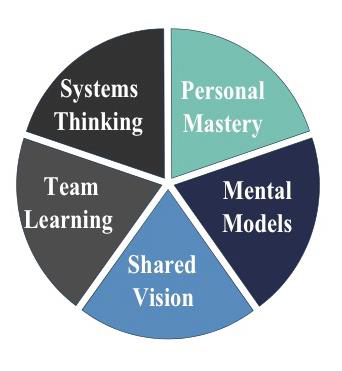
Systems Thinking
Systems thinking involves looking at problems and goals as a part of a whole. It is the cornerstone of a true learning organisation, integrating all the other disciplines depicted in the diagram above.
Often, companies are looked upon as a collection of departments rather than the complex network of interrelationships between departments and the outside world. Systems thinking focuses on the patterns and interrelationships between work systems, procedures, departments and teams.
Personal Mastery
Personal mastery is one of the core disciplines for building a learning organisation. It refers to an individual’s commitment to life-long learning. It is a continuous and never-ending process. The three important elements of personal mastery are personal vision, creative tension and commitment to truth.4 Personal mastery allows individuals to continuously focus and clarify their personal vision for the desired future (personal vision), look at their current reality and desired future (commitment to truth and reality) and use these gaps to create the dynamic energy to get to their desired future (creative tension).
Articulating the goals and objectives an individual wants to achieve is personal mastery. Senge defines personal mastery as “the discipline of continually clarifying and deepening our personal vision, of focusing our energies, of developing patience, and of seeing reality objectively”.
Shared Vision
Although goals, values and purpose are important for organisations to achieve their objectives, a dry vision or mission statement alone is not enough. Genuine commitment starts with a shared vision of the future.7 Building shared vision is necessary for the organisation, where key individuals have bought into and share the leader’s vision.
A leader’s role is to share his/her own vision with the rest of the organisation/ business unit. The vision should not be forced on others, but should rather describe what the organisation/ business unit stands for, or wants to become. Encouraging other individuals to participate in this process allows them to share in the vision and therefore, work together to make it happen.
It is naive to expect that the entire organisation would adopt the vision of its leaders, by simply reading the vision statement set up for display.
When an organisation has a shared vision, the driving force for change comes from knowing the difference between the shared vision and what is currently happening; i.e. creative tension. Truly committed employees will drive the organisation toward its goals
A shared vision is a mutual purpose among a group of people with common interests. “It binds people together around a common identity and a sense of destiny” (Senge, 1990). It builds a sense of commitment and facilitates open communication.
Mental Models
Mental models are the deeply ingrained ideas, assumptions, generalisations and images that influence how we understand the world.5 Mental models affect our perceptions, thinking and behaviour.
Good new ideas rarely get put into practice.6 This is often because they conflict with deep-seated internal images of how the world or the company works. It is essential to re-evaluate our mental models and preconceived ideas. Sometimes learning requires “unlearning”.
Senge describes mental models as “deeply ingrained assumptions, generalisations, or even pictures or images that influence how we understand the world and how we take action”.
We need to encourage reflection and inquiry, to develop awareness of attitudes and perceptions and define the current reality of the organisation.
Team Learning
Team learning has been described as “the process it takes to develop a team to create the desired results.”8 Team learning actually provides a forum for growth, rapid learning for participants and can be faster than individual learning, contributing to personal mastery. The discipline of team learning starts with dialogue and the capacity of members of a team to think together.
Team learning is facilitated through dialogue and discussion within small groups. Collective thinking is used to achieve a common objective. Members of a team learn and grow together to develop intelligence and competence and leverage the knowledge of the whole together as one.
Using systems thinking and shared vision disciplines will enable the organisation to give its employees the big picture and show them how they fit into the organisation and how the alignment of the Performance Management Programme will align their efforts to the organisation’s goals and objectives. Human Resources will facilitate this change by implementing systems, mechanisms, and processes that enhance organisational capabilities. Life-long learning is a requirement to sustain competitive advantage. “The difference between companies that lead and those that follow is the degree to which management invests in building a learning organisation” (Meister, 2005).
The underlying cause for recent emphasis on organisational learning is because of the increased pace of
change. In the past, work has been thought of as being conservative and difficult to change. Learning was
something divorced from work and innovation was seen as the necessary but disruptive way to change.
Nowadays, we know that the organisation which is able to quickly learn and then innovate will be able to change its work practices to perform better in the constantly changing environment. Change is now measured in terms of months, not years, as it was in the past.
Furthermore, the old hierarchical communication barrier between manager-worker has devolved into more of a coach- team member scenario. Leaders support the team; they do not dictate to team members. The team members appreciate this, which in turn helps them to be highly motivated.
All workers have an increased awareness of the company’s status and goals, and all that goes on in other departments. Communication between and across all layers of the company gives a sense of coherence, making each individual feel like a vital part of the whole system. Workers perform better, as they feel more a part of the company; they are not just resources to be used at will.
Ways to create a learning organisation:
Communicate – “The role of communication is truly the central focus in creating and maintaining a learning organisation”. Learning organisations typically have a free exchange and flow of information. Systems are established for all individuals to network across organisational boundaries, broaden their knowledge base, and develop expertise.
Reward the process – Processes that encourage cross-organisational interaction should be rewarded. Implementing programmes that recognise and reward the acquisition of new skills, team-work, as well as individual effort, will help fuel creativity and provide employees with motivation. Celebration of the successes and accomplishments of employees also encourages continuous personal development which broadens the company’s knowledge base.
Build a collaborative environment – To build a collaborative environment, support must flow from the top management downward. An environment of openness and trust encourages individuals to develop ideas, speak out, and to challenge actions. “Collaboration requires both formal and informal spaces to meet to generate and exchange ideas”. Collaboration can be encouraged by having designated spaces for developing and exploiting information—such as conference rooms, bulletin boards, etc. to share knowledge.
Run formal company or job orientation courses – “Providing a company orientation for new and existing employees that covers why the company is in business, what the objectives of the company are, and how each department, or job, moves the company closer to its goals will bring an enormous return on the time and effort invested”. This develops employees’ understanding of their environment, reinforces company values and vision and provides management with an opportunity to instil the culture of cohesiveness and information sharing.
Record lessons learned – Developing a system whereby lessons learned are recorded and retained for future use, aids the company, which is continually moving forward, instead of just treading water. “In the long term, the only sustainable competitive advantage is an organisation’s ability to learn faster than its competition.”11
Change culture – The most defining attribute of a learning organisation is its culture. The culture is a support system for learning, change and improvement. An authoritarian culture, where decisions on what needs to be done are driven by people in authority rather than by people with the most knowledge, stifles learning and leads to negative behaviours and tendencies.
The following are examples of what might be heard in a company that operates in an authoritarian culture:
“It’s not my job.”
“It’s not my or my department’s problem.”
“They’ll shoot the messenger; I’d better keep quiet.”
“It’s a serious problem, but pointing it out will only make everybody angry.”
“They wouldn’t listen anyway.”
“Why isn’t anyone motivated?”
“We need to crack the whip more often.”
The key to counteracting defeatist rationalisations and thinking patterns is to harness them as learning opportunities rather than interpreting them as cause for criticism or disciplinary action.
Share authority – Imposed authority, where decisions are imposed upon people based on authority rather than technical rationale or proficiency, does not work. Authority must be earned from those over whom it is exercised. It means giving power to those closest to the action.
Create a learning culture – Learning initiatives are the responsibilities of the individuals or groups within the framework of company support. Nothing motivates learners more than empowering them with the task of designing their own training programme and deciding what to learn and how to learn it. Training is often seen as something employees have to do rather than something they choose to do because it is relevant to the problems at hand. In most cases, failure to learn is the fault of the system, not the learner.
In conclusion, we can say that an inspired team with a unified vision, armed with the magic of systems thinking, can identify what they need to do to maintain and enhance their business. Organisational learning requires answering some uncomfortable questions about the business’ current reality and defining what needs to improve in order to survive and thrive. The five disciplines can serve as a road map to diagnose and devise strategies for survival. Organisations that fail to learn somehow learn to fail. Learning is not an option; it is a survival strategy.
Consider the strategic plan for your business. How can you categorise your strategic goals within this framework? This becomes your foundation for cascading strategy to your team.
Align the Operational Strategy
One of the sources of staff motivation and job enrichment rests in people’s ability to under
stand their
contribution to the strategy and how their job role makes a difference.
There is the infamous story of a group of consultants that were conducting an analysis at NASA. One of the consultants bumped into a floor cleaner and asked him “what is it that you do here?’. To which the floor cleaner replied, “I’m putting a man on the moon.” He understood that although he plays a small part in the bigger picture, he still contributes to the overall objectives of the business.
Begin by creating a miss
ion statement for your own department that aligns to the company mission
statement.
Let’s look at an example. If an organisation’s vision/mission statement is to “To be the most highly rated and
respected bank by our staff, clients, shareholders, regula tors and communities”, the mission statement for a
call centre within the bank could be “To be the most highly rated call centre in the SA banking industry, highly
rated and respected by our internal and external customers”.
Let your department’s mission s
tatement link directly from the organisation statement, yet have a personalised
meaning for your staff. With the above example, a call centre operator will immediately see that the
expectation for service excellence extends beyond his own banking environm ent to that of the whole of
South Africa.
Defining your mission statement is a collaborative process and buy
in will be far greater if you involve your
people. Set this up in a workshop environment where you describe the organisation’s mission statement and
brainstorm an ideal mission statement for your own department. Avoid long and complicated statements.
Make it concise, direct, a nd easy to understand.
Develop Goals, Objectives and Performance Standards
When setting your objectives, align them to the overall strategy and to your internal mission statement. It is very important that the organisation’s management team reaches consensus, not only on what the objectives for each perspective should be, but what each objective means. In their book “The Balanced Scorecard”, Kaplan and Norton tell the story of a financial institution that thought that all 25 members of the senior management team agreed about its strategy: “To provide superior service to targeted customers”. When the time came to translate this strategy into measurable strategic objectives, it soon became clear that each executive had a different view of what constituted “superior service”, and who the “targeted customers” were!
Many organisations have statements about their mission, vision, values and strategic intent which sound wonderful. Often, however, the reality is that people do not seem to live up to them. But if one asks those people, they believe that their activities are, in fact, supporting the statements. This is because the statements were never analysed and turned into SMART objectives.
Characteristics of objectives
The best objectives have several characteristics in common. They are all S.M.A.R.T. + C.:
They are specific. That is, they tell how much (e.g., 40 %) of what is to be achieved (e.g., what behaviour of whom or what outcome) by when (e.g., by 201X)
They are measurable. Information concerning the objective can be collected, detected, or obtained from records (at least potentially).
They are achievable. Not only are the objectives themselves possible, it is likely that your organisation will be able to implement them.
They are relevant to the mission. Your organisation has a clear understanding of how these objectives fit in with the overall vision and mission of the group.
They are timed. Your organisation has developed a timeline (a portion of which is made clear in the objectives) by which they will be achieved.
They are challenging. They stretch the group to set its aims on significant improvements that are important to stakeholders.
For example:
Sony wants to achieve 55% market share within two years of launch with its PlayStation 300.
Specific – a person has been designated to deliver the objective
Measurable- a number value has been set, e.g. sales or market share (55%)
Achievable- the target can be met
Realistic- in terms of human and financial resources required
Timed- within a given period of time, e.g. 24 months
There are many good reasons to develop specific objectives for your organisation. They include:
Developing objectives helps your organisation create specific and feasible ways in which to carry out your mission
Completed objectives can serve as a marker to show members of your organisation, investors, and the greater community what your initiative has accomplished
Creating objectives helps your organisation set priorities for its goals
It helps individuals and work groups set guidelines and develop the task list of things that need to be done
It re-emphasises your mission throughout the process of change, which helps keep members of the organisation working towards the same long-term goals
Developing the list of objectives can serve as a completeness check, to make sure your organisation is attacking the issue on all appropriate fronts
The balanced scorecard allows us to examine the past and plan for the future to ensure continuous improvement as a team and as individuals. It is a tool for turning vague and sometimes ambiguous statements about organisational strategy into specific objectives. This means that everyone in the organisation knows what is expected of him/her in terms of activities and results. Once these expectations are understood by the individual, he/she is in a strong position to identify and request whatever training and other resources are needed to carry out the activities and achieve the results. Thus, the balanced scorecard removes the elements of uncertainty that surround jobs in many organisations, and people need no longer ask, “I wonder is really expected of me? How is my manager really judging my performance?”
Turning strategy into specific objectives for the business unit
There are various sources when cascading strategy. One would refer to the overall business strategy or high level scorecard and ensure there is alignment with the business unit’s strategy.
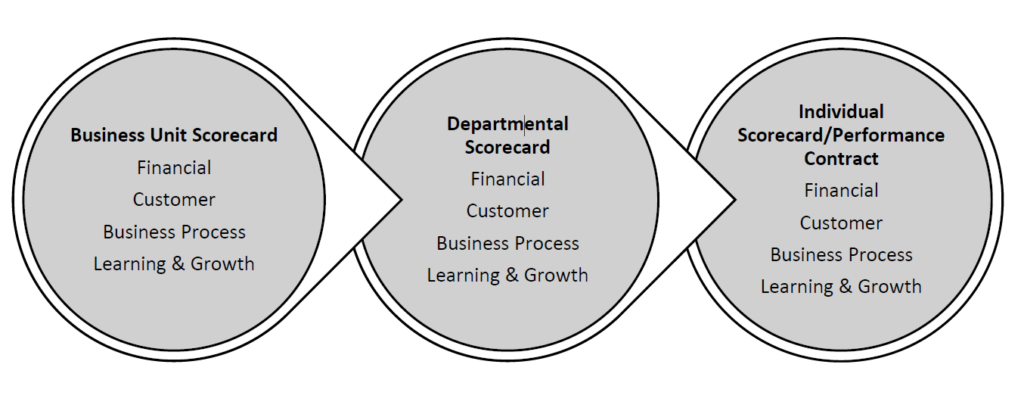
The objectives set for a Business Unit as a whole will be achieved through the focused activities of individuals. Therefore, the broad objectives for the business unit must be translated into specific measurable objectives for departments. These objectives in turn are translated into measurable objectives for each job function.
Once your organisation has decided that it does wish to develop objectives, how do you go about doing so? Let’s look at the process that will help you to define and refine objectives for your organisation or business unit.
Step 1- Define or reaffirm your vision and mission statements
The first thing you will need to do is review the vision and mission statements your organisation has developed. Before you determine your objectives, you should have a “big picture” that they fit into.
Step 2 – Determine the changes to be made
The crux of writing realistic objectives is learning what changes need to happen in order to fulfil your mission. There are many ways to do this, including:
Research what experts in your field believe to be the best ways to solve the problem. For many issues, researchers have developed useful ideas of what needs to occur to see real progress. This information may be available through local libraries, the Internet, and university or organisational research groups.
Discuss with local experts what needs to occur. Some of the people with whom you may wish to talk include:
- Other members of your organisation
- Local experts, such as members of other, similar organisations who have a great deal of experience with the issue you are trying to change
- Your agents of change, or the people in a position to contribute to the solution.
- Your targets of change, the people who experience the problem or issue on a day-to-day basis and those people whose actions contribute to the problem. Changing their behaviour will become the heart of your objectives.
Discuss the logistical requirements of your own organisation to successfully address the needs. Do you need an action plan? Additional funding? More staff, or more training for additional staff? This information is necessary to develop the process objectives.
At this point in the planning process, you don’t need hard and fast answers to the above questions. What you should develop as part of this step is a general list of what needs to occur to make the changes you want to see.
For example, perhaps your organisation has decided upon the following mission: “To reduce risks for cardiovascular diseases through an organisation-wide initiative.”
At this point in your research (without getting into specifics!), your organisation might have decided that your objectives will be based on the following general goals:
Begin smoking cessation programs
Begin smoking prevention programs
Bring about an increase in aerobic exercise
Decrease the amount of obesity
Encourage healthier diets
Increase preventative medicine (for example, more check-ups for earlier detection of disease; better understanding of warning signs and symptoms)
Increase the scientific understanding of your own organisation regarding the causes of cardiovascular disease
Strengthen your organisation’s ties with national organisations committed to the same goals as your organisation
Step 3: Collect baseline data on the issues to be addressed.
As soon as your organisation/ business unit has a general idea of what it wants to accomplish, the next step is to develop baseline data on the issue to be addressed. Baseline data are the facts and figures that tell you how big the problem is; it gives specific figures about the extent to which it exists in your organisation.
Baseline data can indicate the incidence (new cases) of a problem in the organisation. For example, “The Finance department has an absenteeism rate of 22.3 days per person per year.” Such data can also reveal the prevalence (existing cases) of the problem. For example, “In Admin, 35% of staff reported that they had stayed off work at least three times in the last three months due to lack of money for transport.”
Baseline data may also measure attitudes towards a problem. For example, “65% of employees do not consider absenteeism to be an important problem for the organisation.”
This information is important because baseline data provides your organisation with the numbers; the starting points against which you can measure how much progress you have made. Not only is this information helpful when originally asking for financial (or other) assistance, it can help you show what your organisation has done later in its lifetime.
So, you can prove to management that there really is a very significant problem in your business unit that needs to be addressed (“My business unit’s absenteeism rate is the highest in the organisation.”) Then, when asked later in the life of your initiative, “What have you done?” you will be able to answer, “Since our project was launched, my business unit has seen absenteeism drop by 35%.” If you don’t collect (or obtain) the baseline information, you can’t prove how much you have done.
There are two basic ways to collect baseline data:
You can collect your own baseline data for the information related to your specific issues. Ways to gather this information include the use of surveys, questionnaires, and personal interviews.
You can use information that has already been collected. Public libraries, city government, social service agencies, or departments in your organisation may already have the statistics that you want, especially if another department or organisation has already done work on a similar issue.
Step 4 – Decide what is realistic for your organisation/ business unit to accomplish
Once you know what you want to do, as well as exactly how big the problem is, it’s time to work out how much you believe your organisation can accomplish. Do you have the resources to achieve all of the goals you looked at in Step Two? And to what extent will you be able to achieve them?
These questions are difficult ones to answer. It’s hard to know what you can reasonably expect to get done. For example, if you are trying to increase rates of HIV testing, will your organisation be able to increase it by 5% in three years, or by 20% in one year? How do you make these decisions?
Unfortunately, there are no easy answers. Your organisation will need to take a good look at its resources, as well as talk to experts who have a sense of what is not only possible, but likely. For example, you might ask members of organisations who have done similar things, or researchers in your topic area what they believe makes sense.
Remember, you are attempting to set objectives that are both achievable and challenging. It’s hard to hit just the right note of balance between these two qualities, and you may not always get it just right. Research and experience, however, should help you come closer and closer to this goal.
Step 5: Set the objectives for your organisation or initiative
With all of this information in mind, your organisation is ready to set some short-term goals or objectives that are feasible but demanding. Remember, objectives refer to specific measurable results. These changes in behaviour, outcome, and process must be able to be tracked and measured in such a way to show that a change has occurred.
Your organisation’s list of objectives should do all of the following:
Include all three types of objectives: objectives that measure behaviour change, community outcomes, and those that measure important parts of the planning process.
Include specific objectives that tell how much of what will occur by when. For example, “By 201X, rates of defaults among lower income earners will decrease by 30%.”
They should include all of the “SMART + C criteria.” This means that they should be: Specific, Measurable, Achievable, Relevant, Timed, and Challenging.
Step 6 – Review the objectives your organisation has created
Before you finalise your objectives, it makes sense for members of your organisation to review them one more time, and possibly, to ask people outside of your organisation to review them as well. You might ask members of your organisation who were not involved in the development process to review your work. You may also wish to get the thoughts of local experts, targets and agents of change, and/or of people doing similar work in other communities to review what you have developed.
You can ask reviewers to comment on:
Do your objectives each meet the criteria of “SMART+C”?
Is your list of objectives complete? That is, are there important objectives that are missing?
Are your objectives appropriate? Are any of your objectives controversial? If so, your organisation needs to decide if it is ready to handle the storm that may arise. For example, a programme that is trying to reduce the spread of AIDS may decide clean needles for drug addicts is an objective they wish to strive for; but it may very well cause difficulties for that organisation. That’s not to say the organisation shouldn’t make that an objective, but they should do so with as clear an understanding of the consequences as possible.
Step 7 – Use your objectives to define your organisation’s strategies
Finally, once you have your general objectives, you are ready for the next step: developing the strategies that will make them possible. Once your objectives are finished, and satisfactory to members of the organisation and important people outside of your group, you are ready to move on to developing strategies and action plans.
Remember, targets should be reviewed regularly, as the world of business is changing at an ever-increasing pace. For example, in the industrial-age type organisation of the past, dominated by measuring tangible assets, it was sufficient to record investments in inventory, property, plant and equipment on the company’s balance sheet. The income statement would also be sufficient to capture the expenses associated with the use of these tangible assets to produce revenues and profits.
However, in today’s economy, intangible assets, such as customer relationships, innovative products and services, high-quality and responsive operating processes, information technology and databases, and employee capabilities, skills and motivation, have become the major sources of competitive advantage.
The diagram below illustrates how objectives cascade down through the organisation:
Questions for Defining Objectives
These are some questions to ask yourself to help you identify business objectives for your department/area:
Financial Perspective
What are the financial business objectives?
Revenue generation?
Budget management?
Cost control?
Which areas need to be focused on?
What measures do we need?
Customer Perspective
Who are our customers internal and external?
What do our customers want?
What is important to our customers?
How can we influence this?
What are our objectives?
Customer satisfaction?
Customer attraction?
Customer service?
Which areas need to be focused on?
What measures do we need?
Internal Business Process
What are the internal objectives?
What are the key outcomes?
What are the key business processes?
What are the critical steps required to deliver the outcome?
What measures do we need?
Learning and Growth Perspective
How do we develop and improve?
How do we develop human capital for the future?
How do we prepare our human capital for future regulatory changes?
How do we prepare our human capital for competitive changes?
How can we influence this?
Which areas need to be focused on?
Employee morale?
Training?
Development?
What measures do we need?
Involve Stakeholders to Obtain their Commitment
Stakeholders can be a variety of people, such as:
All people with a comprehensive knowledge of the company and its competitive environment
Men and women with varied roles inside the organisation, particularly upper management
Department managers, especially those involved in research and development
People of different ages
Suppliers, strategic partners and major customers
New company employees, regardless of the positions they’ve been hired for, as they don’t have preconceived notions of how things ‘should’ be done. Usually they will come up with innovative new ideas
Outside consultants
Industry specialists
Individuals who don’t come burdened with the “baggage” of being employed by the organisation and who can provide a valuable objective view
Stakeholders, therefore, consist of people who can benefit and people who can help. That is, there are people for whom your initiative has things to offer and people from whom you can learn and get assistance.
You need to be clear about who should benefit, and who can help address the issue or problem. Knowing just who these people are is an important step.
The people your organisation or initiative is trying to reach are called targets of change, and those who can help you reach them are called agents of change. 12
Like finding the root cause of a problem, understanding whom you want to target for change can be relatively simple or more difficult. Generally, targets of change will fall into two categories:
Those people who directly experience the problem or are at risk
Those people who contribute to the problem through their actions or lack of actions.
To find potential agents of change, ask yourself the following questions:
Who can influence the people and the conditions that contribute to the problem or issue?
Who has the power to bring about change?
Who has the time, resources and desire to bring about change?
Who might be able to make a difference, if your initiative is able to convince them?
Who has a relationship with the people in whom you want to bring about change? Who do the “targets of change” trust? Who will they listen to?
Think about people who were formerly (or are currently) targets. They might be some of the best “agents of change” now.
These are the key individuals or groups who, if they put forth an effort, can help address the issues. The agents of change can influence others in a variety of ways. If they are working with someone who is directly affected by the problem, they will probably do the following:
Establish a strong relationship with the person most affected. If the target of change sees them as credible, trustworthy and caring, it is much more likely they will confide in the agent of change, and listen to his or her advice.
Diagnose the issue or problem. A good agent of change will walk around in other people’s shoes if she really wants to understand them. To help someone change unsafe or harmful behaviour, she needs to really understand why that behaviour is happening.
Convince the person experiencing the issue of the need for (and of the possibility of) a change. The support person might be responsible for convincing someone that her behaviour is a problem, that alternatives exist and that things really can change.

Develop an operation plan for a unit
Once you have developed a strategy for your department, the next step is to develop action (operational) plans for your department.
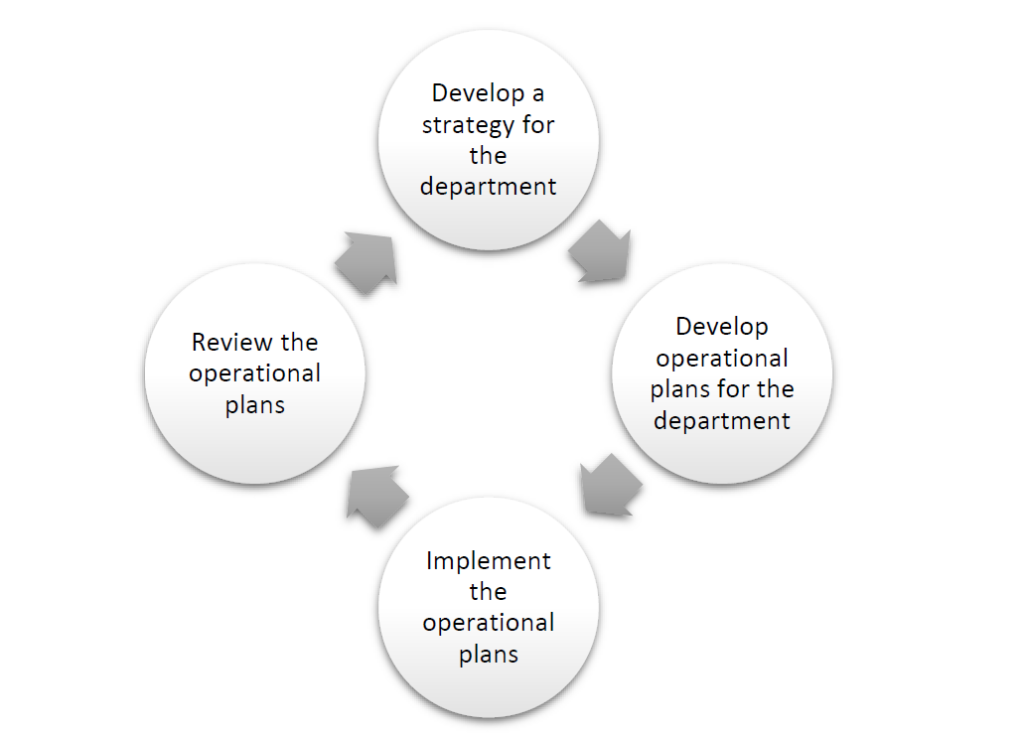
Successful businesses use detailed operational plans to ensure a systematic process to implement strategic initiatives. The departmental operational plan is regularly updated to reflect achievements, changes in performance and shifting priorities. The scope and scale of the action plan is dependent on the size of the department.
When preparing your operational plan, document the strategically-aligned departmental objectives and include a provision for contingencies that addresses potential risks and weaknesses. The operational plans must also document tasks, responsibilities, timeframes, performance measures and resource needs.
DEVELOP THE OPERATIONAL PLAN
The framework for your operational plan
The framework for your action plan is recommended as follows:
Departmental objectives (aligned to organisational strategy)
Potential risks and contingencies to address these
Tasks
Responsibilities
Timeframes
Performance measures
Resource needs
The operational plan will detail what needs to be done and how it will be achieved. It will be used to monitor and measure performance towards the strategic goals and progress.
Complete operational plans and include provisions for contingencies
Identify the potential risks and define contingencies. A risk is “the potential harm that may arise from some present process, or from some future event. It is often mapped to the probability of some event which is seen as undesirable”. A contingency is “the planned allotment of time and cost for unforeseeable elements or risks”. Within the action plan identify potential risks, such as the availability of skilled resources, market changes, budgetary restraints and when preparing your contingency plans, document how these can be managed to minimise the potential impact of the risk.
Document operational plan to show tasks, responsibilities, timeframes, performance measures and resource needs
Tasks – List all of the tasks and activities that need to be carried out to achieve each departmental objective. This is an important step in the process as it is these tasks that will be cascaded to an individual level. Break down each objective into logical, bite-sized steps or actions.
Responsibilities – Allocate responsibilities to resources for each of the tasks. This is likely to be line management’s responsibility and they will then cascade the tasks to their respective staff members.
Timeframes – A start and finish date supply you with definitive measures for performance. They also assist in defining predecessor and successor relationships between the tasks. Some actions may be dependent on others before they can commence. Line and staff should understand the knock-on effect of not achieving specified timelines.
Performance Measures – Performance measures should cover cost, quantity and quality. All too often, organisations focus on one element and neglect the others. Typically in call centre environments, for example, the focus is on quantitative measures, e.g. call duration, number of abandoned calls, but just as important is the quality of the interaction with the customer.
Resource Needs – Resource needs may include people, equipment, machinery, vehicles, IT systems, or money, to name a few. Ensure that in your plan you define specific resource needs that are required to achieve the objectives. In instances where there is limited budget available, develop contingencies to address shortfalls. In addition, create a benefit case for the “spend”. Define the future cost or impact of securing versus not securing the resources.
Consider your own department and the operational plan you need to prepare to ensure that:
It is in accordance with the overall strategy.
It includes provisions for contingencies.
It shows tasks, responsibilities, timeframes, performance measures and resource needs.
Including existing organisational tools for implementing strategy in the operational plan
We mentioned the importance of identifying resource needs when preparing your operational plan. Throughout the process, however, make use of organisational tools that are at your disposal. If the company has suitable technology to support your objectives, use it. If there are processes and systems in place that can enhance your performance, use them. This may take some research into what is currently available. An example of a system could be the internal performance management system. Use this as your tool for cascading strategy to an individual level.
Refer to the example of an operational plan template:
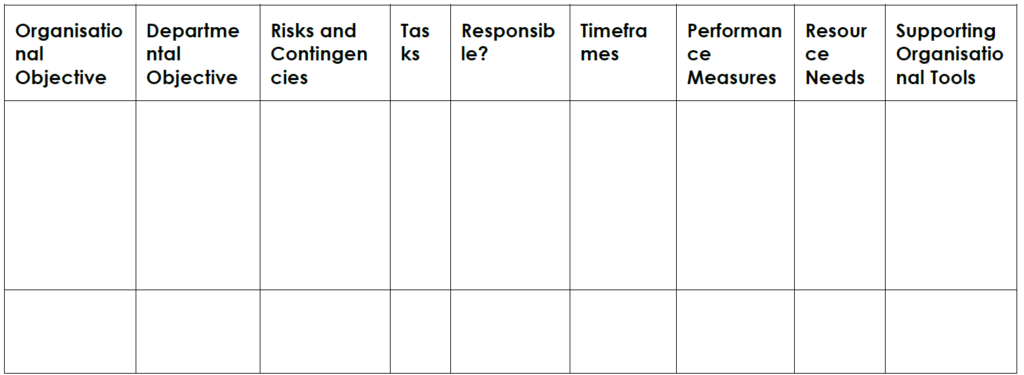
We mentioned that the ability to operationalise strategy is a company’s greatest competitive advantage.
Include your people and other internal and external stakeholders in the defining of the action plan. External
stake holders could be service providers or suppliers. For example, a consulting firm involved in training, may
use external facilitators. Make use of their knowledge, experience, thoughts and ideas to define your action
plan. A participative process will ass ist you in ensuri ng you have all areas covered.
Elements of an Operational / Business Plan
A business plan is a document that describes an organisation’s current status and plans for several years into the future. It generally projects future opportunities for the organisation and maps the financial, operations, marketing and organisational strategies that will enable the organisation to achieve its goals.
A business plan is a formal statement of a set of business goals, the reasons why they are believed attainable, and the plan for reaching those goals. It may also contain background information about the organisation or team attempting to reach those goals.
The business goals being attempted may be for-profit or non-profit. For-profit business plans typically focus on financial goals. Non-profit and government business plans tend to focus on service goals, although non-profits may also focus on maximising profit.
Experienced business owners and managers will tell you that the business plan is a very important management tool. The business plan is a written road map of where the business is going, what it has to do to get there, and what it will look like on arrival.
Business plans may also target changes in perception and branding by the customer, client, tax-payer, or larger community. A business plan having changes in perception and branding as its primary goals is called a marketing plan.
Business plans may be internally or externally focused. Externally focused plans target goals that are important to external stakeholders, particularly financial stakeholders. They typically have detailed information about the organisation or team attempting to reach the goals. With for-profit entities, external stakeholders include investors and customers.
We can simply say that a business plan is a document that details the past, present and intended future of the company.
If you have a comprehensive and well-motivated business plan, you, as well as potential investors, can obtain a thorough understanding of your existing or proposed business, your own goals and objectives and your financing requirements.
Format of a business plan
A business plan can take many forms, from a glossy, professionally-produced document to a handwritten manuscript in a file outlining the goals, objectives, strategies and tactics of the business.
The format of a business plan depends on its presentation context. It is not uncommon for businesses, especially start-ups to have three or four formats for the same business plan:
A short, three- minute executive summary of the business plan. This is often used as a teaser to awaken the interest of potential funders, customers, or strategic partners.
An oral presentation – a slide show and oral narrative that is meant to trigger discussion and interest potential investors in reading the written presentation. The content of the presentation is usually limited to the executive summary and a few key graphs showing financial trends and key decision-making benchmarks. If a new product is being proposed and time permits, a demonstration of the product may also be included.
A written presentation for external stakeholders – a detailed, well-written, and clearly formatted plan targeted at external stakeholders.
An internal operational plan – a detailed plan describing planning details that are needed by management, but may not be of interest to external stakeholders. Such plans have a somewhat higher degree of transparency and informality than the version targeted at external stakeholders.
We are going to be focusing on the written version of the business plan:
Specific attention should be given to four key areas when writing your business plan: the business itself, the management of the business (the entrepreneurs involved), the market in which the business operates, the financial management and planning – the risks and rewards associated with the total investment in the business.
1 EXECUTIVE SUMMARY
The executive summary is the most vital part of the business plan – it has to sell your strategy for success to the investor.
The summary is an overview of the entire plan and must contain the highlights of the business plan and summaries of each section. Therefore, although it is at the beginning of the document, it is usually written last to capture the essence of the plan.
2 BUSINESS OVERVIEW
Write a business profile, including the following:
Information on the background and history of the business
Indicate the business form (What is the business structure; i.e. sole proprietorship, general partnership, limited partnership, close corporation, or private company?) Who is (are) the principle(s)/ members?
Legal registrations and any legislative compliance in relation to a new venture are explained and included in business plan (Legal registrations include but are not limited to PAYE (Pay As You Earn), VAT (Value Added Tax), RSC (Regional Services Council), COIDA, Skills Development Levy, Industry regulations)
If a company or close corporation, state the full registered name and enclose Form CK1 or CK2 where applicable
If a company or close corporation, state the address of the registered office
Is it a new business, take over, expansion, or franchise?
The vision and mission, and the company’s long- and short-term goals in terms of business growth and development, as well possible exit strategies (for example: buy out investors, sell to larger company, go public, etc.)
The product or service
Describe in full the product or service(s) offered by the business and the innovative features of these products and services, their benefits to your customers and the competitive edge they afford the business over rivals in the market.
The expected product life cycle where applicable
Include descriptions of key technologies employed and current and future research and development
Describe the location, premises and – where applicable – production facilities
Why you have chosen your particular location? What are the attributes and/or important features of your present or desired business location, e.g. central business district, near highway, etc? Why is this a desirable area?
What kind of building do you need? Are the premises adequate for the short to medium term?
Why is this a desirable building?
Does the community around which you intend to locate the business show enthusiasm for you and your business?
What are the advantages and disadvantages of the site in terms of labour availability?
How much space do you need?
Do you need a long-term or short-term lease? If the premises are leased – attach a copy of the lease agreement, state the term of the lease, the date that the lease expires, whether the lease is subject to annual increases, percentage increase per annum, the monthly rental
Is the building accessible by public transport?
Is the building close to customers or suppliers?
Is free or low cost parking nearby?
If the premises are owned – the present market value, when purchased, the purchase price, amount for which the premises are insured, date that the insurance expires
If the property is bonded – to whom, value of the bond, outstanding balance of the bond
Production and technology
Describe production processes and capacity, identifying any possible problem areas
Details of suppliers and sub-contractors, and any contractual arrangements governing the supply of key inputs
Elaborate on the business’s past achievements and strengths and past problems and weaknesses, and critical success factors
3 COMPANY MANAGEMENT
The management structure of the business
Show company ownership structure, business units and subsidiaries where applicable
Attach an organisation chart showing the functions and responsibilities of directors, key management and staff
Formulate remuneration, incentives, share options, and conditions of employment of key management and directors
Analyse any deficiencies in management and how these positions are to be filled
Comment on current and future employment levels, labour relations and union membership
Include details of auditors, attorneys, bankers and professional advisers
Personnel
What are your personnel needs now? In the near future (3 years)? In five years?
What skills must they have?
Are the people you need available?
Will your employees be full-time or part-time?
Will you pay salaries or hourly wages?
Certain employee benefits are mandatory. Find out what they are.
Will you provide additional fringe benefits? If so, which ones? Have you calculated the cost of these additional fringe benefits?
Will you utilise overtime? If so, you will be required by law to pay time and a half, double time, and/or other extra costs.
Will you have to train people for both operations and management? If so, at what costs to the business?
4 THE MARKET
Industry analysis
Summarise the industry in which you will compete. Find most of the facts from government statistics and trade organisations. Discuss topics such as:
Current trends and developments in the industry
Large and important players in the industry
How the industry is segmented
Problems the industry might be experiencing
National or global events influencing the industry
National and global growth forecasts
How legislation affects the industry (for example, how the law limiting smoking in a restaurant affects the industry)
Market analysis
Who exactly is your market? Describe characteristics: age, sex, profession, income, etc., of your various market segments.
What is the present size of the market?
What market you intend to service, the size of the market, and your expected share
What is the market’s growth potential?
As the market grows, will your share increase or decrease?
How are you going to satisfy the market?
How will you attract and keep your share of the market?
How can you expand your market?
How are you going to price your service or product, to make a fair profit, and at the same time, be competitive?
What price do you anticipate getting for your product or service?
Is the price competitive?
Why will someone pay your price?
How did you arrive at the price? Is it profitable?
What special advantage do you offer that may justify a higher price? (You don’t necessarily have to engage in direct price competition).
Will you offer credit to your customers (accounts receivable)? If so, is this really necessary? Can you afford to extend credit? Can you afford bad debts?
Describe the existing market and its potential for growth
Include a detailed analysis of the size and maturity of the market, trends and seasonality exhibited by the market, and the business’s current and expected market share together with an analysis of the time, resources and actions required to achieve this desired market share
List existing and potential customers, supported by letters of intent, orders on hand, contracts, where applicable
Include a detailed analysis of competitors, the price and quality of their products, service and delivery, and their expected reaction to your activities
Highlight and discuss your competitive advantage
Why you can service that market better than your competition
Your competition
Who are your five nearest competitors? List them by name.
How will your operation be better than theirs?
How is their business: steady? increasing? decreasing? Why?
How are their operations similar and dissimilar to yours?
What are their strengths and/or weaknesses?
What have you learned from watching their operations?
How do you plan to keep an eye on the competition in the future?
5 SALES AND MARKETING STRATEGY
Describe current and planned sales and marketing strategies and promotional activities (advertising, exhibitions, promotions, public relations, etc.)
Describe your distribution strategy and channels
Formulate sales staffing, recruitment, remuneration and commission structures
Include sales projections (in monetary terms) with an analysis of the time expected to reach sales targets and milestones (e.g. break-even point)
Describe your pricing strategy and how it compares with your competition
Where the business is a franchise, include the full marketing strategy of the franchisor
Debtor terms that will be allowed
- Cash sales
- 30 days
- 60 days
- 90 days
- over 90 days
- What is the industry norm?
- When will outstanding debtors be regarded as bad debt?
6 FINANCIAL STATEMENTS AND PROJECTIONS
Include only a summary of the financial statements and projections in the body of the business plan – attach detailed analysis as an appendix
Include operating budgets, cash flow projections, income statements and balance sheets for at least three years (recommended five years). Provide monthly projected figures for the first and second year, quarterly figures for years three and four and annual projections thereafter.
Where applicable, provide: - Historical financial performance as shown by at least the last three sets of audited annual financial statements and up to date management accounts comprising income statements (monthly and year-to-date), balance sheets, and debtors and creditors age analysis
- Costing methodology employed, or to be employed, and detailed costings giving a full analysis of cost of sales
- Pricing policies giving a full analysis of theoretical and actual mark up and gross profit percentages
- Rebates, discount structures and terms offered to and received from customers and suppliers respectively
- Break-even analysis
- Details of overdraft and medium and long term loans
Ensure that your financial projections agree with any other statements in the business plan (for example, costs involved in your proposed marketing strategy)
Formulate and motivate your capital requirements
7 LEGAL AND REGULATORY ENVIRONMENT
Include:
Details of any licences, copyrights, trademarks and patents registered (or in the process of being registered)
Details of any legislation and regulations governing the industry, product and production processes
Proof of compliance with tax and labour legislation (VAT, PAYE, RSC, UIF, COIDA, Employment Equity Act, Skills Development Act, etc.) where applicable
Details of duties and tariffs to which inputs or products are subject if the business is a regular importer or exporter
8 SWOT ANALYSIS AND RISK/REWARD ASSESSMENT
Discuss definite and possible strengths, weaknesses, opportunities and threats
Give an honest assessment of the risks faced by the business, entrepreneurs and investors in relation to the potential for growth, profitability, and capital appreciation
Discuss strategies that can be implemented to address the risk factors highlighted
9 APPENDICES AND SUPPORTING DOCUMENTATION
The following supporting documentation should be included where applicable:
Newspaper clippings, promotional literature, product brochures, market research, trade and industry publications
Partnership, association or shareholders’ agreements
Offers to purchase, purchase and sale agreements
Contracts, orders, letters of intent
Memoranda of understanding, lease, franchise, agency or distribution agreements
Documentation relating to licences, copyrights, trademarks and patents
Quotations or pro-forma invoices for capital items to be purchased
Detailed personal balance sheets of the entrepreneurs
Copies of identity documents and marriage certificates of the entrepreneurs
Schedules of life assurance and endowment policies of the entrepreneurs
Copies of company or close corporation certificates and registration documents
Drawings, workflow charts, plans, factory layouts, maps, etc.
A list of persons to whom reference can be made regarding creditworthiness, product and service quality, and the skills, abilities and integrity of the entrepreneurs
Techniques for Identifying Strengths and Weaknesses
The Situation Analysis – SWOT
The SWOT analysis can be considered as the first (or initial stage) of planning and helps stakeholders in the business to focus on the key internal and external issues affecting the business and its environment.
SWOT stands for strengths, weaknesses, opportunities and threats. Strengths and weaknesses are internal factors. Opportunities and threats are external factors. The SWOT analysis is used to understand the current situation of a company. To perform a SWOT analysis for your business, determine and summarise in point form the strengths, weaknesses, opportunities and threats of your business model relative to competitors.
Remember, even the most successful businesses have areas of weakness – acknowledging them shows a thorough analysis and understanding of your business’s operating environment. Having done that, consider strategies to combat the weaknesses and threats as far as possible.
All businesses benefit from a SWOT analysis, and all businesses benefit from completing a SWOT analysis of their main competitors.
Here are some examples of what a SWOT analysis can be used to assess:
A company (its position in the market, commercial viability, etc.)
A product or brand
A business idea or a potential partnership
A strategic option, such as entering a new market or launching a new product
An opportunity to make an acquisition or investment opportunity
Changing a supplier or outsourcing a service, activity or resource
The SWOT analysis provides a framework by which issues can be developed into actions:
Strengths: maintain, build and leverage
Opportunities: prioritise and optimise
Weaknesses: remedy or exit
Threats: counter
If the SWOT analysis is being used to assess a proposition, then it could be that the analysis shows that the proposition is too weak (especially if compared with other SWOT’s for alternative propositions) to warrant further investment, in which case further action planning, other than exit, is not required.
If the proposition is clearly strong (presumably you will have indicated this using other methods as well), then proceed as for a business, and translate issues into category actions with suitable ownership by team(s).
The table that follows shows the issues the SWOT analysis investigates:
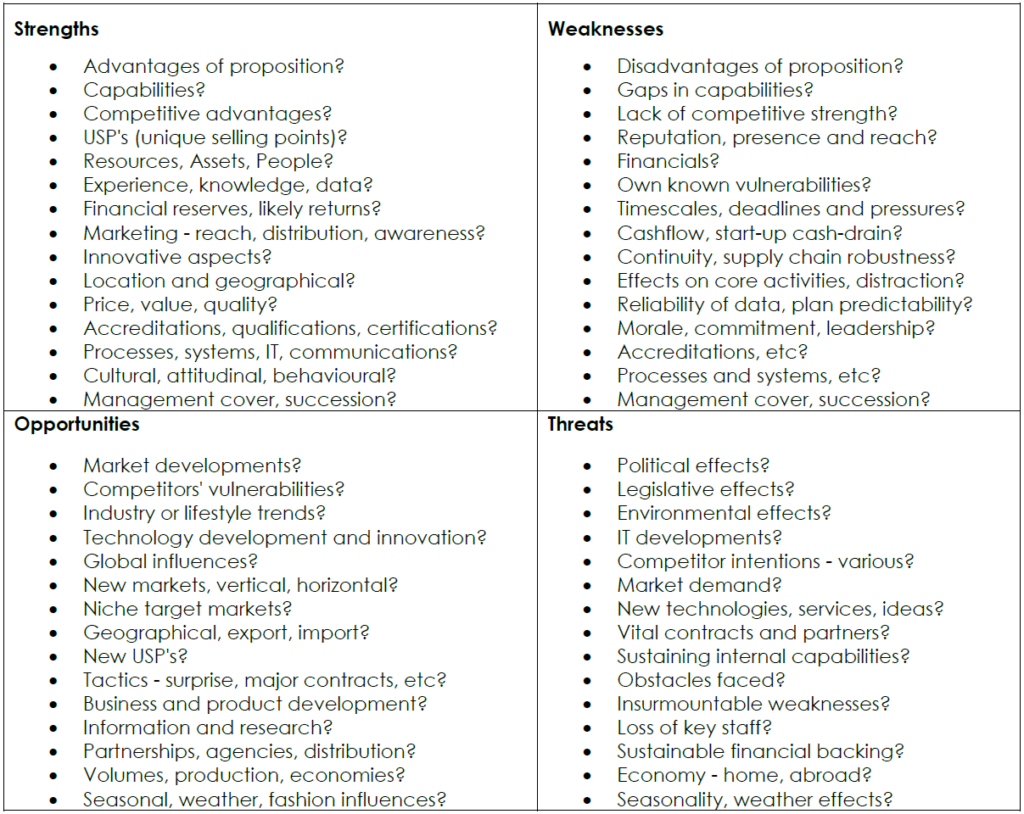
Translating SWOT into actions
Translating the SWOT issues into actions happens by breaking them down into the following six categories:
- Products and services (what are we selling?)
- Process (how are we selling it, how the products and services are to be made and/or assembled, including subcontracting and purchasing, labour and machinery?)
- Customer (to whom are we selling; how will customers be persuaded to buy?)
- Distribution (how does it reach them; how are products warehoused, transported, delivered?)
- Finance (what are the prices, costs and investments; how will the cash flow be controlled?)
- Administration (How the organisation will be managed, the management style, the organisation structure and the people skills required?)
There are other ways of applying SWOT of course, depending on your circumstances and aims, for instance if concentrating on a department rather than a whole business, then it could make sense to revise the six categories to reflect the functional parts of the department, or whatever will enable the issues to be translated into manageable, accountable and owned aims.
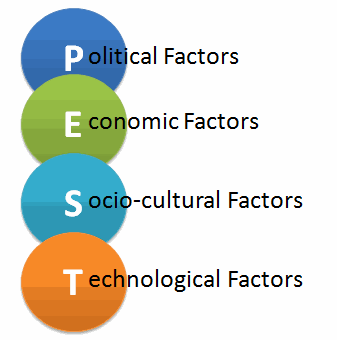
The PEST Analysis
The PEST analysis considers the environment of the business before beginning the strategic planning process.
The company’s environment for this analysis consists of the internal and external microenvironment, as well as the external macro environment.
In a PEST analysis you should take a broad view of the political, economic, socio-cultural and technological factors which impact on the business externally and then assess how these external factors have shaped and will continue to shape the internal environment.

Political Factors
The political environment has a huge influence upon the regulation of businesses, as well as the spending power of consumers and other businesses.
“At the time of writing, oil is top of the agenda again. The political tensions of the Middle East, the economic development of China and India, the volatility of energy prices, and concerns about global climate change have brought attention back to the energy source upon which our automotive society most depends.
With the supply of oil uncertain and no clear consensus about alternative energy sources, the continued viability of carbon-fuelled economic development — and thus the future of our highly mobile industrial society — is being questioned”13.
For strategic planners to understand the future of transportation and energy, even on as simple a matter as the speed with which fossil fuels are “running out,” they need to consider these sources together. A forced transition away from fossil fuel dependence is almost certain, and sooner than many people expect; but on the details and impact of that transition, there are still many uncertainties.
One would consider issues like:
How stable is the political environment?
Will government policy influence laws that regulate or tax the business?
What is the government’s position on ethics?
What is the government’s broad economic policy?
Does the government have a view on culture and religion?
Is the government involved in trading agreements and how will this impact on the business?
Economic Factors
All businesses operating in an economy need to carefully consider the state of an economy in both the short and long-term. Among the economic factors to be considered are:
Issues in monetary policy set by the Reserve Bank, like interest rates, inflation targets, relative health of the currency, etc.
Issues in fiscal policy like government spending, the annual budget, tax levels, budget deficits, etc.
General issues like employment levels, long-term prospects for the economy, gross domestic product (GDP) per capita, the position/health of the economy on world indices, broader global economic issues and initiatives, etc.
Socio-cultural Factors
The social and cultural influences on business vary from country to country. It is very important that such factors are taken into account. These factors include:
What is the dominant religion?
What are local attitudes to foreign products and services?
Does language impact upon the diffusion of products onto markets?
How much time do consumers have for leisure?
What are the roles of men and women within society?
What is the average life-span of the population? Is the older generation wealthy?
Does the population have a strong/weak opinion on green/environmental issues?
Technological Factors
Technology is vital for competitive advantage, and is a major driver of globalisation. When considering technological factors you should think about the following issues:
Does technology allow for products and services to be made more cheaply and to a better standard?
Do the technologies offer consumers and businesses more innovative products and services such as internet banking, new generation mobile telephones, etc.?
How is distribution changed by new technologies, e.g. books via the internet, etc.?
Does technology offer companies a new way to communicate with consumers, e.g. customer relationship management (CRM), etc.?
Validate Measurable Parameters
According to the Merriam-Webster online dictionary a parameter is “a factor that restricts what can result from a process or policy. In this use it often comes close to meaning “a limit or boundary.” For example, the provisions of a zoning ordinance that limit the height or density of new construction can be reasonably likened to mathematical parameters that establish the limits of other variables”.
Wikipedia define parameters as “those combinations of the properties which suffice to determine the If we apply these definitions to our operational plan, we can see that we need to validate the objectives and metrics (measurements) we set as targets for ourselves against proven, historical customer and unit performance requirements in order to see if they are achievable, as there is nothing as demotivating to a team as being set “impossible” targets.
The historical data and evidence will enable us to set realistic “lower” and “upper” limits to our targets.
Describe Monitoring Systems
Data are the foundation of any effective objectives-setting initiative. The collection and analysis of both quantitative and qualitative data are critical for setting priorities/targets for your unit.
All the effort you put into implementing your operational plan will be to no avail if it is not recorded and followed up. Once you have received the data, it needs to be recorded and processed, so that conclusions can be drawn from it.
There are two different techniques for measuring continuous improvement; the quantitative method and the qualitative method.
Quantitative techniques are used to gather the facts of the situation. A tally sheet is one such an example.
Example:
A tally sheet can be used for instance by the customer service representative who deals with customer complaints. She will never remember at the end of the day how many people complained about what, if she doesn’t record it.
Here is how she could do it:

By making a mark next to the appropriate problem, she will know exactly how many people complained about each respective problem.
Qualitative techniques depend on people’s opinions. This could be responses to questions such as: “Do you get value for money from our garbage removal service?” One person would say yes, because he has had no problems with the service, but another who has had one isolated problem, would say no, although he has received the exact same quality of service as the other person.
You can gather customers’ opinions through interviews, questionnaires and surveys.
The information gathered from your research should always be recorded and presented in such a way that conclusions can be drawn from it. It is usually best to represent such facts in a visual way so that you can see which aspects need urgent attention and which are satisfactory at a glance, for example in a table or pie chart.
Once you have identified the priority areas and potential indicators, a baseline must be set (may require collecting new data) to determine where the unit currently is on a given problem or indicator and set the stage for determining where it wants to be by the next month/next year/ next five years (target).
Setting targets (determining the desired amount of change over a given time interval) is the next critical step.
Finally, monitoring progress toward meeting objectives, through collection and analysis of tracking data, should be done on a scheduled basis.
You will decide which monitoring system you are going to be using in your unit:
Why do you need to monitor performance? What are you trying to achieve? Are you “looking over your team’s shoulder” or are you trying to be proactive to detect a problem before it occurs, or gets out of hand?
How will you monitor performance? Track graphs, computer data, etc.
How often will you track the data? Hourly, daily, weekly, monthly?
Who is going to be responsible for tracking the data and reporting to you?
The monitoring system chosen will, of course, be in line with the system used in the organisation, but metrics will possibly be adapted to what your unit needs to measure.
Obtain Feedback on the Operational Plan
Do not simply delegate the implementation to the team and disengage from the process. The key stakeholders, which includes your team members, must be involved every step of the way.
Let your team members know that you are listening to them and acting on their feedback. Whenever possible, link the specific actions that are taken back to their recommendations.
The team also need to be informed of recommendations or expectations that cannot be implemented (at least over the short term) and the reasons why the organisation cannot meet their expectations at this time.