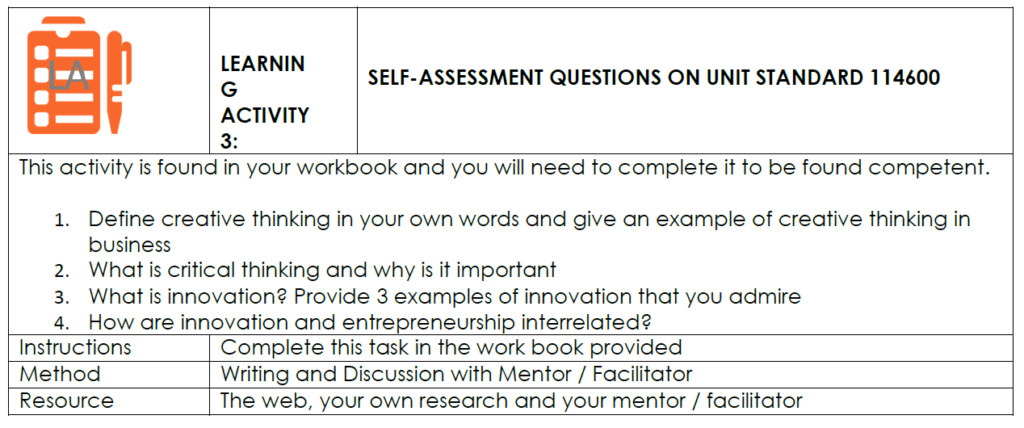
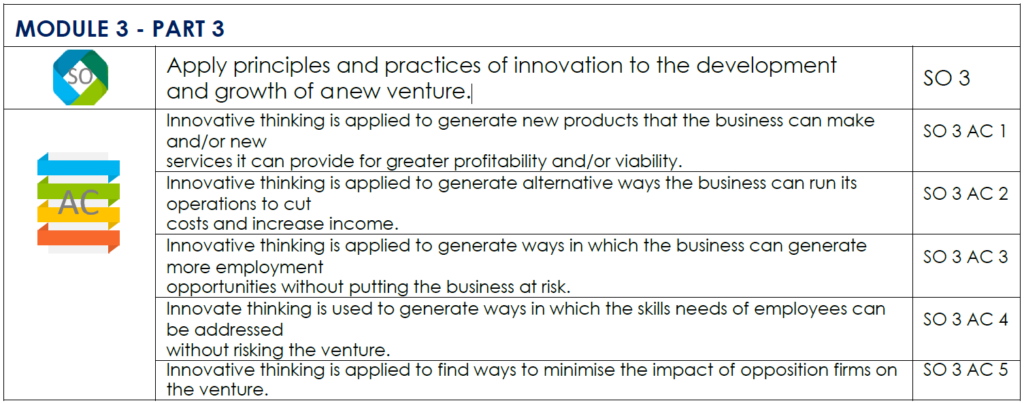
MODULE 3 – PART 3: Apply principles and practices of innovation to the development and growth of a new venture.
INTRODUCTION
If your business is alive and well this time next year, or this time in five years, it might well be because you have followed, either actively or subconsciously, the Basic Entrepreneurial Model.
The principles of the Basic Entrepreneurial Model are that, to survive in business, we must:
I.
Continue to develop innovative products and services that meet the needs of the market.
II.
Produce and package them well, and
III.
Market and sell them effectively.
Without innovation in our business, we run the risk of failing to maintain what the Americans call our Unique Selling Proposition and the British refer to as the Distinctive Competence. Both of these terms simply refer to the aspects of a business which sets it apart from its competitors and prevents its products from becoming just ‘commodities’.
When products or services become ‘commoditised’, customers are more likely to make buying decisions solely on the basis of price. One sure way for a business to be distinctive in a manner that extends buying decisions beyond price alone is for it to continually develop innovative products and/or services to meet market needs.
INNOVATIVE THINKING AND DEVELOPMENT OF NEW PRODUCTS
In business and engineering, new product development (NPD) is the term used to describe the complete process of bringing a new product to market. A product is a set of benefits offered for exchange and can be tangible (that is, something physical you can touch) or intangible (like a service, experience, or belief). For new product development to be successful, innovative thinking is crucial.
The following are the main steps in product development. It must be noted that, at each and every stage of these steps innovative thinking is very important.
Idea Generation is often called the “fuzzy front end” of the NPD process
▪
Ideas for new products can be obtained from basic research using a SWOT analysis (Strengths, Weaknesses, Opportunities & Threats), Market and consumer trends, company’s R&D department, competitors, focus groups, employees, salespeople, corporate spies, trade shows, or Ethnographic discovery methods (searching for user patterns and habits) may also be used to get an insight into new product lines or product features.
▪
Lots of ideas are being generated about the new product. Out of these ideas many ideas are being implemented. The ideas use to generate in many forms and their generating places are also various. Many reasons are responsible for generation of an idea.
▪
Idea Generation or Brainstorming of new product, service, or store concepts – idea generation techniques can begin when you have done your OPPORTUNITY ANALYSIS to support your ideas in the Idea Screening Phase (shown in the next development step).
Idea Screening
The object is to eliminate unsound concepts prior to devoting resources to them. The screeners should ask several questions:
▪
Will the customer in the target market benefit from the product?
▪
What is the size and growth forecasts of the market segment/target market?
▪
What is the current or expected competitive pressure for the product idea?
▪
What are the industry sales and market trends the product idea is based on?
▪
Is it technically feasible to manufacture the product?
▪
Will the product be profitable when manufactured and delivered to the customer at the target price?
Concept Development and Testing
▪
Develop the marketing and engineering details
▪
Investigate intellectual property issues and search patent data bases
▪
Who is the target market and who is the decision maker in the purchasing process?
▪
What product features must the product incorporate?
▪
What benefits will the product provide?
▪
How will consumers react to the product?
▪
How will the product be produced most cost effectively?
▪
Prove feasibility through virtual computer aided rendering, and rapid prototyping
▪
What will it cost to produce it?
▪
Testing the Concept by asking a sample of prospective customers what they think of the idea.
Business Analysis
▪
Estimate likely selling price based upon competition and customer feedback
▪
Estimate sales volume based upon size of market
▪
Estimate profitability and break-even point
Market Testing
▪
Produce a physical prototype or mock-up
▪
Test the product (and its packaging) in typical usage situations
▪
Conduct focus group customer interviews or introduce at trade show
▪
Make adjustments where necessary
▪
Produce an initial run of the product and sell it in a test market area to determine customer acceptance
Commercialization (often considered post-NPD)
▪
Launch the product
▪
Produce and place advertisements and other promotions
▪
Fill the distribution pipeline with product
▪
Critical path analysis is most useful at this stage
New Product Pricing
▪
Impact of new product on the entire product portfolio
▪
Value Analysis (internal & external)
▪
Competition and alternative competitive technologies
▪
Differing value segments (price, value, and need)
▪
Product Costs (fixed & variable)
▪
Forecast of unit volumes, revenue, and profit
INNOVATIVE THINKING AND GENERATION OF ALTERNATIVES TO CUT COSTS AND INCREASE REVENUE
Reducing small business costs is something every business needs to do, no matter the type or the structure of the business. In today’s economic situation, it has become increasingly important for small businesses to find ways to reduce overall costs. This helps to boost the bottom line of the business even when sales are lower. In some cases, it can help to restructure a budget and work from the ground up by analyzing all areas where costs are too high. In other cases, you may know exactly where the problem is and may be looking for a specific solution.
- Reduce Business Credit Card Debt
Credit card debt is one of the most expensive aspects of a business that gets less attention. However, carrying a balance month to month on credit cards is a sure way to raise costs. Interest rates and fees add up quickly, leading to serious problems. Consolidate credit card debt into lower interest loans, or pay it off in full. Doing so could save your business thousands of dollars each year in interest, depending on the amount of debt you have. Consider requesting a business line of credit from your bank. Typically these interests are lower than the credit card rates. - Keep Your Budget Focused to Keep Costs under Check
Use your business plan to help prioritize goals for the next five years. Then, focus on creating an annual budget that focuses specifically on the goals. For example, if your business is working towards goal A, prioritize your budget for those sectors of the business that can contribute towards that goal. Other sectors of the business may face a budget reduction. Doing this can help you to achieve large goals quickly and keeps costs in line. - Market Your Business Smarter to Keep Marketing Costs Low
New marketing campaigns can be expensive. Even for a small business, though, marketing is critical to establishing the success of the organization. Therefore, focus specifically on marketing that costs less. Here are some ideas to consider.
▪
Cut costs by removing advertising no one sees anymore. Billboard ads, yellow page ads and similar types of advertisements are expensive and are easy for customers to miss.
▪
Market your business online through local ad placement services and listing services.
▪
Create a website to attract visitors to your business. Use social marketing methods to increase traffic to your site and to build your brand name. ▪Communicate through email marketing rather than through snail mail. All you need is the customer’s email address and permission to keep them on the list. ▪Market in unique ways. Guerrilla marketing is a new type of technique that focuses on methods that get the attention of prospective clients. It causes a surprise “in your face” thus it is eye catching. - Manage Equipment Effectively to Save Cost
Equipment can often be that thorn in a small business’s budget. If your business properly maintains the equipment, it will last longer. When you do need to buy new equipment, purchase refurbished equipment instead of buying new equipment. Doing this could save your business thousands of dollars in the lifetime of the product. It can also help you to update old technology or equipment that is costing you money, but in a less expensive manner. - Cutting costs during procurement
The following can be done to cut costs relating to procurement;
▪
Find other small-business owners and collaborate with them to save money on supplies and other goods. Keep in mind that you can even form alliances with other business owners in your niche. It’s called “co-
opetition,” and it is one of the latest trends in business. You’re certainly not cutting yourself short by forming these partnerships if you can save yourself some cash.
▪
Shop around before you buy
REMEMBER FINDING WAYS TO CUT COSTS AND INCREASE REVENUE REQUIRES INNOVATIVE THINKING. INNOVATIVE THINKING AND GENERATION OF MORE EMPLOYMENT WITHOUT RISK
What better way to contribute to the development of the country than by creating a successful business that will employ people and in turn help them develop their skills and careers?
Just think about the ripple effect of a truly successful business. Not only will you create a new job for yourself and hire people as you grow, you also will indirectly spur employment at companies you do business with. Every piece of office equipment you buy and every contact you make with a vendor represent the ripple effect of commerce on the overall economy.
The following are some of the ways that small businesses can create employment opportunities;
▪
Learnerships- to create employment opportunities, small businesses can participate in learnership programmes. A learnership is a structured learning process for gaining theoretical knowledge and practical skills in the workplace leading to a qualification registered on the NQF. Learnership programmes gives learners employment experience which is necessary when they are looking for jobs.
▪
Internship- commencing internship programmes for graduates or prospective graduates is another way that a small business can assist in employment creation. Internships provide real world experience to those looking to explore or gain the relevant knowledge and skills required to enter into a particular career field. Internships are relatively short term in nature with the primary focus on getting some on the job training and
taking what’s learned in the classroom and applying it to the real world. Interns need on the job experience.
INNOVATIVE THINKING AND ADDRESSING SKILLS NEEDS FOR EMPLOYEES
The ability of employees to perform is based on the skills and knowledge that they have. Therefore, if employees lack certain skills that are necessary in executing their job functions, the business will find it hard to meet its objectives.
Entrepreneurs must use innovative thinking skills to find ways of addressing the skills needs of their employees without exposing the business to risk. The following are some of the ways of addressing skills;
In house training- the entrepreneur can conduct in-house training to address the skill in short supplier. The in-house training can be conducted by internal staff (who have the skill) or contracted from outside.
1.
Public workshop- The entrepreneur can also send employees to public workshops advertised by various training providers.
2.
Coaching- In certain instance, some skills deficiencies are best addressed through coaching. That is, an employee can be given a coach (usually a supervisor) who can guide him or her in doing a particular job. Coaching is used where an employee has the skill but lacks the technical knowledge of doing the job practically.
3.
Mentoring- skills can also be transferred through mentoring programmes. Mentoring is a powerful personal development and empowerment tool. It is an effective way of helping employees to progress in their careers. Mentoring can be viewed as a partnership between two people (mentor and mentee) normally working in a similar field or sharing similar experiences. It is a helpful relationship based upon mutual trust and respect.
INNOVATIVE THINKING AND MINIMISING COMPETITION
Present day business environment is fraught with cut throat competition and companies are clueless as to how to combat domestic as well as global competition. Panchatantra, an ancient Indian Literature that teaches wisdom about human nature through animal fables, offers several strategies to deal with enemies. Particularly, Book III in Panchatantra which describes the enmity between crows and owls is richly endowed with strategies to fight competition.
Apparently, a crow-king named Cloudy was living in a big banyan tree along with a countless retinue of crows. A rival king, an owl named Foe-Crusher had its fortress in a mountain cave, and had an unnumbered retinue of owls. Due to previous enmity Foe-Crusher kept killing every crow that came in its way. Cloudy summoned all its counsellors and asked them to advise a course of action out of the following six possibilities.
▪
Peace
▪
War
▪
Change of Base
▪
Entrenchment
▪
Alliances and
▪
Duplicity
The rest of the story is about the choice of a suitable strategy to counteract the owl menace. In this article, we describe each one of the strategies and also offer some suggestions on when to use what strategy.
PEACE: When the enemy is powerful and, it does not make sense to fight one can make peace with the enemy. However, the enemy should be gentle enough to make peace with an under-dog. Enemy should not be a cunning fellow who in the guise of peace might end up devouring the weaker opponent.
The following example from Time, October 14, 1996 (Page – 34) illustrates a typical situation when a company opts for peace.
“ ……..Thailand’s giant Charoen Pokphand Group (CP) started selling its Chia Tai brand animal feed in China’s Sichuan
province a decade ago After two years of research, a small, family-owned Hope Group introduced its hope feed
which produces the same results as CP’s. (It) did not simply put its product on the market. Instead, the firm slashed
prices and waged a farm-by-farm battle for CP customers until, Hope Chairman Liu Yongxing claims, the Thai firm sent its manager to seek truce.”
WAR: War refers to the frontal attack on the enemy. This should be attempted only when one can match the enemy in every respect. The fight between HLL and P&G in the detergent market is a good example of a War strategy. When Ariel was launched in the compact detergent category by P&G, Surf-Ultra was launched by HLL to counteract Ariel.
The ad budgets were matched or surpassed by HLL. Point of purchase displays were matched. In every respect it was a war to gain territory in the detergent market.
CHANGE OF BASE: This refers to retreating to save imperilled life and then planning an invasion to win. This is practiced by near equals when one cannot match the enemy on certain critical factors. You retreat now to build those capabilities and then launch a frontal attack on the enemy or attack when the enemy is not alert. When a company starts bleeding red, it may not be worthwhile to continue fighting; which will only weaken the company further.
The trouble with this approach is that once you vacate a territory and leave it to the enemy, he becomes stronger and it may be difficult to recapture the same. Particularly in marketing, even a temporary withdrawal from the market can cause irreparable damage to a company. Solidaire, a TV brand popular in south India temporarily shifted its attention to the German Market. Due to it shifting is customer base overseas meant that other brands could become popular in India and it gave rise to new brands and companies. Solidaire is yet to regain its market share in its home market, India, because it shifted its customer base.
ENTRENCHMENT: This is a kind of defence wherein you strengthen your base and stay entrenched. It is said that one man entrenched can hold a hundred foes at bay. Panchatantra says that a crocodile at home can beat an elephant but if he goes elsewhere even a dog can make him pant. Similarly, a hostile blizzard spares the shrubs that grow in clumps. This is practiced by smaller people who are very strong in their narrow territories.
Though there are star hotels that offer exotic food, road-side restaurants also prosper side by side. Similarly, we have branded confectionery items like bread and biscuits which are not able to dampen the enthusiasm of the neighbourhood bakeries. In every city there are small bakeries which have earned name for themselves. People tend to prefer the bakery bread to the branded ones. Also small firms can fight in unison like the match factories in Sivakasi or the spots goods makers in Patiala.
ALLIANCE: In this strategy you stay at home and seek some competent ally, to make a counterweight against the enemy. According to Panchatantra the ally can either be strong or weak. The wind is a friend to forest fire though it can put off a candle. At the same time a weak bamboo stem can provide strength to the scaffolding. The choice of an ally depends on the purpose and mutual interests. In the Indian business context, there is certain amount of immaturity exhibited in the way strategic alliances are made. It has become fashionable to enter into some kind of an alliance with a foreign company without understanding the motives of the ally. That is the reason why several joint ventures are in trouble in India.
DUPLICITY: In this you win the trust of the enemy, enter his fort and then destroy him. It is sometimes coupled with change of base. This is a form of guerrilla attack. Find a weakness in the enemy and then make a surprise attack to pulverize the enemy. Ramesh Chauhan did this to Campa Cola in Delhi by introducing Thums-Up in its Maha Cola version in one summer. It was done so swiftly that Campa Cola did not have an answer to the Thums-Up campaign of
more quantity for the same price’. Ramesh Chauhan kept his operation so secretive that Campa Cola was clueless as to how to react. First of all it was a summer month and Campa Cola had to react fast or else lose the market; additionally introducing larger bottles required such a large lead-time that effectively kept them out of the summer months. HOW DID THE CROWS OVERCOME THE OWL MENACE?: Live-strong was one of the counsellors of the crow-king Cloudy. Live-Strong staged a drama in which Cloudy pounced upon LiveStrong, pecked at him gently, smeared him with blood (which Live-Strong had provided), and departed with his retinue to another place. This was promptly reported by a spy to the owl-king Foe-Crusher. Immediately Foe-Crusher visited the site and made an enquiry. Live-Strong explained how Cloudy had hurt him badly and earned the sympathy of Foe-Crusher, which in tern took Live-Strong to its fortress in the mountain cave. In a short-while Live-Strong won the confidence of Foe-Crusher, and started building a nest at the entrance of the cave with the consent of the owl-king. Once the nest was completed, LiveStrong flew to its King and requested each crow to come with a lighted fagot apiece in their bills and throw upon the nest built by it. The operation was carried out during the day-time when the owls were blind. As there was only one entry to the cave all the owls got roasted inside the cave. In this fashion Cloudy exterminated all its foes and returned to his old fortress in the banyan tree. POST-SCRIPT FROM PANCHATANTRA: No victory is permanent and one need to sustain the territory wrested from the enemy. The following advice by Live- Strong to Cloudy should serve as a note of caution to all entrepreneurs. “ the thoughtMy Kingdom is Won’ should not shatter your soul with the intoxication of glory. And this because the power of kings is a thing uncertain. Kingly glory is hard to climb as a bamboo-stem; hard to hold, being ready to tumble in a moment, with whatever effort it be held upright; even though conciliated, yet sure to slip away at last; un-equilibrated as water on a lotus-leaf; mutable as the wind’s path; untrustworthy as the rogues’ friendship; hard to tame as a serpent; gleaming but a moment like a strip of evening cloud; fragile by nature, like the bubbles on
water, ungrateful as the substance of man’s body; lost in the moment of attainment, like the treasure of a dream.
SOLUTIONS- LATERAL THINKING EXERCISES
1.
The man is very, very short and can only reach halfway up the elevator buttons. However, if it is raining then he will have his umbrella with him and can press the higher buttons with it.
2.
The surgeon was his mother.
3.
It was day time.
4.
At the time she went into labour, the mother of the twins was travelling by boat. The older twin, Terry, was born first early on March 1st. The boat then crossed a time zone and Kerry, the younger twin, was born on February the 28th. Therefore, the younger twin celebrates her birthday two days before her older brother.
5.
A square manhole cover can be turned and dropped down the diagonal of the manhole. A round manhole cannot be dropped down the manhole. So for safety and practicality, all manhole covers should be round.
6.
The poison in the punch came from the ice cubes. When the man drank the punch, the ice was fully frozen. Gradually it melted, poisoning the punch.
7.
He recognized Adam and Eve as the only people without navels. Because they were not born of women, they had never had umbilical cords and therefore they never had navels. This one seems perfectly logical but it can sometimes spark fierce theological arguments. (Just what a HUMOUR list needs!!) ;^)
8.
They were two of a set of triplets (or quadruplets, etc.). This puzzle stumps many people. They try outlandish solutions involving test-tube babies or surrogate mothers. Why does the brain search for complex solutions when there is a much simpler one available?
9.
The man had hiccups. The barman recognized this from his speech and drew the gun in order to give him a shock. It worked and cured the hiccups–so the man no longer needed the water. The is a simple puzzle to state but a difficult one to solve. It is a perfect example of a seemingly irrational and incongruous situation having a simple and complete explanation. Amazingly this classic puzzle seems to work in different cultures and languages.
10.
The third. Lions that haven’t eaten in three years are dead.
11.
The woman was a photographer. She shot a picture of her husband, developed it, and hung it up to dry.
12.
Freeze them first. Take them out of the jugs and put the ice in the barrel. You will be able to tell which water came from which jug.
13.
The answer is Charcoal.
14.
Sure you can: Yesterday, Today, and Tomorrow!
15.
The letter “e,” which is the most common letter in the English language, does not appear once in the long paragraph…
ALTERNATE SOLUTIONS
Kyle Powerly offers several alternate solutions that fit and that are actually simpler, thus meeting Occam’s Razor. (when presented with two explanations, the simpler of the two is probably the correct one)
- Because one of them did not necessarily celebrate their birthday on the day they were born, but celebrated later or earlier. Much simpler than having Mom giving birth while crossing the International Date Line and tossing in a Leap Year and the like. Needlessly complicated.
- Because he was the one who put the poison in the punch. Of course he wouldn’t drink any after he poisoned it. Who goes to the effort of making poison ice cubes, except Bond villains and those bad guys in the “Encyclopedia Brown” mystery stories we read in elementary school?
- Because they were adopted. It’s a coincidence they were born on the same exact day. OK, so Occam’s Razor could be applied equally to both solutions…
Other alternate solutions offered: - Elaine wrote: There’s another good answer to the gent in black being seen by the black car. (#3) Both were lit by the headlights of a car coming the other way.