
MODULE 3 – PART 2: Determine the role of innovation in the development and growth of a new venture.
INTRODUCTION
Too often small businesses argue that innovations are only for bigger businesses, citing costs as the deciding factor. This argument is too short-sighted. Innovativeness is not exclusively coupled with the use of the most exquisite, expensive and complex of technologies. Experience shows that innovativeness has little to do with the technology used. Being innovative is a state of mind, a particular way in which a business perceives itself and its surroundings. A strong focus on technologies may even have a negative influence on innovativeness. No matter how outstanding and ingenious a new technology, in the end it is the market which determines the success or failure of an innovation.
When it comes to innovations, SME are in a privileged position:
▪
Swift response times: Due to their size, SME can react quickly to new ideas and are able to develop and implement them in relatively little time. The so-called time to market (TTM) remains short.
▪
Direct and short decision making processes: SME are usually managed by the owner and thus have short decision making processes.
▪
Direct motivation: Experience has shown that the success of an innovation is strongly dependent on the commitment and motivation of influential people.
▪
Cost-effective structures: Due to smaller overhead costs, small businesses are usually able to launch innovations at lower costs than their larger competition.
▪
Customer focus: SME are often technologically highly specialized and strongly focused on their customers. Thus, they are close to their customers and often acutely aware of their needs.
CONCEPT OF INNOVATION
Innovation is a natural tendency of the human mind to thrive on variety, regardless of the activity involved. All the man-made changes that the world has witnessed are a result of this tendency to look for something different. The urge to try something else is a prominent human characteristic. When properly directed, this urge can have results that enhance the quality of an activity. A positive outcome of this urge to be different is called innovation. There is no end to the new ideas in the world, but when these ideas create value, it becomes innovation. Often enough, it is the application of existing knowledge in a different manner that stands out as an innovative idea. Usually, one idea gives birth to the next and new technologies, processes and methods come into being.
Being innovative involves a lot of risks. Only a person who is willing to go out on limb is capable of being innovative. Good ideas are of no use unless they are implemented, and implementation in a new way always attracts criticism. It is only by being optimistic in the face of odds that an individual stands a chance of achieving something unique.
At times, innovation is done by taking an existing idea, concept or product and improving upon it. However,
what is more remarkable is to be able to think beyond what already exists, and coming up with a brand new concept. Mankind has come this far by riding on the benefits of innovative ideas through the ages. It is the problems that people encounter that cause a solution to be sought. Of course there have always been the gifted few who can go beyond the mundane and come up with brilliant visions. Great scientific inventions that we now take for granted are products of the innovative ideas of great minds.
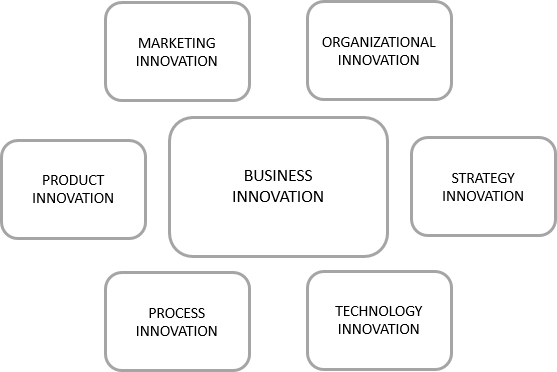
Innovation can be applied to a variety of systems in business as illustrated in diagram:
TYPES OF INNOVATION
Below is the innovation Spectrum

There are three types of innovation that an organization can choose to pursue: incremental, breakthrough, transformational. One type is not better or worse than another but they may require different processes to achieve success.
TRANSFORMATIONAL

Is the most difficult because it changes the way we live and often makes big companies, even whole industries, obsolete in a short period of time. Most organizations are loath to pursue ideas that will make themselves obsolete.
Unfortunately, this is one of the reasons that they die. The computer and entertainment electronics industries have been prime examples of this. How many of us have audio 8-track machines, cassette players, videotape cameras, recorders and players, bag phones, clunker desktop computers, etc. sitting in our basements? In most cases transformational innovation starts in someone’s “garage;” by a visionary outsider. It rarely happens within the walls of an organizational structure.
INCREMENTAL INNOVATION
If transformational innovation sits at one end of the innovation spectrum, then the opposite end is Incremental Innovation. This is the kind that most of us are used to pursuing. It focuses on the kinds of improvement that keep a product, brand or company in the game. They tend to be line or brand extensions, new bells & whistles, new packaging, new improved ingredients, etc. In fact, an Advertising Age innovation study several years ago concluded that over 60% of innovations claimed by the consumer products industry were nothing more than packaging improvements. Nevertheless, it is instrumentalism that fuels most of the competition experienced in any industry. And it is this type of innovation that requires:
▪
Multi-disciplined, cross-functional collaboration
▪
Strong, definable metrics at each decision-making point
▪
Consensus-based decision making between multiple stakeholder functions
▪
Internal competition for people, money, and operational resources, such as:
▪
R&D
▪
Packaging development
▪
Qualitative and quantitative market research
▪
The interruption of production lines for short, unprofitable test market runs
▪
Distribution channel support in small test market geographies where channel competition is fierce enough for the established brands (who has the bandwidth to push the new ones [sales] or hear about them [buyers]?)
▪
Promotional and advertising development
The amount of resources that are made available for this type of innovation are almost always tied to current business performance; available in the good times and one of the first things to be cut in the bad times (right after the ad budget).
BREAKTHROUGH
Innovation falls between incremental and transformational on the innovation spectrum. It requires significant change on the part of the innovating organization, both in terms of cultural and systems support. It creates true competitive advantage for a sustainable although increasing shorter period of time and it involves significantly more risk-taking, which is why the decision-making that results in true breakthroughs must in many ways be the opposite of the decision-making that supports incremental innovation. It must be sponsored at the top. Breakthrough ideas create new markets and business opportunities that did not exist before. Therefore, there is no “frame of reference” upon which to deliver the metrics called for by a Stage Gate process. Customers don’t have a frame of reference by which to easily judge the idea, business analysts have no track records – no sales numbers, no relevant trial or repeat data, etc. upon which to build volumetrics. For this reason, breakthrough needs the higher level of consideration and judgment.
THE IMPACTS OF INNOVATION ON A BUSINESSES
The following is how innovation impacts on a business;
Leadership
The creativity exhibited by innovative companies often puts them in positions of leadership within their respective industries. Apple, for example, regularly makes the news for its latest innovations which generally set the bar for other similar products that are later developed by other companies trying to piggyback off of their success. By the time these companies finally manage to catch up, Apple and other companies taking a leadership role have generally created another innovative product to once again lead the way. Although small business are not generally in a position to take this type of leadership role from the outset, they can develop their reputation and do so over the course of time, one product at a time.
Experience
Innovative companies also have the advantage of experience on their side. They typically get the process of product development down to an exact science that can repeated over and over again. Their ability to repeat this process with efficiency generally sets them apart from other companies that try to create new products for the first time. For small businesses this generally involves a considerable amount of trial and error.
Name Recognition
Because they are leaders within their respective industries, innovative companies generally do not need to do an excess amount of advertising or branding to capture their target market. Instead, their name alone carries considerable weight in their industry and people await their products to hit the market. Their name recognition generally sets them apart from other companies in the market, which means that they need to do very little to promote their products. This is probably one of the more difficult things for small businesses to establish. However, with just one truly innovative product, these companies can also begin to carve their niche in the market and gain that same type recognition.
RELATIONSHIP BETWEEN SUCCESSFUL ENTREPRENEURSHIP AND INNOVATION
Entrepreneurship and innovation are related naturally. Each requires creative thinking and a desire to take some risks. Proven research indicates the intensity of said risks, making it possible to forge new paths for business success and technological advancement. Comparing entrepreneurship and innovation, one can’t help but recognize the similar characteristics of each, and how when joined together, they expand business prospects.
Entrepreneurship characteristics
Entrepreneurs are natural-born leaders with innate characteristics that generate ideas and challenge the status quo. They are philosophical by nature, often contemplating unique relationships, cause and effect scenarios and extended capabilities of their projects and endeavours. Common characteristics of entrepreneurs include:
Willingness to learn: Entrepreneurs have an insatiable appetite for learning new things. They read, study, experiment and test new ideas regularly. As they do so, they determine what works, learning from failure as it happens.
Engaging personality: Entrepreneurs are exciting individuals who engage in the world around them. They are leaders with the ability to build teams of people who can fulfill a task, while setting and achieving goals in the process. Their ability to sell others on their innovative ideas allows them to pursue dreams, often turning them into realities.
Strong moral compass: Entrepreneurs value their reputation. They understand the importance of networking and work hard to preserve their integrity. Entrepreneurs are honest people willing to do whatever it takes in business, providing their reputation doesn’t get tarnished in the process.
Resource-oriented abilities: Entrepreneurs are resourceful. Finding answers and solutions is like second nature to them. They are organized, detail-oriented people willing to do research and ask for help when necessary.
THE CHARACTERISTICS OF INNOVATIVE PEOPLE AND COMPANIES
Innovation necessarily invents and expands on new and existing ideas. Innovators promote growth in communities by responding to their needs and desires. In their quest to solve community dilemmas, develop economically sound environments and create culturally responsible enterprises, innovators often work with entrepreneurs to achieve prevailing community goals.
COMMON INNOVATION CHARACTERISTICS ARE:
Uninhibited intellectual freedom: Innovation solves problems in unique and varied ways. Innovators often think abstractly, recognizing the implications of their inventions and trouble-shooting before long-term problems result.
Ability to overcome obstacles: Change, while often necessary, isn’t always embraced readily by communities. Innovation introduces ideas, communicating them effectively so that they are accepted by the majority. Innovators are well versed in the psychology of human feelings, emotions and personalities. Their ability to work with others enables the development of new ideas.
Strong sense of integrity: Innovators slowly become trusted members of communities. Their innovations must stand the test of time. The integrity of innovators is constantly being tested in the interim. Obstacles and hurdles are faced and overcome in this dynamic phase of integrating new inventions into established communities.
Goal-oriented productivity: Innovation relies on ideas for its development. Then it creates the process that transforms viable ideas into realistic goals for production. Gradually, innovators introduce progressive advancements into communities, meeting and exceeding the needs of citizens on a grand scale.
EXAMPLE OF AN ENTREPRENEUR & INNOVATOR: MARK SHUTTLEWORTH PROFILE

Mark studied finance and information technology at the University of Cape Town. After completing his studies he founded his own company – Thawte. The company specialised in digital certificates and internet privacy. Thawte became the first company to produce a full-security e-commerce web server commercially available outside the United States. It was one of the first companies to be recognized by both Netscape and Microsoft as a trusted third party for website certification, and it quickly established a leadership position in helping businesses around the world to accept secure transactions over the web. By 1999 Thawte was the fastest-growing internet certificate authority and the leading certificate authority outside of the USA.
Mark sold Thawte to VeriSign in December 1999 and is no longer involved in the company. He founded HBD Venture Capital and The Shuttleworth Foundation. In April 2002 Mark flew into space to the International Space Station as a cosmonaut and member of the crew of Soyuz mission TM34. Mark was born and raised in South Africa and is currently living in London, where he researches new projects and technologies.
FACTORS THAT CONTRIBUTE TO THE DEVELOPMENT AND SUCCESS OF A VENTURE
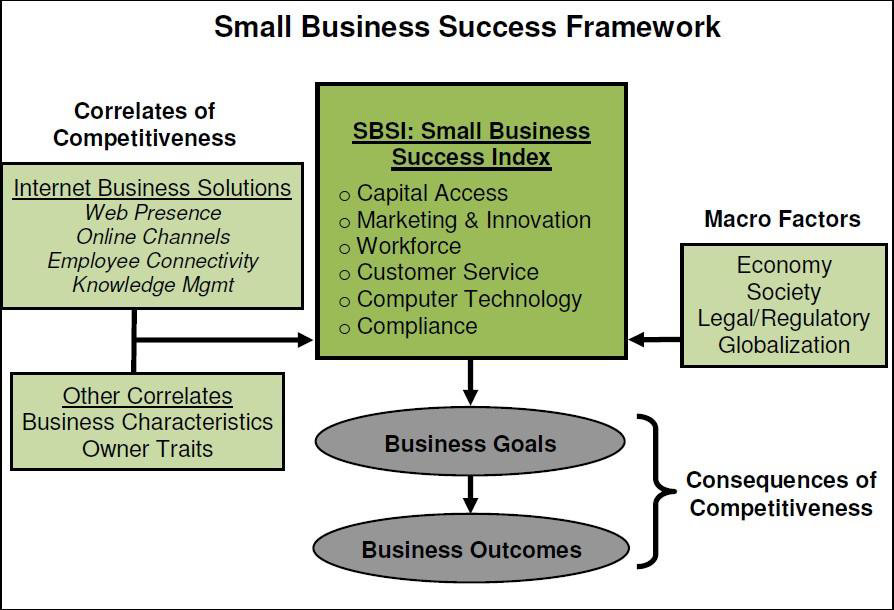
The diagram below shows the small business success framework. This framework shows the key factors that contribute to the success of any small business in South Africa.
1.
Capital Access, including availability of working capital, capital for long term investments, and expert financial advice
2.
Marketing and Innovation, such as identifying new prospects, showing effective corporate positioning, converting leads, finding ways to efficiently advertise, and the ability to come up with new ideas
3.
Workforce, including the ability of small businesses to attract, retain, develop, motivate and deploy employees efficiently, as well as encourage creativity from them
4.
Customer Service, which is the ability of small businesses to service their customers, show they care about them and grow their relationships
5.
Computer Technology, which includes making technology work effectively and efficiently in the organization
6.
Compliance, which is the ability of the small business to understand and comply with laws and regulations.