
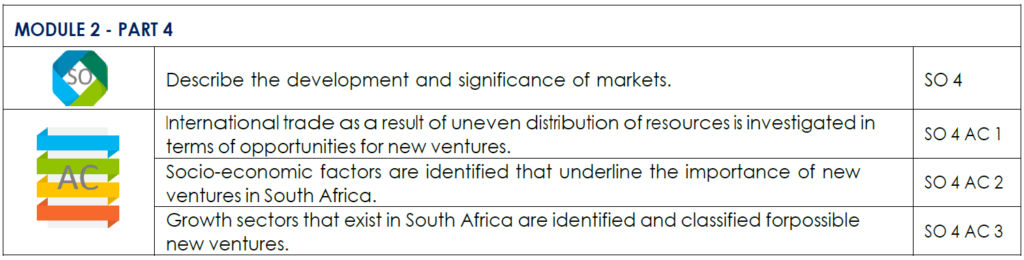
MODULE 2 – PART 4: Describe the development and significance of markets.
INTRODUCTION
South Africa’s economy has been in an upward phase of the business cycle since September 1999 – the longest period of economic expansion in the country’s recorded history. During this upswing (working on data for the period up to the fourth quarter of 2007), the country’s annual economic growth rate has averaged over 4%. In the decade prior to 1994, economic growth averaged less than 1% a year. It is therefore essential to develop entrepreneur in South Africa that will contribute to the overall economy.
INTERNATIONAL TRADE AS A RESULT OF UNEVEN DISTRIBUTION OF RESOURCES
International trade is the buying and selling of goods and services across national borders or territories, allowing both the buyer and seller to expand their markets for goods and services that otherwise may not be made available to them. All countries have different assets or strengths in terms of land, labour, capital, technology and natural resources. Hence, most countries usually focus on those products and services which they possess comparative or absolute advantage through specialisation. However, such specialisation may result in excess production capacity for certain goods and services, but also opportunity cost for not producing enough of other goods and services.
International trade exists for the following reasons:
▪
There is an uneven distribution of natural resources in different countries. Therefore, international trade exists to bridge the gap across geographical boundaries.
▪
All countries possess diverse strengths and weaknesses in terms of land, labour, capital and technology. By focusing on industries with comparative advantage, cost and operations efficiencies are reaped via specialisation.
▪
It provides consumers the opportunity to be exposed to those goods and services that are not available in their own country.
▪
It reduces dependency on domestic market by expanding customers’ demand in other countries.
▪
It enhances economic growth and contributes significantly to the country’s Gross Domestic Product.
Instead of international trades, South Africa can create opportunities for new ventures. The government can do this by supporting/funding new ventures. An example of ways the South African government is supporting new venture creation is through initiatives like the Black economic empowerment.
South Africa’s drive to bring the long-excluded majority of its people into the mainstream of economic life is paying healthy dividends. A lot of jobs are created for South Africans and organisations can buy goods and services locally instead of exports or international trade.
▪
BEE is not affirmative action, although employment equity forms part of it. Nor does it aim to take wealth from white people and give it to blacks. It is simply a growth strategy, targeting the economy’s weakest point: inequality.
▪
At the core of the policy is the BEE scorecard, which measures companies’ empowerment progress in ownership, management, employment equity, staff training and direct empowerment.
▪
Private companies have to apply the codes if they want to do business with the government – to tender for business, apply for licences and concessions, enter into public-private partnerships, or buy state-owned assets.
▪
Companies are also encouraged to apply the codes in their interactions with one another, as preferential procurement will affect most private enterprises throughout the supply chain.
▪
The National Empowerment Fund, set up to provide capital for BEE transactions, is working on deals worth more than R1-billion.
▪
International investors are increasingly embracing BEE.
ACCELERATED AND SHARED GROWTH INITIATIVE
The Accelerated and Shared Growth Initiative for South Africa (Asgi-SA) is a bold plan by the government and business to boost the country’s growth to 6% and halve poverty and unemployment by 2014. South Africa’s economic growth has been impressive, rising from 3% in the first decade of freedom to nearly 5% in 2005. But to have the desired impact on poverty and unemployment, this growth must be boosted to at least 6% – if not higher.
▪
Economic growth cannot be at any cost: it must be sustainable, and it must be shared. If large numbers of people are excluded from the mainstream economy, the potential for future growth will be seriously obstructed.
▪
In developing Asgi-SA policy, it was concluded that interventions to accelerate must surgically target weaknesses unique to South Africa’s economy.
Asgi-SA initiatives therefore fall into six broad categories:
I.
Massive investment in infrastructure
II.
Targeting economic sectors with good growth potential
III.
Developing and harnessing skills
IV.
Building up small businesses
V.
Revamping public administration
VI.
Creating a macroeconomic environment that’s good for growth
The investment in infrastructure is to smooth the way for growth, creating a strong and reliable backbone to support rapidly growing demand.
Not only is South Africa itself an important emerging economy, it is also the gateway to other African markets. The country plays a significant role in supplying energy, relief aid, transport, communications and investment on the continent. Its well-developed road and rail links provide the platform and infrastructure for ground transportation deep into Africa.
SOCIO-ECONOMIC FACTORS
1.
Not only is the GDP per capita in South Africa far below that of the world’s wealthiest nations, the country is plagued by vast income inequalities and high poverty levels (42.9% of the population live on $2 a day) t
hat have fuelled the spread of communicable diseases, particularly HIV AIDS and TB (life expectancy in South Africa is 49.6 years). The poorest 10% of the population account for a mere 1.3% of the country’s income or expenditure, while the richest 10% account for 44.9%.
2.
To compensate for the inability of the formal sector to absorb the labour force and to relieve these high poverty and inequality levels, a vibrant, albeit unstable informal sector has developed over the years leading to a dual economic system. Nonetheless, overall unemployment remains high and continues to be fed by large numbers of unskilled labour entrants
3.
Skills mismatches exist that are partly the result of inefficient education institutions and partly of the “brain” drain that has impacted the country since 1994. In addition, tertiary education institutions are neither attracting sufficient entrants that are ultimately able to graduate nor are they attracting them in the appropriate fields of study. 4.
These factors, coupled with an increasing number of child-headed households whose parents have been lost to AIDS place a large social burden on the state, which has responded by providing social grants to the most destitute. The social relief net has widened over the years but there are doubts that it will be sustainable in the long-term if nothing is done to address the root causes of the problem. Such high social inequalities also bear the potential to spill over into socio-political unrest if left unchecked.
5.
In addition to these home-grown problems, the country’s porous borders have resulted in a large influx of destitute immigrants, both legal and illegal, from neighbouring countries. The impoverished local population blames high crime levels on illegal immigrants, while the shortage of employment for the lowly-skilled has also given rise to instances of extreme xenophobia.
6.
Crime and theft have been identified as the most problematic factors for doing business in South Africa, according to the World Economic Forum (WEF). An inadequately educated workforce is the next most problematic factor.
If new ventures are created, they will employ a lot of skilled and unskilled individuals thereby reducing the unemployment and crime rates in South Africa. New ventures will also assist individuals to afford basic commodities and reduce anti-social activities like prostitution. This helps to reduce the spread of diseases like HIV/AIDS.
GROWTH SECTORS THAT EXIST IN SOUTH AFRICA
There are numerous investment opportunities in all South Africa’s business sectors. The TradeInvestSA business sector list is comprised mainly of industry and market sectors that have the greatest investment potential.
Currently, mining is South Africa’s most important business sector. Other major industry sectors include manufacturing, oil and gas, chemicals, agriculture and tourism. The financial services, banking and clothing and textiles sectors have also shown major growth over the last few years.
Agriculture and Agri-processing:

South Africa has a large agricultural sector and is a net exporter of farming products. There are almost a thousand agricultural cooperatives and agribusinesses throughout the country, and agricultural exports have constituted 8% of South Africa’s total exports for the past five years. The agricultural industry contributes around 10% of formal employment, relatively low compared to other parts of Africa, as well as providing work for casual labourers and contributing around 2.6% of GDP for the nation. However, due to the aridity of the land, only 13.5% can be used for crop production, and only 3% is considered high potential land. There are a lot of investment opportunities in the agriculture and Agri- processing sector. Entrepreneurs may consider investing in this sector.
Clothing and Textiles
The South African textile industry is well developed- not only in the traditional activities of clothing, textiles and home textiles, but also in the modern sub-sector of technical textiles. Textiles are South Africa’s sixth largest employer in the manufacturing sector and the eleventh largest exporter of manufactured goods. The bulk of this sub-sector’s products are sold as intermediate inputs to the clothing industry (19% of total sales) and other sub-sectors. The reduction of U.S. import duties will potentially be a huge boost to the South African industry all round. For the most part, the industry is concentrated in the coastal areas – i.e. KwaZulu Natal, Eastern and Western Cape. The local market is characterised by a few large firms, with a number of smaller concerns. Entrepreneurs may consider starting new ventures in this sector.
Construction and Materials

Construction and Materials The South African construction industry, encompassing residential, commercial and industrial building, as well as infrastructure development, is robust and in a generally healthy state. The middle and upper residential sector has experienced unprecedented growth and the non-residential building sector has performed well, driven by demands for office space, industrial facilities and retail locations. Between 1994 and 2005, more than 1.7million housing units were provided as part of the government’s goal of eradicating informal settlements by 2014. This plan includes the development of low-cost housing, the implementation of amenities and the changing of spatial settlement patterns to build multicultural communities. Opportunities in this sector for new businesses are endless.

Energy Energy is fast becoming an increasingly important sector, not just in South Africa but globally. The launch of the country’s first commercial wind farm in Darling in the Western Cape in 2008, excited interest and more wind farms are currently under development. The abundance of sun in Africa has also prompted calls for further investment into and use of solar energy facilities, particularly in light of the country’s electricity supply crisis. Entrepreneurs may start new ventures to resolve the electricity supply crisis in the country.

Personal and Household Goods The household appliances market reflects the sale of six product sectors: refrigeration appliances (including fridges, freezers and fridge freezers), cooking appliances (including cookers, microwaves, ovens, cooker hoods, food processors and toasters), washing appliances (including washing machines, clothes dryers and washer-dryers), heaters (which include space heaters and water heaters), vacuum cleaners and dishwashers. In 2003 up to 70% of the population was able to receive electricity. Eskom, South Africa’s electricity provider is trying to roll this out to all potential customers. However, there are logistical problems which are holding back both the industry and consumers. Entrepreneurs can start new ventures in this sector
SUMMARY
SYNOPSIS
In this section you learnt to describe the development and significance of markets.
REFLECTION
Note what you have learnt in this section in relation to:
▪
New venture opportunities in South Africa
▪
Socio-economic factors that underline the importance of new ventures in South Africa
▪
Growth sectors that exist in South Africa for possible new ventures