
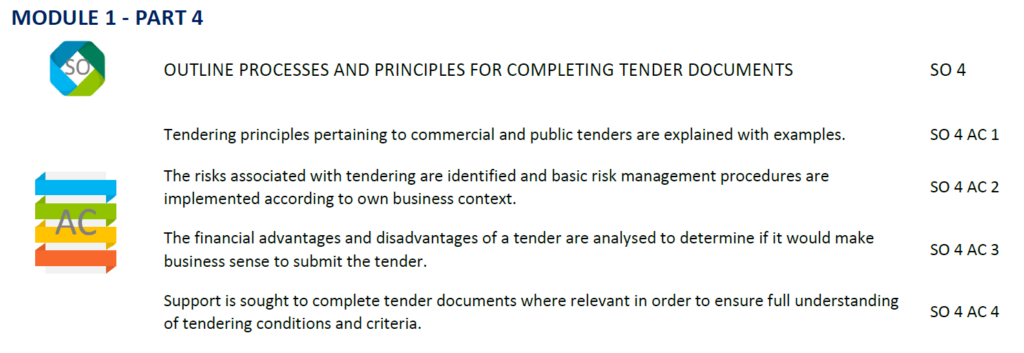
MODULE 1 – PART 4: OUTLINE PROCESSES AND PRINCIPLES FOR COMPLETING TENDER DOCUMENTS
PROCESSES AND PRINCIPLES FOR COMPLETING TENDER DOCUMENTS
A Tender Process (or “Invitation to Tender” process) is a method by which suppliers are selected for the provision of products and services to an organization. The process involves creating a suite of Tender Documents to manage the supplier selection process. The Tender Documents help the organization to select the best possible supplier available, and include documents such as the “Statement of Work”, “Request for Information” and “Request for Proposal”.

A business tender is an offer to do work or supply goods at a fixed price. The tender or bid process is designed to ensure that the work to be done is given out in a fair way.
There are a number of policies (known as “procurement policies”) which are used as guides on how to make decisions on which tender to accept. Although price is very important in the decision on which tender or bid to accept, it is not the only factor taken into account. Once the client entity accepts a tender, it is binding on both parties. This means that the person or company that won this business opportunity has to provide the goods or services in the manner agreed to and at the price offered, and the client entity must pay the agreed price at the agreed time. In other words, once accepted, a tender is a binding business contract.
Even if you don’t win the work this time, writing a tender can clarify your aims, strengths and weaknesses and you can learn for next time by asking for feedback on your bid. It raises your profile with the client and helps you learn about the client’s needs.
Title and Section LEARNER GUIDE: MARKETING MANAGEMENT PROGRAMME
Next revision 09-10-2022 Created 09-10-2020
Page number
Page 44 of 138 Reference LG-MMP-01
© Copyright Phakamani Impact Capital 2020 Revision Number 4
Tenders in South Africa are a lucrative source of income for small business, but can be challenging to negotiate, particularly since legislation has changed, and requirements differ between organisations and government sectors. Getting the process right not only saves time and effort but has the potential to set up lucrative income streams.
TENDERING PRINCIPLES
You can find out about private sector contracts in a number of ways:
▪
Build contacts with potential customers
▪
Advertise in local and national newspapers
▪
Advertise in trade and professional magazines covering your area of business
▪
Research contracts outside your business sector which may produce secondary contracts for you, for example, if a new office block is built, it will need desks, carpets, signage, stationery, cleaning and laundry
▪
Follow up press and other reports – a company may be expanding or sub-contracting part of a big order
▪
Network and pick up information from other businesses
You can identify public-sector contracts by:
▪
Following up contract notices published in newspapers and trade magazines;
▪
Getting the government tender bulletin;
▪
Searching department websites;
▪
Alternatively, one can access the Online Tenders website at a nominal monthly subscription cost to get the latest tenders and business leads in SA.

Online Tenders is a tender notification service that researches business tenders in South Africa and business leads throughout the country, classifies and matches the tender that is relevant to your exact business requirement. These tenders are then emailed to you on a daily basis or you can simply access the Online Tenders website for further tender information.
Finding the right tender opportunity is exciting and may just prove to be your first step in forging a profitable new business relationship. However, finding requests for tender that are well matched to your business requires time and persistence. Public sector tender processes tend to be time-consuming and particular. However, they can reap big rewards if supported by a well-considered approach and professional attention to detail and presentation. Here are some of the main ways you can find out about tender opportunities.
MONITORING TENDER SOURCES
Subscribe to tender search websites
Numerous public and private tender sources advertise tender opportunities. Monitoring these sources regularly will help you make sure you stay aware of tender contracts on offer in your sector. For paid subscriptions, private tender search organisations send you updates on tenders that match your business profile. You can find local, state and federal government tenders through government and independently managed tender alert websites.
Monitor local and national newspapers
Most papers include a list of current tenders in their public notices of classifieds sections. Check selected newspapers regularly for national, state-wide and regional tender advertisements from public, corporate and regional business sectors.
Read trade magazines
Subscribe to industry or trade publications in your sector to make sure you find out about tender opportunities in your industry.
Attend networking events
Trade shows and industry expos are good sources of information on business opportunities. They also help you make contacts and build relationships with peers in your industry who will share their market knowledge.
TYPES OF PROCEDURE
Tenders are normally invited under either a “restricted” or an “open” procedure.
Open Tendering Procedure
This procedure is generally used where the expected number of responses is likely to be manageable. Any organisation expressing an interest in an advertised opportunity is invited to tender and is issued with a tender pack. This must be completed fully and returned with any requested supporting information by a specified date and time. A panel of officers evaluate responses against pre-set criteria and the highest scoring tenderer is awarded the contract.
Restricted Tendering Procedure
This procedure is generally used if a high level of interest is anticipated. This procedure requires organisations who express an interest to undergo an initial pre-qualification assessment to appraise such things as their economic and financial standing, capability and capacity and compliance with Health and Safety and Equal Opportunities. Normally organisations are sent a pre-qualification questionnaire which must be completed fully and returned by a specified date and time. A panel of officers evaluate responses against pre-set criteria and the most suitable applicants are then invited to tender.
Electronic Tendering (e-Tendering)
Electronic tendering (e-Tendering) uses a secure portal to conduct the entire tendering process electronically. This involves every step in the tender process from expression of interest through to contract award. This form of tendering requires organisations to register an interest online, at which point they will be able to access all tender information and questionnaire(s). Organisations are required to complete and submit their tender submission online, by a specified date and time. Evaluation will be against pre-set criteria and will either be completed automatically by the portal, or by a panel of officers where automatic scoring is not achievable e.g. for a lengthy written response.
Electronic tendering can be used when following any type of tendering procedure, and if appropriate, could also involve the use of an electronic reverse auction (e-Auction).
RISKS ASSOCIATED WITH TENDERING
Tendering processes require stamina. Be confident in your tender choice and approach. A well-chosen tender opportunity increases your chances of success and reduces your risks, time-wastage and costs to your business. The risks pertaining to tendering includes, cash flow, funding requirements, compliance requirements, performance requirements and technical requirements.
Project risk process comprises five key areas. This includes the decision to tender, tender risk review, project start-up, project execution and finally project close-out.
The risks associated with projects are potentially the biggest risks faced by an organisation. Accordingly, the process used in this area must be rigorous and provides for many hold and witness points to ensure that only projects that are appropriate to the group are tendered. The risks associated with these projects are considered on a project by project basis and a specific report, risk register, cash flow and other documents are required to ensure that he conditions surrounding each individual project have been properly evaluated and that appropriate control measures instituted.

Cash flow is the incomings and outgoings of cash, representing the operating activities of an organization. In accounting, cash flow is the difference in amount of cash available at the beginning of a period (opening balance) and the amount at the end of that period (closing balance). It is called positive if the closing balance is higher than the opening balance, otherwise called negative. Cash flow is increased by (1) selling more goods or services, (2) selling an asset, (3) reducing costs, (4) increasing the selling price, (5) collecting faster, (6) paying slower, (7) bringing in more equity, or (8) taking a loan. The level of cash flow is not necessarily a good measure of performance, and vice versa: high levels of cash flow do not necessarily mean high or even any profit; and high levels of profit do not automatically translate into high or even positive cash flow.
Risk is a probability or threat of a damage, injury, liability, loss, or other negative occurrence that is caused by external or internal vulnerabilities, and that may be neutralized through pre-emptive action.
The cost and effort in responding to and complying with Tender Specifications can be very expensive and taxing on the business. Compliance is often regarded as part of the drudgery of writing a tender response. Failure to take compliance seriously and manage it properly can result in disaster. By putting some simple processes in place, you will not only make sure you never get disqualified for non-compliance, but you’ll add value to your response.
Low pricing – companies that lack past experience may try to score high points by submitting a low price. This can be risky as, if the price is too low, the tendering company may not be able to pay their staff and suppliers.
RISK MANAGEMENT PROCEDURE
Risk management should be seen as an ongoing process, rather than a one-off procedure that you apply to an individual threat. You should continuously reassess threats and actively search for new ones.
Risk management is a structured way of controlling risk. There are various ways you can do this, but the following steps outline a typical approach:
Identify risk – to manage risk, you have to be able to identify potential threats. This allows you to act before something happens, rather than ‘fire-fighting’ after an event.
Risk assessment – you might not need to invest time and money in reducing risk, but you need to take a measured approach to it. Assess its importance to your business. If the risk is serious enough, then you may need to take further action. Some risks may not warrant further work.
Risk mitigation – risk reduction – with many risks you can implement preventative measures that will significantly reduce the probability of the risk occurring.
Risk mitigation – impact reduction – for some risks, you may not be able to reduce the probability of them occurring to an acceptable level. Therefore, you should think more about reducing the negative consequences of that risk should it actually affect your business.
Contingency planning – often the best you can do is make plans for how you would survive a problem. Contingency plans are what you would do after the worst has happened. A particularly important form of contingency plan is a disaster recovery plan.
EXAMPLE
(Construction tender risks)
Responding to RFTs (requests for tenders) can be risky, given that your tender response is a legal offer and you may be bound to the terms within it, if the client accepts it. Responding to a complex tender can also be very time-consuming, tying up substantial company resources for significant periods of time.
For both of these reasons you need to:
▪
Evaluate the risks associated with each tender carefully, to ensure that it is in your organisation’s best interests to respond
▪
Establish an effective team to develop the bid and work to a realistic schedule that will allow the team to produce a thorough response within the available timeframes
▪
Oversee the development of human and physical resource cost estimates very carefully, to ensure that the tendered price is accurate and comprehensive of all likely costs
▪
Prepare the response carefully, to ensure that it meets all necessary requirements and evaluate it to ensure that it is accurate and professional
▪
Gain the necessary endorsement or approval before submitting the tender response to the client
Top 10 risks
Below is a list of potential risks that should be assessed when responding to Requests for Quote or Tenders. These risks are generally the same as those you would identify for any building and construction project:
1.
What constitutes a breach of contract and what is the resultant impact. Will a breach trigger termination, or will it require make good or rectification at your own cost? Can you terminate the contract or can it only be done by the client?
2.
Delays caused by circumstances outside the builder’s control, such as:
✓
Delivery delays that delay project completion
✓
Subsequent delays in progress payments
✓
Labour shortages
✓
Weather
✓
Are you liable for any delays and what is the impact of this liability?
3.
Exposure through clauses that work against the building organisation, such as clauses that hold the builder responsible for circumstances outside their control.
4.
Disputes over payments, either payments from the client to your organisation or payment from your organisation to subcontractors. Assess your cash flow to ensure that you can make payments to subcontractors even if you haven’t been paid by the client for a particular milestone.
5.
Incorrect labour or materials costs, or miscalculations in any figures given. Have you added any budget or materials contingency?
6.
Inappropriate funding levels and funding shortfalls for the project, resulting in a suspension or cancellation of the project or renegotiation of terms and conditions during the project.
7.
Industrial disputes through misunderstandings onsite or through overt action.
8.
Risk of default or non-performance of one or more of the key players, including the client, the builder and subcontractors.
9.
Ignoring risk and failing to plan for it.
10.
Positive risks. Risk is usually seen in a negative light, but some risks are positive and can be seen as an opportunity to enhance procurement objectives. These can include currency fluctuations and even proposed changes to legislation or regulations which could simplify compliance requirements and therefore reduce the overall cost of the contract.
Some tips
Scrutinise all the RFT documentation and complete a risk assessment for the project. Check the information in all of these documents and note all the project requirements / special features or issues. Look for missing information / inconsistencies / discrepancies in the information provided. These kinds of omissions and inconsistencies pose a risk right from the outset and need to be considered carefully.
All the contract documents need to be thoroughly scrutinised to identify all requirements, all conditions and all risks. Review proposed conditions of contract, as many of its clauses will seek to apportion the risk associated with the project to one of the parties to the contract, either the client or the head contractor.
Generally, risk should be borne by the party that can best control the risk, so it is appropriate that the head contractor bear some risks that are within their control, such as those related to the schedule of work or site management. The head contractor needs to ensure, however, that they are not being asked to bear risks over which they have limited or no control.
Given that builders are frequently engaged through tendering processes, especially for large projects and particularly by government agencies, knowing how to respond well to RFT’s can greatly increase the volume of work that a building organisation can bid for and win.
FINANCIAL ADVANTAGES AND DISADVANTAGES OF A TENDER
There are many benefits to your business if you decide to tender for a public sector contract.
▪
Public sector organisations are good customers, because:
✓
dealing with suppliers and the selection process they have in place must be honest and professional
✓
most public sector organisations are also long-standing customers, and are obliged to pay within 30 days (or any other agreed period) of receiving a valid bill or invoice
▪
You may also find that trading successfully with the public sector can make your business more attractive to other private sector customers
▪
Public sector contracts are not simply awarded to the lowest bidder. They are obliged to obtain the best value for money which means they must choose the bid which offers the best combination of costs and quality (or fitness for purpose), as required by the buyer
▪
Maximum Sale Price- Tenderers have the opportunity to submit bids, and do not know how much anyone else is tendering, they are therefore forced to go straight to their best price
▪
A Tender may well offer more than what a Tenderer expects. The Tenderer’s cash flow will be improved
▪
Another general advantage is Confidentiality- Tenders submitted are confidential, and the sale price of the property is generally not public knowledge
Disadvantages
Preparing business tenders can help you to win big orders, but it can also;
✓
Be time-consuming
✓
Cost money and
✓
Takes up valuable resources.
If you don’t get the contract, the money and time spent is usually lost, so you need to weigh up whether or not a tender is worth bidding for.
Key points to consider:
✓
Get hold of the bid documents and analyse them
✓
Make sure you can match the technical, skill and experience requirements
✓
How much will it cost to prepare your bid?
✓
Would the work fit in with your strategy and positioning of your business?
✓
Estimate the costs of fulfilling the contract and whether or not you’d make enough money to justify it.
✓
Assess how the contract would affect your other work, staffing and ability to take on other new business opportunities
You also need to consider how important the client is to your business contracts. Is this a good potential client or one you don’t want to offend by not tendering? Try to understand things from the client’s point of view.
SUMMARY
Working out whether a new business opportunity is worth going for is an important skill. Tendering for contracts you have no realistic chance of winning wastes your time and that of the purchaser.
✓
Do you do what they are looking for?
✓
Fit your company profile?
✓
Match your experience?
✓
Match your staffing and facilities level?
✓
Require a capital investment from you?
✓
Require you to show that you have successfully completed similar work in the past?
✓
Require you to have policies and systems in place such as health and safety, sustainability and standards and quality?
✓
Require you to obtain any additional accreditation or certification?
The answers to these questions will determine to some extent whether it is worthwhile for you to tender for the work or whether you need to improve your company fitness before you start to tender for this and other public sector work.
As a business, you may want to ask yourself the following questions:
✓
Does this opportunity match your marketing strategy?
✓
Who will you be competing against and what is the strength of that competition?
✓
Will you make sufficient margin on the sale or are you willing to bear the loss to get a foothold in a new market?
✓
What impact will it have on your cash flow?
✓
Would this sale take up spare capacity or warrant investment in a new plant or new machinery?
✓
Will this contract enable you to increase investment in your business and move to a new level?
✓
Would you have to recruit extra staff to take on this job?
✓
Does the contract give you the opportunity to develop new product lines?
✓
Does your performance of the contract depend on the performance of others (either another contractor or the public sector)?
SEEKING SUPPORT WHEN COMPLETING TENDER DOCUMENTS
Once you have identified a tender that you would like to pitch for, you need to access and complete the tender documents. On this point, filling them out correctly plays a vital part in the potential success of your bid. It’s not so much that it’s difficult, but more that it requires you to be highly specific and pay close attention to detail, especially for government tenders. If you forget to include your price you will be disqualified. Deliver your tender one minute after the deadline and it won’t even be considered. If your product or service does not comply with the specifications of the tender, your bid will be removed from the list and you would have wasted your time. For national and provincial government tenders you will need to fill out standard forms. Give yourself plenty of time to complete and post, courier or hand-deliver the documents by the deadline.
It’s advisable to contact a Tender Advice Centre (or experts) who will help you get hold of and complete the tender documents correctly.

Tender document are the focal point in the tendering process and furnish all information necessary for a prospective tenderer to prepare a responsive tender for the supplies, services and works to be provided. While the detail and complexity of these documents may vary with the size and nature of the contract, they generally should include:
1.
Invitation to tender;
2.
Instructions to tenderers;
3.
General and special conditions of contract;
4.
Technical/services specifications;
5.
Tender form;
6.
Contract form;
7.
Appendices (model financial offers, forms for guarantees, etc., as applicable)
The tender documents are drafted so as to permit and encourage the widest possible competition. They clearly define the scope of supplies and associated services, the services and works to be supplied, the rights and obligations of the contracting authority and of suppliers, service providers and contractors, and the conditions to be met in order for a tender to be declared responsive, and they set out fair and non-discriminatory criteria for selecting the winning tender.
Sometimes when completing tender documents, the answer is to go to an expert, a creative company (or freelancer) to design and produce a professional tender document that has all the elements to create a successful sale. Your tender document is like a mirror. It’s a direct reflection of your organisation and you as a person, and the reader will judge you. Remember, first impressions last. Although there are some great software tools for creating documents yourself, there is no substitute for some real creative input from someone who understands the fundamentals of creating a visually precise document and the tendering conditions and criteria.
PREPARATION
The following must be put into consideration when completing tender documents.
Do not rely on reputation
You may have the name but there is always a competitor who will go the extra mile to out-shine you for a new contract. Invest in your tender production and never get complacent with your existing contacts. Treat every tender as if it were your first for a client.
Timings
Plan ahead and take the time to get it right. Create the best presentation you can, both in terms of the information you need to present and the way you need to present it.
Competitive research
How does the competition look? What do they say about themselves? How can you differentiate yourself? Can you use their own information to your advantage in any way?
Be creative
Use creativity and design to compete with the “big-boys”! You may feel that if you are a smaller organisation your tender document will not be taken as seriously. But, if you present a tender as professionally as the competition, you’re in with a chance. You may even gain the advantage if you can offer the same solution at a lower cost than the larger company.
DESIGN
How do you make yourself memorable? Is it your name? Your brand? Your corporate identity? Whatever it is, in addition to the quality content you produce for your tender, open your mind to the value some creative thinking and quality design input could bring to make you stand out from the competition. This could be through typography, illustration, tone-of-voice, or, quite simply, the professional design execution of your corporate guidelines. Creativity also adds value to the finished physical document. Here are some insights from a creative point-of-view.
Branding
Be confident with your brand. After all, this is who you are, what you are proud of and at the heart of “what” you are trying to sell to the reader. Don’t be afraid to utilise the recipient’s branding, but do use it appropriately. Do not try and mimic their collateral or house-style, you may fail, devaluing their identity and therefore your proposal. Concentrate on being confident in who you are.
Page layout
By using a clear and simple page structure in your document design, your information will be more legible and have more impact. Proper use of white space, margins and consistent page styling throughout your tender document will allow the reader to engage with each page.
Contents and page numbering
Make it easy for the recipient. Provide a table of contents, even an index if necessary, so they can easily get to the data that is pertinent to them. Ensure your page numbering corresponds with the contents and that your page numbers are legible and easy to find on each page.
SECTIONS
Break your tender document up into defined sections and consider using tabbed inserts in your presentation to differentiate them. If your content is placed into manageable “chunks”, they are far more likely to be read. Also, consider using colour-coding as a visual aid and relate this back to the contents section.
Colour
Use your corporate colour palette consistently and effectively. Use colour to break up sections in your design, define headings, create call-to-actions, or to draw the eye of the reader to any information you feel is key. Also, don’t overdo reversed text – white text out of a colour – as this will be more difficult to read when used on larger areas of copy.
Typography
Utilise your corporate font consistently throughout your tender document, placing emphasis and clarity on headings and key information. Ensure that your body copy font is easy to read with a point size and leading (the space between lines of text) that allows for clarity. Finally, lower case text is proven to be easier to read for longer blocks of text so STAY AWAY FROM CAPITALISATION.
Imagery
If the design of your tender document requires imagery, make sure it is good quality and at a decent resolution for the final piece. When printed, a poor quality image at low-resolution will not look professional. Also, ensure your company imagery does not look too dated.
CONTENT
Spelling and grammar
It is vital that you spell-check and proof-read your tender document before you send it. If it reads poorly and is riddled with spelling mistakes, this will reflect on your levels of competence. Utilise colleagues to read your document. Is it legible? Does it make sense? Try showing a family member or someone who does not understand the subject. Can they still take away the key message?
Table and charts
If you are displaying data as a graph, or in a table, make the data clear and engaging within your design. Consider how the recipient will interpret your data. A dull page of figures may not stimulate interest in what could be your most important page of data. Similarly, a graph can also create an easy-to-interpret display of what could be complex data. Keep it legible and avoid complicated graphing styles that get in the way of the data you are presenting.
Copywriting
The value of a good copywriter to translate your content into easy-to-read and compelling words could make the difference when it comes to getting your message across effectively. Do not let your tender document suffer as a result of your inability to write in an engaging manner. Asking for help, accepting feedback, or even paying a copywriter to reshape your basic draft should be considered.
Testimonials
Although not always appropriate if you are tendering to a vertical market, a good testimonial is actual evidence of success. If genuine, the reader has a third party endorsement of the good work/service you are already providing for someone else. Use these to your advantage.
Personalisation
Why not make this personal? You should know the name of the company, and of the decision maker your tender document is being sent to. A tender document with personalisation has an extra dimension when it comes to engaging someone. Digital printing and variable data systems make personalisation very affordable to incorporate into your design.
PRODUCTION
It is very important that you produce your tender document professionally. There is nothing worse than a tender document, however good the information inside, that has been printed on an office colour printer and thrown together into a folder. Chances are the colours will be off-brand, margins will move and you will be restricted to a white border on the outer edge of every page. Have your presentation printed, cut and bound by specialists, this will ensure that the first impression is excellent.
Templates
If you produce a number of tender documents for your business, why not design and produce templates with the option to overprint? This will ensure you are getting better value for money in the long-term by reducing the chances of unnecessary production and increasing the likelihood of consistent production. Create a set of design templates. Information can be replaced and updated, saving time by not having to start from the beginning each time. But, you must ensure brand consistency from one tender document to the next and be sure to proof thoroughly. Any reference to a previous tender, or company, could ruin your chances of success.
What stock (material) is your tender document printed on? Does it adhere to your corporate sustainability values? Do the delicate print finishes say “first-class organisation”? Have you even considered the impact a print finish could have on your design ideas? Specifying the appropriate material to print your tender document on, can add to the tactile experience of the reader. Remember, that you are not just limited to A4 paper. Get creative, but do remember the practical issues with size. Can it still be mailed? Will it sit in an in-box? A bit of lateral thinking may give you the edge.
Finishing
Do you need to be able to add further information to your tender document at a later date? Does the recipient need to be able to add anything? If so, why not produce an item that is flexible, like a folder or binder? It can still be branded, plus the binders can be bought in larger numbers if required. Another option is to purchase plain folders then produce a personalised sheet that is riveted in with the D-ring. This will add to the quality feeling of your tender document and demonstrate that you have considered who you are providing the proposal for and their needs beyond the initial delivery.
Tender carrier
If your tender document is made up of various pieces of documentation, consider how you will collate these items together. What will be the device that the various pieces go into? A well-produced tender put in a jiffy-bag will fail to impress. Creating a branded, individual carrier, be it a branded box, wallet, or the like, enhances the professional delivery of your tender. Furthermore, the additional container will ensure your valuable documents arrive cleanly and safely. The first impression your reader will receive is that you care about the documents and therefore the tender. Chances are, that will convey the message that you are the type of organisation that cares enough to be trusted.
Branded carrier sleeve
If your carrier/carton is not branded or personalised, or has been produced as a generic item, consider producing a sleeve that could slide over the item. This can be produced simply and cost effectively utilising a template. Simply update the name and/or branding of the recipient and produce digitally. This also enables you to produce the carrier in greater quantities and with more sophisticated finishes.
Delivery
Do not underestimate the value of the delivery process. Although you may have planned well in advance and your tender document is ready ahead of schedule, it may not be enough to rely on the ordinary mail to get it there for you. The additional cost of a dedicated courier could be perceived as excessive, but the value of your tender arriving before a deadline and being placed into the hands of the key decision maker is priceless if you win the business.
Deadlines
After all the blood, sweat and tears of getting the presentation perfect in every way… don’t deliver late.
You will be eliminated from consideration, the hard work will have been worthless and your reputation will probably be taking a hammering.
In order to achieve the above, external sources and experts may be sought to assist in completing tender documents.
Compiling your tender submission
Each tender indicates a closing date. This is a very firm deadline and no late business tenders can be accepted. Bids or business tenders in South Africa have to be in writing. Each tender has a number of associated forms, which must accompany the tender you submit. The specific forms you require for your tender should be listed in the tender documentation. You should consider very carefully how you fill in these forms. Get advice if you are unsure of anything. The forms usually required for national and provincial business tenders in South Africa are the following:
THE BID
In this document you agree to be bound by the terms and conditions of the tender or bid.
TAX CLEARANCE REQUIREMENT
Your taxes must be in order to be successful with your tender or bid. This document has an ‘Application for tax clearance certificate’ form attached to it. You have to complete this form and hand it in at your nearest South African Revenue Services (SARS) office, to get a tax clearance certificate. You must then attach the original tax clearance certificate that you get from SARS, to the tender or bid documents. This certificate serves as proof that you are not in arrears with your tax payments.
PRICE AND MOTIVATION
Which of these documents you complete depends on the subject of the tender. In this form, you motivate your price, by describing the product you will supply or the experience of the person who will perform the service.
This form is often amended for the particular tender, so carefully check which one you need to complete.
DECLARATION OF INTEREST
This is the document in which you declare whether or not you have a relationship (friend, family, business leads) with anyone who works for government. This is so that those people are not involved in awarding the tender in any way, to avoid corruption.
PREFERENCE CERTIFICATE
You must fill in the form for tenders even if you are not claiming any of the preference points.
CONTACT FORM
This is the contract that binds the parties should the tender be successful. There are different forms for different contracts. There may be other forms to fill in for a specific tender or bid. These should be included with the tender or bid documents that you receive.
WRITING YOUR TENDER
Make sure that you match the bid specification and answer all questions. Summarise your bid and explain why it answers the client’s needs. Write this last, yet include it at the beginning of your tender.
Clients will also expect you to:
▪
State the purpose and origin of the bid
▪
Summarise your work as a contractor, past experience and credentials for this job
▪
Say how you’ll carry out the work, and how and when the client’s aims will be achieved
▪
Explain the benefits and value for money of your bid
▪
Detail when and how goods and services are to be delivered, and provide a timetable
▪
Demonstrate your team’s skills, experience of similar work and their responsibilities if you win the contract
▪
Explain how you will manage the project
▪
Give details of your pricing and any aftercare arrangements within the price
▪
Be practical and identify potential problems without promising what’s clearly impossible for you to deliver
Include a covering letter that responds to the bid invitation, summarises your main message. Additionally, explain how the documents are organised.
LEARNING ACTIVITY: SELF-ASSESSMENT QUESTIONS ON UNIT STANDARD 119672
Complete this task in the workbook provided.
1.
State and explain any two selling techniques that can be used to promote a product/service
2.
Sometimes it is necessary to ask for help when compiling quotes. Discuss.
3.
Explain some of the common pitfalls in quoting and order taking with examples in relation to own business venture
4.
In your own words define the term negotiation.
Method
Writing and Discussion with Mentor / Facilitator
Resource
The web, your own research and your mentor / facilitator