
Part 1 – MANAGE FINANCES FOR A NEW VENTURE
INTRODUCTION
Finance and accounting systems help drive business performance by efficiently handling a multitude of daily
transactions, sharing valuable information hidden in transactional data, and adapting processes fluidly as business
conditions and regulatory environments change.
Financial Management Systems enables business integrates and streamline financial resources and processes. By
doing so, they achieve a reliable, apples-to-apples view of financial performance across the entire enterprise, as well
as the flexibility and control necessary for adapting to the demands of even the most challenging business
environment. An effective Financial Management system will ensure that the business:
Reduce transaction costs
Shorten process cycle times
Achieve data consistency
Enforce global financial standards and processes
Improve financial transparency
IMPORTANCE OF MANAGING YOUR FINANCES
Financial management is about planning income and expenditure, and making decisions that will enable you to
survive financially.
Financial management includes:
financial planning and budgeting
financial accounting
financial analysis
financial decision-making
financial problem solving
Financial planning
Financial planning is about:
Making sure that the organisation can survive
Making sure the money is being spent in the most efficient way
Making sure that the money is being spent to fulfil the objectives of the organisation
Being able to plan for the future of the organisation in a realistic way.
FINANCIAL ACCOUNTABILITY
Financial accountability means having to account for the way money is spent in the business.
Being able to account for the way the money is spent to:
boards and committees
members, and
the people whom the money is meant to benefit
FINANCIAL RESPONSIBILITY
Managing finances also include meeting all obligations required such as:
Paying staff and accounts on time
Keeping proper records of the money that comes into the organisation and goes out of the organisation
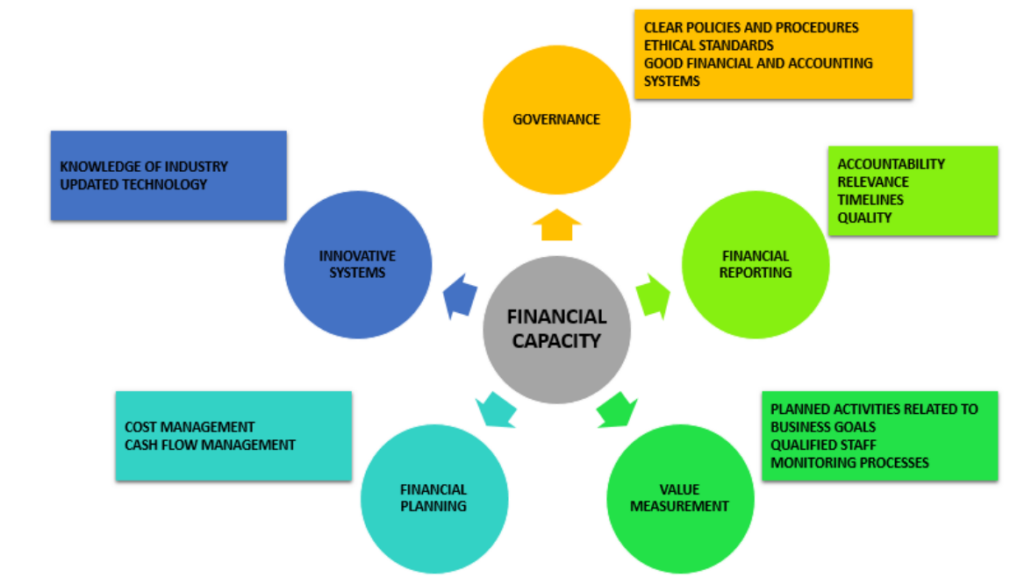
Financial Capacity is the essence of financial management and is summarised in the following diagram:
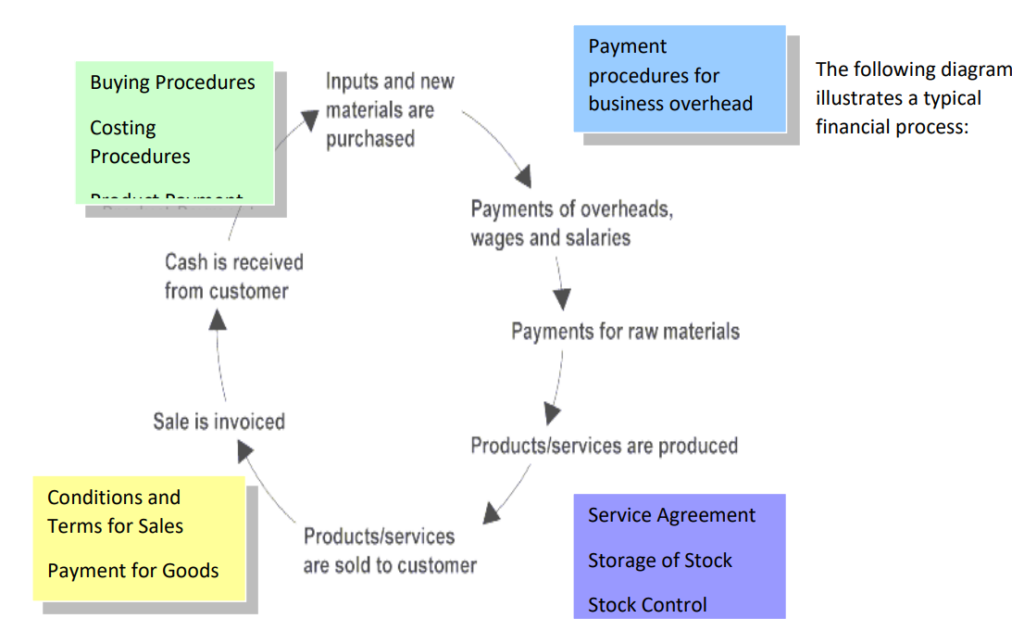
TYPICAL FINANCIAL PROCESSES
FINANCIAL CONCEPTS AND PRINCIPLES
The key financial concepts and principles that apply to new ventures include the following:
- START-UP CAPITAL
Start-up capital is the money needed to begin your business. This would include everything essential for product
development and the product launch. Before going after start-up capital make sure you know how much money you
need, and then how you will apply those funds. Being as specific as possible with the plans for the money will
increase the likelihood that your business will get financed.
Other factors needed before going after start-up capital is a business plan that spells out everything about your
business. Make sure that you spend some extra time on the Executive Summary of your business plan. This will be
the first part of the plan that lenders look at, and it also summarizes all aspects of your business plan. If it doesn’t
grab the attention of the lender your business plan will not get read which means you won’t get the business
financing you are seeking. Other things to consider before going after any capital is that your business has an
established business bank account and your business should be able to be found by the business 411 directory. - WORKING CAPITAL
Working capital is the amount of money that a company has tied up in funding its day to day operations. It is
regarded as the lifeblood of a business without which, a company can become bankrupt. A company has to tie up
money to fund its stocks, credit sales and other current assets, but this is offset by its ability to fund this from current
liabilities liabilities, such as purchases on credit. If a company buys on credit it does not have to tie up (as much)
money in its stocks. In some businesses (such as grocery retail) working capital can even be negative. A business that
buys on credit and sells for cash is being partly funded by its suppliers. - CASH FLOW MANAGEMENT
Cash flow management is the process of monitoring, analysing, and adjusting your business’ cash flows. For small
businesses, the most important aspect of cash flow management is avoiding extended cash shortages, caused by
having too great a gap between cash inflows and outflows. You won’t be able to stay in business if you can’t pay your
bills for any extended length of time!
Therefore, you need to perform a cash flow analysis on a regular basis, and use cash flow forecasting so you can take
the steps necessary to head off cash flow problems. Many software accounting programs have built-in reporting
features that make cash flow analysis easy. This is the first step of cash flow management.
The second step of cash flow management is to develop and use strategies that will maintain an adequate cash flow
for your business. One of the most useful strategies for small businesses is to shorten your cash flow conversion
BANKING AND BANKING ACCOUNTS
A bank is a financial institution that accepts deposits and channels those deposits into lending activities. Banks primarily provide financial services to customers while enriching investors.
TYPES OF BANKS
There are several types of banks in the world, and each has a specific role and function – as well as a domain – in
which they operate. In broad strokes, banks may be divided into several groups on the basis of their activities and
these include investment banks, retail, private, business, and also corporate banks. Many of the larger banks have
multiple divisions covering some or all of these categories.
- Retail banks deal directly with consumers and small business owners. They focus on mass market products
such as current and savings accounts, mortgages and other loans, and credit cards. - Private Banks normally provides wealth management services to high net worth families and individuals.
- Business banks provide services to businesses and other organizations that are medium sized, whereas the
clients of corporate banks are usually major business entities. - Investment banks provide services related to financial markets, such as mergers and acquisitions.
- Offshore banks operate in areas of reduced taxes, as compared to the country in which the investor lives in.
This is why most offshore banks are private banks. - Community banks are monetary organizations operated on a local basis, while community development
banks cater to the populations, or markets, which have typically not been served properly. - Postal savings banks are basically savings banks that operate in conjunction with the national postal systems
of South Africa. It targets the low income earners in the society - Building societies where traditionally mutually owned by their customers, which provide a full range of retail
banking services, but with a particular focus on mortgages.
TYPES OF BANK ACCOUNTS
There are different types of banking accounts offered by banks. The
following are the most common ones.
BASIC BANK ACCOUNTS (SAVINGS ACCOUNT)
Basic bank accounts offer a convenient place to keep money you need for
everyday use. You can arrange to have wages, State Pension and benefits
or tax credits paid into one. You can also pay in cheques or cash free of
charge, and set up ‘direct debits’ which pay regular bills automatically
from your account.
With a basic bank account, you get a cash card which you can use at a
bank machine to withdraw cash. Some also offer a ‘debit card’ that you can pay for items with, and get ‘cashback’;
but with a basic account these will only work if there’s enough money in your account.
You don’t get a cheque book with a basic bank account, and you can’t take out more money than is in the account
(‘go overdrawn’). For this reason, basic bank accounts are useful for anyone worried about overspending.
CURRENT ACCOUNTS
Current accounts have more features than basic bank accounts. For example, they usually offer:
cheque book
cheque guarantee card (acts as a ‘guarantee’ so makes cheques more widely acceptable)
debit card (some allow payments without checking your account)
direct debits (automatic bill payments direct from your account)
standing orders (regular set payments from your account to someone of your choice)
BACS (Bankers’ automated clearing service) – the facility to accept payments directly into your account (e.g
from your employer), or for you to make one-off payments to someone else out of the account
overdraft facility – the bank may allow you to go overdrawn up to a certain amount; but you need to arrange
this in advance and charges apply (you pay extra charges if you go overdrawn without an agreement)
THE IMPORTANCE OF A BANK ACCOUNT TO A BUSINESS
Many small business owners avoid or do not pay too much attention when considering whether to open up a bank
account in their business name. They make the mistake of using their personal account to carry out their business
transactions, just so they can save a small amount of money required to open a new business bank account. The
following are some of the importance of a bank account to a business:
GIVES THE BUSINESS A PROFESSIONAL IMAGE
A business account gives your business a more professional look when dealing with your customers or clients. Using
your personal account for business purposes gives the impression you are not really serious regarding your business
and it is more like a hobby.
IT MAKES IT EASY WHEN PREPARING BUSINESS ACCOUNTS
Having a separate business account proves to be beneficial when you need to complete the accounts for the
business and any related tax returns. Indeed, you can quickly check the income and expenses for the year, rather
than having the hassle of separating your personal and business transactions if you only have a personal account.
IT HELPS TO SHOW TRANSPARENCY OF THE BUSINESS TO AUTHORITIES
Another good reason to have a business bank account is to show the tax authorities that your business is transparent
in terms of the financial transactions it carries out. All the income and expenses should be accounted for through the
business account. Thus, if SARS Customs & Revenue want to look at your records, this will demonstrate that you are
declaring all your income and only claiming expenses related to business.
THE BANK ACCOUNT GIVES THE BUSINESS ACCESS WITH ADDITIONAL PERKS AND FACILITIES
Opening a company account with a bank also has other additional perks. For example, you can usually obtain free
banking for at least a year as a new business. Also some banks even offer new clients special deals on accounting
software to use in their businesses. Lastly, it may be easier for you to obtain a business overdraft or loan if you have
a company bank account.
Some entrepreneurs are put off from opening a business bank account because they think it will be complicated in
terms of the formalities and legalities. This is a misconception as it is very easy to open a bank account most of the
time.
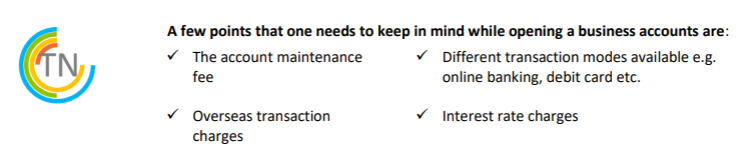
MINIMAL BALANCE THAT YOU NEED TO MAINTAIN
A company bank account may initially seem to be an extra overhead on your business, but the amount paid will be
worth in terms of the time and money you will save by not having to separate out your business transactions from
your personal transactions. Having a business bank account also sends a clear message to other businesses you deal
with and the tax authorities that you are a proper business with nothing to hide.
OPERATING A BUSINESS ACCOUNT
It is critical to keep track of funds in the bank account (e.g. by checking your bank statement and recording the
balance of funds available at any point). It is important to monitor Direct Debits, Standing Orders etc for accurate
recording of receipts and payments from the bank account.
CHEQUES
You should issue a cheque for payment only if you are certain that sufficient funds are available in the account to
meet the payment. The bank is most likely to return the cheque by not honouring if sufficient funds are not
available in the account. It is paramount to make prior arrangements with the bank for temporary overdrafts where
there are gaps in meeting financial commitments. The golden rule is not to issue cheques unless sufficient funds are
available in the account after taking into account all the payments channelled through the account including bank
charges.
It is also critical to recognize that cheques issued by others and deposited to your account would not be regarded as
funds available until such time the said cheque has been realized and recorded in your bank account as a receipt.
This is part of the clearing process delay and varies depending on the issuing bank, branch, couriering timings,
central clearing timings etc.
STATEMENTS
The banks issue periodic statements for your accounts showing all the transactions through the account. The period
for which the statements are issued depends on the type of account and your needs. It is customary to issue
monthly statements for current accounts and the customer could request for the preferred timing for statements.
The bank may levy a charge for special requests of customers. It is advisable to check the bank statements for
accuracy. Mistakes are rare but may occur. The bank should be informed promptly for any inaccuracies. If a cheque
guarantee card is given, it is advisable to keep in a safe place separate from the cheque book
LEGITIMACY
Further the bank is legally required to take steps in ensuring that transactions undertaken by the customers through
the bank account do not contravene the law. Money laundering is a matter of serious concern to regulators and
therefore the banks are required to be vigilant. For this purpose, it is not uncommon for banks to seek verification
from customers with regard to unusual transactions as a step towards protecting against unlawful conduct. The
regulators / state authorities are generally given statutory rights to have access to information about bank accounts
of customers and transactions. Therefore, customers must ensure that bank accounts are only used for legitimate
transactions
BANK CHARGES
It is also advisable to check the basis on which charges are levied against any account for facilities offered. Financial
institutions thrive on levying various forms of charges though they appear small to an individual customer, in
aggregation the amounts run into billions. These are hard earned money of individuals just taken off by financial
institutions due to ignorance or carelessness of customers.
The banks are in a unique position and do not need to obtain your consent for levying charges. The agreement for
opening a bank account / securing facilities would generally give the bank the right to levy charges to the account
and there is no legal requirement to consult the customer. The bank would automatically charge the account for any
dues even if funds are not available in the account for recovery. Thereafter, the bank would levy further charges for
overdrawing the account. Sadly, the bases of arriving at the figures are never disclosed in the statements.
The basis of computing charges and interest vary from, bank to bank. Further, factors such as credit rating, overall
market rates, duration, type of facilities required etc, will have a bearing on the charges / interest levied. For
example, the overdraft rate is linked to the risk level of the customer and the bank’s cost of funds. High Street banks
today offer an extensive range of financial products/services. Bank accounts, credit cards, loans, bonds, insurance,
savings, investments, pensions, travel, shares dealings are some of the facilities that could be obtained from a High
Street banker.
ONLINE AND TELEPHONE BANKING
Many banks today offer on line facilities for managing bank accounts which means 24-hour banking. Telephone
banking is generally limited to extended office hours. There are claims that the security issues on internet banking
are weak and therefore banks are exposing customers to risks of hacking. It is understood that teething problems at
infantry stages are part and parcel of new concepts and systems implemented. However, benefits accruing from
online facilities outweigh such drawbacks. Customers must support and commend the efforts taken by financial
institutions to invest and promote the concepts that are likely to change the way financial products would be used
for betterment of our lives.
There is no doubt that the facility offered to operate a bank account from a location and time of your choice is a
major breakthrough in managing our finances. The customers must encourage growth of online facilities to enhance
competition, efficiency and effectiveness of markets to a scale that boundaries are broken for the benefit of all.
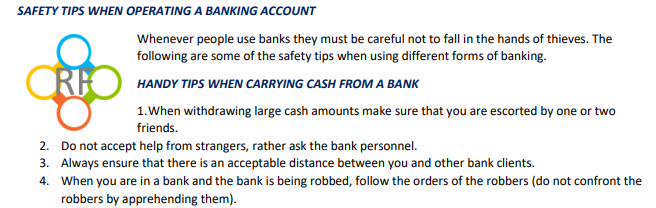
HANDY TIPS TO KEEP IN MIND WHEN USING ATMS:
- Choose your ATMs carefully – make sure it’s clearly visible and well lit
- Don´t let anyone distract or assist you when you are using the ATM
- Be wary of strangers around you, make sure that they are not watching you key in your PIN
- Key in your PIN only when prompted to do so by the screen
- Use your free hand as a shield when keying in your PIN (to protect you from secret cameras)
- Do not count your money at the ATM
INTERNET BANKING SAFETY TIPS
- When accessing your account through the internet make sure that you verify the site certificate.
- Ensure that you are on the secure Internet banking website by checking that the URL begins with “https”
rather than “http”. - Always ensure the secrecy of your Profile number, PIN and Password.
- Your digital banking profile number is not a derivative of any of your bank account numbers.
- Never disclose your PIN number and Password to anyone. This information is stored in a manner that bank
employees cannot access. - Make sure that your logoff and close your browser after banking online.
- As an added security measure, some banks make use of a cryptographic generated reference number which
is sent to you via an SMS on your mobile phone. This feature ensures two-factor authorisation when
performing selected functions. - Check your statements regularly for any unauthorised entries.
GENERAL TIPS
- Check that the card is actually yours before and after a transaction
- If only one ATM is working in a specific area be conscious of the fact that the others could have been
sabotaged to direct, you to that one - Set a low daily and monthly withdrawal limit on your account, but note that this limit is not always
applicable to purchases - Cancel your card immediately if it is lost, stolen or retained by an ATM
- Immediately report your lost or stolen cards to your bank and police
- Safe use of Personal Identification Numbers (PINs), passwords and credit cards
- The bank tells its clients to be careful about tearing up the PIN that they send you with a new card. But did
you know that there are more things that you can do to protect your number and ensure that nobody tries
to use your account? Debit cards are very attractive to would-be thieves because immediate cash is always
more desirable than goods on a credit card. Here are some additional, simple steps for you to take to protect
your PIN (personal identification number)
STEPS IN SAFEGUARDING YOUR PIN NUMBER
- Never share the PIN. It might be tempting to trust a friend or a family member with your PIN but it is not a
good idea - Never give out your PIN in response to e-mail or telephone requests
- Shield your PIN when using it. Use your hand, a piece of paper etc. to shield the PIN as you enter it into a
bank machine or a store machine. Be especially vigilant in store queues, where somebody may be paying
more attention than you. Also, be wary of “card skimmers” at ATMs - Choose a PIN password that is not obvious. Your birth date, wedding anniversary, phone number and home
address are obvious picks, so just do not use them. Instead, think of numbers unrelated to major events and
addresses in your life to create your PIN - Do not write your PIN down on the card, ever. Do not even write it in a diary. If you must write it down,
disguise it in some way or put it somewhere totally unrelated to the card, such as in the middle of
Shakespeare’s Complete Works - Vary your PIN on different cards. Don’t keep the same PIN for all your cards. Have a different PIN for each
one, so that if you do happen to lose your wallet, it will be much harder for the PINs to be cracked - Contact your bank immediately if your card is stolen or lost. Tell them immediately if you think that there is
anything that may compromise your PIN, such as an easy PIN, other ID in your wallet making it easy to work
out or, horror of all horrors, the PIN being written down somewhere in the wallet or on the card. Get the
bank to cancel the card immediately - Be proactive. If you suspect any fraudulent activity using a card still in your possession, apart from notifying
the bank and the police, have your PIN changed immediately
UNDERSTANDING THE BANK STATEMENT
The bank statement is a handy way of seeing all your incomings and your outgoings at once. It’s definitely a good
idea to open and read your bank statements so you can check you’ve received what you expected, and that you
recognise all the payments going out too. We’ll help you to understand how to read and make sense of your bank
statement.
Your bank statement might be sent monthly, quarterly or yearly, depending on what type of account you have. Have
a look at the table below for a simple explanation:

You’ll probably get your statement through the post, but if you bank online, you can also access it on the internet,
and possibly opt out of receiving paper statements.
Your statement will show all the money in and out for your account during the set period (monthly or
otherwise). The details will include the date, amount and an identifier for the payment (such as a shop name for
purchases). For benefits, the identifier could be the Department for Work and Pensions, Jobcentre Plus or HM
Revenue and Customs, or your local council if it’s housing benefit.
Here’s our handy example of a bank statement showing the kinds of things you’ll see. Yours might look a bit
different, but the same kind of information will be on there.
EXAMPLE BANK STATEMENT
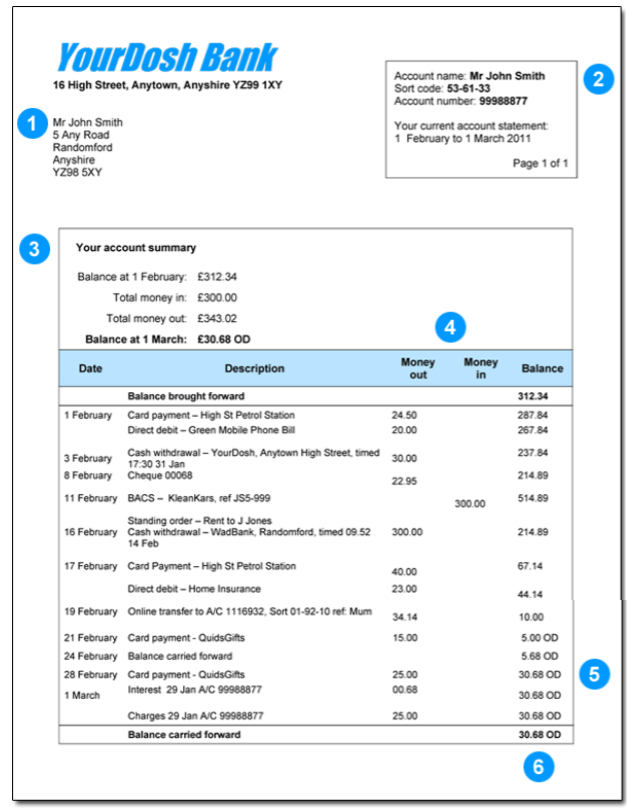
WHAT DOES THIS MEAN?
- YOUR PERSONAL INFORMATION
This is your name and permanent home address. Make sure it’s right, and that you haven’t got someone else’s bank
statement! It’s really important to tell your bank if you move house, so they can safely and securely send any
information about your account to you. - YOUR ACCOUNT INFORMATION
This will show the name you used to open your account with. In addition, it will show the type of account (such as a
cheque or savings account or credit card). It will also show your account number and branch code. Your sort code is
a six-digit number with dashes in (for example, 53-61-33) that helps the whole banking system identify which bank
and local branch your account’s based at. - STATEMENT SUMMARY
You’ll be shown a basic account summary, which will usually show the total amounts paid in and out during that
month (or other period if it’s a savings account). You can also see here that there’s a closing balance – this means
the balance of your account at the time the statement was sent out. - MONTHLY INCOMINGS AND OUTGOINGS
On your statement there will be two columns showing money paid into your account (credits) and one for money
paid out (debits). Your statement will be ordered by date, so it’ll show the oldest payments at the top, working
down to the most recent. Next to each payment is also a description, which shows where you were when you made
the payment (a shop or cash machine) or who you paid. There might also be standing orders or direct debits you’ve
arranged. This information should also be available for the ‘money in’ section – it might say ‘bank transfer’ for your
wages, ‘counter credit’ for cash or cheques you’ve paid in at your branch, refunds from shops, or automated
payments made by the state to you, such as benefits.
Sometimes payments will show up on your statement a few days after you actually made them. For example, if you
buy something with your debit card in a shop (or withdraw cash from a machine), it might not show up on your
statement for a few days. This is because it takes time for payments to go through the banking system, especially
over a weekend. When this happens, the actual date you made the purchase or cash withdrawal should be shown in
the ‘description’ column.
In the far right column, you can see a running total, the ‘balance’. This means the total you have in your account
each day, as a result of money in and out of your account. - GOING OVERDRAWN
In your balance column, sometimes you’ll see the letters OD or a minus sign next to the figure. This means your
account’s gone overdrawn and you’ve spent more money than you had in your account. So, if you had R10.00 in your
account, but buy something on your debit card for R15.00, you’ll go overdrawn by R5 (R10-R15=-R5). You’ll have to
pay this back to the bank, along with any interest and charges unless you have an interest-free overdraft. The longer
you leave it to pay pack your overdraft, the longer you’ll be charged interest on it, and the harder you may find it to
get out of your overdraft.
That’s why it’s really important not to become reliant on your overdraft it costs you more money in the long-term to
borrow from the bank like this. It’s a good idea to do all you can to stay in ‘the black’ (plus numbers) and get out of
‘the red’ (minus numbers). It could be a spiral into debt, so make sure you’re not always right at the limit of your
overdraft. - BANK CHARGES
If your account’s gone overdrawn beyond your agreed limit, or you didn’t have an agreed overdraft, the bank will
charge you for ‘unarranged borrowing’. They can also charge you if you pay in a cheque that bounces (that’s when
the other person doesn’t have enough in their account to cover the amount they wrote the cheque for). Banks have
to notify you before they take any money from your account for these charges.